Have you ever been hungry and then found out there was no snack ready, or rushed to start your online class and could not find your charger? That can make a day feel hard very quickly. A small plan can fix many of these problems. Planning is like giving your future self a helping hand.
Planning means thinking ahead about what you will need and what you will do. When you plan, you make choices before the busy moment arrives. That helps you stay calm, save time, and feel more ready.
If you do not plan, little problems can pile up. You may forget your water bottle, miss breakfast, or start late because you are still looking for socks or a pencil. But when you plan, you already know what comes next. That makes home life smoother.
Planning is thinking ahead and getting ready before something happens. A routine is a set of steps you do in the same order again and again.
Planning is useful in many parts of life. It helps with food, supplies, and time. These three things work together. If you know what you will eat, what you need to bring, and when you need to be ready, your day feels easier.
Food gives you energy for learning, playing, and growing. A simple meal plan helps you know what you will eat and which foods you need, as shown in [Figure 1]. When you think ahead about breakfast, lunch, snack, and dinner, there are fewer surprises.
You do not need a fancy plan. You can ask, "What will I eat in the morning? What will I eat later? Do we have the food at home?" If the answer is no, you can tell an adult early. Then there is more time to help solve the problem.
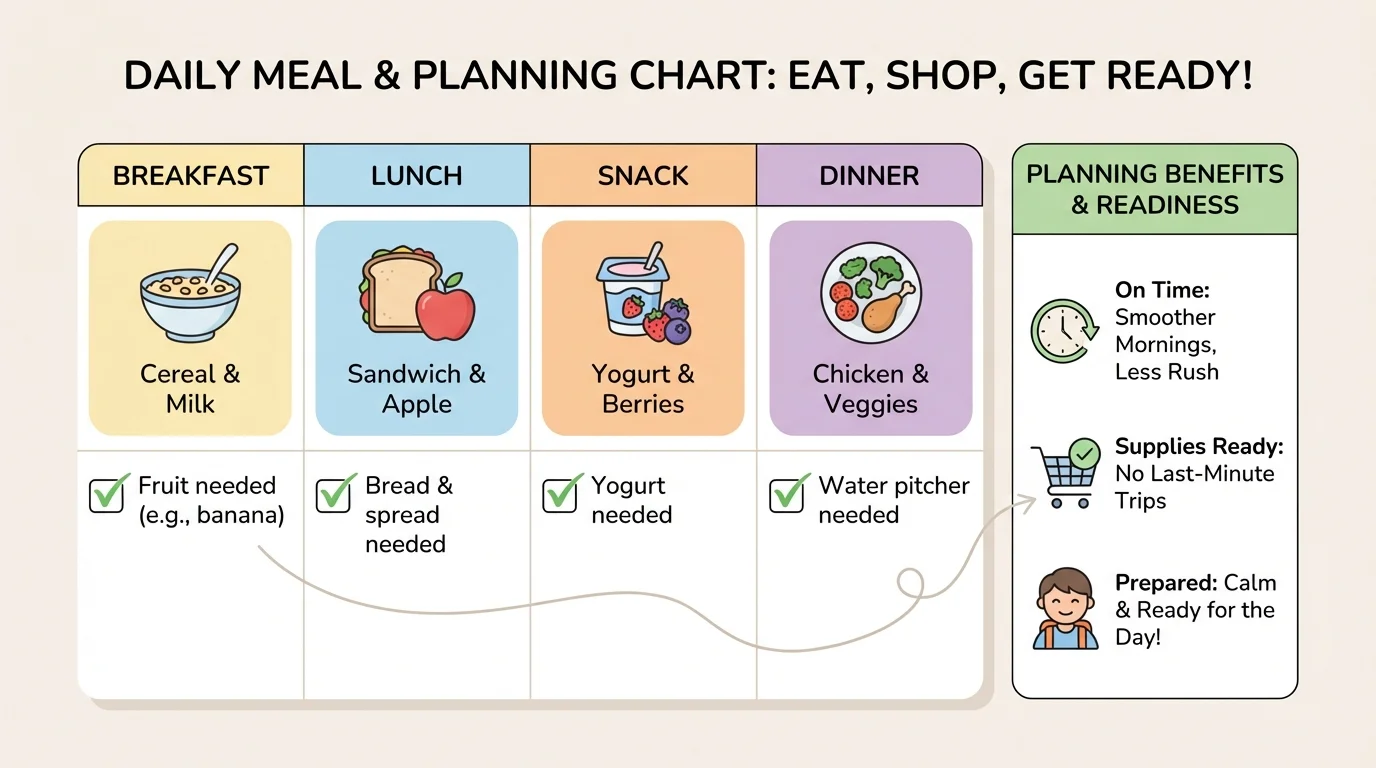
Planning meals also helps you make healthy choices. If you wait until you are very hungry, you may grab the first thing you see. When you plan ahead, you can include foods that help your body feel good, like fruit, vegetables, protein foods, and water.
A meal plan can be very simple. For example, breakfast might be oatmeal and banana. Lunch might be a sandwich, apple, and milk. A snack might be crackers and cheese. Dinner might be rice, chicken, and carrots. The plan does not have to be perfect. It just needs to help you know what is coming.
Example: Planning one day of meals
Step 1: Think about the day.
You have online lessons in the morning and soccer practice in the afternoon.
Step 2: Choose meals and snacks.
Pick breakfast, lunch, one snack, and dinner.
Step 3: Check what is at home.
Look for bread, fruit, water, and any other needed foods.
Step 4: Get part of it ready early.
Wash fruit, fill a water bottle, or place lunch items together in the fridge.
Now you are less likely to get too hungry or feel rushed later.
Meal planning can also help stop waste. If you know you already have yogurt and apples, you can use them before they go bad. That means less food is thrown away.
Later in the day, the meal chart in [Figure 1] still helps because you can quickly check what comes next instead of asking again and again. A plan saves thinking time.
Your brain uses energy all day. Eating regular meals and snacks can help you stay focused and keep your body ready for play and learning.
Even helping with tiny jobs counts as meal planning. You can put napkins on the table, rinse grapes, or remind an adult when a food item is running low. Planning is not only for adults. Kids can do it too.
Supplies are the things you need to do your day well. They might be headphones, a charged tablet, crayons, a notebook, sports shoes, or a library book. Making a checklist helps you put items into groups so you do not forget them, as shown in [Figure 2].
One smart way to plan supplies is to check the night before. Ask yourself: "What do I need tomorrow?" If you have online learning, maybe you need your device, charger, pencil, and notebook. If you have dance class later, maybe you also need special clothes and a water bottle.
It helps to keep similar things in the same place. School tools can go in one bin. Sports gear can go in another. Art supplies can stay in a drawer. When things have a home, they are easier to find.
You can also use a short checklist. A checklist is a list you use to check off items as they are ready. It can be written on paper or spoken out loud with an adult.
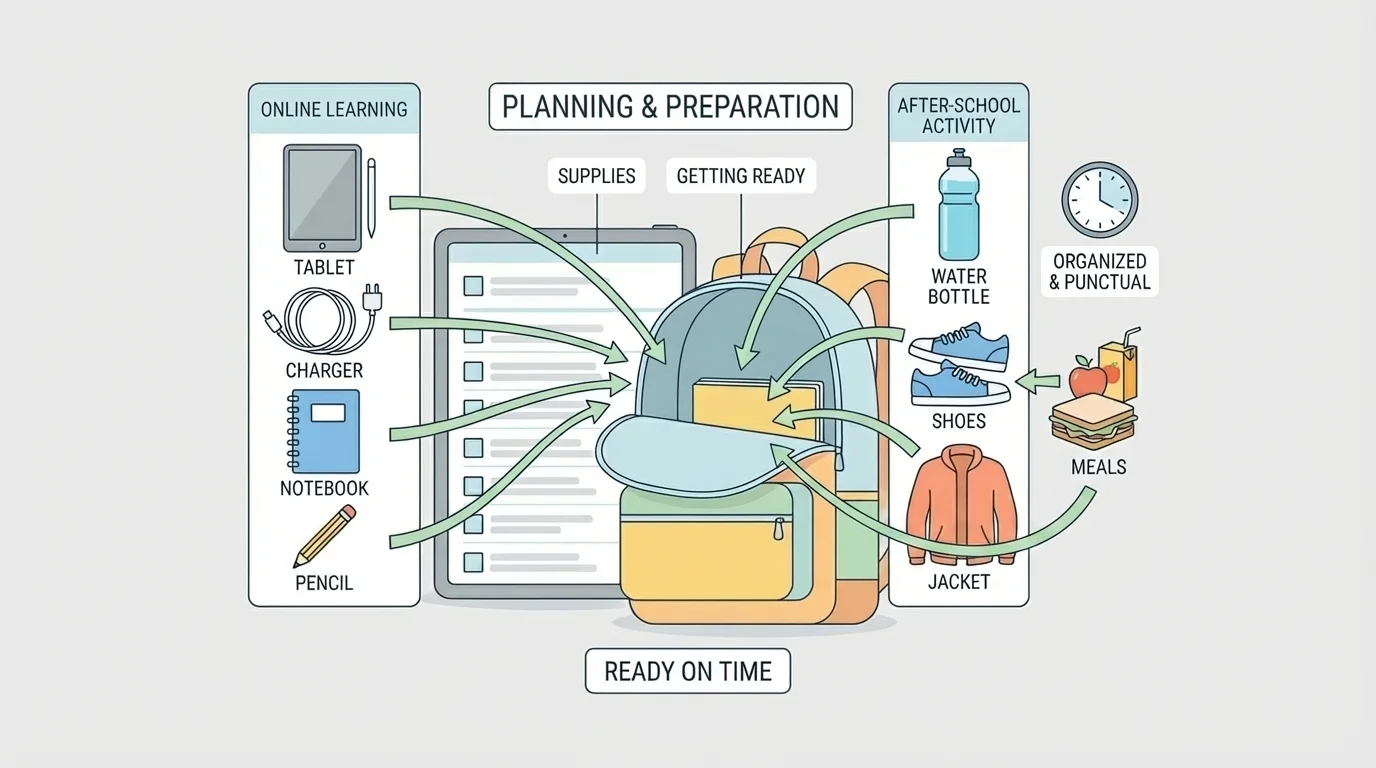
For example, your checklist might say: device, charger, notebook, pencil, water bottle, sweater. Before bed, you can check each item. In the morning, you do a quick look again.
Planning supplies helps you in another way too: it lowers stress. When you already know where your things are, you do not have to rush around the house searching. That means more time to get dressed, eat, and begin on time.
Why grouping items works
Your brain remembers better when items are organized. If your online learning tools stay together and your activity items stay together, you have fewer places to search. That makes getting ready faster and easier.
The grouped supply setup in [Figure 2] shows how one small system can stop a big morning mess. You do not need many bins or labels. Even one basket for important daily items can help.
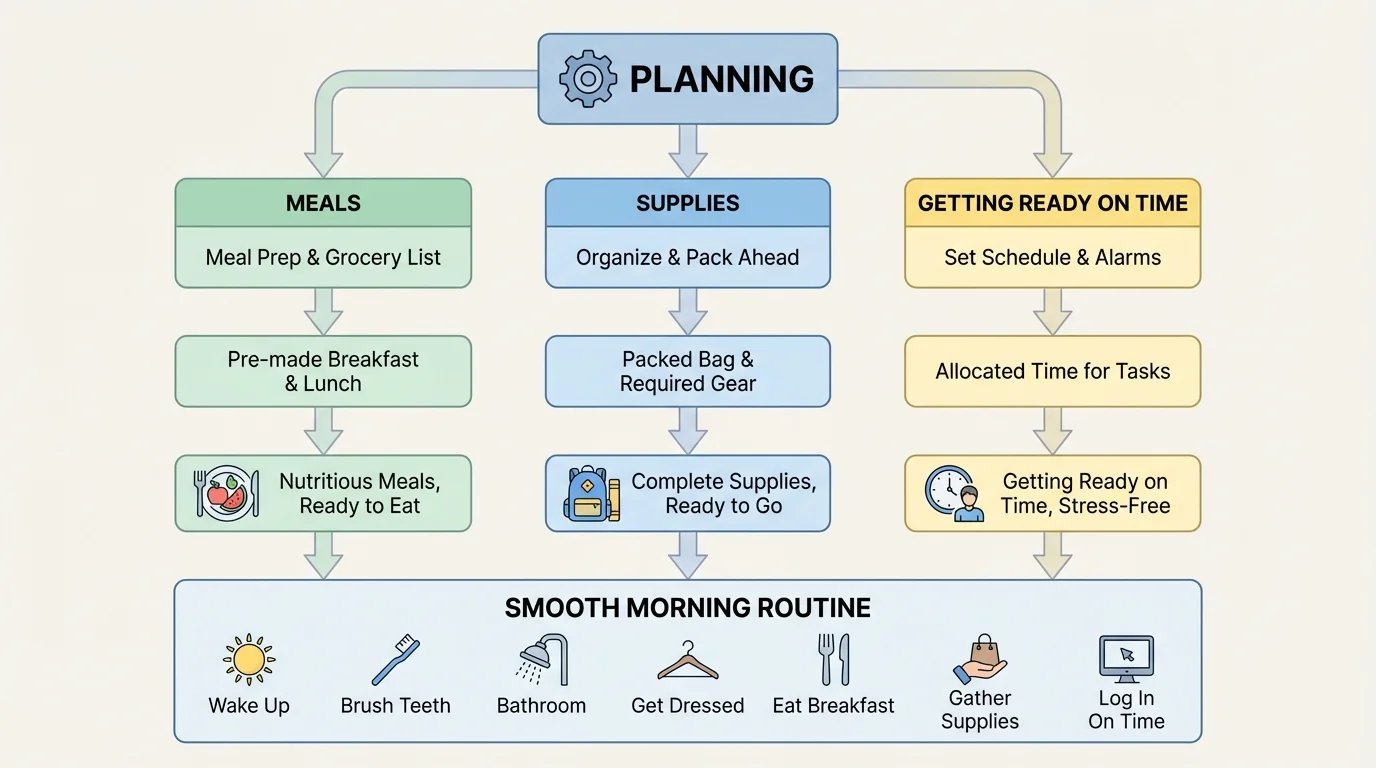
Being on time does not mean moving very quickly. It means starting early enough and following a routine. Routines help your brain remember what comes next, as shown in [Figure 3]. When the order stays mostly the same, getting ready feels easier.
A morning routine might look like this: wake up, get dressed, use the bathroom, brush teeth, eat breakfast, gather supplies, and log in for class. If you do these steps in the same order each day, you waste less time deciding what to do next.
One of the best ways to be on time is to do some jobs early. Put out your clothes at night. Place your shoes by the door. Charge your device before bed. Fill your water bottle when you can. These tiny jobs save time later.
Another smart idea is to leave a little extra time. Sometimes a sock is missing, toast takes longer, or the internet needs a moment. Extra time helps you stay calm when something small goes wrong.
You can even use simple time thinking. If getting dressed takes about 10 minutes, breakfast takes about 15 minutes, and brushing teeth takes about 5 minutes, then you need about \(10 + 15 + 5 = 30\) minutes for those jobs. That means starting only 5 minutes before class would not work.
Example: Getting ready for a \(9{:}00\) online class
Step 1: Count the jobs.
Get dressed \(10\) minutes, eat breakfast \(15\) minutes, brush teeth \(5\) minutes, gather supplies \(5\) minutes.
Step 2: Add the time.
\(10 + 15 + 5 + 5 = 35\)
Step 3: Count back from class time.
If class starts at \(9{:}00\), then you should begin by about \(8{:}25\).
Planning backward helps you know when to start.
This is called planning backward. You start with the time you need to be ready, then count back to see when to begin. It is a very useful life skill.
When you look at the flow in [Figure 3], you can see why the order matters. If you leave breakfast until the very end or hunt for supplies in the middle, the whole routine can slow down.
You do not need a long schedule. A short plan can work very well. Here is one easy way to plan each day.
Step 1: Think about tomorrow. What meals, activities, and supplies will you need?
Step 2: Check your food. Make sure you know what breakfast, lunch, and snack will be.
Step 3: Gather supplies. Put important items together in one spot.
Step 4: Set out clothes or other things you will need first.
Step 5: Know your start time. Count back so you know when to begin getting ready.
"A little bit of planning now can save a lot of rushing later."
If you try this every day, it becomes a habit. Habits are helpful because you do not have to think through every step each time.
Sometimes even a good plan needs to change. Maybe the bread is gone, your shirt is still in the wash, or the tablet battery is low. That does not mean the plan failed. It means you make a new plan.
Here is what to do when something changes: stop, notice the problem, choose the next best idea, and keep going. If your snack is missing, choose a different one. If your charger is not in its usual place, ask for help early. If you are running late, do the most important jobs first.
You already know how to follow steps in order. Planning uses that same skill in real life: first think, then gather, then do.
Being flexible is part of good planning. Planning is not about everything being perfect. It is about being more ready than before.
When you plan well, meals are easier, supplies are easier to find, and getting ready on time is less stressful. That gives you more time and energy for the important parts of your day.
