Have you ever played a game where one person wanted to do everything? It usually stops being fun very fast. But when people work together, everyone has a chance to help, and the job often gets done better. Cooperation means working with other people in a helpful way so the group can do well together.
Cooperation is an important life skill. You use it when you help at home, join a video call with a club, play on a team, or work on a project with friends in your neighborhood. When people cooperate, they feel included, respected, and proud of what they do together. When people do not cooperate, others may feel left out, frustrated, or unheard.
Cooperation is working together toward the same goal.
Fair participation means everyone gets a real chance to help, speak, and be included.
Shared success means the whole group does well, not just one person.
Working together does not mean one person is in charge of everything. It also does not mean everyone must do the exact same thing all the time. Good teamwork means each person helps in a way that matters.
When you cooperate, you help build trust. Trust means people believe you will listen, take turns, and do your part. That matters in family life, sports, clubs, online game teams, and community activities. People like working with someone who is kind, dependable, and fair.
Cooperation also helps you solve bigger problems. One person may have one good idea, but a group can often think of even better ideas. If one child remembers the rules, another has a creative plan, and another notices who needs help, the team becomes stronger.
Teams often do best when members use different strengths. One person may be great at explaining, another at organizing, and another at noticing feelings.
This is why cooperation is connected to leadership. A strong leader does not grab all the attention. A strong leader helps everyone join in and helps the group move forward together.
Good teamwork is made of small actions, as [Figure 1] shows in a simple online group setting. These actions include waiting for your turn, looking and listening when someone speaks, sharing materials or ideas, and using kind words. In this lesson, you will also learn how turn-taking helps conversations feel fair and calm.
You cooperate when you say things like, "You go first," "I can help with that," "What do you think?" or "Let's do this together." You also cooperate when you notice if someone has not had a chance to speak yet.
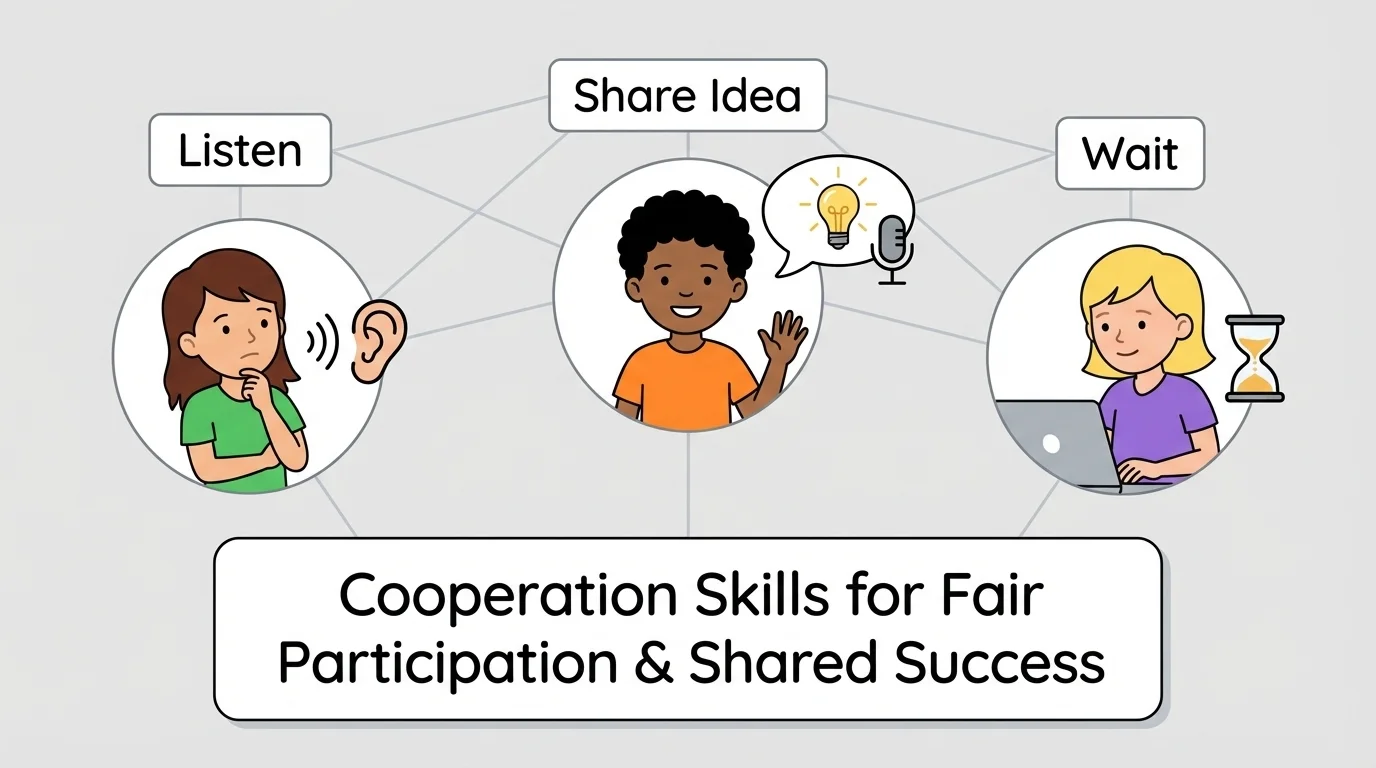
Sometimes cooperation is quiet. It can be as simple as letting your brother finish talking, helping a teammate pick up supplies, or muting your microphone on a video call when it is noisy at home. Small respectful choices make teamwork smoother.
Another important teamwork skill is encouragement. Encouragement means using words or actions that help others feel brave enough to join. Saying, "That is a good idea," or "You can try it," can help another person feel ready to participate.
Cooperation is a set of habits
You do not have to be perfect to be a good teammate. You just need to practice helpful habits again and again: listen, wait, speak kindly, share jobs, and notice who needs a turn.
Later, when you work in any group, think back to the behaviors in [Figure 1]. The picture is simple, but the idea is powerful: everyone has a part, and everyone deserves respect.
Fair does not always mean the same. Fair means each person gets a chance to help in a way that fits the job, as [Figure 2] makes clear. In a family cooking project, one person may wash vegetables, one may stir, and one may read the recipe aloud. The jobs are different, but the teamwork can still be fair.
Fairness means people are treated with care and respect. If one person always talks, chooses, and decides, that is not fair participation. If one person is shy and never gets invited to share, that is not fair either.
You can help fair participation happen by noticing who has had a turn and who has not. You might say, "Let's hear Maya's idea," or "We all did one job. Now we can switch." These little choices make a big difference.
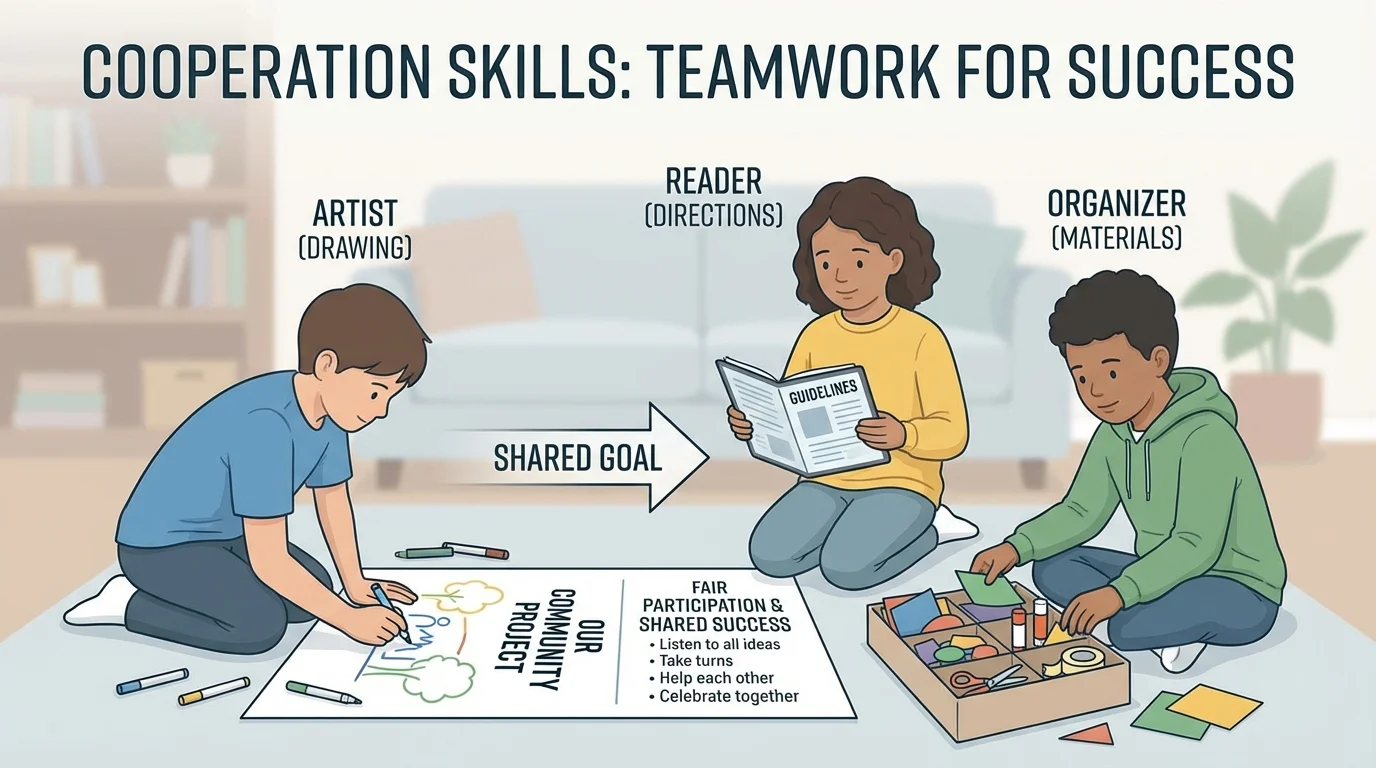
Sometimes a person needs a different kind of help to join in. A younger child may need simpler directions. Someone on a video call may need more time to unmute and answer. Fairness means helping people participate successfully, not rushing past them.
| Helpful team choice | What it does |
|---|---|
| Taking turns | Gives each person time to speak or act |
| Sharing jobs | Makes the work feel balanced |
| Inviting quiet people | Helps everyone feel included |
| Switching roles | Gives everyone a chance to try different tasks |
| Saying thank you | Shows respect for each person's effort |
Table 1. Team choices that support fair participation and shared success.
When you remember the different roles in [Figure 2], you can see that sharing success does not require everyone to do one identical task. It means everyone matters.
You can use a simple teamwork plan almost anywhere: at home, in a community class, during an online club meeting, or while playing a game with friends.
A simple teamwork plan
Step 1: Know the goal.
Ask, "What are we trying to do together?"
Step 2: Share ideas.
Let more than one person speak before choosing a plan.
Step 3: Choose jobs.
Pick jobs so each person has a real way to help.
Step 4: Check in.
Ask, "Does everyone understand?" and "Does anyone need help?"
Step 5: Finish together.
Notice the team effort, not only the loudest person's work.
If you skip these steps, problems often appear. People may talk over each other, forget jobs, or feel left out. If you follow these steps, the group is more likely to stay calm and succeed.
A helpful teammate does not only think, "What do I want?" A helpful teammate also thinks, "What does our group need?" That question can guide many smart choices.
Even good teams have problems. Someone may interrupt. Someone may want to be first every time. Someone may stop helping. The important part is not pretending problems never happen. The important part is knowing what to do next, and [Figure 3] lays out a calm path you can follow.
First, stop your body. Do not yell, grab, or say something mean right away. Take a breath. Next, use calm words. You can say, "I was still talking," "I want a turn too," or "Let's find a fair way." Then listen to the other person. After that, choose a simple fix together.
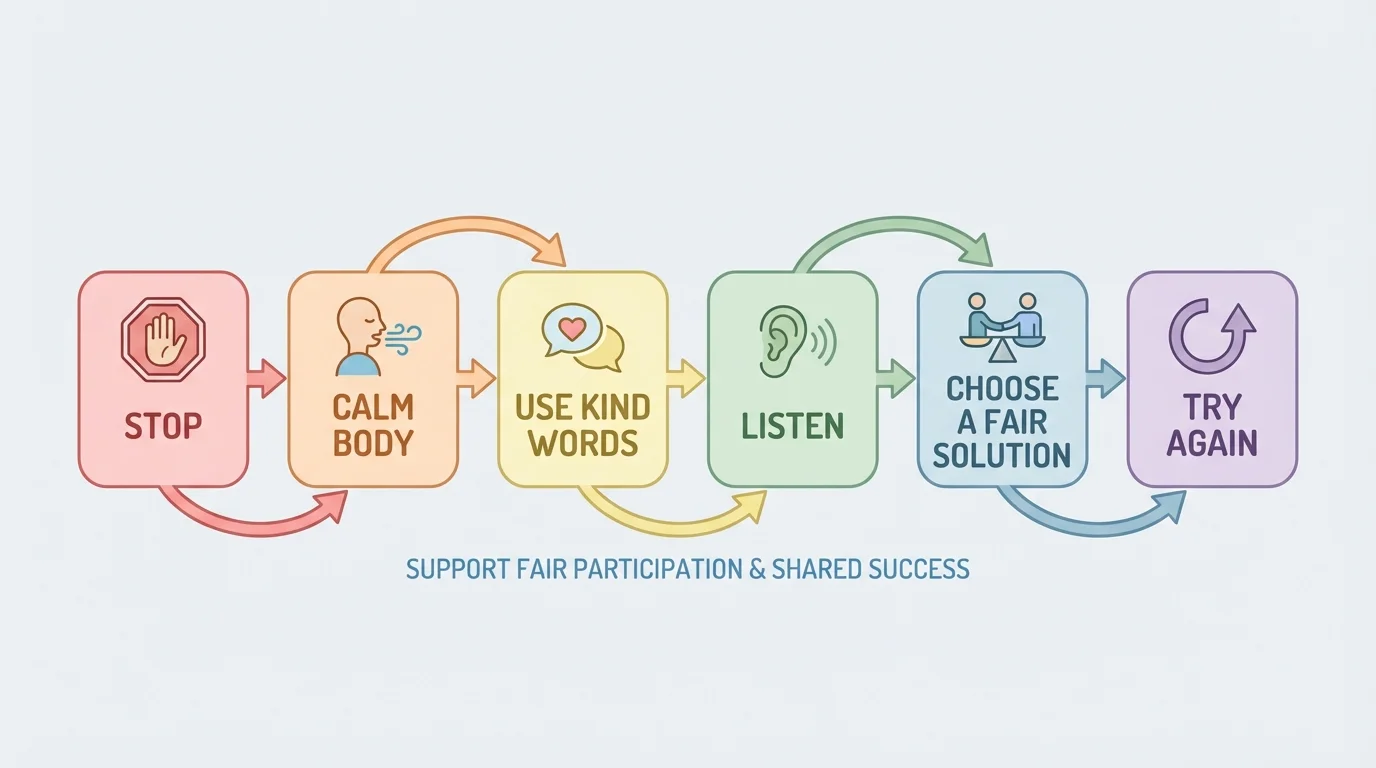
Here are some fair solutions: take turns, flip roles, set a timer, vote kindly, or combine two ideas. The best solution is one that helps the group move forward and respects everyone.
Problem-solving example
Two children in an online art club both want to pick the first drawing idea.
Step 1: One child says, "We both want a turn."
Step 2: They listen to each other instead of arguing.
Step 3: They choose one idea first and save the second idea for next time.
Now both children feel respected, and the project can continue.
If a problem keeps happening, ask a trusted adult for help. Asking for help is not giving up. It is a smart way to protect fairness and keep the group safe and respectful.
When you use the steps in [Figure 3], you make it easier to solve problems without hurting feelings or stopping the group goal.
Initiative means starting helpful action without waiting to be told every single thing to do. In a team, initiative is useful when it helps everyone, not when it turns into bossing.
For example, you might say, "I can make the list," "I will check if everyone has a turn," or "Do you want me to help set this up?" Those are strong teamwork choices. They move the group forward while still respecting others.
"We can all be leaders when we help others shine."
Bossy behavior sounds different. It sounds like, "Do it my way," "I decide everything," or "You do this because I said so." That kind of behavior can stop fair participation. Helpful leadership invites people in. Bossy behavior pushes people out.
A good team leader notices who needs support. Maybe one friend is confused. Maybe another has a great idea but is too quiet to share it. Leadership and cooperation work together when you help the whole group succeed.
You do not need a big event to practice cooperation. You can use it in everyday life. At home, you can share chores, clean up together, or plan part of a meal. In a neighborhood game, you can help choose fair rules and include everyone. On a video call, you can wait, listen, and speak one at a time.
Here are some examples: if you and a sibling are building with blocks, decide who gathers pieces and who builds first. If your team is playing a game, ask whether everyone knows the rules. If you are doing a craft with friends, make sure nobody gets stuck doing all the work.
You already know how to be kind and respectful. Cooperation uses those same skills, but now you use them to help a whole group work well together.
Every time you practice cooperation, you build a stronger habit. Over time, people learn that you are someone who helps, includes, and supports others.
Here are simple reminders you can keep in your mind: listen fully, wait your turn, notice who is left out, share the work, use calm words, and celebrate the group. These habits help create shared success.
You will not always get it right. Sometimes you may interrupt, forget to invite someone, or become upset. That is okay. What matters is that you notice it, fix it, and try again. Teamwork gets stronger with practice.
When people cooperate, everyone has a better chance to join, help, and feel proud. That is what fair participation and shared success look like.
