What happens when people can count on you? Big things feel calmer. A pet gets fed. A game works fairly. A message stays kind. A family task gets finished. Responsibility means people know you will try to do the right thing, tell the truth, and take care of your part.
Responsibility means being careful with your words, your choices, and the jobs you share with others. It means you do not blame other people for something you did. It also means you try to fix a problem if you make one.
Being responsible does not mean being perfect. Everyone forgets things sometimes. Everyone makes mistakes. A responsible person says, "I did that," or "I forgot," and then works to make it right. That is a sign of strong character.
Responsibility is taking ownership of what you say, what you do, and what you promise to help with.
Ownership means saying, "This is my job," or "This was my mistake," instead of hiding it or blaming someone else.
Responsibility matters in many places: at home, during video calls, in sports or clubs, when playing with friends, and when using apps or games. When you act responsibly, people feel safe with you and trust you more.
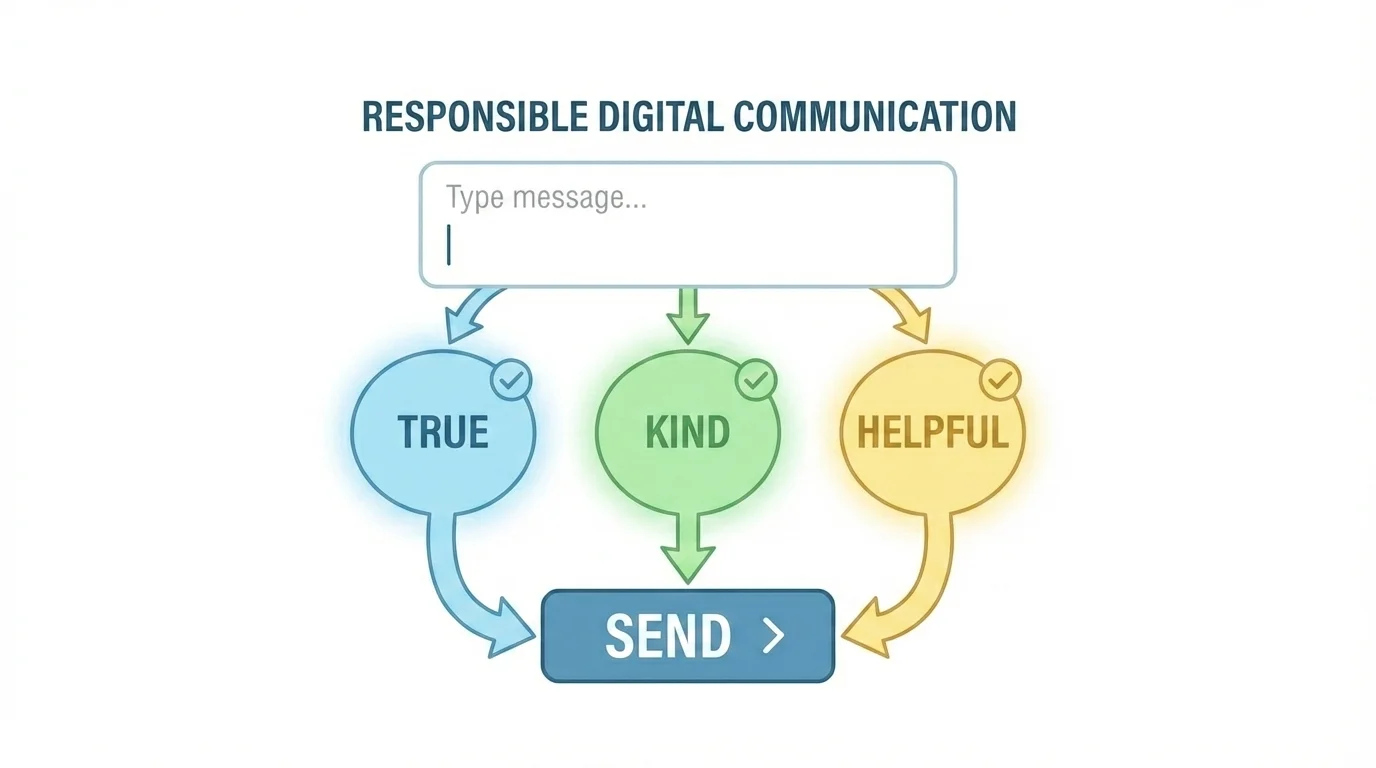
Your words are powerful. They can help, hurt, teach, or confuse. Responsible words follow a small check, as [Figure 1] shows: Is it true? Is it kind? Is it helpful? This works when you speak out loud and when you type a message online.
If you are upset, it is smart to pause before you answer. You can take a breath, count slowly to ten, or ask for help. When you slow down, you are more likely to choose words that solve a problem instead of making it bigger.
Here are some responsible word choices:
Suppose your cousin sends you a drawing and says, "Do you like it?" A careless answer might be, "No, it's bad." A responsible answer could be, "I like the bright colors. Maybe you could add a sun as well." That answer is honest and kind.
Real-life example: a message mistake
Step 1: You type a mean reply because you feel mad.
Step 2: You stop before sending and read it again.
Step 3: You change it to: "I don't like that. Please stop."
The second message is responsible because it is clear without being hurtful.
Later, the same check still helps. If you want to joke in a group chat, think back to the three-question path in [Figure 1]. A joke that feels funny to one person may hurt another person's feelings.
Your actions are the things you do. Responsible actions are safe, honest, and fair. They show that you can be trusted even when no one is watching.
Here are some examples of responsible actions:
Sometimes you have a choice between the easy thing and the right thing. For example, you spill water near a charger. The easy thing is to walk away. The responsible thing is to tell an adult right away so no one gets hurt.
Choices have results
Responsible actions often prevent bigger problems later. A quick honest choice now can save time, protect people, and keep trust strong. Irresponsible choices may seem easier for a moment, but they often create more trouble afterward.
If you forget to feed the pet, the responsible action is not to hide. It is to tell an adult, feed the pet if it is safe to do so, and make a plan so you remember next time. Responsibility grows when you learn from what happened.
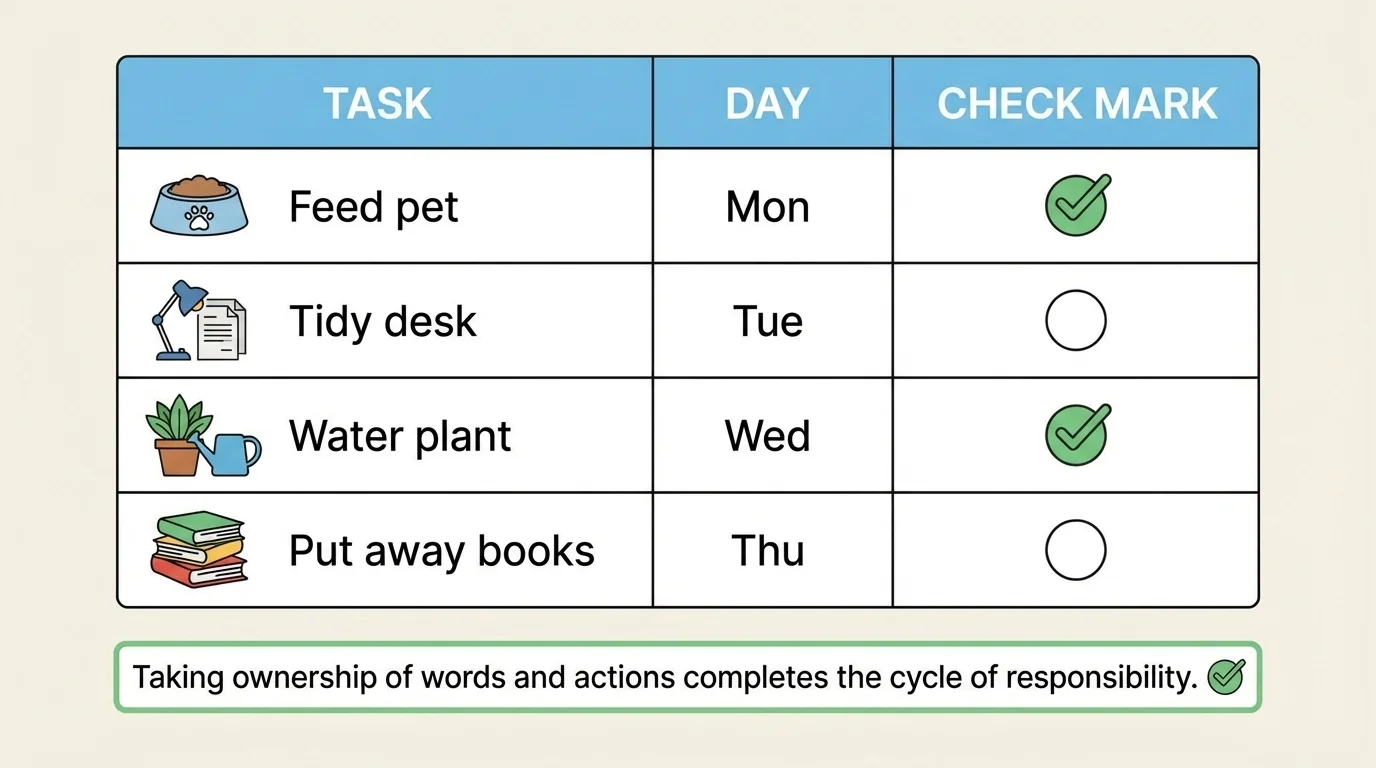
Some jobs belong to more than one person. These are shared tasks. They happen in families, teams, clubs, and online group projects. A task chart helps everyone see their part, as [Figure 2] illustrates, so the work does not all fall on one person.
Shared tasks can include cleaning up art supplies, setting the table, feeding a pet on certain days, taking turns in a game, or helping collect ideas for a group activity. When each person does their part, things run smoothly.
If you are given one part of a shared task, try these simple steps:
Step 1: Listen carefully to what your job is.
Step 2: Ask questions if you are not sure.
Step 3: Do the job on time.
Step 4: Tell the group when your part is done.
Step 5: If you cannot do it, speak up early so someone can help.
Think about a family movie night. One person brings the blanket, one gets cups, one turns off bright lights, and one puts things away at the end. If one person says, "I'll do it later," and never helps, the others must do extra work. That does not feel fair.
Tools can help you stay responsible. You can use a checklist, a timer, or a reminder on a device. The checked boxes in [Figure 2] show how a simple chart helps you remember what still needs to be done.
| Situation | Responsible Choice | What Happens |
|---|---|---|
| Family chore | Finish your part | The job gets done faster and feels fair |
| Group game | Take turns honestly | Everyone enjoys the game more |
| Online project | Send your part on time | Others can finish their work too |
| Problem at home | Tell the truth | Adults can help solve it |
Table 1. Examples of responsible choices and their real-world results.
Even responsible people make mistakes. The important part is what you do next. Making things right is called repair. Repair means you try to fix the hurt or problem you caused.
You can remember this simple plan:
Notice it. Stop and be honest about what happened.
Say it. Use clear words: "I'm sorry I interrupted you."
Fix it. Clean up, replace, help, or correct the problem.
Learn from it. Make a plan for next time.
"Being responsible means doing the right thing, even when it is not the easiest thing."
Here is an example. You promised to help put away groceries, but you started watching videos instead. Later, bags are still on the counter. A responsible response is: "I'm sorry I forgot my job. I will put them away now, and next time I will pause my video first."
An apology is strongest when it has three parts: what happened, ownership, and repair. "I knocked over your blocks. That was my fault. I will help rebuild them." That is better than saying only, "Sorry," and walking away.
Responsibility grows with practice. You do not need giant jobs to build it. Small daily choices matter a lot.
Try this in your everyday life:
Another useful habit is making a plan before play time. First finish the job, then enjoy the fun. For example: "First I water the plant, then I play my game." This helps your brain remember what matters first.
Trust grows from many small responsible choices, not just one big moment. When people see you tell the truth, keep promises, and help with shared jobs, they begin to count on you more and more.
Responsibility also includes caring about the future. If you put trash in the right place, save materials, or turn off what you are not using, you help other people too. Responsible choices today can make tomorrow easier and safer.
When you use responsible words, actions, and teamwork, you help build a kinder community. People feel respected. Tasks get done. Problems get fixed. And you become someone others can count on.
