Have you ever seen a spill on the floor and thought, "Someone should clean that up"? A person who shows initiative does not just wait. They notice the need and do something helpful. That can be as small as putting away a game after using it or as kind as helping a family member carry something light. These little actions make homes, groups, and neighborhoods feel better for everyone.
Showing initiative means being a responsible person who helps without needing a reminder every time. It means you use your eyes, ears, and heart. You notice what needs care, think about what is safe, and take a helpful action. This matters at home, in online clubs or video calls, and in community places like a park, library, or sports field.
Initiative means noticing what needs to be done and starting it without waiting to be told. Shared spaces are places used by more than one person, like a living room, kitchen table, playground, or library area.
When you show initiative, people learn they can trust you. They see that you care about others and about places everyone uses. That is part of being a good member of a family and a good member of a community.
Initiative is not about being bossy or doing everything yourself. It is about seeing a need and choosing a kind, useful action. If your art supplies are still on the table after a project, initiative means putting them away. If your younger sibling drops crayons, initiative means helping pick them up. If you join an online club call and see the chat getting messy, initiative might mean using kind words and waiting your turn.
Sometimes initiative is quiet. You may refill the pet's water bowl if that is one of your family jobs. You may straighten couch pillows before guests come. You may put library books back in their spot. Nobody may clap for you, but the space works better because you cared.
Many strong communities run on small helpful actions that no one is forced to do. Picking up litter, holding a gate, returning items to their place, and speaking kindly all help everyone.
That is why initiative is a life skill. It helps you now, and it also helps you as you grow older. People who notice needs and help in safe ways are often trusted with bigger jobs later.
A simple helper plan makes initiative easier. As [Figure 1] shows, you can use three steps: notice, think, and help. First, look around. Is something messy, missing, unfair, or hard for someone? Next, think: is helping safe, kind, and allowed? Then choose a helpful action.
For example, you notice shoes left in the walkway. You think, "Someone could trip. I can place them by the wall." Then you help by moving them neatly. Or you notice your grandparent reaching for a light blanket. You think, "I can bring that safely." Then you help by handing it over.
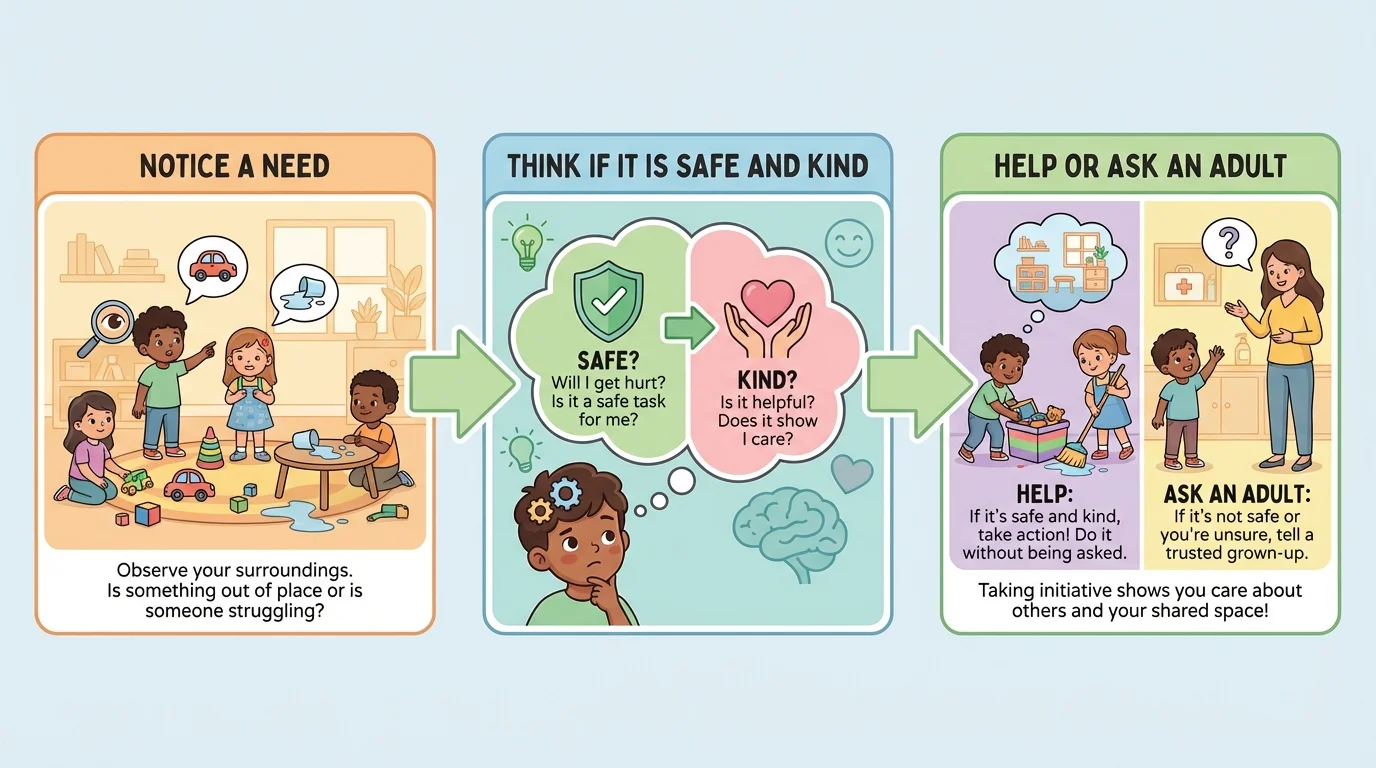
This plan also works online. You might notice that someone in a group chat is being left out. You think, "I can say something kind." Then you help by writing, "You can join us," or by asking a grown-up for help if the chat is becoming mean.
The helper question
Before you act, ask yourself: "Will this help, and is it safe?" If the answer is yes, you can begin. If the action could hurt someone, break a rule, or invade privacy, stop and ask an adult.
Sometimes helping means doing the whole task. Sometimes it means starting it. Sometimes it means finding the right grown-up. Telling an adult about a dangerous spill, a broken step, or unkind online messages is also showing initiative.
A shared space is any place more than one person uses. In your home, that may be the living room, bathroom, kitchen table, play area, or yard. In the community, it may be the park, apartment hallway, library reading corner, or sports bench. In a digital way, it can even be a shared online meeting or chat where everyone deserves respect. Caring for these places matters, as [Figure 2] illustrates with simple actions that keep spaces clean, safe, and ready for others.
When you care for a shared space, you remember that other people use it too. You do not leave your snack wrapper on the couch. You do not scatter game pieces across the floor. You do not leave markers uncapped on the table. You put things back, wipe up small messes if it is safe, and leave the place ready for the next person.
Caring for spaces also means treating objects gently. Books should be closed and put back neatly. Sports gear should be stacked where it belongs. Reusable water bottles should be placed in the right spot. Doors should be closed softly. Lights may be turned off when a room is empty, if that is a family rule.
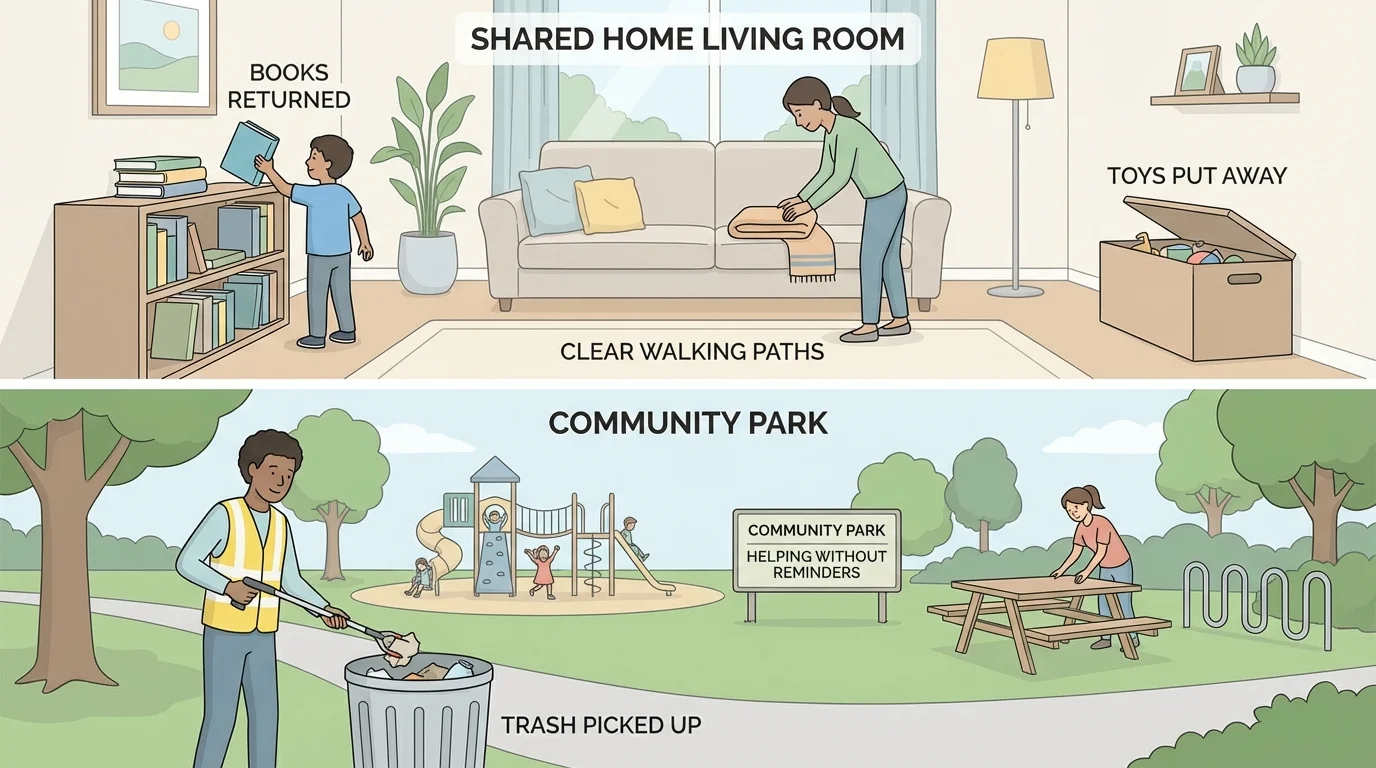
Shared spaces feel calm when everyone helps. They feel stressful when everyone says, "Not my job." If one person leaves a mess, another person must stop and clean it. If many people do that, the whole place becomes harder to use.
Example: caring for a family room
Step 1: Look around the room.
Do you see cups, blankets, books, or toys out of place?
Step 2: Choose one quick helpful action.
You might stack books, fold a blanket, or carry a cup to the sink.
Step 3: Leave the room ready for the next person.
Make sure the walkway is clear and the space looks cared for.
That is initiative because you helped without waiting for someone to remind you.
Later, when you think again about the notice-think-help plan from [Figure 1], you can see how useful it is in every shared place. First you notice the mess, then you think about what is safe, and then you help.
Helping others does not always mean big jobs. Many helpful actions are small and quick. You can bring a tissue, hold a light bag, read a label for someone, help set the table, or get crayons for a younger child. You can offer a turn, share space kindly, or speak in a calm voice when someone feels upset.
At home, helping may mean feeding a pet if that is your job, placing dirty clothes in the basket, or matching socks from the dryer with permission. In the community, it may mean picking up your own trash and one extra piece, returning borrowed items on time, or helping clean up after a club activity.
Online, helping can look different. You can mute when it is noisy on your side, wait before speaking, and use kind words in messages. If someone is confused during a virtual activity, you can say, "The directions are on the screen," or "We are on question two." That keeps the group running smoothly.
"See a need, and be a help."
Real helping is respectful. It does not grab, push, or take over. If someone says, "No thank you," you can respect that. Helping is kind when it supports people, not when it controls them.
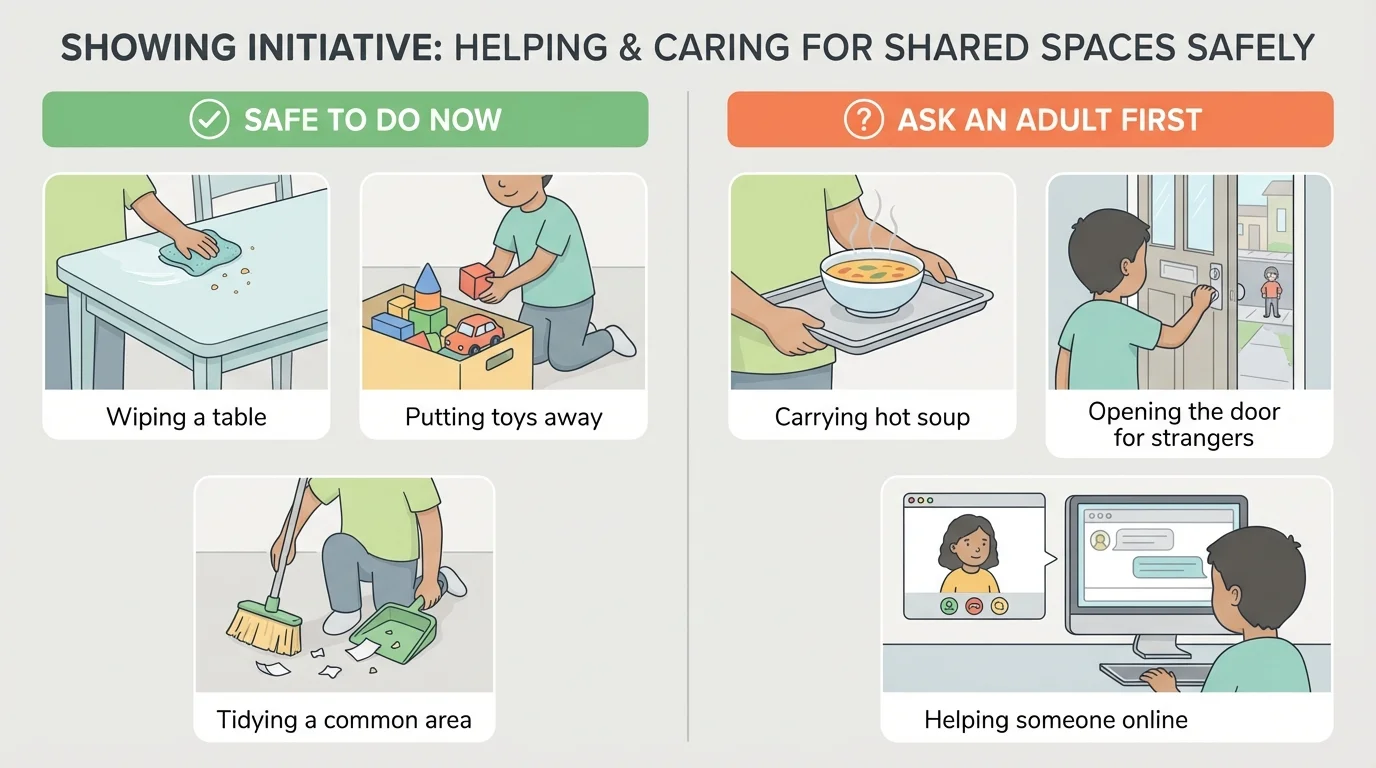
Not every helpful idea should be done alone. Some actions need permission, and some need adult help. As [Figure 3] shows, a good rule is this: if something is hot, sharp, heavy, private, or dangerous, ask first.
It is usually fine to throw away your trash, place books on a shelf you can reach, wipe a dry table, or put toys in a bin. But carrying hot soup, using strong cleaners, opening the door to a stranger, touching someone else's private belongings, or joining an unsafe online conversation are times to stop and get a trusted adult.
You also need to think about privacy. If you find a letter, phone, password, or private message, do not look through it just because you are curious. Caring for others includes respecting their private things.
You already know some safety rules from everyday life: stop, think, and ask a trusted adult when something feels unsafe or confusing. Initiative works best when it follows safety rules.
If someone is hurt, very upset, lost, or being bullied, tell a trusted adult right away. That is not "telling for no reason." That is caring for people. In fact, asking for adult help is often the bravest and most responsible thing to do.
Later, when you look back at the safety choices in [Figure 3], you can sort many situations quickly. Safe small jobs can be done right away, but risky jobs belong to adults or need adult guidance.
You do not need to wait for a big moment to become helpful. Initiative grows from little habits you do again and again. When you finish one activity, look around before you leave. Ask yourself, "What is one thing I can put back, wipe, carry, or straighten?"
Try these simple habits: put items away after using them, check the floor for trash, push in your chair, return borrowed things, and notice if someone nearby needs a small kindness. These actions may take only a minute, but they make a big difference over time.
Try This: a one-minute helper scan
Step 1: Stop before you leave a room or finish an online activity.
Step 2: Look for one thing out of place or one person who may need help.
Step 3: Do one safe, kind action.
One minute of care can keep messes small and help others feel supported.
Habits also make responsibility easier. If you always return pencils to the cup, you do not have to search for them later. If you always rinse your dish or place it in the sink, the kitchen stays calmer. If you always close out of a shared online account when you are done, you protect privacy and show care.
Picture this: you finish a snack and see crumbs on the table. If you walk away, the next person finds the mess. If you wipe it up, the table is ready. Or you notice a soccer ball left in the path. If it stays there, someone may trip. If you move it to the sports bin, you prevent a problem before it starts.
Here is another one. During a video club, one child keeps talking over others. You cannot control everyone, but you can show initiative by raising your hand tool, waiting your turn, and using kind words. Good actions can spread. One calm choice often helps the whole group.
Example: helping a neighbor in a simple way
Step 1: Notice the need.
Your neighbor drops a light scarf near the gate.
Step 2: Think about safety and respect.
The scarf is light, nearby, and easy to reach. You can help politely.
Step 3: Act kindly.
You pick it up and say, "Here you go."
This is a small action, but it shows kindness, awareness, and respect.
Each of these examples teaches the same lesson: initiative is not about being perfect. It is about noticing, thinking, and helping in ways that are safe and useful.
Communities work best when people care about more than just themselves. When you clean up after yourself, help with small jobs, and protect shared places, you show civic responsibility. That means doing your part so life is better for everyone.
This can happen in simple ways. At a park, you use the trash can. At a library, you speak softly and return books carefully. In an apartment building, you keep walkways clear. In an online group, you follow rules, use kind language, and report unsafe behavior to an adult. These are all ways of being a helpful citizen.
Why initiative matters for the future
When people trust you with small jobs, they are more likely to trust you with bigger jobs later. Initiative helps build trust, teamwork, and strong habits that you will use for years.
Even though you are young, your actions matter. A picked-up toy, a kind message, a wiped table, or a warning to an adult about something unsafe can improve someone else's day. That is real power. It is the power to care before being told.
