What do a nurse, a baker, a scientist, and a volunteer at an animal shelter all have in common? They all had to learn, practice, and care about others in some way. Your future does not have just one road. It can have many roads, and each one can lead to something useful, exciting, and kind.
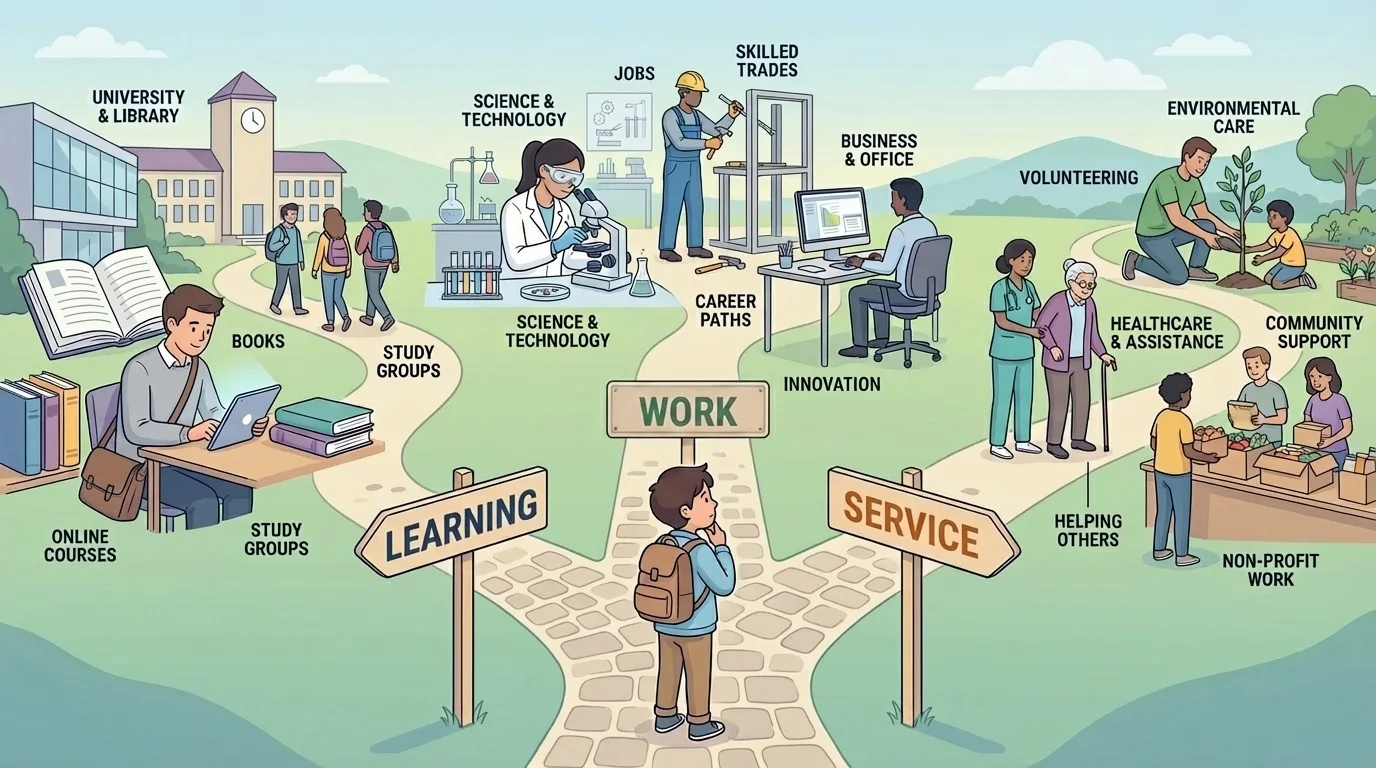
As you grow, you will make more choices about your future pathway, as shown in [Figure 1]. A future pathway is a direction you may take in learning, work, or service. Some people go to college. Some learn a job by training with experts. Some serve their community often while they work in another job. Many people do all three at different times in life.
It is important to know that no one has to decide everything right now. At your age, a smart goal is to start noticing what you enjoy, what you do well, and how you like to help. Those clues can help you later.
One person may love reading about animals and become a veterinarian one day. Another may enjoy drawing and become a designer. Another may like fixing things and become a mechanic. Another may spend time helping neighbors and become a community leader. Different paths can all be good paths.
When people understand their choices, they can feel less worried. Instead of thinking, "I must know my whole future now," you can think, "I can learn about choices one step at a time." That is a calm and strong way to grow.
Learning means gaining new knowledge or skills.
Work means using your skills to do a job or task.
Service means helping other people or your community.
These three parts often connect. A person might learn how to cook, work as a chef, and serve others by making meals for people in need. A person might learn computer skills, work with technology, and serve by helping older adults use devices safely.
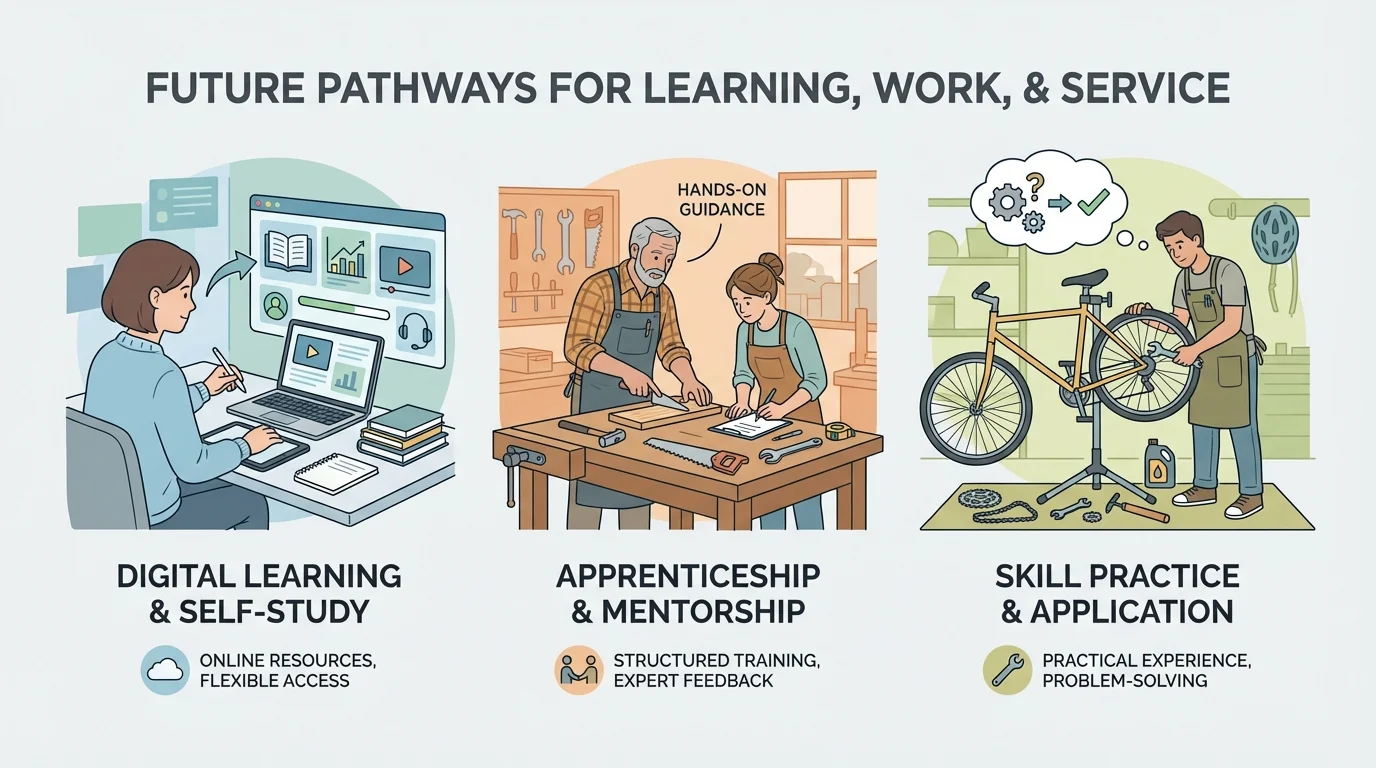
Growing up does not mean learning stops. In fact, many adults keep learning for years, as [Figure 2] shows with different kinds of training. Some learning happens in college. Some happens in classes online. Some happens while practicing a skill with a trained adult. Some happens by reading, watching lessons, asking questions, and trying again.
College is a place where many adults go after high school to study more. They may learn about teaching, science, art, health, or many other subjects. Not every job needs college, but some jobs do.
Training means learning how to do a job or skill. A person who wants to cut hair safely, repair cars, cook in a restaurant, or care for animals may need special training. Training can include watching, practicing, listening carefully, and learning safety rules.
Another kind of learning is called an apprenticeship path. An apprentice learns by working with someone who already knows the job well. For example, a young adult might learn building, baking, or repair work by practicing with a skilled worker.
You do not need to choose one kind of learning forever. Some people start with training. Some go to college later. Some learn a skill first and then keep learning in a new field. Learning can change as your life changes.
Many adults do jobs that did not even exist when they were children. That is one reason learning how to learn is so important.
Here is a simple way to think about learning choices:
| Path | What it means | Example |
|---|---|---|
| College | Studying more after school | Learning to become a teacher |
| Training | Practicing a job skill | Learning how to cook safely |
| Apprenticeship | Learning from someone skilled | Watching and helping a bike repair worker |
| Online learning | Using videos, classes, or lessons | Learning art or coding at home |
Table 1. Different ways people continue learning as they grow.
Career is a word for the kind of work a person does over time. A career can change, and some people have more than one kind of job in life. What matters most is that work uses skills and helps meet needs.
Work can be done in many places. A person might work from home on a computer, help in a hospital, repair homes, grow food, make music, write stories, or care for children. Some jobs are quiet. Some are busy. Some need strong talking skills. Some need careful hands. Some need teamwork.
When work matches a person's interests and strengths, that person often feels more confident and motivated. For example, if you love organizing toys, books, or art supplies, you may enjoy work that needs careful sorting and planning. If you love asking questions, you may enjoy work that includes research or solving problems.
Good-fit work means work that matches your interests, strengths, and values. A good fit does not mean every day is easy. It means the work makes sense for who you are and what matters to you.
If a person does not prepare well for work, problems can happen. They may be late, forget tasks, or have trouble working with others. But when a person practices responsibility, listens well, and keeps learning, people can trust them. Trust is a big part of future success.
Even now, you can build work skills by finishing small jobs at home, following directions, speaking politely on video calls, and taking care of your materials. These are little habits, but little habits grow into big strengths.
Community service means helping people or places without doing it just for money. Service matters because communities become safer, cleaner, kinder, and stronger when people help one another, as [Figure 3] illustrates.
Service can be small or big. A child can help sort books to donate, make a kind card for an older neighbor, pick up litter with family, or help care for a pet while someone is sick. An adult might volunteer at a food pantry, coach children, help at a shelter, or visit people who feel lonely.
Service is not only about big projects. It is also about noticing needs. If you see that your home learning area is messy, cleaning it can help your family. If a younger child needs help opening a container, helping kindly is service. If a friend online feels sad, sending a respectful, caring message can be a form of service too.
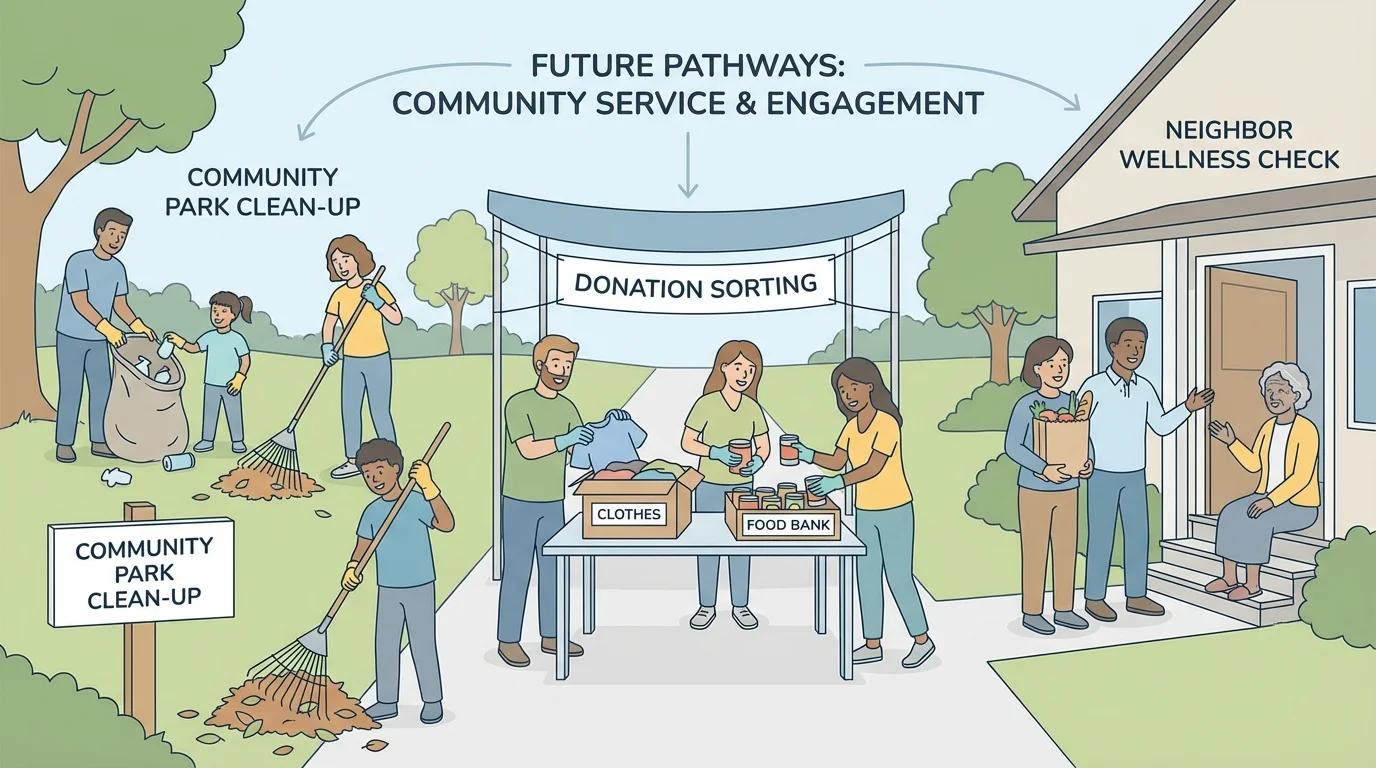
Service teaches important life skills. It teaches empathy, which means understanding how others may feel. It teaches responsibility because people count on you. It also teaches that helping feels meaningful. As we saw earlier in [Figure 1], service is one of the important paths people can choose, and it often connects with learning and work.
Example: Three simple service choices
Step 1: Look around.
Ask, "What needs help right now?" Maybe toys need sorting, a pet needs fresh water, or a family member needs help carrying something light.
Step 2: Choose one safe action.
Pick one helpful task you can do safely with permission.
Step 3: Finish the job kindly.
Do the task carefully and with a good attitude.
Small service actions help build big caring habits.
You do not need a perfect plan. You just need a simple way to think. A four-part guide can help you: notice what you like, notice what you do well, ask trusted people questions, and try small actions now.
[Figure 4] First, notice your interests. What makes you curious? Do you enjoy animals, stories, building, music, helping, cooking, sports, or computers?
Second, notice your strengths. Are you patient? Are you creative? Are you careful? Are you a strong listener? Strengths do not have to be flashy. Being dependable is a powerful strength.
Third, ask questions. You can ask family members, trusted adults, mentors, coaches, or online teachers, "What do you do in your work?" or "How did you learn that skill?" Questions help you learn what different paths are really like.
Fourth, try tiny steps now. Read about a job. Watch a safe lesson with an adult. Help with a real task at home. Practice speaking clearly. Keep your promises. Tiny steps are the beginning of big futures.
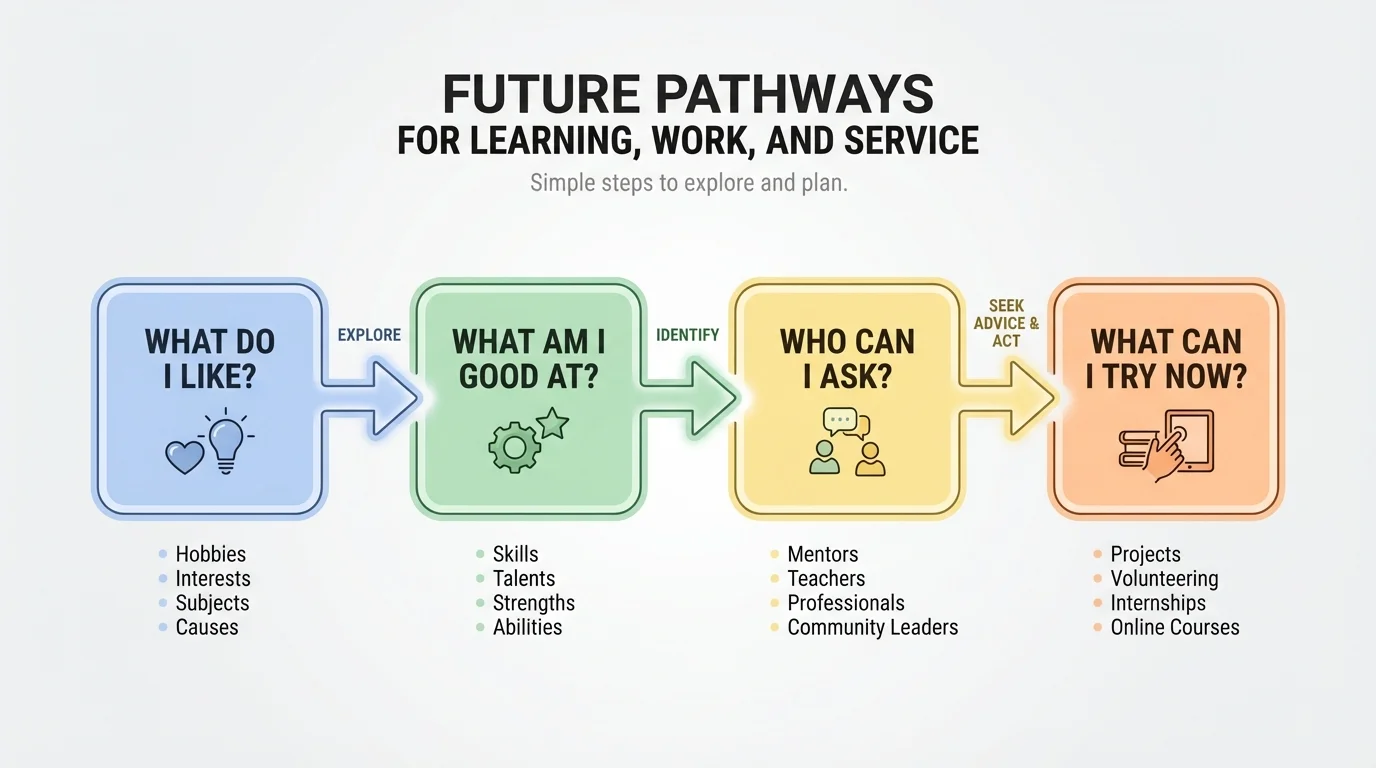
This four-part guide helps because it turns a huge question into smaller ones. Instead of asking, "What will I be forever?" you can ask, "What can I learn this week?" That is easier and wiser. Later, when you think about learning paths again, [Figure 2] reminds you that there are many ways to learn, not just one.
"Big futures grow from small steps."
No one has to figure out the future alone. Trusted adults can help you notice strengths you may miss. A parent or caregiver might say, "You are patient with younger children." A coach might notice that you keep trying after mistakes. An online teacher may see that you explain ideas clearly.
A mentor is a trusted person who gives guidance and encouragement. A mentor might be a family friend, a club leader, a coach, or another safe adult. Mentors can answer questions, share experiences, and help you think about next steps.
When you ask for help online, safety matters. Use approved platforms, talk with trusted adults, and do not share private information. Learning from others is wonderful, but being safe is part of being responsible.
You already use planning skills when you get ready for your day, finish home tasks, or practice something hard. Future planning uses those same skills in a bigger way.
You can start building your future today. You do not need to wait until you are grown. The habits you practice now can help with learning, work, and service later.
Try This: Keep one small promise each day. If you say you will put away art supplies, do it. People learn they can trust you.
Try This: Ask one good question each week about a job, a skill, or a way to help others. Curiosity helps you grow.
Try This: Practice one useful skill. You might fold clothes, measure ingredients with help, organize a shelf, type carefully, or speak politely during an online meeting.
Try This: Do one act of service. Hold the door, help clean a shared space, or make a kind message for someone who needs encouragement.
Try This: Notice what feels exciting and meaningful. Write it down or tell a trusted adult. Your interests are clues, not commands. They help you explore.
When people ignore these small habits, they may feel unprepared later. When they practice them, they often feel more ready. Readiness grows little by little, like a plant that gets water each day.
