Have you ever wanted to do something important, but it felt too big to start? Maybe you wanted to finish all your online schoolwork on time, clean your play space, or practice reading every day. A big job can feel hard at first. The good news is that you do not have to do everything at once. You can use a plan.
A goal is something you want to do or reach. A plan is the path that helps you get there. When you make a simple plan, you are being responsible. You are telling yourself, "I know what I want to do, and I know how to begin."
Goals help you grow. Some goals are for school, like turning in your online lesson by Friday or practicing math facts for 10 minutes each day. Some goals are personal, like remembering to feed a pet, making your bed, or learning how to zip your jacket by yourself.
Without a plan, a goal can stay only a wish. With a plan, a goal becomes something you can work on step by step. That is important for your future too. People who practice planning learn how to finish jobs, solve problems, and keep promises to themselves.
Goal means something you want to do, make, or improve.
Plan means the steps you will follow to reach your goal.
Step means one small action that is part of a bigger job.
Planning does not mean everything will always be perfect. It means you are ready to try, notice what happens, and keep moving forward.
Some goals are small and can be done today. For example: "Put my crayons away after art time." Some goals are bigger and take many days. For example: "Finish my online reading project this week."
When a goal feels too big, break it into smaller parts. A big goal is like a stack of blocks. You build it one block at a time. If you try to jump to the top too fast, you may feel stuck.
A good goal for you should be clear. Instead of saying, "I want to do better," you can say, "I want to read for 10 minutes after breakfast on three days this week." That is easier to understand and easier to do.
Your brain often feels calmer when you know the next small step. A simple plan can make a hard job feel smaller and more possible.
It also helps to pick a goal you can really work on. You cannot control everything, but you can control your own actions. "I will open my lesson, watch the video, and finish one page" is a goal you can act on right away.
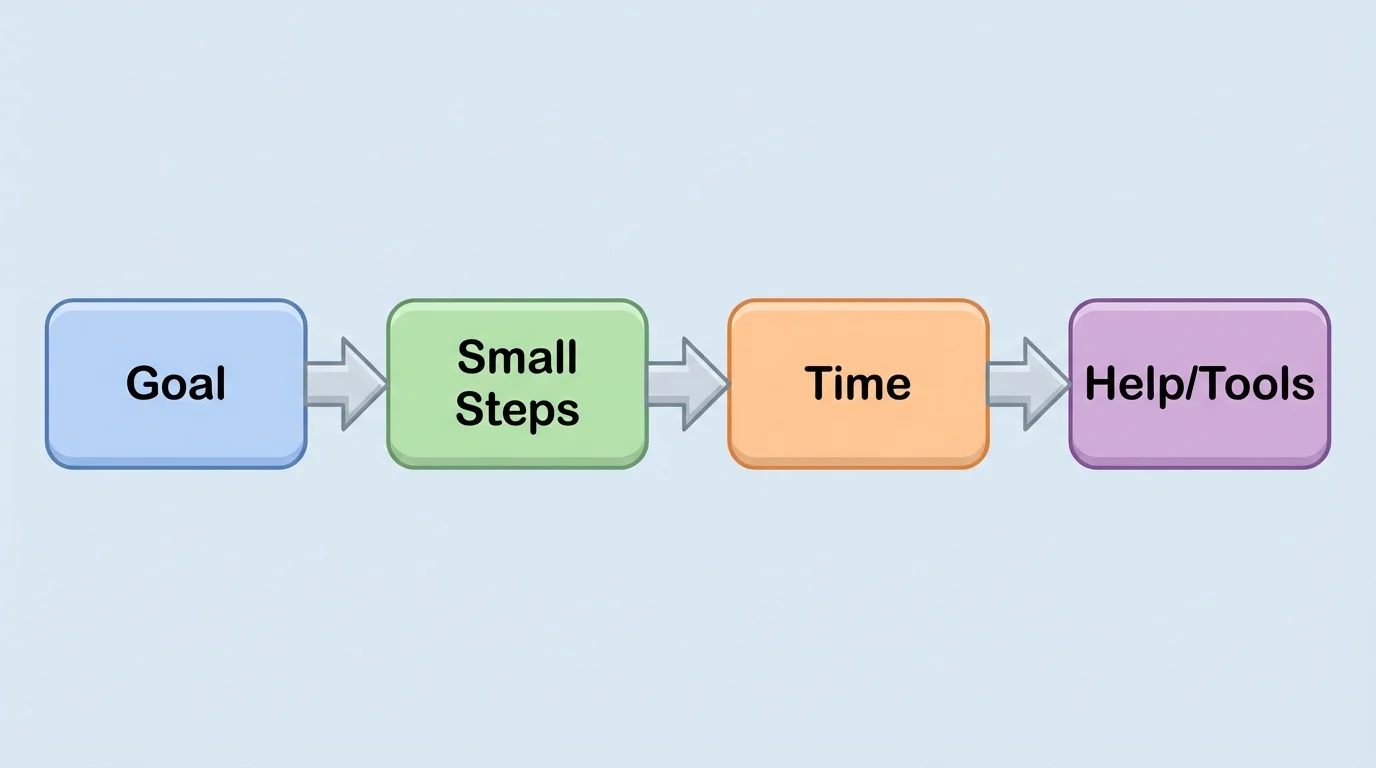
A simple plan, shown in [Figure 1], has four easy parts. First, choose the goal. Next, break it into small steps. Then, decide when you will do it. Last, think about what help or tools you need.
Part 1: Name the goal. Say it in a clear way. For example, "I will finish my science video and worksheet by Thursday."
Part 2: Make small steps. Small steps are easier to follow than one giant job. You might write: watch the video, pause to think, answer five questions, check my work, submit it.
Part 3: Pick the time. Ask yourself when you will do each step. Maybe one step happens after breakfast and another step happens after a break. A time plan helps you remember.
Part 4: Gather help and tools. You may need a pencil, headphones, login information, a timer, or help from a grown-up. Planning for tools saves time later.
If you forget one of these parts, your plan can become harder. For example, if you know your goal but not your time, you may keep saying, "I will do it later." If you know your steps but do not get your tools ready, you may have to stop in the middle.
This is why responsible planning is so useful. It helps you start, keep going, and finish.
Small steps build big success
When you break a goal into small actions, you give yourself many chances to succeed. Each finished step shows progress. Progress helps you feel proud and ready for the next step.
You do not need a fancy chart or a long notebook page. A simple list with check boxes can work very well. The best plan is one you can understand and use.
Let's say your school goal is to finish one online reading assignment by Friday. Breaking it into a checklist helps a lot, and [Figure 2] shows how a week can be organized with one small job at a time.
Example: Finishing an online reading assignment
Step 1: Choose the goal.
"I will finish my reading assignment by Friday."
Step 2: Break it into steps.
Open the lesson, read page one, read page two, answer questions, check answers, turn it in.
Step 3: Pick times.
Monday: open the lesson. Tuesday: read page one. Wednesday: read page two. Thursday: answer questions. Friday: check and submit.
Step 4: Get tools and help.
Use headphones, a pencil, and ask a grown-up to help if the directions are confusing.
This plan is simple, clear, and easy to follow.
Now the assignment does not feel like one giant job. It feels like a few small jobs. That can help you stay calm and finish on time.
If you wait until Friday to do everything, you may feel rushed. You might forget a step or make mistakes. But if you follow a plan, you have more time to think carefully and do your best.
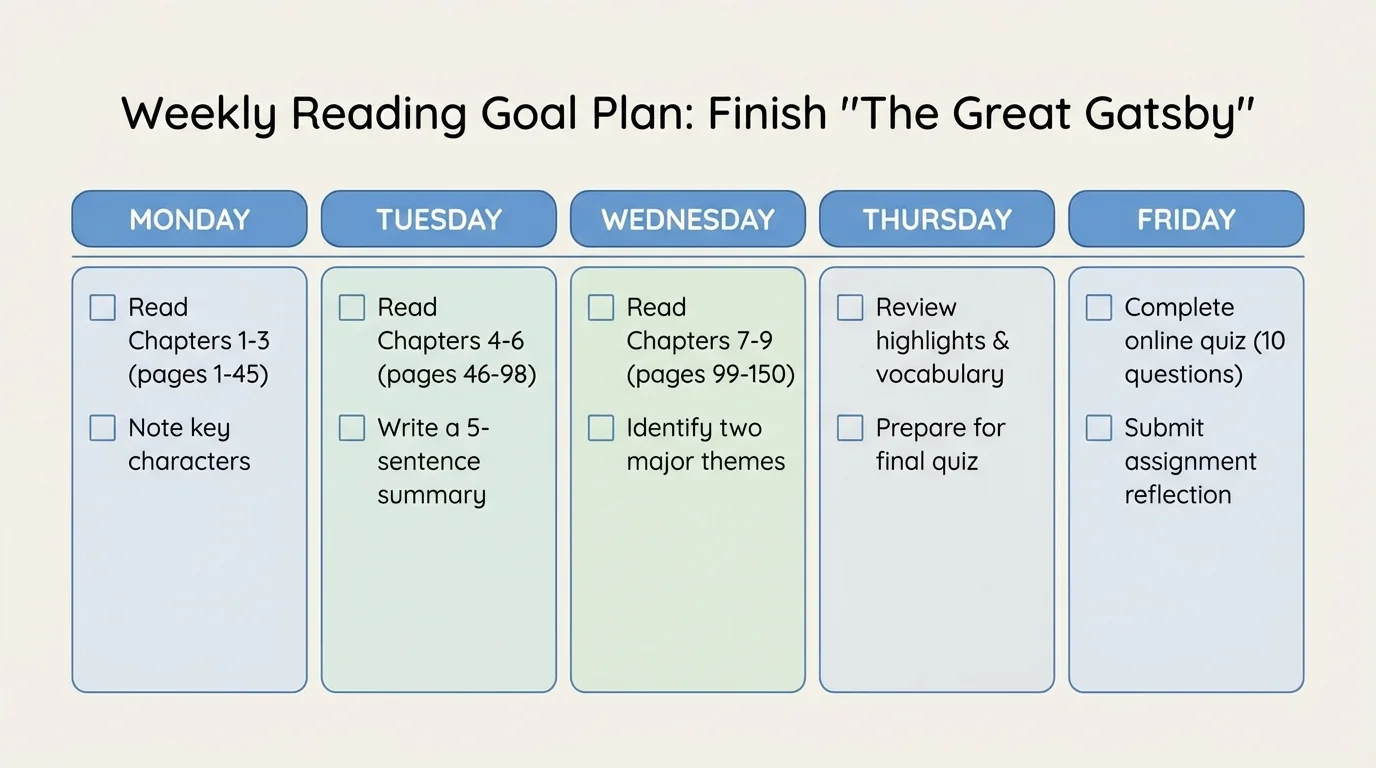
Later, when you make another school plan, you can use the same idea from [Figure 2]: split one big assignment into smaller pieces across a few days.
Plans are not only for school. They also help at home. Maybe your personal goal is to keep your room tidy for one week. You can still use the same four parts.
Your goal could be: "I will put away my toys and books before dinner every day this week." Your small steps could be: pick up blocks, place books on the shelf, put clothes in the basket, check the floor. Your time is before dinner. Your tools might be a basket or a shelf.
This kind of plan helps your home feel calmer. It also shows that you can take care of your own space. That is part of being responsible in a community. When everyone helps, life runs more smoothly.
"Little by little, a little becomes a lot."
You can use this same kind of plan for brushing teeth without reminders, practicing piano, reading every evening, or helping prepare for bedtime.
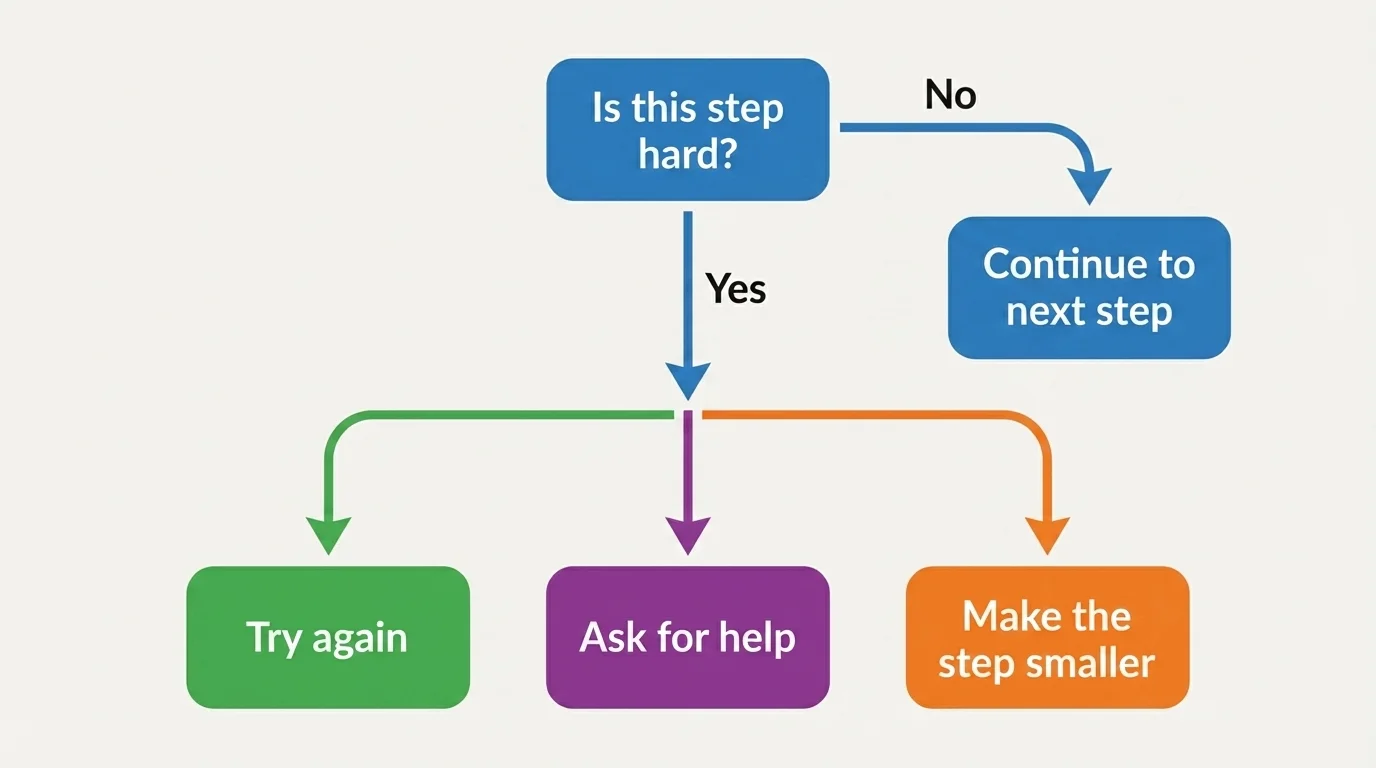
Sometimes a plan does not go perfectly. That is normal. [Figure 3] shows three simple choices that good planners use: try again, ask for help, or make the step smaller.
Maybe a step is too big. If so, cut it into even smaller steps. "Clean my room" may be too much. "Put stuffed animals on the bed" is smaller. Then, "Put books on the shelf" is another step.
Maybe you forgot the time. You can fix that by choosing a new time and writing it down. Maybe you do not understand directions in an online lesson. You can ask a grown-up or send a message to your teacher in the school platform.
Changing a plan is not giving up. It is being smart. If one path does not work, you can choose another path and keep moving toward your goal.
You already know how to follow directions one step at a time. Planning uses that same skill, but now you help make the steps too.
Another problem can be forgetting. A reminder note, a timer, or a checked box can help. Tools like these support your memory and keep your plan visible.
When a step feels hard, think back to the choices in [Figure 3]. You do not have to stay stuck. You can try again, get help, or make the job smaller.
It feels good to see progress. You can check off a step, color a box, or tell a grown-up what you finished. Each time you complete one step, you are moving closer to your goal.
Progress matters because goals are not reached in one second. They are reached through many small actions. If your plan had 5 steps and you finished 3 of them, that means you already completed part of the job. In mathematical terms, that is \(\dfrac{3}{5}\) of the plan. You are not starting from zero anymore.
Celebrating progress does not have to mean getting a prize. It can mean saying, "I did it," taking a short break, or showing your work to someone who supports you. The important part is noticing your effort.
Keep your goal where you can see it. Say it out loud. Make your steps short. Get your tools ready before you begin. Ask for help when you need it. Check your work when you are done.
It also helps to be honest with yourself. If your plan is too hard, make it smaller. If your plan is too easy, you can add a little more. A good plan fits you.
Using a plan now helps you in the future. Children who practice planning grow into people who can organize tasks, meet deadlines, and care for their responsibilities. That matters at home, in school, and in the community.
Every goal does not have to be huge. Small goals count. In fact, small goals are a great way to practice. When you learn to plan one small thing well, you are building a skill you can use again and again.
