Have you ever noticed that some kids seem brave and dependable, even when something is hard? It may look like they were just born that way, but usually that is not true. Most confidence and responsibility grow from small actions repeated again and again. When you make your bed, finish your online lesson, tell the truth, or keep practicing a skill, you are building strong habits inside yourself.
Habits are actions you do often. Some habits help you, and some do not. Helpful habits can make you feel ready, proud, calm, and trustworthy. Unhelpful habits can make you feel rushed, worried, or unsure. The good news is that habits can be changed. You do not have to be perfect. You just have to keep practicing helpful choices.
Small habits matter because they shape your day. If you wake up, get dressed, eat breakfast, and log in to your online class on time, your day starts smoothly. If you forget materials, rush, or put things off, the day feels harder. One choice may seem tiny, but repeated choices become patterns.
These patterns affect how you feel about yourself. When you do what you said you would do, you begin to trust yourself. That trust helps build confidence. When other people see that they can count on you, they begin to trust you too. That shows responsibility.
Confidence means believing that you can try, learn, and handle challenges, even if something is not easy at first.
Responsibility means doing what you are supposed to do, taking ownership of your choices, and trying to fix problems when you make a mistake.
Confidence does not mean never feeling nervous. Responsibility does not mean never making mistakes. Everyone feels unsure sometimes, and everyone slips up. What matters is what you do next.
Confidence can look quiet. A confident person might raise a hand on a video call, try reading a hard word, or say, "I need more practice, but I can keep going." Responsibility can look quiet too. A responsible person might return a borrowed item, feed a pet on time, or remember to charge a device before class.
Sometimes confidence and responsibility work together. For example, if you practice piano each day, you may feel more confident playing for family or during a community event. At the same time, practicing daily shows responsibility because you are taking care of your job as a learner.
Your brain gets stronger at a habit when you repeat it often. That means small, good choices made over and over can become easier with time.
This is one reason routines are powerful. A routine helps you remember what to do without using so much energy to decide every time. That leaves more energy for learning, helping, and solving problems.
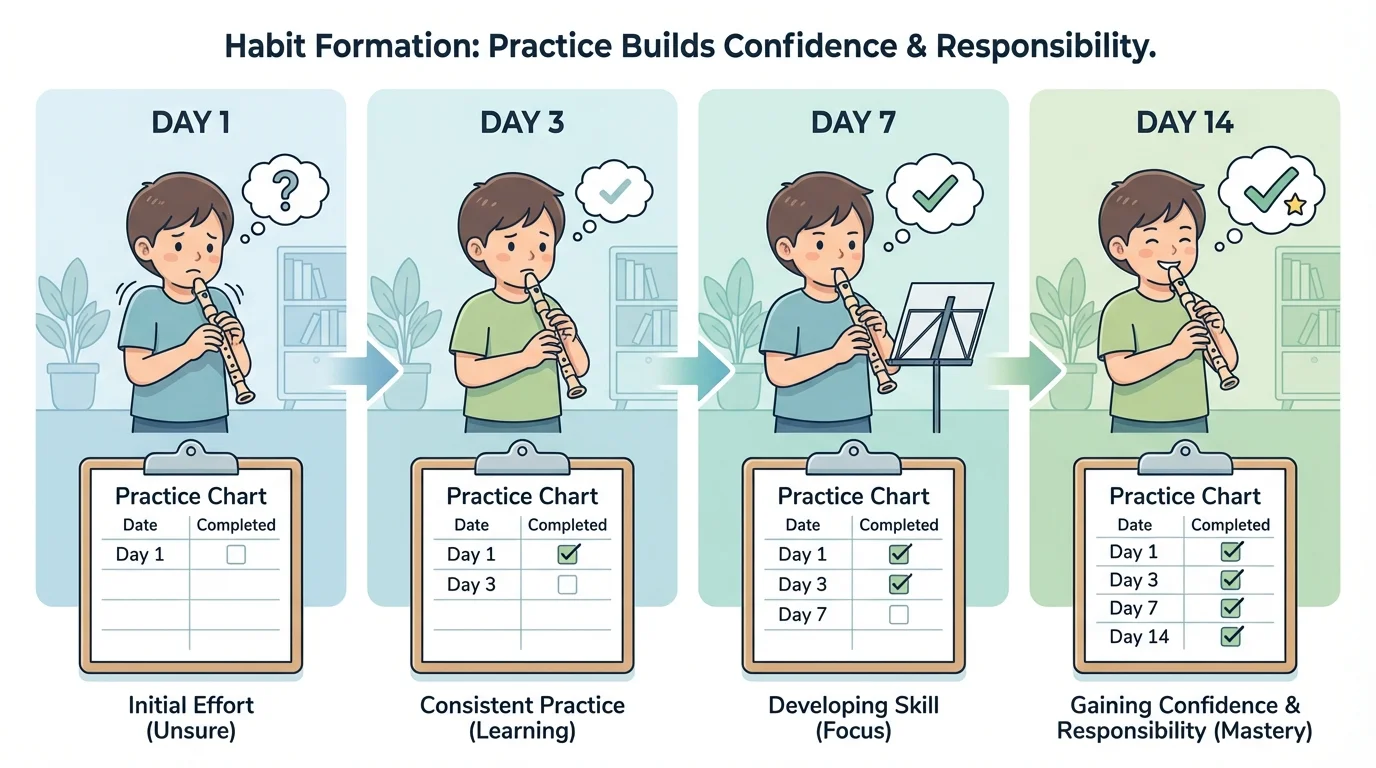
One strong habit that builds confidence is preparation. As [Figure 1] shows, when you get ready before a task, you feel more steady. If you are about to join an online class, you can check your device, open your lesson, get a pencil, and sit in a quiet space.
Another helpful habit is regular practice. You might not feel good at drawing, soccer, coding, cooking, or reading out loud on the first try. That is normal. Skills grow with repetition. Every time you practice, you send yourself an important message: "I am someone who keeps trying."
A third habit is using kind self-talk. Self-talk is the way you speak to yourself in your mind. If you think, "I always mess up," you may want to quit. If you think, "This is hard, but I can learn," you are more likely to keep going. Kind self-talk is honest, not pretend. It does not say, "I am perfect." It says, "I can improve."
Asking for help is also a confidence habit. Some people think asking for help means weakness, but it actually shows strength. It means you care enough to learn. You can ask a parent, teacher, coach, or trusted adult, "Can you show me again?" or "Can you help me make a plan?"
Finishing small tasks matters too. When you clean up your art supplies, complete your reading, or put laundry in the basket, you prove to yourself that you can follow through. Later, when a bigger challenge appears, you remember those smaller wins. That memory helps you feel capable, just as the growth pattern in [Figure 1] reminds you that progress builds over time.
Why confidence grows from action
Many people wait to feel confident before they begin. Usually it works the other way around. You begin, you practice, you learn from mistakes, and then confidence grows. Action comes first, and strong feelings often follow.
Here are some simple confidence habits you can practice right away:
Try This: Before your next online lesson or activity, take two minutes to get ready. Open what you need, sit down calmly, and tell yourself, "I can take this one step at a time."
Responsibility starts with doing what needs to be done, even when no one is watching. That may mean brushing your teeth, putting dishes away, logging in on time, or feeding a pet. Responsible habits help life run more smoothly for you and for the people around you.
One important habit is telling the truth. If you forgot an assignment, broke something, or did not finish a chore, honesty matters. Saying, "I forgot, and I will do it now," is better than making excuses. People trust honest words.
Another habit is taking care of your belongings and shared spaces. Put your headphones where they belong. Charge your device after use. Return library books. Wipe up a spill. When you care for things, you show respect for your home and the people in it.
Being on time is also part of responsibility. If a class starts at a certain time, logging in late can make you miss instructions. If a family member asks for help, waiting too long can create stress. Being ready on time says, "I understand my actions affect others."
Following through is a big one. If you say, "I will walk the dog after lunch," then try to remember and do it. If you promise a friend in a club chat that you will send your part of a project, do your best to send it when you said you would. Keeping promises builds trust.
| Helpful Habit | What It Looks Like | What Happens |
|---|---|---|
| Being prepared | Materials are ready before a task | You feel calmer and more confident |
| Telling the truth | Admitting when you forgot or made a mistake | People can trust you |
| Following through | Doing what you said you would do | Jobs get finished and others can depend on you |
| Taking care of things | Cleaning up and putting items away | Less mess, less stress, fewer lost items |
| Being on time | Logging in or showing up when expected | You are ready and respectful |
Table 1. Examples of habits that support confidence and responsibility in everyday life.
Try This: Pick one job you often forget. Put a note where you can see it, or ask a trusted adult to help you make a reminder. A reminder is not cheating. It is a tool for responsibility.
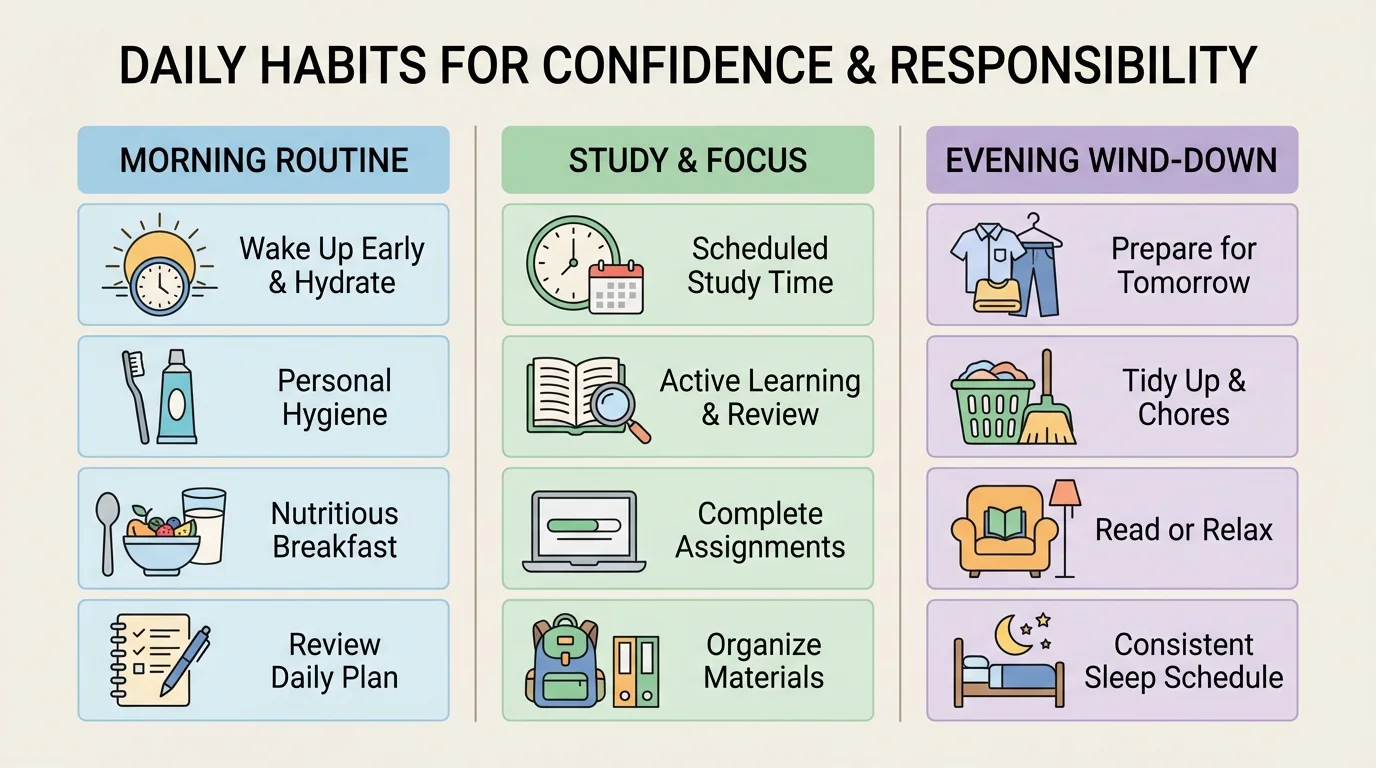
A routine is a set of steps you do in the same order often. As [Figure 2] shows, routines help because they turn good choices into something easier to remember. Morning, learning time, and evening habits can fit together into one simple day.
You do not need a perfect schedule. You need a plan that is simple enough to follow. When your routine is too big, it is hard to keep. When it is small and clear, it works better.
A simple routine you can copy and adjust
Step 1: Morning start
Wake up, get dressed, eat breakfast, brush teeth, and check what you need for the day.
Step 2: Learning time
Log in on time, keep your space neat, listen carefully, and finish one task before moving to the next.
Step 3: Home responsibility
Do one chore, put away supplies, and ask, "What still needs to be done today?"
Step 4: Evening check
Set out what you need for tomorrow, charge your device if needed, and go to bed at a helpful time.
This kind of routine supports both confidence and responsibility because you know what to do and you follow through.
If your routine stops working, that is okay. Change it. Maybe the reminder needs to be in a different place. Maybe the list is too long. Maybe you need to start with just two steps. A routine is a tool, not a test.
Many students feel less worried when they can look at a plan and know what comes next. That is why simple charts like [Figure 2] can be useful. They help turn big days into smaller, manageable parts.
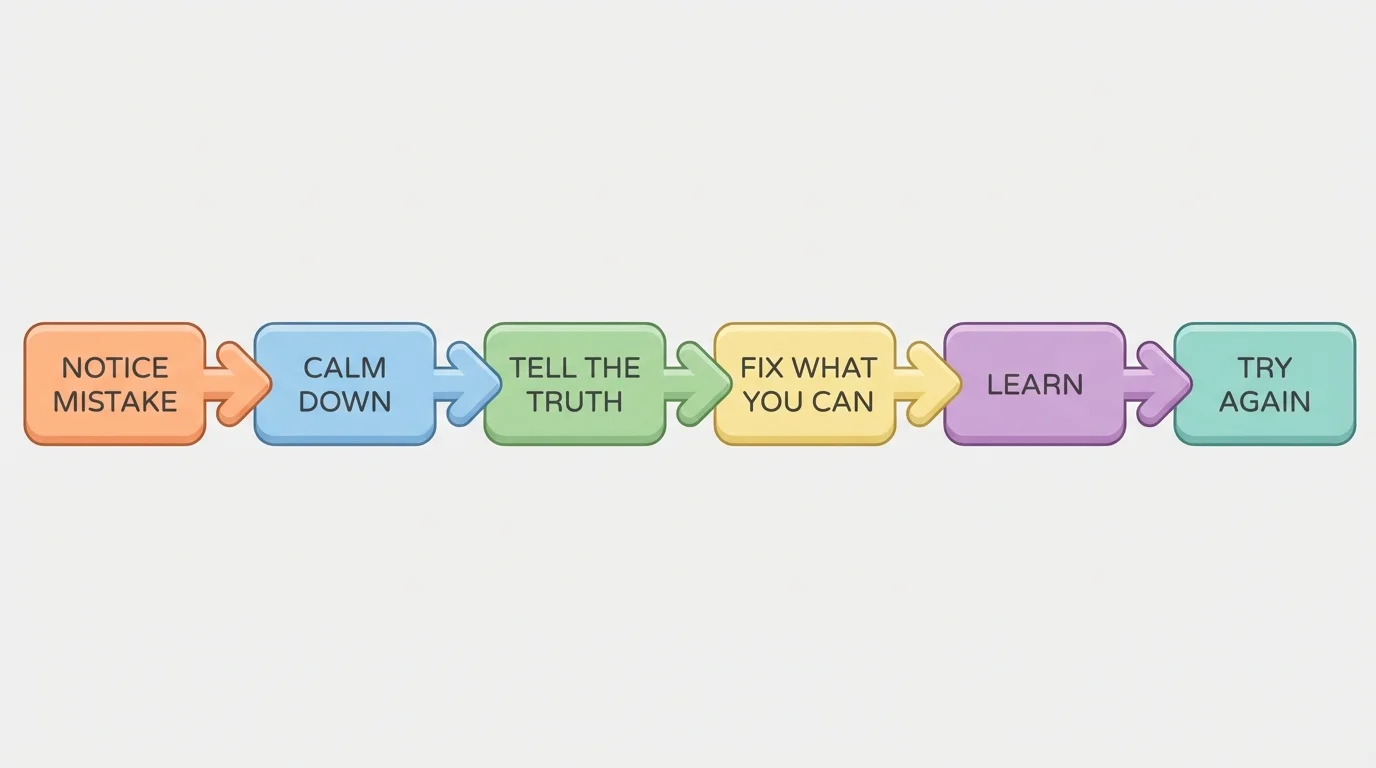
Everybody makes mistakes. As [Figure 3] shows, you might forget to mute your microphone, leave your notebook on the couch, lose track of time, or say something unkind in a message. What matters most is how you respond. The repair steps give a calm way to handle mistakes and grow from them.
Mistakes are not proof that you are bad at something. They are chances to learn. Responsible people do not pretend mistakes never happened. They notice them, tell the truth, and try to fix them.
How to handle a mistake responsibly
Step 1: Pause
Take a breath. If you feel upset, calm your body before you speak.
Step 2: Tell the truth
Say what happened clearly. For example: "I forgot to do the chore," or "I sent that message without thinking."
Step 3: Fix what you can
Clean it up, finish the task, apologize, or ask how to help repair the problem.
Step 4: Learn for next time
Ask yourself, "What will help me remember or choose better next time?" You might set a reminder or slow down before pressing send.
These steps do not erase the mistake, but they show growth and responsibility.
For example, suppose you forgot to join a live class meeting. You could blame the computer even if that is not true. Or you could say, "I forgot to check the time. I am sorry. Next time I will set an alarm." The second response builds trust. It also helps you learn.
"Being responsible does not mean being perfect. It means being honest, helpful, and willing to try again."
Later, when another problem comes up, you can remember the same repair path shown in [Figure 3]. Over time, this habit helps you stay calmer and act more wisely.
Your habits affect more than just you. They affect your family, friends, teammates, club members, and people you talk with online. If you answer politely, listen during a video call, and take turns speaking, you show respect and self-control.
If you promise to bring something to a community activity, remember it. If you borrow scissors from a sibling, return them. If you make a mistake in a group chat, apologize clearly instead of disappearing. These are real ways responsibility shows up in relationships.
Confidence matters with other people too. It helps you speak up when you need help, say "no" to something unsafe, or share your ideas kindly. A confident person does not have to be loud. Confidence can sound like, "I am not comfortable with that," or "Can you explain the directions again?"
When confidence and responsibility work together, you become someone others can count on and someone who believes in their ability to keep learning.
You do not need to change everything in one day. In fact, trying to change too much at once can make you give up. It is better to start with one small habit and repeat it.
Maybe your first habit is putting your learning supplies in the same place every afternoon. Maybe it is checking tomorrow's plan each evening. Maybe it is saying one kind sentence to yourself before a hard task. Small habits are powerful because they are easier to keep.
Growth usually happens little by little. When you keep practicing a skill or a habit, improvement may feel slow at first, but steady effort adds up.
You can also connect a new habit to something you already do. For example, after brushing your teeth, you might check your schedule. After finishing lunch, you might do one chore. Linking habits together makes them easier to remember.
Try This: Choose one tiny habit for this week. Make it so small that it feels easy to start. Then repeat it every day. Notice how that one small action changes the way you feel and the way others can rely on you.
Each time you prepare, tell the truth, practice, follow through, or fix a mistake, you are growing. You are building a stronger version of yourself—one small choice at a time.
