Have you ever started something that looked easy, but then it took way longer than you thought? Maybe you were building with blocks, learning a new game, cleaning your room, or trying to follow directions on a screen. That happens to everyone. Hard tasks are not a sign that you are failing. They are a sign that you are doing something that takes time, focus, and practice.
Sometimes a task feels hard because it has many steps. Sometimes it feels hard because it is new. Sometimes it feels hard because you are tired, distracted, or upset. A job can also feel hard when you thought it would take a short time, but it keeps going. That can make you feel frustrated.
Feeling stuck does not mean you should give up. It means your brain and body need a plan. When you know what to do next, hard things become easier to handle.
Persistence means keeping at a task even when it feels difficult or takes longer than expected.
Resilience means bouncing back after mistakes, disappointment, or challenges.
Frustration is the upset feeling you may have when something is not working the way you want.
These skills matter in real life. If you stop every time something feels tricky, many important jobs stay unfinished. But if you learn to stay calm, try again, and use a new plan, you become stronger and more confident.
Persistence is not about being perfect. It is about staying with a task in a smart way. You may make mistakes. You may need more time. You may need help. You are still being persistent if you keep working toward the goal.
Think about tying shoes, riding a bike, or learning how to make a sandwich. At first, those things can feel slow. You might forget a step. You might need someone to show you again. Over time, practice helps your brain remember what to do.
That is why persistence is powerful. It helps you finish chores, learn new hobbies, solve problems, and stay calm when things do not go perfectly.
Your brain gets stronger when you practice hard things. Each time you keep trying, you help your brain learn a little more.
When you work from home, persistence is especially important. You may need to follow directions on your own, finish tasks without someone standing next to you, or wait patiently while a page loads or a video lesson buffers. Small delays can feel annoying, but they are chances to practice calm and steady effort.
Before you can keep going, you need to notice what is happening inside you. Your body often gives clues. Maybe your shoulders feel tight. Maybe you want to groan, cry, slam a pencil, or walk away. Those are signs that your feelings are getting big.
Frustration can make a small problem feel huge. If you try to work while you are very upset, you may rush, forget steps, or quit too soon. That is why it helps to pause first.
Big feelings need small calming actions. You do not have to make the feeling disappear. You only need to calm down enough to think clearly. A slow breath, a sip of water, or relaxing your hands can help your brain get ready for the next step.
You can say, "I feel frustrated," or "I feel disappointed," or "I feel worried this will take too long." Naming the feeling helps you understand it. Once you know the feeling, you can choose a helpful action instead of reacting right away.
Here are some calming ideas you can use at home: take three slow breaths, count slowly from \(1\) to \(5\), stretch your arms, get a drink of water, or rest your eyes for a short moment. These are short resets, not ways to escape the task forever.
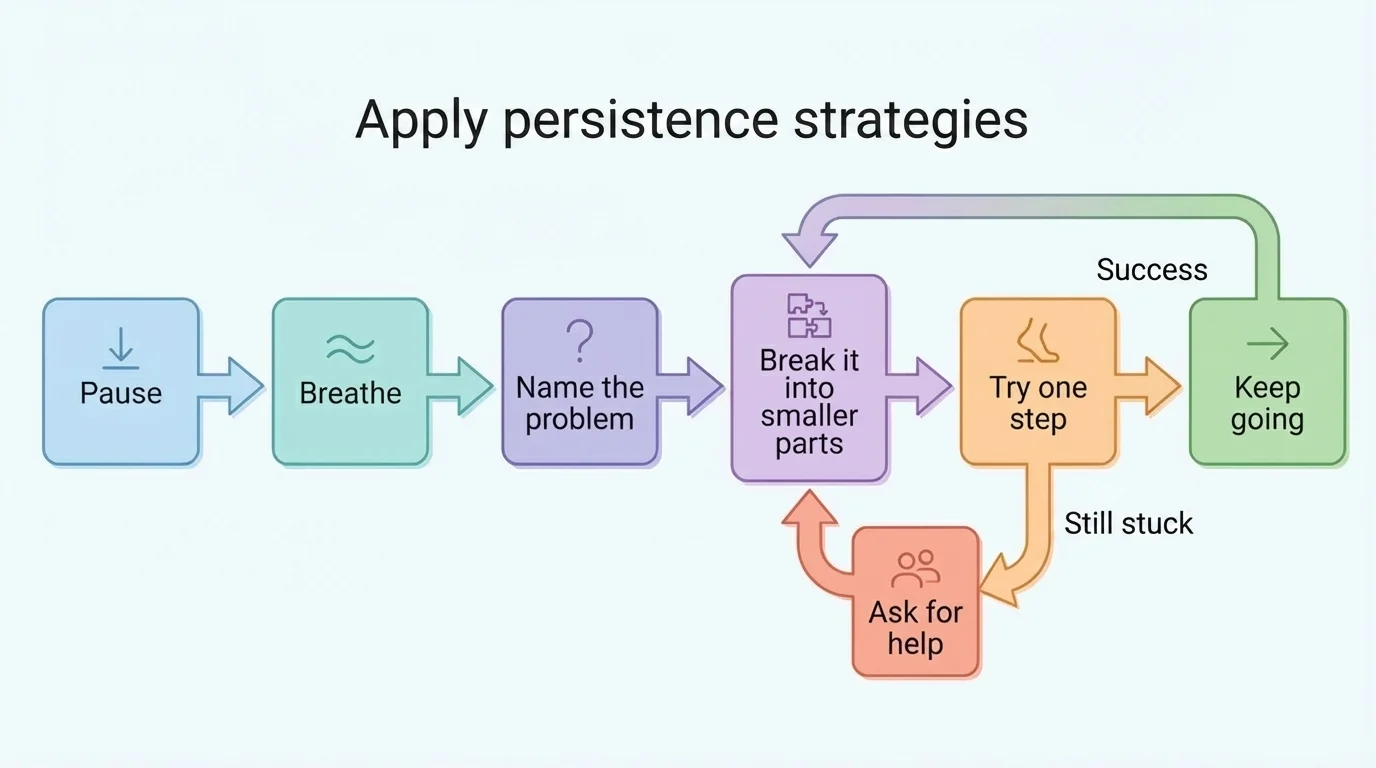
When a task feels too hard, use a simple plan, as [Figure 1] shows. A plan helps because you do not have to guess what to do next. You can move one small step at a time.
Step 1: Pause. Stop for a moment instead of rushing or giving up.
Step 2: Breathe. Take a slow breath in and a slow breath out.
Step 3: Name the problem. Ask yourself, "What part is hard?" Maybe the directions are confusing. Maybe there are too many pieces. Maybe you do not know the first step.
Step 4: Break it into smaller parts. Big jobs feel easier when you split them into tiny actions.
Step 5: Do just one next step. Do not worry about the whole job yet.
Step 6: Ask for help if you need it. You can message a teacher, ask a parent or caregiver, or check directions again.
Step 7: Keep going or come back after a short, planned break.
Breaking a task apart is one of the best strategies. Instead of saying, "I have to clean my whole room," you can say, "First I will put books on the shelf. Next I will pick up clothes. Then I will make the bed." The room is still the goal, but your brain only has to handle one piece at a time.
Example: Making a snack when it feels confusing
You want to make toast with fruit, but the directions feel like too much all at once.
Step 1: Name the hard part
You might say, "I forget what comes first."
Step 2: Break it down
Get plate. Get bread. Put bread in toaster. Wash fruit. Put food on plate.
Step 3: Do one step only
Start with getting the plate. After that, choose the next small step.
This turns one big job into a set of easy actions.
You can use the same plan when a game level is tricky, when your art project does not look right yet, or when directions on a website are hard to follow. Later, when another job feels overwhelming, think back to the flow in [Figure 1] and use the same steps again.
Being persistent does not mean doing the exact same thing over and over when it is not working. Smart persistence means paying attention and making a good choice.
You usually have three good choices, as [Figure 2] explains: keep trying with focus, take a short break, or change your strategy. The best choice depends on what is happening.
If you are still thinking clearly, you might keep going. If your body feels too upset, a short break may help. If your plan is not working, try a different way or ask someone for support.
| Situation | Helpful choice | Why it helps |
|---|---|---|
| You know what to do, but it is slow | Keep going | Some jobs just need more time |
| You feel too upset to think clearly | Take a short break | Calming down helps you focus |
| You are stuck on the same part again and again | Change strategy or ask for help | A new idea can get you unstuck |
Table 1. Helpful choices to make when a task feels hard or slow.
A short break should be planned. For example, you might stretch, drink water, or sit quietly for a few minutes. A break is different from avoiding the task. If you take a break and never come back, the problem stays waiting for you.
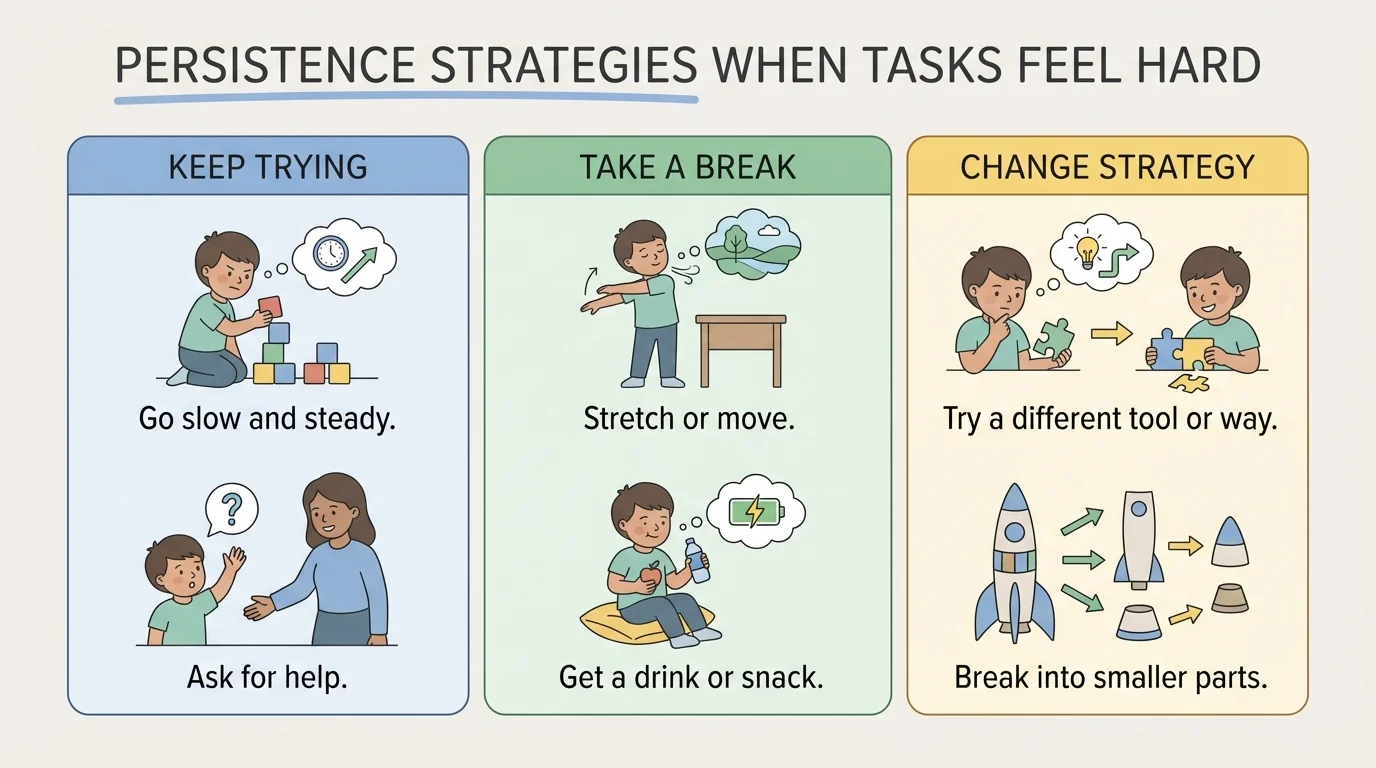
Changing strategies can mean reading directions one more time, watching the example again, using scrap paper to plan, cleaning up your workspace, or asking, "Can you show me the first part?" That is not quitting. That is being flexible.
You do not have to do everything alone to be strong. Strong learners use tools, directions, practice, and support.
When you compare choices later, think about what kind of persistence you need: steady effort, a calm reset, or a new plan.
Persistence is useful in many parts of your day, not just in schoolwork on a screen. You use it when you learn how to care for a pet, practice a dance move, save a game after losing, sort laundry, or help cook dinner.
Suppose you are building a model and one part keeps falling off. You could yell and quit. Or you could pause, check the directions, hold the pieces more carefully, and try again. The second choice gives you a better chance to finish.
Example: Cleaning a messy space
Your play area looks messy, and you do not know where to start.
Step 1: Pick one category
Choose only books, only toys, or only clothes.
Step 2: Set a tiny goal
Put away just \(5\) items first.
Step 3: Check your progress
After \(5\) items, decide on the next \(5\).
Small goals make the job feel possible.
Now think about an online situation. You are trying to upload a file, but it is not working. A persistent response might be: read the directions again, check whether you clicked the right button, wait for loading, and then ask an adult for help if needed. Giving up right away may mean the job stays unfinished.
Persistence also matters with friends, siblings, and teammates in clubs or activities. If a problem happens during an online game or group video call, staying calm and trying to solve the problem respectfully can help everyone enjoy the activity more.
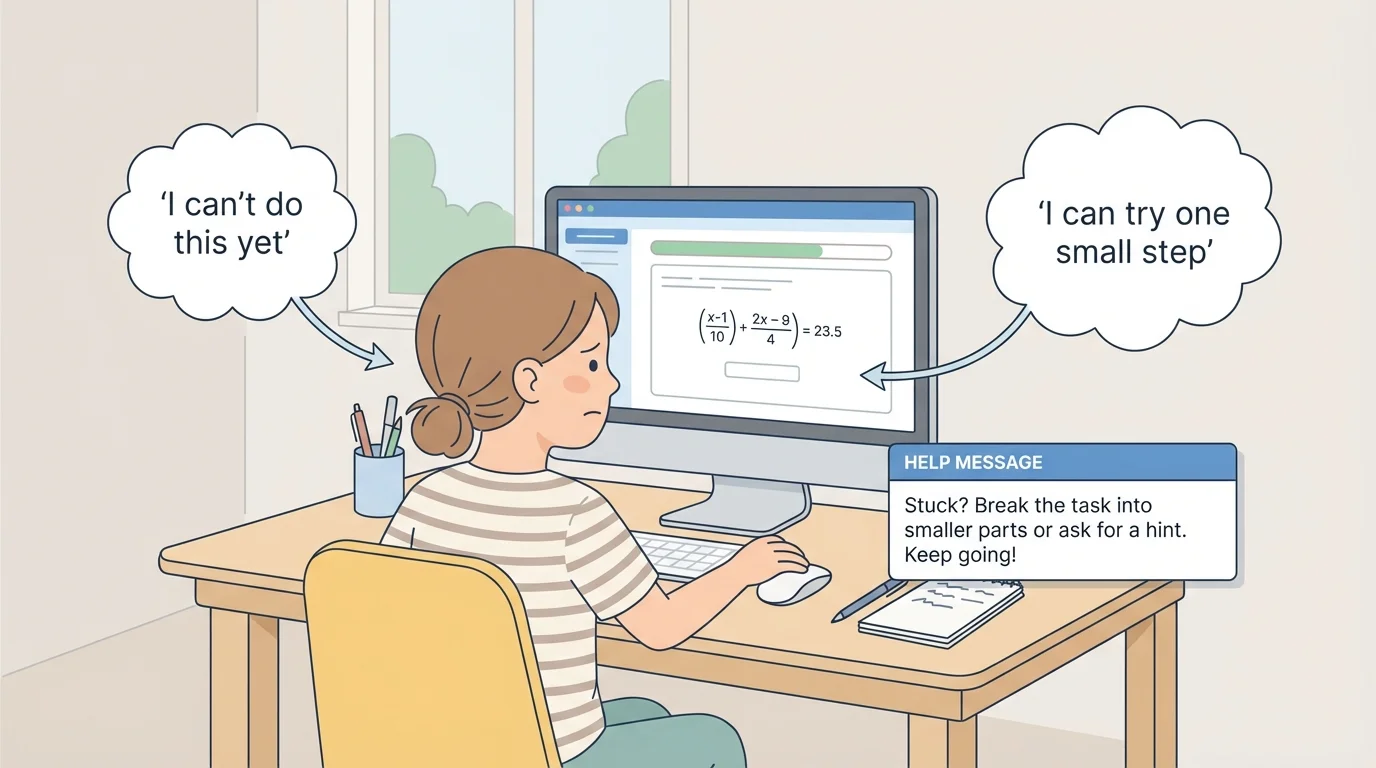
[Figure 3] The words you say to yourself matter. Self-talk can change an unhelpful thought into a helpful one. If you tell yourself, "I am terrible at this," your brain may want to shut down. If you tell yourself, "This is hard, but I can try one small step," you give yourself room to continue.
Self-talk is the quiet voice in your mind. It can make you feel weaker or stronger. Helpful self-talk is honest but encouraging.
Try sentences like these:
"This is hard, not impossible."
"I can do one part at a time."
"Mistakes help me learn."
"I do not know it yet."
"I can ask for help and still be strong."
Asking for help is a smart strategy, not a last resort. You can ask a parent, caregiver, tutor, coach, or teacher. You can also ask for help clearly: "I understand the first part, but I am stuck on the second step." That kind of message makes it easier for someone to support you.
"I can try again with a new plan."
Sometimes support is not about getting the answer. Sometimes it is about having someone sit nearby, remind you of the first step, or help you calm down. The child in [Figure 3] uses both helpful thoughts and support, and you can do that too.
Resilience grows when you practice it often. You do not have to wait for a huge problem. Small daily jobs help build this skill.
Here are simple ways to practice:
Finish one small job every day. Put away dishes, feed a pet, or organize a backpack area at home.
Use a checklist. Crossing off steps helps you see progress.
Notice effort. Instead of only saying, "I finished," also say, "I kept going when it was hard."
Plan for delays. If you think a job will take a short time, remember it may take longer. That helps you stay calmer.
Celebrate growth. Maybe you still need help, but now you stay calm longer or solve more of the task by yourself. That is progress.
Progress is often slow and steady. Many useful skills do not improve all at once. They grow little by little. When you expect steady growth instead of instant success, you are more likely to stay with the task.
Try This: The next time something feels hard, stop and say, "What is my next small step?" Then do only that step.
Try This: Make a short "keep going" list on paper with calming ideas, helpful self-talk, and names of people you can ask for help.
Try This: When a task takes longer than expected, remind yourself that time is not the boss of your effort. If the task matters, it is worth using patience and a smart plan.
When you practice persistence, you become someone who can handle bumps in the road. You may still feel annoyed or disappointed sometimes, but you know what to do next. That is a life skill you can use again and again.
