Have you ever sent a message, said something, or slammed something down, and then wished you could take it back one second later? That tiny moment between a feeling and an action is powerful. When you learn how to use self-control in that moment, you give yourself a better chance to be kind, fair, and smart about what you do next.
Self-control helps you pause before you act. It does not mean you never feel angry, excited, sad, or frustrated. It means you learn how to handle those feelings without letting them push you into hurtful or unsafe choices. That is a big life skill whether you are doing online schoolwork, playing a game, texting a friend, talking with family, or solving a problem in your neighborhood or on a team
Self-control is the ability to manage your feelings, words, and actions. Respectful choices are actions that show care for yourself and other people. Problem-solving means figuring out what is wrong and choosing a helpful way to fix it.
When you use self-control, you are more likely to listen, think, and choose well. When self-control is missing, people may interrupt, yell, blame, quit, or make a problem bigger. The good news is that self-control can be practiced, just like shooting a basketball, learning a song, or getting better at riding a bike.
Sometimes people think self-control means being quiet all the time or hiding feelings. That is not true. Self-control means you notice what you are feeling and decide what to do with it. You are still allowed to feel upset. You are still allowed to disagree. You are still allowed to need space. The important part is how you act.
For example, if your brother grabs a game controller, you might feel mad. If someone in a group chat leaves you out, you might feel hurt. If your internet freezes during a live lesson, you might feel frustrated. Those feelings are real. Self-control helps you keep the feeling from choosing your actions for you.
Without self-control, a person may shout, type something mean, throw an object, or stomp away before understanding what really happened. With self-control, that same person can pause, breathe, and choose a response that is safer and more respectful.
Self-control supports respectful choices because respect is not only about being polite when things are easy. Respect matters most when things are hard. It shows up when you are disappointed, when someone annoys you, when you lose, when you have to wait, or when you do not get your way.
Think about these everyday situations:
In each situation, self-control gives you a chance to choose respect. You might wait for your turn to speak, ask a question instead of making an accusation, use a calm voice, or walk away for a minute before answering. These choices help people trust you and help problems get solved faster.
Your brain gets stronger at self-control when you practice it often. Small calm choices today can make bigger calm choices easier later.
Self-control also matters because choices have consequences. If you type something mean in anger, the other person may feel hurt, your relationship may be damaged, and the problem may grow. If you pause and answer respectfully, the other person is more likely to calm down too. Respect often spreads from one person to another.
As [Figure 1] shows, your body often warns you before you make a rushed choice. Strong feelings can come with clues like a hot face, tight fists, a fast heartbeat, a frown, or a loud voice. These clues are important because they tell you, "Slow down. I need self-control right now."
You may notice that when you are upset, your thoughts can race. You might think, "That is so unfair!" or "I need to answer right now!" Those thoughts can make you want to react fast. But fast reactions are not always smart reactions. A pause gives your mind time to catch up.
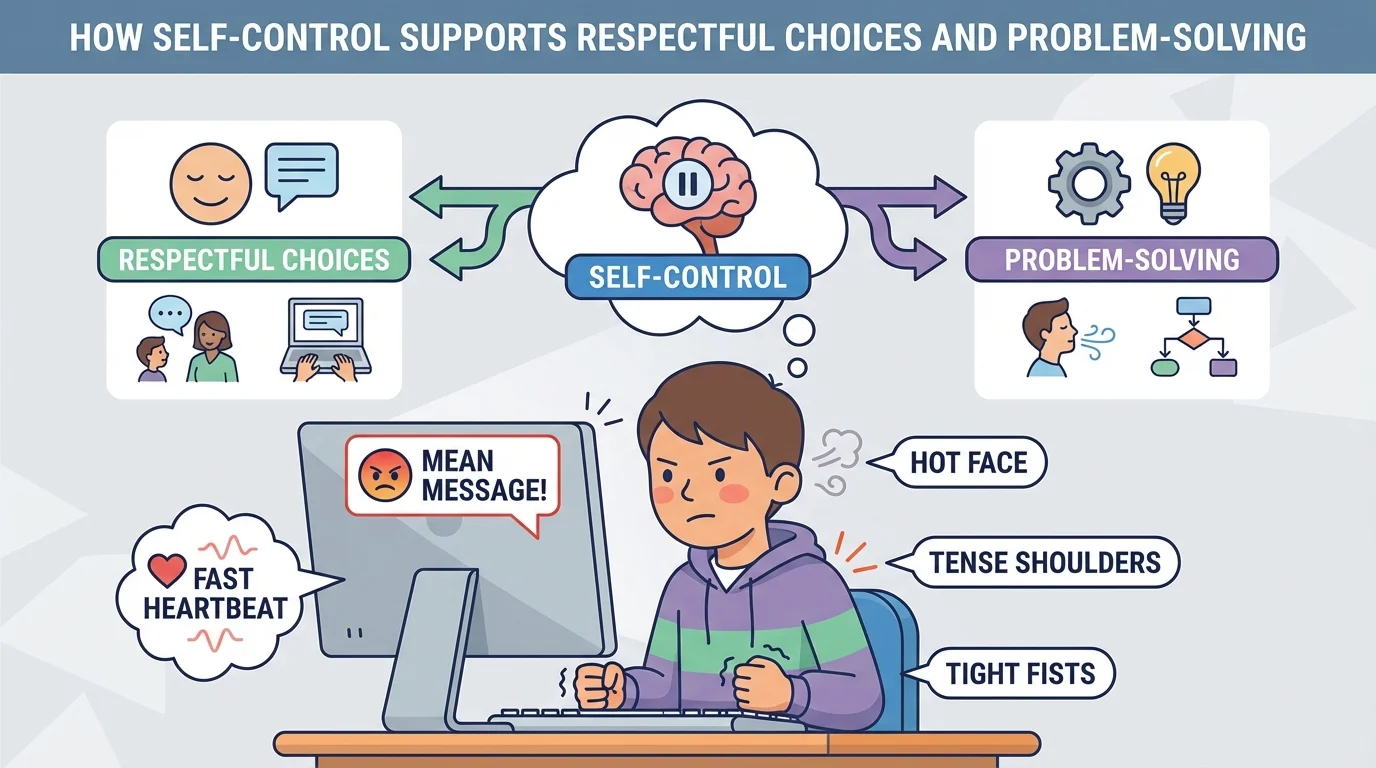
Paying attention to body clues is part of emotional regulation. That means managing feelings in a healthy way. If you can spot your clues early, you have a better chance of making a respectful choice before the problem grows.
Some common body clues are different for different people. One child may get very quiet. Another may talk loudly. Someone else may cry, cross their arms, or feel like stomping away. None of these clues make you a bad person. They are signals. Signals help you know it is time to use your plan.
A helpful way to build self-control is to use the same steps again and again. The plan in [Figure 2] gives you a simple routine: stop, breathe, name the feeling, think of choices, and choose a respectful action. When you repeat these steps, they become easier to remember during a hard moment.
Step 1: Stop. Do not act right away. If you are holding something, put it down. If you are typing, take your hands off the keyboard. If you are talking, close your mouth for a moment.
Step 2: Breathe. Take slow breaths. You might breathe in through your nose and out through your mouth. Slow breathing can help your body calm down.
Step 3: Name the feeling. Say it in your mind or out loud: "I feel angry," "I feel embarrassed," or "I feel disappointed." Naming a feeling can make it easier to manage.
Step 4: Think of choices. Ask yourself, "What can I do next?" Try to think of at least two choices.
Step 5: Choose a respectful action. Pick the action that is safe, kind, and helpful.
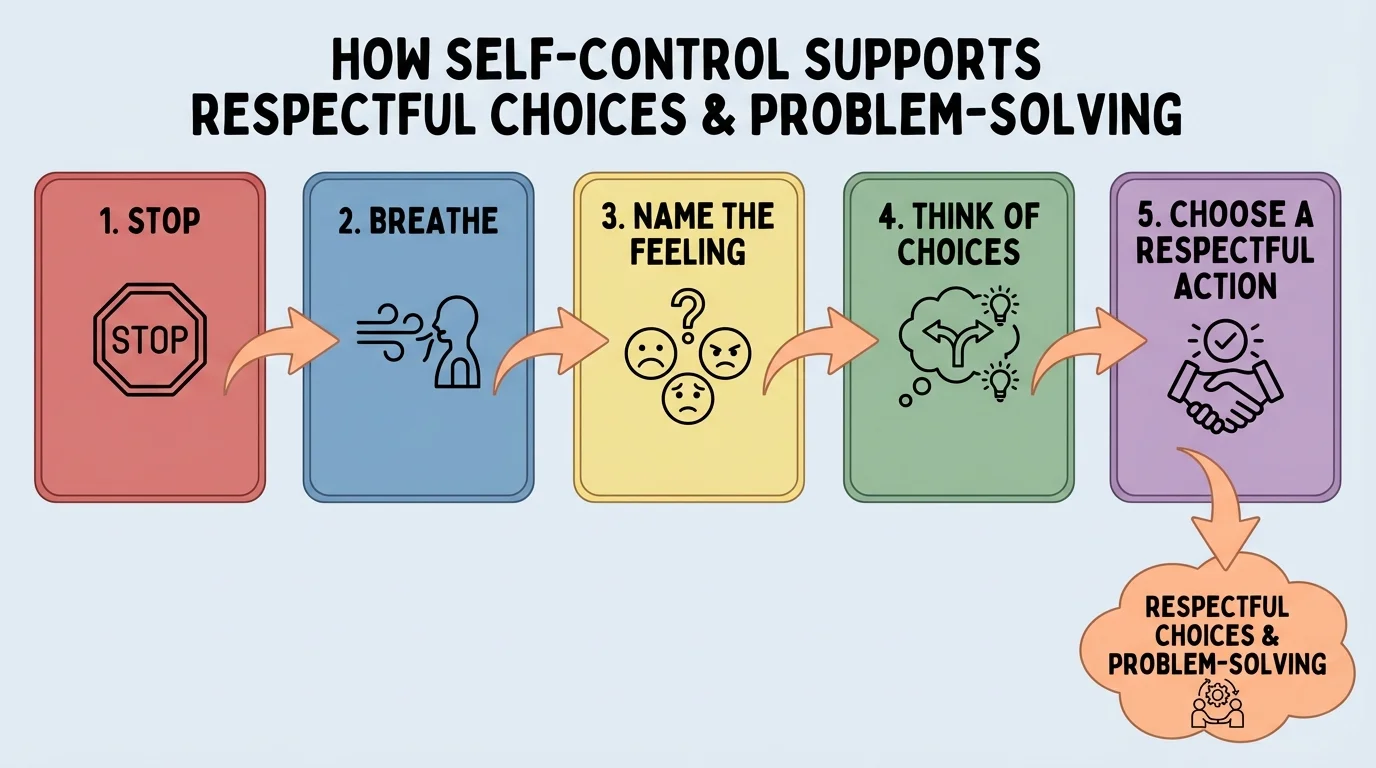
This plan does not take a long time. Sometimes it happens in only a few seconds. But those few seconds matter. They can be the difference between making the problem worse and helping it get better.
Using the self-control plan
You are playing an online game, and someone says, "You made us lose." You feel angry right away.
Step 1: Stop
You do not answer immediately.
Step 2: Breathe
You take three slow breaths.
Step 3: Name the feeling
You think, "I feel blamed and mad."
Step 4: Think of choices
You could type something mean, leave the game, or answer calmly.
Step 5: Choose a respectful action
You type, "Let's try again and work together next round."
Your choice helps keep the problem from getting bigger.
Later, when another hard moment happens, the same plan still works. Just as [Figure 2] lays out the steps clearly, your job is to practice using them until they feel natural.
Respectful choices are choices that protect people's feelings, safety, and dignity. They do not have to be perfect. They just need to be thoughtful and kind. Self-control helps you get there by slowing down your first reaction.
Here are some respectful choices that self-control can support:
Respectful choices are not weak choices. In fact, they often take more strength than rude ones. It is easy to snap. It takes real strength to pause and choose words carefully.
"You cannot always control what happens, but you can control what you do next."
Self-control also helps you show respect to yourself. For example, if someone is unkind online, a respectful choice does not always mean staying in the conversation. It might mean blocking, muting, saving the message, or telling a trusted adult. Respect includes protecting yourself.
As [Figure 3] shows, problems get solved better when feelings do not take over. Good problem-solving means understanding the problem, thinking about choices, and checking what may happen next. Different choices can lead to very different results.
When you have a problem, try this simple guide:
First, identify the problem. Ask, "What is the real problem?" Sometimes the first thing you notice is not the whole problem. Maybe the real issue is a misunderstanding, feeling left out, or needing help.
Next, think of possible choices. Try not to stop at the first idea. Think of two or three possibilities.
Then, check the consequences. Ask, "What might happen if I do this?" A choice may feel good for one second but cause trouble later.
Finally, choose the best action. The best action is usually safe, respectful, and likely to help.
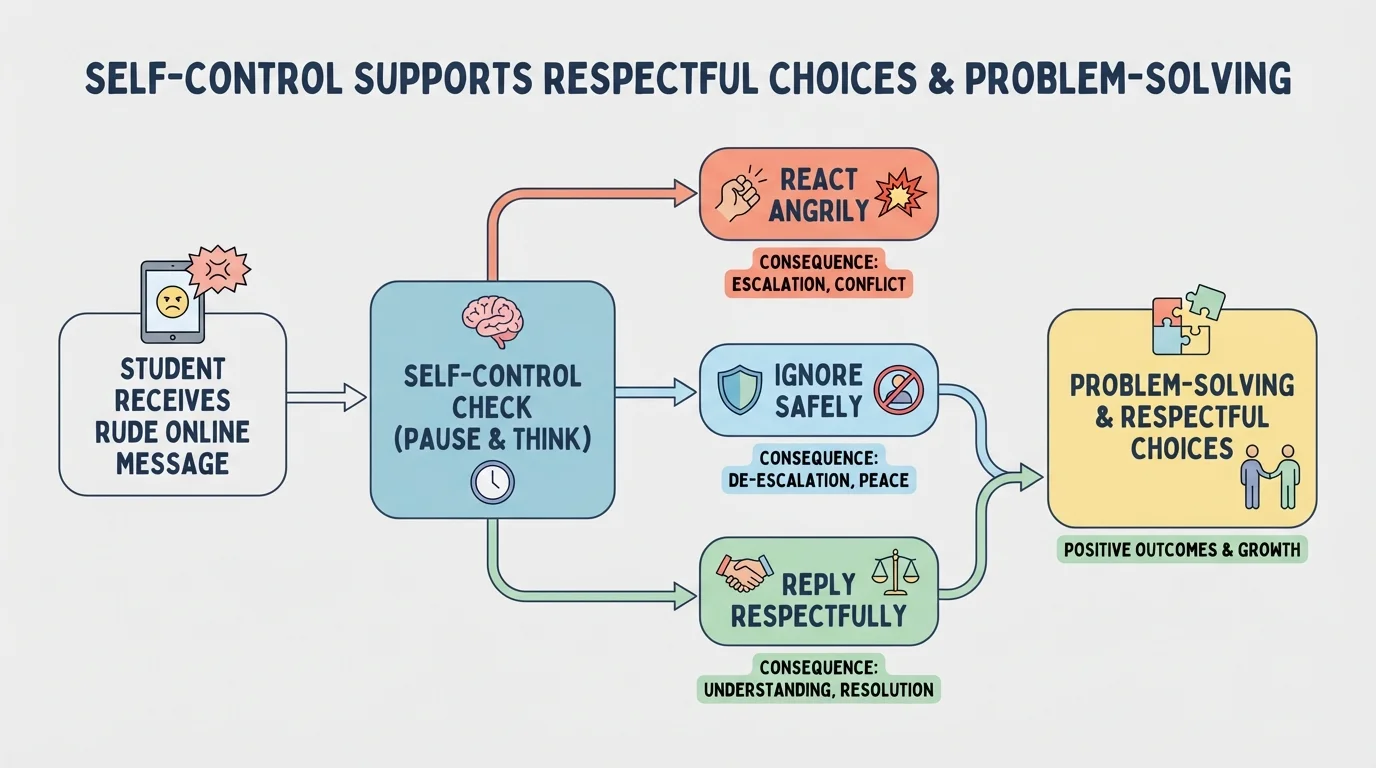
This is where self-control becomes very important. If you act before thinking, you may never reach the best solution. Self-control creates the small pause that makes problem-solving possible.
| Choice | What might happen next? |
|---|---|
| Yell back | The other person may yell more, and the problem may grow. |
| Pause and ask a calm question | You may learn what really happened and fix the misunderstanding. |
| Walk away for a short break | You may calm down and return ready to solve the problem. |
| Ask a trusted adult for help | You may get support with a problem that feels too big to handle alone. |
Table 1. Examples of choices and possible consequences during a conflict.
When you study the choices in the table and compare them with the paths in [Figure 3], you can see a clear pattern: calmer choices usually lead to calmer results.
Pause first, solve second
Self-control and problem-solving work as a team. Self-control helps you pause, and problem-solving helps you decide what to do. If you skip the pause, your feelings may choose for you. If you pause, your brain has time to look for a better answer.
This does not mean every problem will be easy. Some problems are unfair, and some are upsetting. But even in hard situations, pausing gives you more power over your own actions.
Let's look at some common situations you might face.
Situation 1: A rude message. Someone writes, "That was dumb." Your first reaction may be to type something mean back. Self-control helps you stop, breathe, and ask, "Should I answer, ignore, block, or tell an adult?" A respectful choice might be, "That comment was not kind. I'm leaving this chat now."
Situation 2: Losing a game. You lose and feel embarrassed. You want to blame your teammate. Self-control helps you notice your tight jaw and angry thoughts. Instead of blaming, you might say, "I'm frustrated. I need a short break."
Situation 3: Being told no. Maybe you want more screen time, but an adult says no. Self-control helps you avoid whining, yelling, or stomping away. A respectful response might be, "I'm disappointed. Can I have more time tomorrow?"
Situation 4: Hard schoolwork. You cannot figure out an assignment, and you feel like giving up. Self-control helps you keep from tearing up the paper or shutting the computer in anger. A better problem-solving choice is to ask for help, take a short break, or try one small part first.
Case study: homework frustration
You are doing online school, and a math page feels confusing. You want to quit.
Step 1: Notice the clues
Your shoulders feel tight, and you feel grumpy.
Step 2: Use self-control
You stop, breathe slowly, and say, "I feel frustrated."
Step 3: Solve the problem
You choose one helpful action: reread directions, ask an adult, message your teacher, or complete one easy question first.
Self-control keeps frustration from turning into quitting.
Each of these situations shows the same truth: feelings are normal, but you still get to choose your actions.
Self-control gets stronger with practice. You do not need to wait for a huge problem to work on it. Small daily habits can help a lot.
Try these habits:
You can also make a short reminder for yourself: "Pause. Breathe. Think. Choose." Put it near your desk or device. That way, when a hard moment comes, you have a clear plan ready.
Everyone makes mistakes. A mistake does not erase your progress. If you lose control, you can still calm down, apologize, and make a better choice next time.
Consequences are a big part of learning self-control. A consequence is what happens after a choice. When you begin to think ahead and ask, "What will happen next?" you become a stronger problem-solver and a more respectful person.
Another useful word is impulse. An impulse is the sudden urge to do something right away. Not every impulse is bad, but when you are upset, following the first impulse can lead to trouble. Self-control helps you wait long enough to decide if the impulse is a good idea.
If your choice hurts someone, self-control can help after the mistake too. You can stop, admit what happened, apologize, and repair the problem. That is also part of being respectful and responsible.
The more you practice self-control, the more ready you are for real life. You become someone who can stay calmer during problems, treat people with respect, and choose actions that actually help.
