Sometimes life changes fast. A pet dies. A friend moves away. A parent gets a new job. A plan you were excited about gets canceled. Hard things can make your heart feel heavy, your stomach feel tight, or your mind feel busy. The important thing to know is this: you are not "wrong" for having big feelings. Big feelings are part of being human, and you can learn healthy ways to handle them.
When something sad, scary, or different happens, you might feel grief, anger, worry, confusion, or even nothing at first. You may cry more, get quiet, feel cranky, or want extra hugs. Some kids feel one emotion at a time. Others feel many emotions in the same day. That is normal too.
Loss means something important is gone or changed. It could be the death of a pet, less time with someone you love, losing a favorite routine, or not being able to do something you planned. Change means something becomes different. Some changes are good, some are hard, and some are both at the same time.
Loss is when something important to you is gone or not the same anymore.
Change is when part of life becomes different.
Difficult life events are hard experiences that can affect your feelings, thoughts, and daily routine.
You do not need to "fix" every feeling right away. Feelings are signals. They tell you that something matters. What matters most is what you do with those feelings. Healthy coping means choosing safe, caring actions that help you get through a hard time.
Hard situations can look different from one person to another. You might be coping with a family move, a new baby at home, a grown-up being sick, parents living in different homes, a friendship problem, a pet dying, or a change in schedule. Even smaller changes, like a favorite club ending or a long trip being canceled, can feel big when they matter to you.
Because you learn from home, some hard changes may happen online or from far away. A friend may stop joining a gaming group or video chat. A grandparent may live in another city. A family member may be in the hospital and only talk by phone or video call. These experiences still count. If your heart feels hurt, the event is important.
Your body can react to strong emotions even when you do not have words for them yet. You might feel tired, get headaches, lose your appetite, or have trouble sleeping when life feels hard.
Sometimes kids think, "Other people have bigger problems, so mine should not matter." But pain is not a contest. What matters is noticing how you feel and using healthy ways to care for yourself.
Think of coping skills like tools in a toolbox. The coping tools in [Figure 1] help in different ways: some calm your body, some help your mind, and some help you connect with people who care about you. You do not need just one tool. You can try more than one.
Name the feeling. Try saying, "I feel sad," "I feel worried," or "I feel mad because things changed." When you name a feeling, it often becomes easier to handle. Instead of one big messy feeling, your brain starts to understand what is going on.
Breathe slowly. Take a slow breath in through your nose, then breathe out gently. You can count slowly to help: breathe in for '4' and out for '5' if that feels comfortable. The exact number does not have to be perfect. Slow breathing tells your body that you are safe enough to calm down.
Talk to someone safe. A parent, grandparent, older sibling, counselor, coach, or family friend can listen. You can talk in person at home, on the phone, or on a video call. If saying it out loud feels hard, you can type a message like, "I'm having a hard day and want to talk."
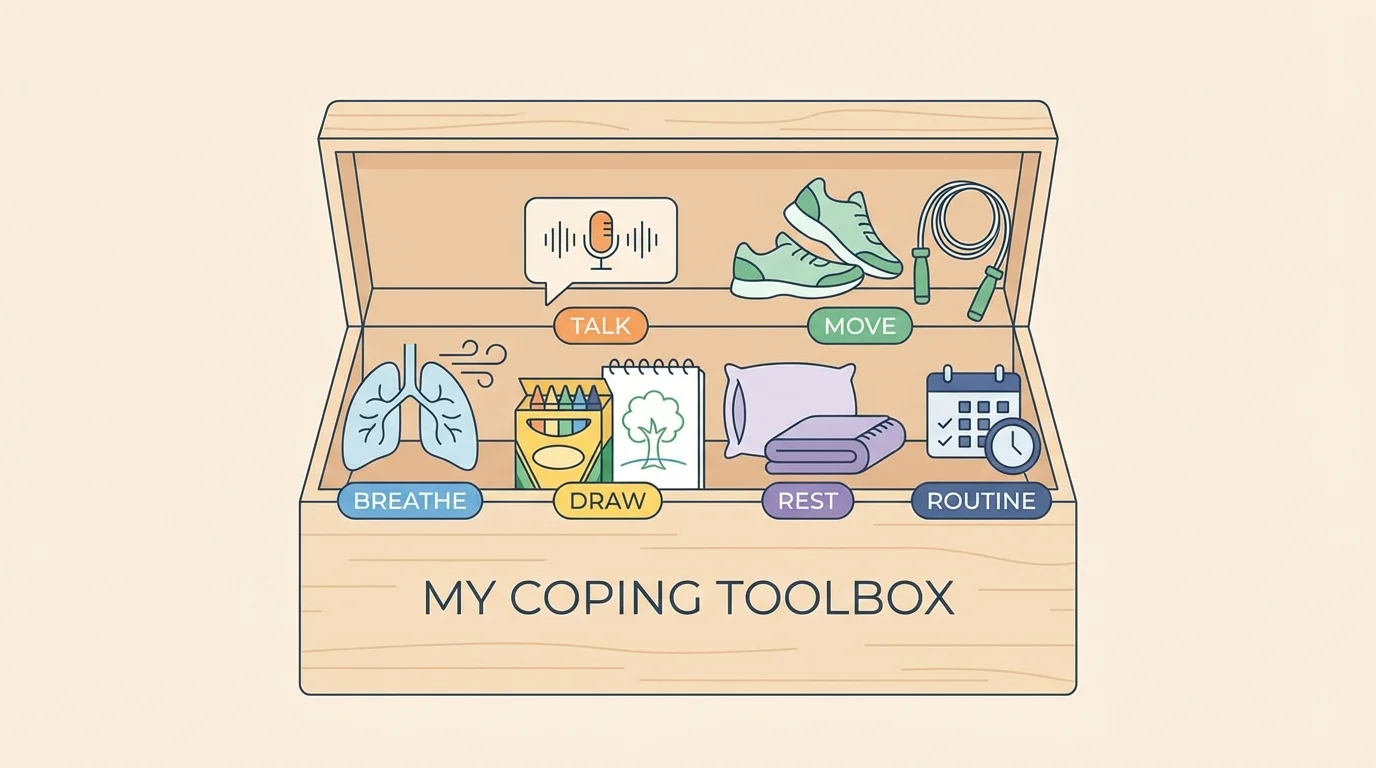
Use creative expression. Draw your feeling, write in a notebook, color, build with blocks, play music, or tell a story. Creative activities help your brain let feelings out in a safe way.
Move your body. Walk outside, stretch, dance to a song, toss a ball, or do jumping jacks. Movement can lower stress and help you feel less stuck. If your feelings are very big, movement is often more helpful than sitting and trying not to think about them.
Keep a simple routine. Routines can feel comforting when life seems uncertain. Waking up, eating, learning, resting, and going to bed at regular times can help your brain feel steadier. This is one way to build resilience, which means getting through hard times and slowly bouncing back.
Why coping skills work
Your brain and body work together. When you breathe slowly, move safely, rest, talk, or create something, you send your brain a message that says, "I can handle this moment." Healthy coping does not erase sadness or make hard events fair, but it helps you stay safe and supported while you heal.
Rest and basic care matter too. Drink water, eat regular meals, get sleep, and spend some time away from screens if they are making you feel worse. When your body is cared for, handling emotions becomes easier.
Later, when you need to choose a coping skill, remember the toolbox in [Figure 1]. If talking feels too hard first, you might begin with breathing or drawing, then talk to someone after you feel a little calmer.
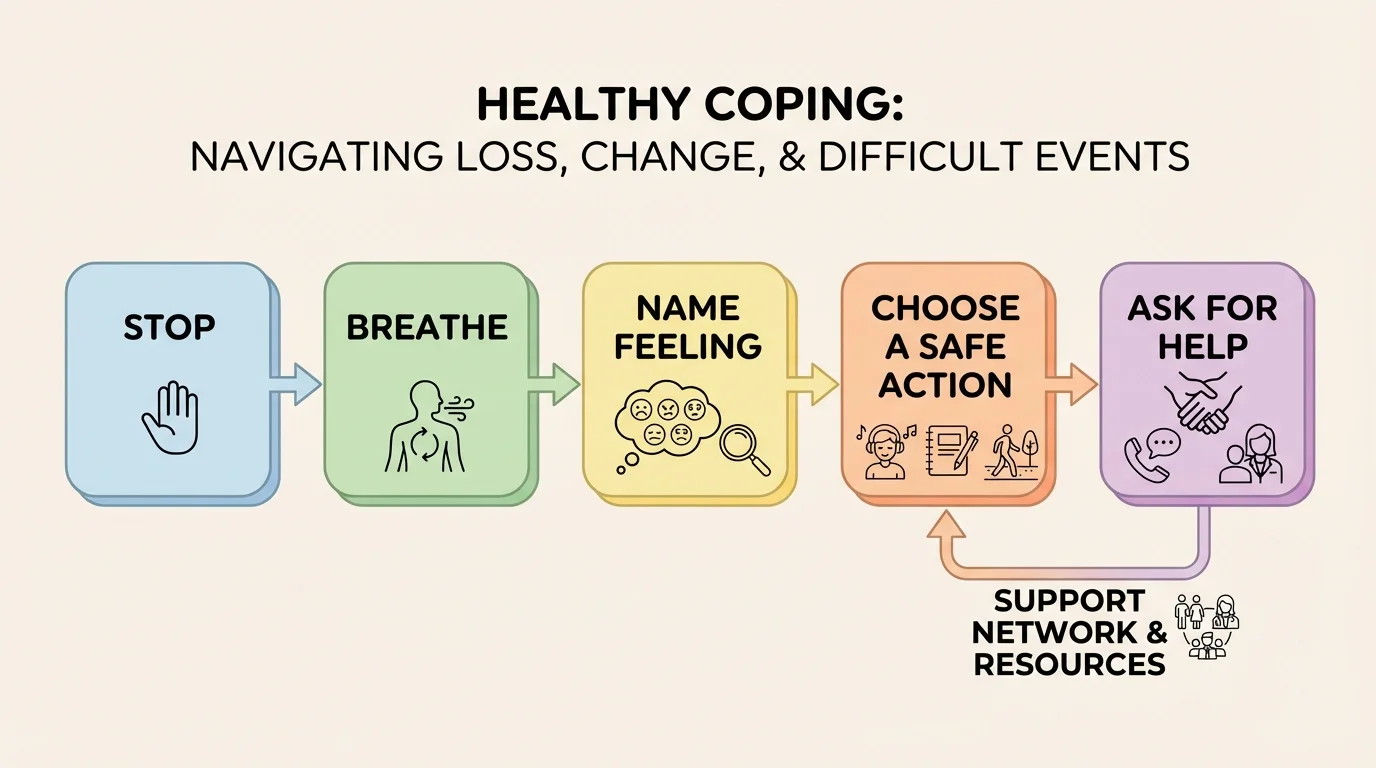
When feelings get very big, it helps to have a plan ready before the next hard moment. The step-by-step plan in [Figure 2] gives your brain something simple to do when you feel upset, scared, or overwhelmed.
Use these steps when you notice signs like crying hard, yelling, hiding, feeling shaky, or thinking, "I can't do this." A plan does not have to be fancy. It just has to be clear enough to remember.
Step 1: Stop and notice. Say to yourself, "I am having a big feeling."
Step 2: Breathe slowly three times. Put one hand on your belly if that helps you feel your breaths.
Step 3: Name the feeling. Try, "I feel sad," "I feel worried," or "I miss how things used to be."
Step 4: Choose one safe action. You can hug a pillow, get a drink of water, draw, step outside with an adult, or ask for a quiet break.
Step 5: Tell a trusted adult what you need. You can say, "Please stay with me," "Can we talk?" or "I need help calming down."
Using the calm-down plan
Your cousin moved away, and now you feel upset after seeing old photos.
Step 1: You notice tears and a tight chest, so you tell yourself, "I'm having a big feeling."
Step 2: You take three slow breaths and sit in a cozy spot.
Step 3: You name the feeling: "I feel sad and I miss my cousin."
Step 4: You choose a safe action: draw a picture for your cousin.
Step 5: You ask a grown-up, "Can you help me send this picture in a message?"
You are still sad, but you are handling the sadness in a healthy way.
The calm-down steps in [Figure 2] are also useful when change is not sad but still stressful, like starting a new activity, adjusting to a different family schedule, or hearing upsetting news.
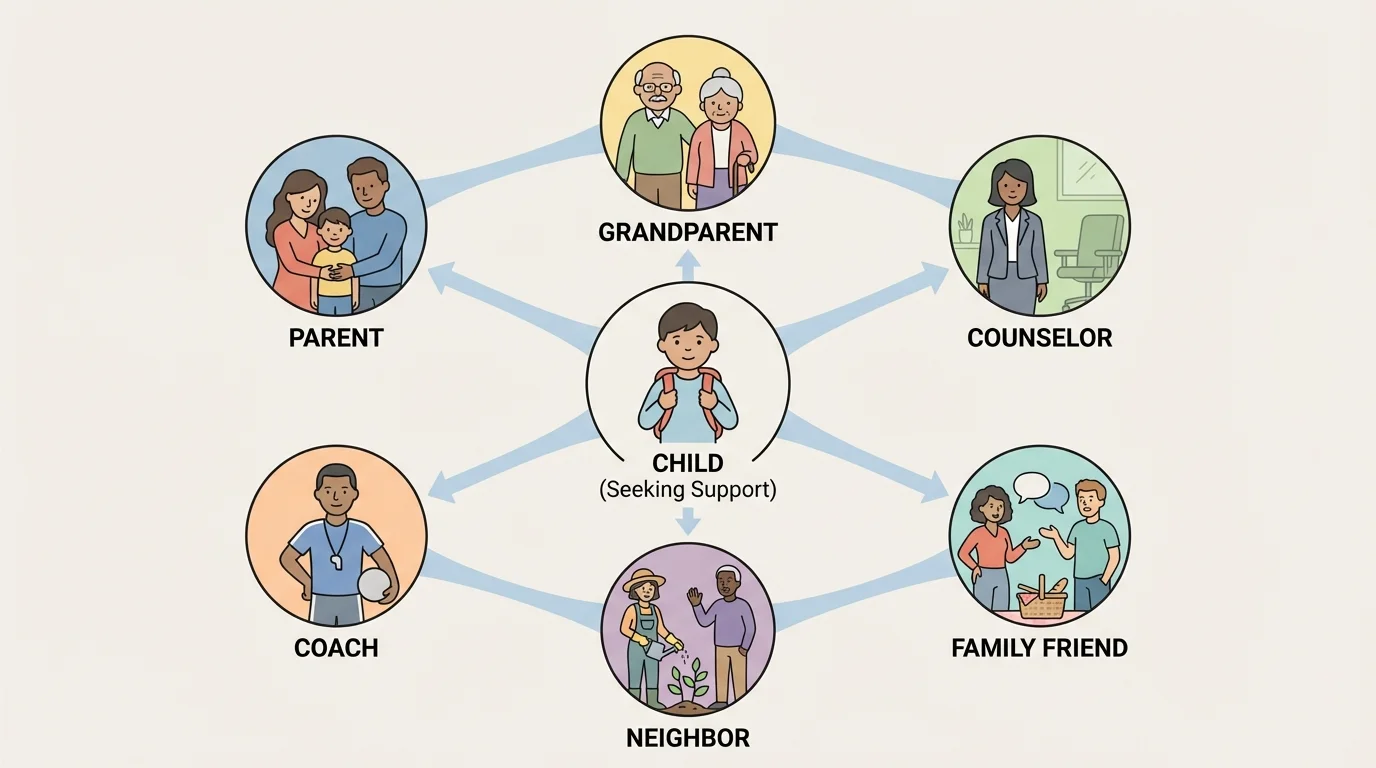
No one is supposed to handle every hard thing alone. Support can come from a circle of trusted adults. A trusted adult is someone safe who listens, cares, and tries to help you.
Your trusted adults might include a parent, grandparent, aunt, uncle, neighbor, counselor, doctor, coach, faith leader, or close family friend. [Figure 3] shows how support can come from several safe people. It is smart to know more than one safe person, because sometimes your first choice may be busy.
You can ask for help with simple words. Try one of these:
If you feel unsafe, if someone is hurting you, or if you are having thoughts about hurting yourself, tell a trusted adult right away. Keep telling safe adults until someone helps. In emergencies, adults should contact emergency services right away.
"Being brave does not mean doing everything alone."
Later, when you think about who to contact first, the support circle in [Figure 3] can help you remember that help may come from several caring people, not just one.
Not every action that feels good for one minute is good for you in the long run. Healthy coping helps you feel better without causing more problems. Unhealthy coping may hide feelings for a short time, but it often makes things worse later.
| Healthy coping | Why it helps | Unhealthy coping | Why it can cause problems |
|---|---|---|---|
| Talking to a safe person | You get support and feel less alone | Keeping everything secret all the time | Feelings can build up and get heavier |
| Drawing, writing, or making music | You express feelings safely | Breaking things or yelling at others | People get hurt and problems grow |
| Walking, stretching, or playing outside | Your body releases stress | Staying upset on purpose by replaying hurtful thoughts | You may feel worse and more stuck |
| Taking a break from screens | Your mind gets space to reset | Watching upsetting videos over and over | Stress and worry may increase |
| Keeping routines like sleep and meals | Your body and brain feel steadier | Skipping sleep, meals, or basic care | Big feelings become harder to manage |
Table 1. Comparison of healthy and unhealthy ways to cope with hard feelings.
Sometimes unhealthy choices happen because a person feels overwhelmed, not because they are "bad." If you make an unhealthy choice, you can still stop, repair the problem, and choose a better next step. Everyone is learning.
Repairing after an unhealthy choice
You get upset about bad news and snap at your brother during a video game.
Step 1: Calm your body with breathing or a short break.
Step 2: Say what happened honestly: "I was upset and I yelled."
Step 3: Repair it: "I'm sorry. I'm going to take a walk and calm down."
Step 4: Use a healthy coping skill next.
Mistakes do not erase your ability to make healthy choices.
Because you learn online, some losses and changes may happen through screens. Maybe a friend stops replying to messages. Maybe a group chat changes. Maybe someone you care about moves far away. These situations are real, and they can hurt.
Healthy coping online means being thoughtful. If a message upsets you, do not answer right away while emotions are hot. Use your calm-down plan first. Then decide whether to send a kind message, ask an adult for help, or take space from the conversation.
You can also stay connected in healthy ways. Schedule a video call with a relative. Send a voice message to a friend. Share a drawing, photo, or short note. When a relationship changes, small acts of connection can still bring comfort.
You already know that words matter. The same is true online. Kind, honest communication helps relationships feel safer during stressful times.
If being online makes you feel worse, tell an adult. Sometimes the best coping choice is less screen time and more real rest, movement, or quiet time at home.
A coping strategy gets stronger with practice. You may not feel better all at once. Healing often happens slowly. Some days will feel easier, and some days may feel hard again. That does not mean you are going backward. It means you are human.
One helpful habit is to notice what supports you. You might keep a small list called "Things That Help Me." It could include: hugging my dog, talking to Grandma, sitting under a blanket, drawing comics, walking outside, or listening to calm music. Keeping your own list makes healthy choices easier to remember when emotions are big.
Resilience grows from small actions
Resilience is not pretending everything is fine. It is using support, skills, and hope to keep going. Every time you breathe instead of explode, talk instead of hide forever, or ask for help instead of staying alone, you strengthen resilience.
You can also remind yourself of true, helpful thoughts: "This is hard, but I am not alone." "My feelings will not stay this strong forever." "I can take one safe step at a time." These thoughts are not magic, but they can guide your next action.
Some losses stay important for a long time. Missing someone or something does not mean you are doing coping "wrong." Love and sadness can exist together. You can remember, miss, and still keep living your life.
Try This: Pick three coping tools you want in your personal toolbox this week. Write them on a card or note: one tool for your body, one for your feelings, and one person you can contact for support.
