Have you ever sent a short message like "Fine." and meant one thing, but the other person thought you were upset? That happens a lot. When we cannot see everything another person is thinking or feeling, we may guess wrong. A wrong guess can lead to hurt feelings, arguments, or teamwork problems. A better guess can lead to kindness, trust, and smoother teamwork.
When you play a game online, talk with family, join a club, or work with others on a video call, you bring your own thoughts and feelings with you. So does everyone else. Sometimes you feel excited while another person feels nervous. Sometimes you think a joke is funny while another person feels left out. If you only think about your own side, you may miss what is happening for someone else.
Perspective-taking is a social-emotional skill that helps you slow down and think, "What might this be like for the other person?" It does not mean you must agree with them. It means you try to understand their point of view before you react. That small pause can stop a lot of hurt before it starts.
Perspective-taking means trying to understand another person's thoughts, feelings, or situation. Empathy means caring about how someone else feels. Perspective-taking helps you build empathy, and empathy helps you choose kinder actions.
When people feel understood, they are more likely to stay calm, listen, and cooperate. When people feel ignored, they may shut down, get mad, or stop helping. That is why perspective-taking is such an important teamwork skill.
You see the world through your own eyes. That is normal. But other people do not have your exact day, thoughts, body, or experiences. A friend may seem quiet in a group chat not because they are rude, but because they are shy or tired. A sibling may snap at you not because they dislike you, but because they are frustrated about something else.
Perspective-taking asks you to look past the first guess. Your first guess might be, "They are ignoring me." A second, smarter guess might be, "Maybe they are busy, confused, or feeling upset." This second guess gives you more choices. Instead of reacting fast, you can ask a question, wait calmly, or answer with kindness.
This skill is especially helpful online. [Figure 1] In person, people may notice more body language. Online, you may only see words on a screen or a face in a small box. That means misunderstandings can happen more easily.
Short text messages can be read in many different ways. The exact same words may sound cheerful, annoyed, or worried depending on timing, punctuation, and what happened before.
Perspective-taking also helps you be fair. Maybe you finish work quickly, but someone else needs more time. Maybe you love talking, but someone else shares ideas best after thinking quietly first. A fair team does not expect everyone to be exactly the same.
To understand someone else better, look for clues in their words, voice, face, and situation. These clues do not tell you everything, but they help you make a kinder guess.
Start with words. If someone writes, "I don't get it," they may need help. If they write, "Whatever," they may be annoyed, embarrassed, or simply tired. Next, notice tone of voice on calls. A shaky or quiet voice may mean nervousness. A loud voice may mean excitement or frustration. Then notice facial expressions if you can see them. Eyes looking down, a tight mouth, or a frown can all give useful hints.
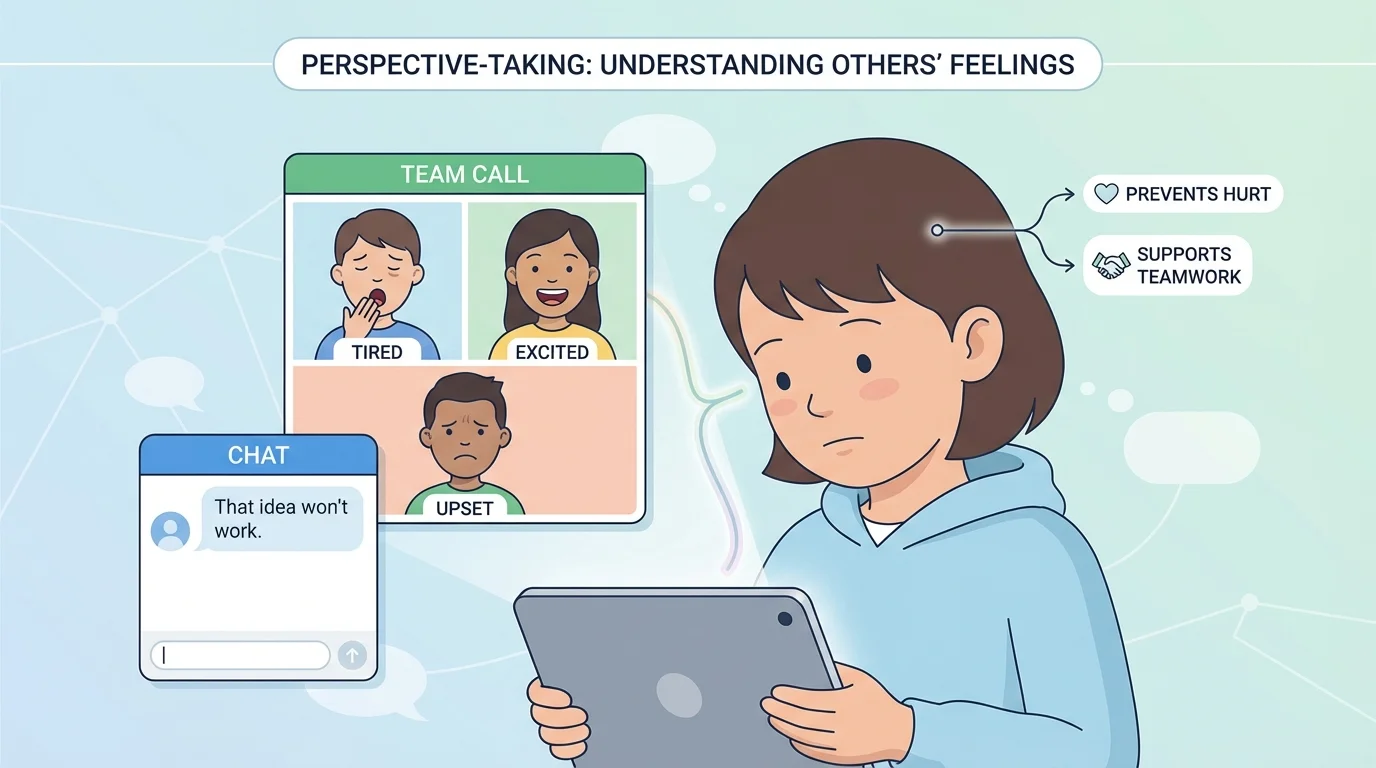
Now think about the situation. Did the person just lose a game? Are they new to the group? Did they say they had a hard day? Context matters. If your teammate joins the call late and looks worried, that is different from a teammate who joins late and laughs about not caring.
Be careful, though. Clues help, but they are not magic. You cannot read minds. Good perspective-taking includes guessing gently and checking kindly. You might say, "You seem quiet today. Are you okay?" or "Did my message sound bossy? I want to be helpful."
That checking step matters because people are not always what they seem. As seen earlier in [Figure 1], the same short message can match different feelings, so asking instead of assuming is usually the safest choice.
[Figure 2] You do not need a complicated plan. A simple routine works well and has four parts: pause, notice, wonder, and respond kindly. You can use these steps with friends, family, teammates, and people in your community.
Step 1: Pause. Do not answer right away when you feel annoyed, hurt, or confused. A short pause gives your brain time to think instead of just react.
Step 2: Notice. Look for clues. What words did the person use? What is their tone? What just happened? What do you know about their situation?
Step 3: Wonder. Ask yourself, "What else could be true?" Maybe they are worried. Maybe they did not understand. Maybe they felt left out. Maybe they are having a rough day.
Step 4: Respond kindly. Choose words that are calm, clear, and respectful. Ask a question. Offer help. Explain your own feelings without blaming.
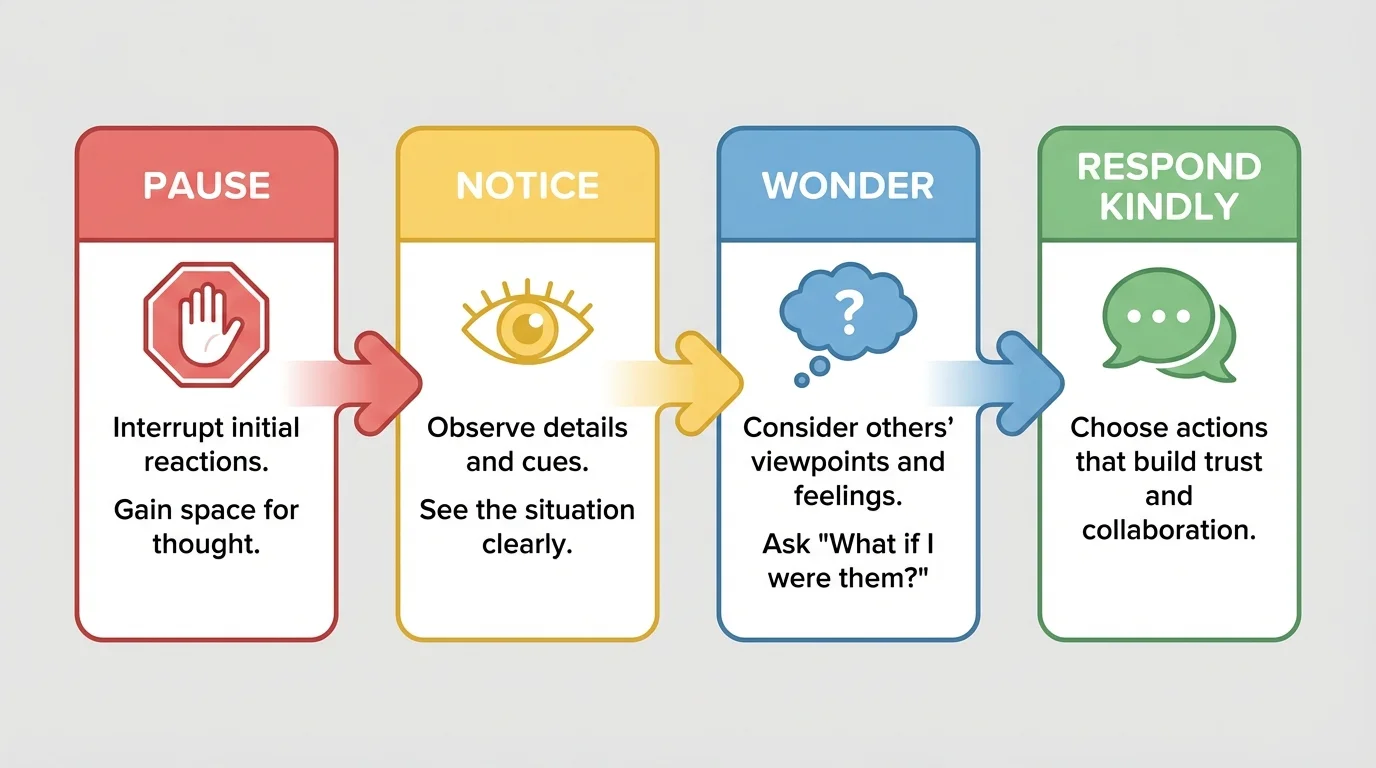
This four-step routine is useful because it keeps you from jumping to the meanest explanation. Many hurtful moments begin with a fast thought like, "They did that on purpose." Sometimes that is true, but many times it is not.
Example: A confusing team message
You send an idea in a group chat. Another student replies, "That won't work." You feel upset.
Step 1: Pause
Instead of typing back, "You're rude," take a breath and wait a moment.
Step 2: Notice
The reply is short. You cannot hear tone. Maybe the student is in a hurry.
Step 3: Wonder
Maybe they saw a problem but did not explain it well. Maybe they are stressed. Maybe they are not trying to be unkind.
Step 4: Respond kindly
You can write, "Can you explain what part might be hard? Maybe we can fix it together."
This response protects feelings and keeps the team focused on solving the problem.
You can even use this process when you are the one who made the mistake. If someone looks hurt after your joke, pause and wonder how it sounded to them. Then respond with care: "I'm sorry. I meant it as a joke, but I can see it felt hurtful."
Hurt often happens when people feel ignored, laughed at, blamed, or left out. Perspective-taking can stop each of those problems before they grow bigger.
For example, suppose your friend does not answer your message for a while. If you assume, "They do not care about me," you may send an angry reply. That can hurt both of you. But if you take perspective, you might think, "Maybe they are busy or offline." Then you can wait, or send a calm message later.
Another example: during an online game, one player keeps missing turns. A quick reaction might be, "Come on, you're ruining it." A better response might be, "Do you need me to explain the rules again?" The first response shames the player. The second response helps them and protects their feelings.
Perspective-taking is also important with jokes. A joke that feels silly to you may feel mean to someone else. Before posting, ask yourself: "How would I feel if this were about me?" If the answer is "embarrassed" or "left out," it is smarter not to post it.
Why a small pause matters
When feelings get big, people often react fast. A pause creates space between the feeling and the action. In that space, you can remember that other people have feelings and reasons too. That space is where kinder choices begin.
Sometimes perspective-taking prevents hurt by helping you explain your own side more gently. Instead of saying, "You never listen," you can say, "I feel frustrated when I do not get a turn to speak." That tells the truth without attacking the other person.
[Figure 3] Good teamwork is not just about finishing a task. It is about working together in a way that helps everyone contribute. Teams do better when they consider each person's point of view.
Maybe one teammate is great at drawing, another is good at reading directions, another likes speaking, and another prefers checking details. Perspective-taking helps the team notice these differences and use them wisely instead of forcing everyone into the same job.
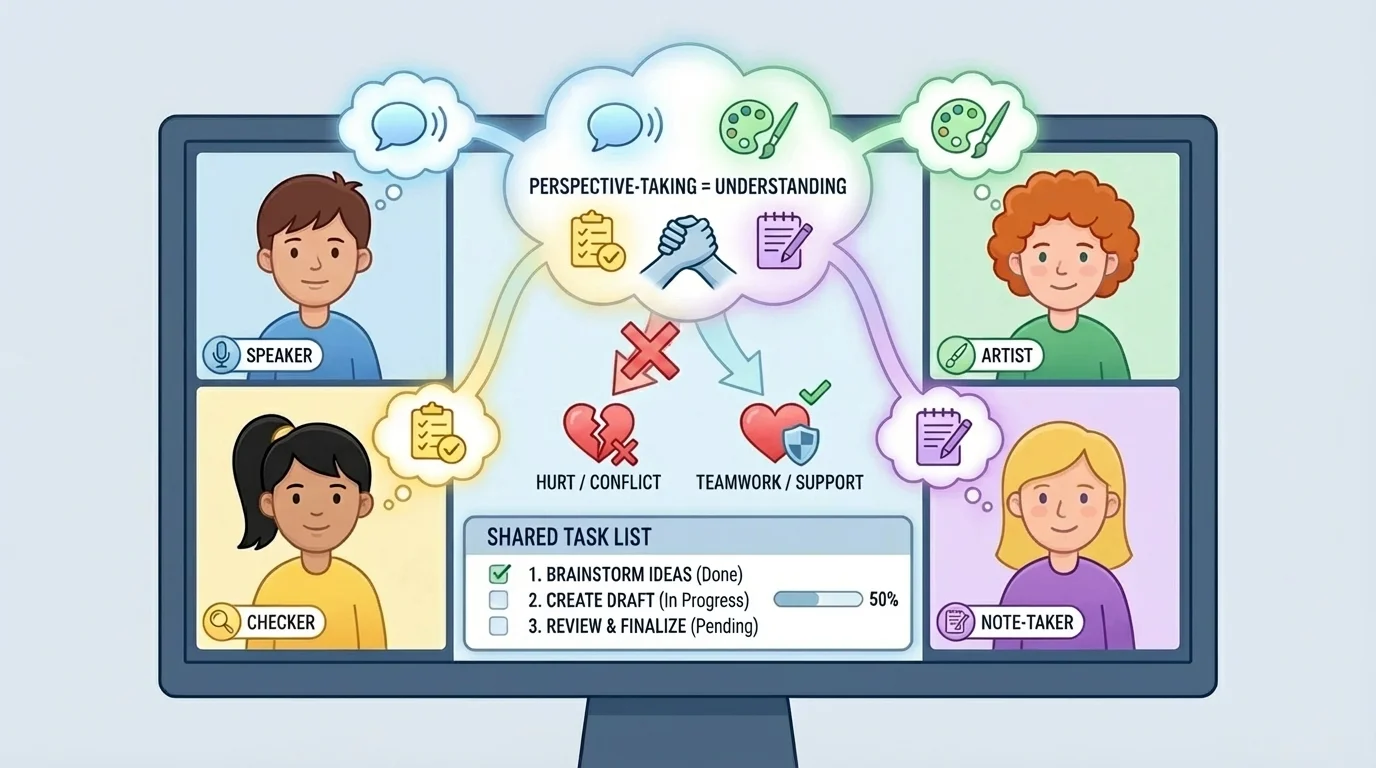
It also helps with timing and fairness. If one person needs directions explained clearly, a good teammate does not roll their eyes. They slow down. If another person has an idea that sounds different, a good teammate listens before saying no.
Teams with perspective-taking often do these things:
Without perspective-taking, teamwork can fall apart fast. One person may take over. Another may stop talking. Someone may feel their ideas do not matter. Then the team may argue or do weak work because people are upset.
With perspective-taking, you build trust. Trust means people believe they will be treated with respect. When trust grows, people share better ideas, ask for help sooner, and keep trying when a task is hard. That is why the teamwork scene in [Figure 3] matters so much: the best plan is not just fast, but fair and thoughtful.
| When perspective-taking is used | What often happens |
|---|---|
| Someone is confused | A teammate explains kindly |
| Someone is quiet | The group invites them to share |
| People disagree | They ask questions and look for a solution |
| Jobs need to be shared | Roles match strengths and needs |
| A mistake happens | The team fixes it without shaming |
Table 1. Examples of how perspective-taking supports stronger teamwork.
Perspective-taking does not mean you always say yes. Sometimes you will still disagree, and that is okay. The goal is not to erase your own thoughts. The goal is to understand the other side well enough to answer respectfully.
You can say things like, "I see why you think that," "I understand you're worried about time," or "I get that you wanted a turn too." Then you can add your own idea: "I still think this plan might work better because..." This keeps the conversation calm.
It is also okay to have boundaries. If someone is unkind again and again, perspective-taking does not mean you must accept hurtful behavior. You can understand that they may be upset and still say, "I want to talk when we can both be respectful." That is empathy with self-respect.
"Try to understand before you try to win."
— A strong teamwork rule
Respectful disagreement is powerful because it keeps a problem from turning into a personal fight. You stay focused on the issue, not on insulting the person.
Perspective-taking gets stronger with practice. You do not have to be perfect. You just need to keep trying in small moments every day.
Here are a few habits that help:
You can also practice by thinking about stories, shows, or real situations. Ask yourself what each person may be feeling and why. This builds your empathy and helps you make wiser choices in real life.
Over time, perspective-taking can become one of your strongest people skills. It helps you make safer guesses, use kinder words, avoid unnecessary hurt, and become a teammate others trust. That matters at home, online, in clubs, on teams, and in your community.
