One short message can change a whole day. If you text, "Thanks for helping me," the other person may feel happy and close to you. If you text, "Whatever," the same person may feel hurt or angry. That is because communication is not just about words. It is also about your tone, your timing, your body language on video, and even whether you answer at all. The choices you make when you communicate can help people trust you, work with you, and solve problems with you.
Every day, you make communication choices at home, in online classes, in clubs, in games, and in your neighborhood. You choose whether to listen or interrupt. You choose whether to be clear or confusing. You choose whether to be kind or unkind. These choices have real results. Good communication often leads to stronger friendships, smoother teamwork, and smaller arguments. Poor communication often leads to hurt feelings, mistakes, and bigger conflicts.
Communication is the way people share thoughts, feelings, needs, and ideas. It can happen by talking, typing, writing, facial expressions, gestures, and even silence.
Trust means people believe you are honest, kind, and dependable.
Conflict is a disagreement or problem between people.
When you understand how communication works, you can make smarter choices. You cannot control every situation, but you can control many of your own words and actions. That gives you power to build better relationships.
Communication is like a bridge between people. [Figure 1] A strong bridge helps ideas and feelings travel safely. A weak bridge makes things fall apart. If you speak clearly, listen carefully, and show respect, your bridge gets stronger. If you shout, ignore, blame, or send confusing messages, your bridge gets shaky.
Your communication choices matter even more online because people cannot always hear your tone or see your face. [Figure 2] A short text might seem angry when you only meant to be quick. A message with no reply might make someone think you do not care. That is why being clear and thoughtful is such an important life skill.
Many arguments start because one person misunderstands what another person meant. The problem is not always the topic itself. Sometimes it is the way the message was shared.
Think about the difference between these two replies to a family member: "I can help after I finish this," and "Not now." Both may mean you are busy, but one sounds respectful and clear, and the other can sound sharp. Small changes in wording can create very different feelings.
Trust grows when your communication shows that you are honest, respectful, and dependable. People trust you more when your words match your actions. If you say, "I will send the picture by tonight," and then you do it, people learn that they can count on you. If you make promises and do not follow through, trust gets weaker.
Trust also grows when you listen. Listening means you do not just wait for your turn to talk. You pay attention, think about what the other person is saying, and respond to what they actually said. When people feel heard, they feel respected. Respect is one of the roots of trust.
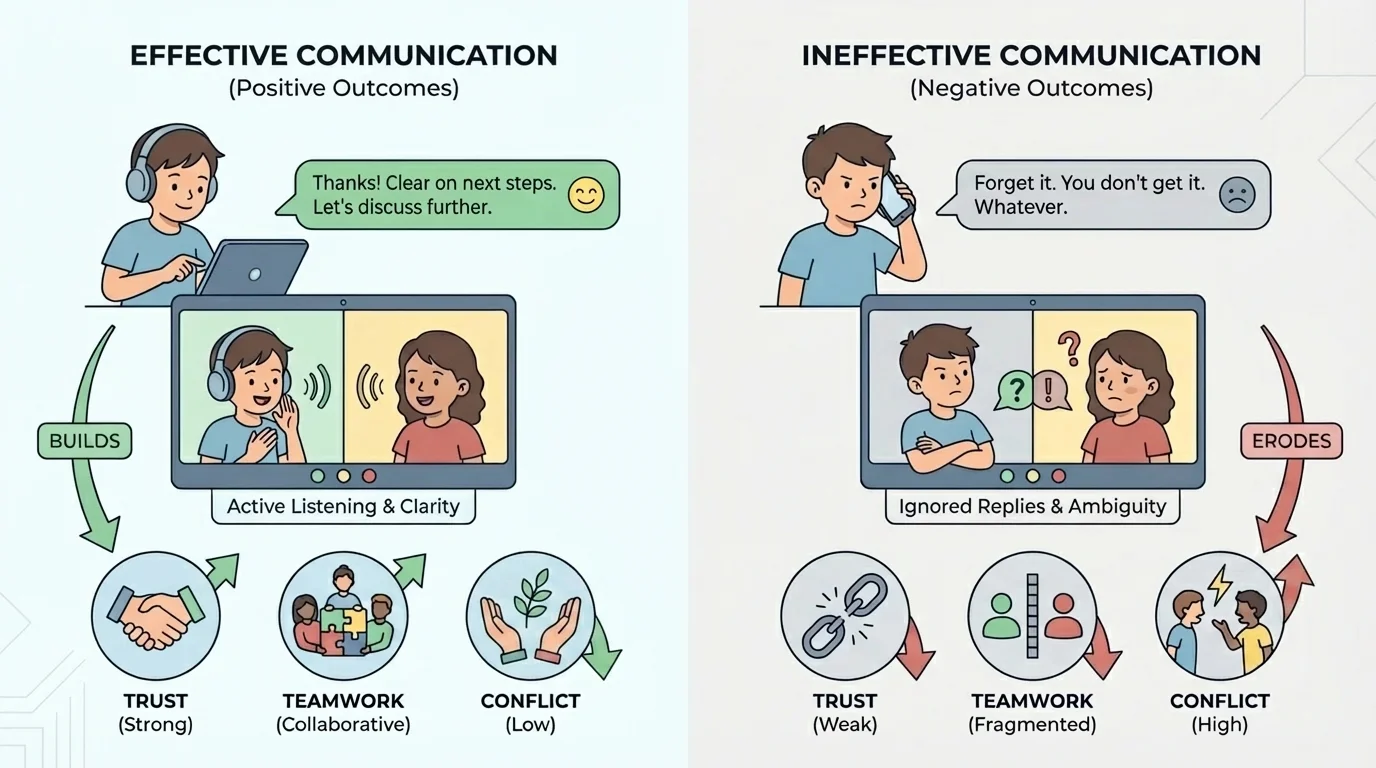
Another trust-builder is honesty. Honest communication does not mean saying every thought in a harsh way. It means telling the truth kindly. For example, if a friend asks whether you can join an online game, you can say, "I can't play tonight, but maybe tomorrow." That is better than saying yes and then disappearing. Kind honesty helps people know where they stand.
Trust can be damaged by several common habits:
If someone tells you something private and you spread it around, they may stop trusting you. If you laugh at someone's idea on a video call, they may not want to share with you again. Trust is often built slowly but broken quickly.
Trust example: two ways to respond
Your cousin sends you a message and asks, "Did you finish your part of the shared project?"
Step 1: A trust-breaking response
You answer, "Yeah, sure," but you have not done it. Later, your cousin finds out. Now your cousin may feel worried about working with you again.
Step 2: A trust-building response
You answer, "Not yet. I need 20 more minutes. I'm sorry for the delay." This answer is honest and clear, so your cousin knows what is happening.
The second choice protects trust better because it tells the truth and gives useful information.
Even when you make a mistake, honest words can start repairing trust. Saying, "I forgot, and that was my fault," is often stronger than making excuses. Later in the lesson, we return to this idea from [Figure 1]: trust grows when your message is kind, clear, and consistent.
Teamwork means people work together to reach a shared goal. Communication helps a team know who is doing what, when to do it, and how to help each other. In online group work, family chores, clubs, or community projects, clear communication keeps everyone moving in the same direction.
Good teamwork communication includes several simple habits: taking turns, speaking clearly, asking questions, checking for understanding, and encouraging others. If one person talks over everyone else, the team may miss good ideas. If no one asks questions, people may get confused. If teammates say encouraging things like, "That's a good idea," or "I can help with that part," the group often feels safer and works better.
It also helps when each person knows their job. One person might gather ideas, another might make slides, and another might check spelling. When communication is clear, people know their roles and deadlines. When communication is unclear, jobs can be forgotten or done twice.
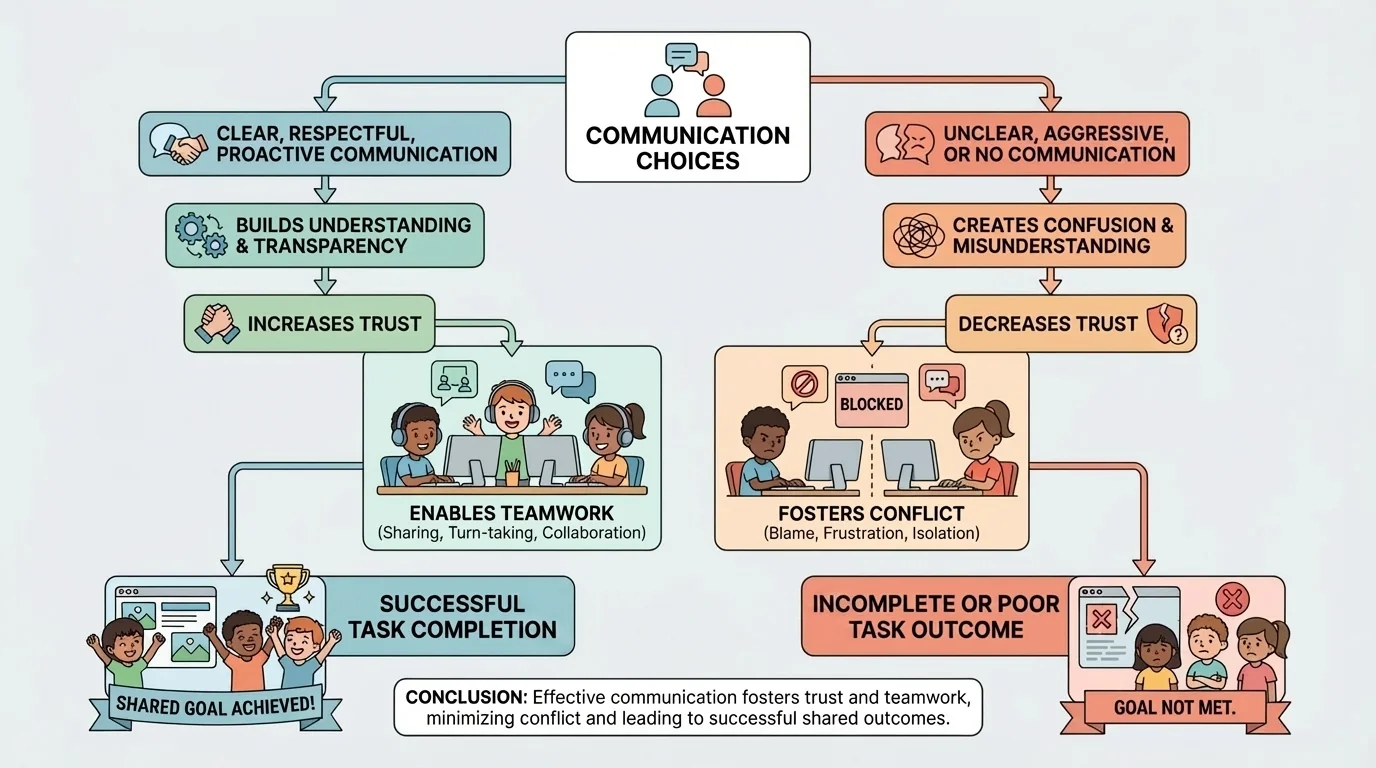
Suppose you are working with two other students on a virtual presentation for an online class. If you say, "You do the pictures, I'll write the first part, and let's meet online at 6:00," your group has a plan. If you only say, "Let's just do it later," your group may end up rushed and frustrated.
Teamwork also gets stronger when you include everyone. That means asking quiet people what they think, not just listening to the loudest voice. Inclusion helps teams because different people notice different things. A team is often stronger when everyone feels welcome to share.
Clear communication makes teamwork easier. When people know the goal, their role, and the next step, they can focus on doing the task instead of guessing. Teams do better when members use simple, direct messages and check that everyone understands.
Sometimes teamwork problems are really communication problems. [Figure 3] If a sibling gets upset during chores, maybe they did not understand the plan. If people in a group chat stop answering, maybe the directions were confusing or sounded bossy. Looking at communication first can solve many teamwork troubles.
| Helpful teamwork choice | What it sounds like | Likely result |
|---|---|---|
| Sharing the plan | "I'll do this part. Can you do that part?" | People know their jobs |
| Asking a question | "Do we all agree on the idea?" | Less confusion |
| Encouraging others | "Nice job. That worked well." | Better effort and mood |
| Listening fully | "Let me hear your idea first." | More teamwork and respect |
Table 1. Examples of communication choices that support teamwork.
Later, when you need to solve disagreements, the teamwork habits in [Figure 2] still matter. Taking turns and making roles clear can stop a small problem from becoming a big one.
Conflict happens when people disagree, feel upset, or want different things. Conflict is a normal part of life. The important question is not whether conflict happens. The important question is how people communicate during it. The same problem can grow or shrink depending on communication choices.
Some choices make conflict bigger. These include interrupting, yelling, blaming, name-calling, rolling your eyes on camera, sending rude texts, or assuming the worst. For example, if your brother uses your headphones without asking and you shout, "You always ruin everything," the problem may spread. Now the conflict is not just about headphones. It is also about hurt feelings.
Other choices make conflict smaller. These include pausing, taking a breath, using a calm voice, saying what happened clearly, and listening to the other side. A better response might be, "I'm upset because you took my headphones without asking. Please ask next time." This message is still honest, but it is less likely to start a bigger fight.
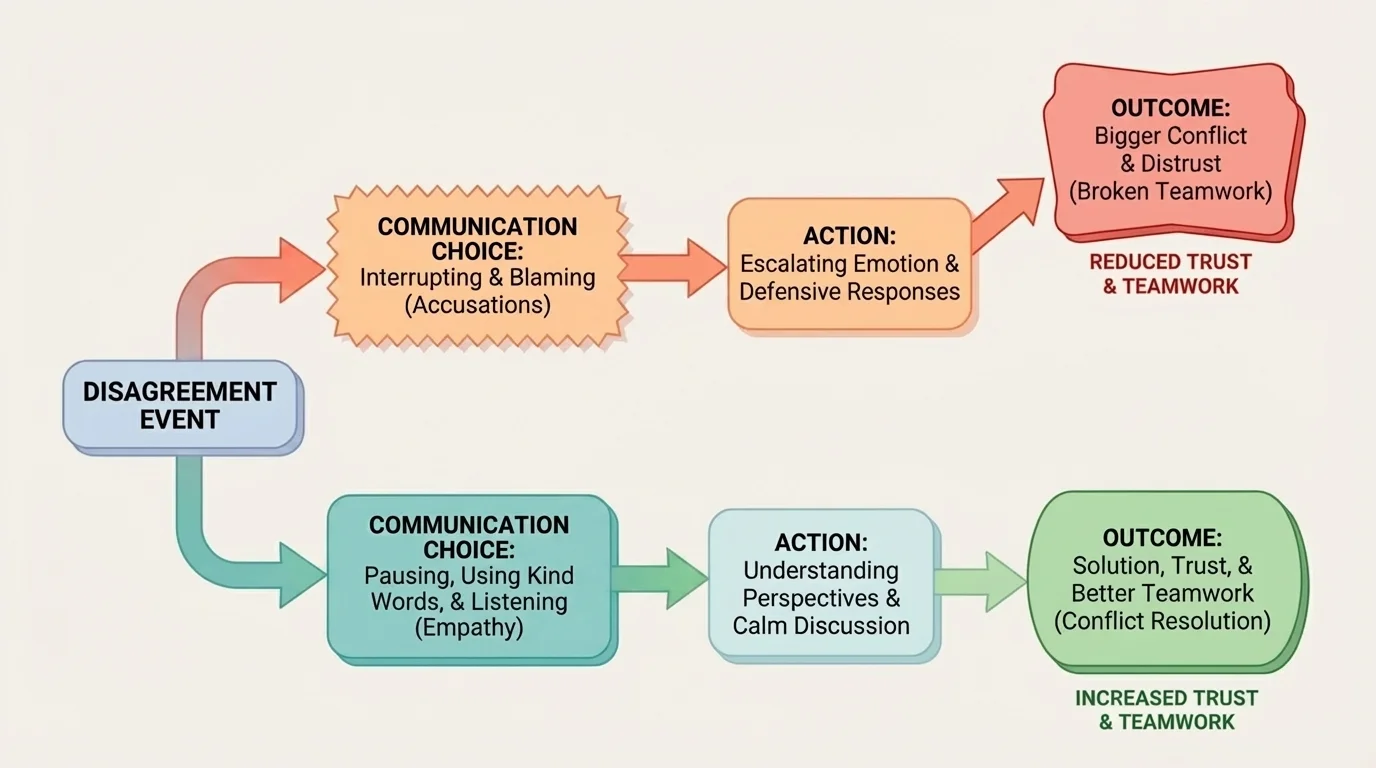
A very helpful tool is the I-message. An I-message starts with your feeling and the problem instead of attacking the other person. For example: "I feel frustrated when the game starts without me because I was still loading." This is usually more helpful than saying, "You never wait because you're rude."
I-message is a calm way to explain your feelings and the problem without blaming. A simple pattern is: "I feel ___ when ___ because ___."
Conflict also grows when people make assumptions. If a friend does not answer your message, you might think, "They are ignoring me." But maybe they are busy, asleep, or away from their device. Asking a calm question is smarter than jumping to a harsh conclusion.
Sometimes the best communication choice is to pause. If your feelings are very big, you may not be ready to talk kindly yet. Taking a short break can help you say what you mean without making things worse. As the calm path in [Figure 3] shows, slowing down often gives you a better chance to solve the problem.
You do not need fancy words to be a strong communicator. You need simple habits that you can use again and again. Here are practical choices that help in real life.
Before you speak or type, pause and ask: Is it true? Is it kind? Is it clear? Is it the right time? If the answer is no, change your message before sending it.
When texting or chatting: read your message once before sending. A short message like "Fine" can sound upset. If needed, add a few words so your meaning is clear: "I'm fine, just busy right now."
During video calls: look at the screen, avoid interrupting, and wait for a turn. Facial expressions matter too. A sigh, eye roll, or laugh at the wrong time can hurt someone, even if you say nothing.
When you disagree: talk about the problem, not the person. "The room is noisy and I can't hear," is more helpful than "You're annoying."
When someone else is speaking: show you are listening. You can nod, say "okay," or repeat the main idea: "So you want to switch turns after this round?" That helps prevent misunderstandings.
Remember: feelings are real, but feelings do not have to control your words. You can feel angry and still choose calm communication.
These habits support trust, teamwork, and conflict-solving all at once. Clear words help people know what you mean. Kind words help people feel safe. Honest words help people believe you. Those three things often work together.
Even good communicators mess up sometimes. You may send a sharp text, interrupt someone, or misunderstand what they meant. What matters next is how you repair the problem.
Step 1: Stop and notice what happened. Did the other person go quiet? Did they look hurt? Did the chat suddenly get tense? Those are clues that something went wrong.
Step 2: Take responsibility for your part. You can say, "I'm sorry. That came out rude," or "I interrupted you, and I shouldn't have." This is one of the fastest ways to start rebuilding trust.
Step 3: Clarify your meaning. Try, "What I meant was…" or "Let me say that more clearly." A repair is not an excuse. It is a better attempt.
Step 4: Listen to the other person's response. They may still feel hurt. Let them explain.
Step 5: Make a better next choice. If you forgot your role in a group job, finish it. If you shared something private, apologize and stop spreading it. Actions help repair what words started.
Repair example
You type in a group chat, "That idea makes no sense." One teammate stops responding.
Step 1: Notice the problem
Your words sounded insulting, even if you only meant that you were confused.
Step 2: Repair with honesty
You write, "I'm sorry. That sounded mean. I meant that I don't understand the idea yet. Can you explain it again?"
Step 3: Change the pattern
Next time, begin with a question instead of an insult: "Can you explain how that would work?"
Repairing communication does not erase the mistake, but it can make the relationship stronger than ignoring the problem.
The same patterns from [Figure 1] and [Figure 3] appear here again: kind clarity builds connection, while harshness breaks it.
At home, communication choices affect trust. If your parent asks whether you fed the pet and you say yes when you forgot, trust drops. If you say, "I forgot, but I'm doing it now," trust has a chance to stay stronger because you told the truth and acted.
During an online club meeting, communication affects teamwork. If one person keeps muting others or talking over them, the group may become frustrated. If members take turns and say, "Let's hear everyone's idea," the meeting usually goes more smoothly.
While gaming with friends, communication affects conflict. If a player makes a mistake and others start blaming, the game may stop being fun. If someone says, "Let's try a different plan next round," the group can move forward without a big argument.
"Talk to solve the problem, not to win the argument."
In community activities, like a library club or sports practice outside of school, good communication helps people feel included. Saying hello, inviting someone to join, and thanking people for helping are small actions with big effects.
Strong communication is a habit, not a one-time trick. You build it by making small good choices again and again. That means practicing when things are easy, not just when things are hard.
Try This: Before sending one message today, read it aloud in a calm voice. If it sounds rude, rewrite it.
Try This: During your next conversation, let the other person finish before you respond.
Try This: Use one I-message this week when you feel upset.
Try This: If you promise something small, like helping with a chore or replying at a certain time, follow through. Keeping small promises builds a strong reputation.
Over time, these choices shape how others see you. People may begin to think, "You are honest," "You are easy to work with," or "You handle problems calmly." Those are powerful qualities in friendships, families, teams, and future jobs.
