Every day, you make lots of choices. Some are small, like which snack to eat. Some are bigger, like whether to finish your work now or wait until later, how to answer a rude message, or what to do if something online feels unsafe. Good decisions do not happen by magic. They happen when you slow down, think clearly, and choose carefully.
Being able to solve problems is a powerful life skill. It helps you do better in your online schoolwork, treat people kindly, and stay safe. You do not have to make perfect choices every time. What matters is learning a process you can use again and again.
A decision is a choice you make. A problem is something that needs to be solved. A consequence is what happens after a choice. Some consequences are helpful, and some are not. When you use a good process, you have a better chance of getting a helpful result.
Decision-making is the process of thinking about a problem, looking at choices, and choosing what to do. Consequences are the results that come after a choice. A trusted adult is a grown-up who helps keep you safe, such as a parent, guardian, coach, or teacher from your online school.
Sometimes a problem has one clear answer. Sometimes it has several possible answers. Your job is not to rush. Your job is to ask, "What is the problem? What choices do I have? What might happen next?"
That is where decision-making process skills help. A process is a set of steps you follow in order. When you have a process, you do not have to guess what to do next.
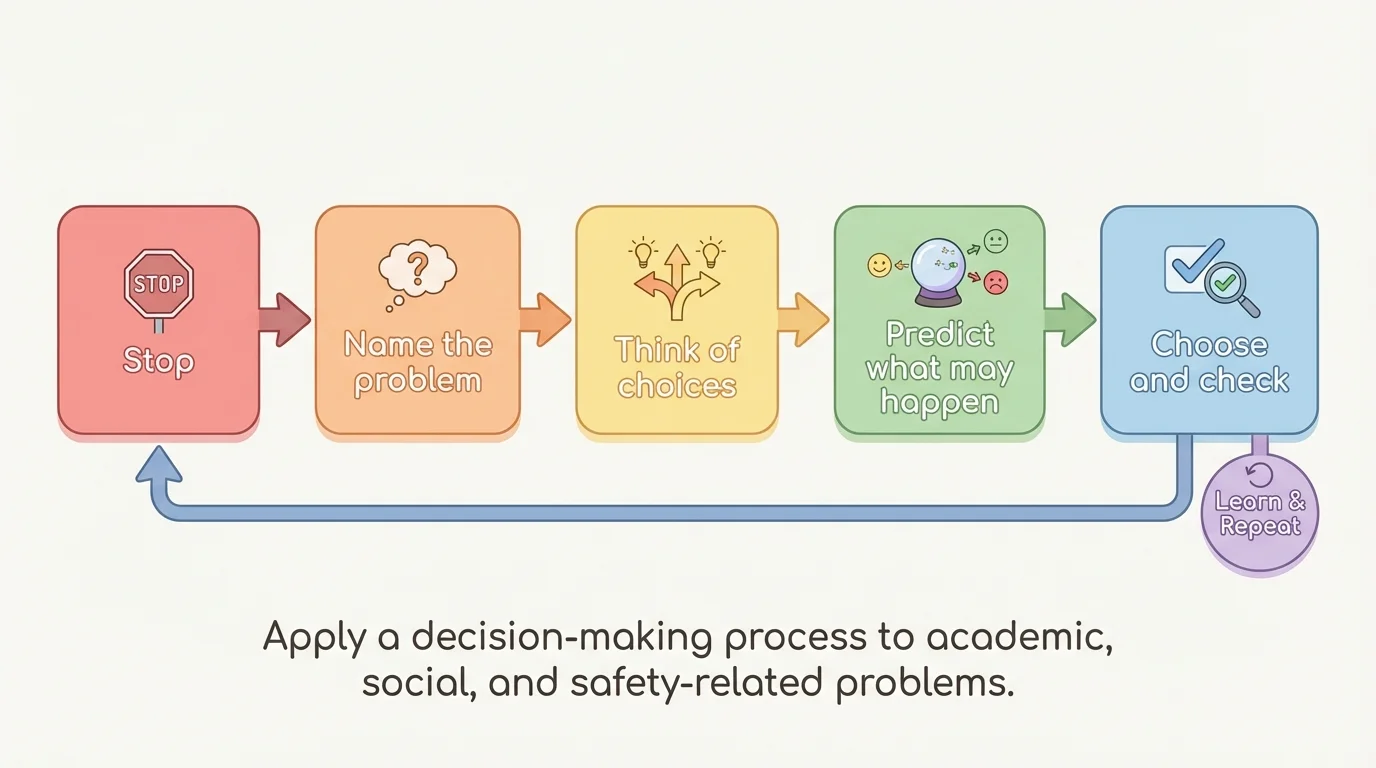
You can use the same five steps for many kinds of problems. The order matters, as [Figure 1] shows, because each step helps you slow down and think before acting.
Step 1: Stop and breathe. If you are upset, excited, or in a hurry, pause first. Take a few slow breaths. This helps your brain think better.
Step 2: Name the problem. Say the problem in a simple sentence. For example: "I have two assignments due today," or "Someone sent me a mean message."
Step 3: Think of choices. Try to name at least two or three things you could do. Good problem solvers do not stop at the first idea.
Step 4: Predict what may happen. Ask yourself what could happen next for each choice. Think about today and later. A choice that feels easy now may cause trouble later.
Step 5: Choose and check. Pick the best choice, do it, and then look back. Did it help? If not, what can you do differently next time?
This process is not only for big emergencies. It works for ordinary problems too. In fact, using it on small problems helps you get better at using it on bigger ones.
Why slowing down works
When people act too fast, they often choose from feelings only. Feelings matter, but they are not the whole story. Slowing down gives your brain time to notice facts, compare choices, and think about consequences.
One easy reminder is this: Stop, think, choose. That short phrase can help you remember the full process even when you feel stressed.
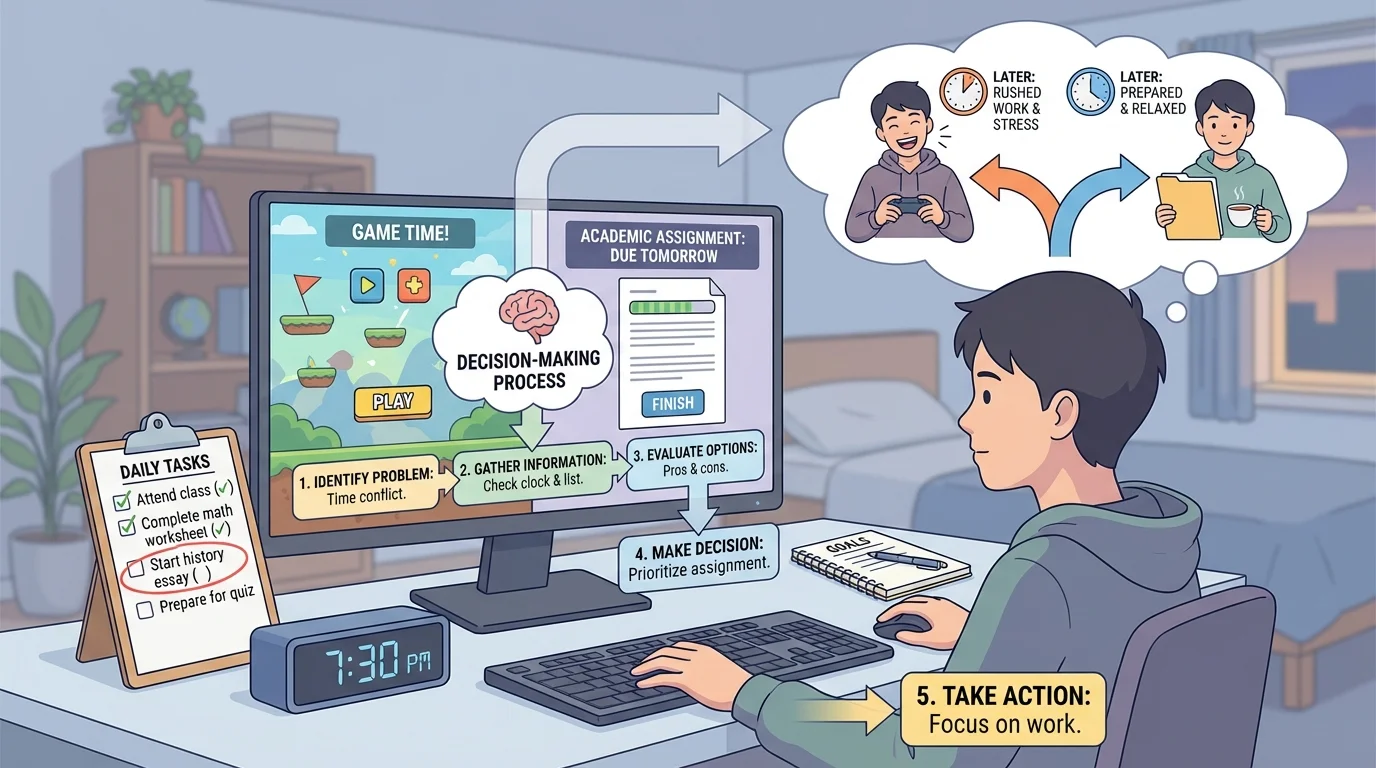
School problems at home often happen quietly. No one may be standing nearby to remind you what to do. That is why your choice in one moment can change your whole afternoon, as [Figure 2] illustrates with a simple work-versus-distraction choice.
Maybe you have a reading assignment, a math page, and a live class online. At the same time, a game, video, or toy is calling your name. That is a real problem, not because fun is bad, but because your time is limited.
First, stop and name the problem: "I want to play, but I also need to finish my schoolwork." Next, think of choices. You might play first, work first, or split your time with a plan. Then predict consequences. If you play first, you may run out of time. If you work first, you may feel proud and relaxed later. If you make a schedule, you may get both work and play.
Example: Choosing what to do first
Step 1: Name the problem.
You have science work that may take about \(20\textrm{ minutes}\) and reading that may take about \(15\textrm{ minutes}\). A game also seems fun right now.
Step 2: Think of choices.
Choice A: Play first. Choice B: Do science first. Choice C: Make a plan and finish both assignments before playing.
Step 3: Predict consequences.
Total work time is \(20 + 15 = 35\textrm{ minutes}\). If you spend \(30\textrm{ minutes}\) playing first, your work may feel rushed. If you finish the \(35\textrm{ minutes}\) of work first, your play time can feel more peaceful.
Step 4: Choose and check.
You choose Choice C: finish the work, then play. Later, you check whether the plan helped you stay calm and on time.
Another academic problem is not understanding something. Some students decide to hide the problem and hope it goes away. That choice usually makes learning harder. A better choice is to ask for help early by sending a message to your teacher, joining office hours, or asking a family member to help you get support.
Notice that good academic decisions are not always the easiest in the moment. But they often save time, lower stress, and help you feel more confident later. That same idea appears again when we look at social choices and safety choices, just as we saw in [Figure 1].
You can also use this process for simple planning. If you need \(10\textrm{ minutes}\) to clean up your space, \(25\textrm{ minutes}\) for writing, and \(15\textrm{ minutes}\) for reading, the total is \(10 + 25 + 15 = 50\textrm{ minutes}\). Knowing that total helps you make a realistic plan instead of guessing.
Social problems can happen in video calls, text messages, games, clubs, sports, or neighborhood activities. Maybe someone leaves you out of a group chat. Maybe a friend says something unkind. Maybe you accidentally hurt someone's feelings.
When emotions are involved, it is easy to react fast. You might want to send a rude message back right away. But quick reactions often make social problems bigger. A better first step is to pause and ask, "What is really happening?"
Suppose a friend does not reply to your message. One choice is to think, "They are ignoring me," and send three angry messages. Another choice is to wait, then send one calm message later. The second choice often works better because there may be many reasons for a delayed reply.
Example: A misunderstanding in a chat
Step 1: Stop and breathe.
You feel upset because someone wrote, "Fine." It sounds rude to you.
Step 2: Name the problem.
The problem is not just the word. The real problem is that you are not sure what they meant.
Step 3: Think of choices.
You could send a mean reply, ask a calm question, or wait until you are less upset.
Step 4: Predict what may happen.
A mean reply may start an argument. A calm question such as "Did you mean that in an upset way?" may clear up the problem.
Step 5: Choose and check.
You choose the calm question. If the misunderstanding gets cleared up, your choice helped protect the friendship.
Kindness is part of smart decision-making. So is honesty. If you make a mistake, a good decision may be to apologize, fix what you can, and do better next time.
It also helps to think about respect. Ask yourself: "Is this true? Is it kind? Is it safe? Is it the right time to say it?" Those questions can stop a lot of social problems before they begin.
"Think before you speak, and think before you click."
Not every social problem is yours to solve alone. If someone threatens you, keeps bullying you, or asks you to keep a hurtful secret, tell a trusted adult. That is not tattling. That is getting help.
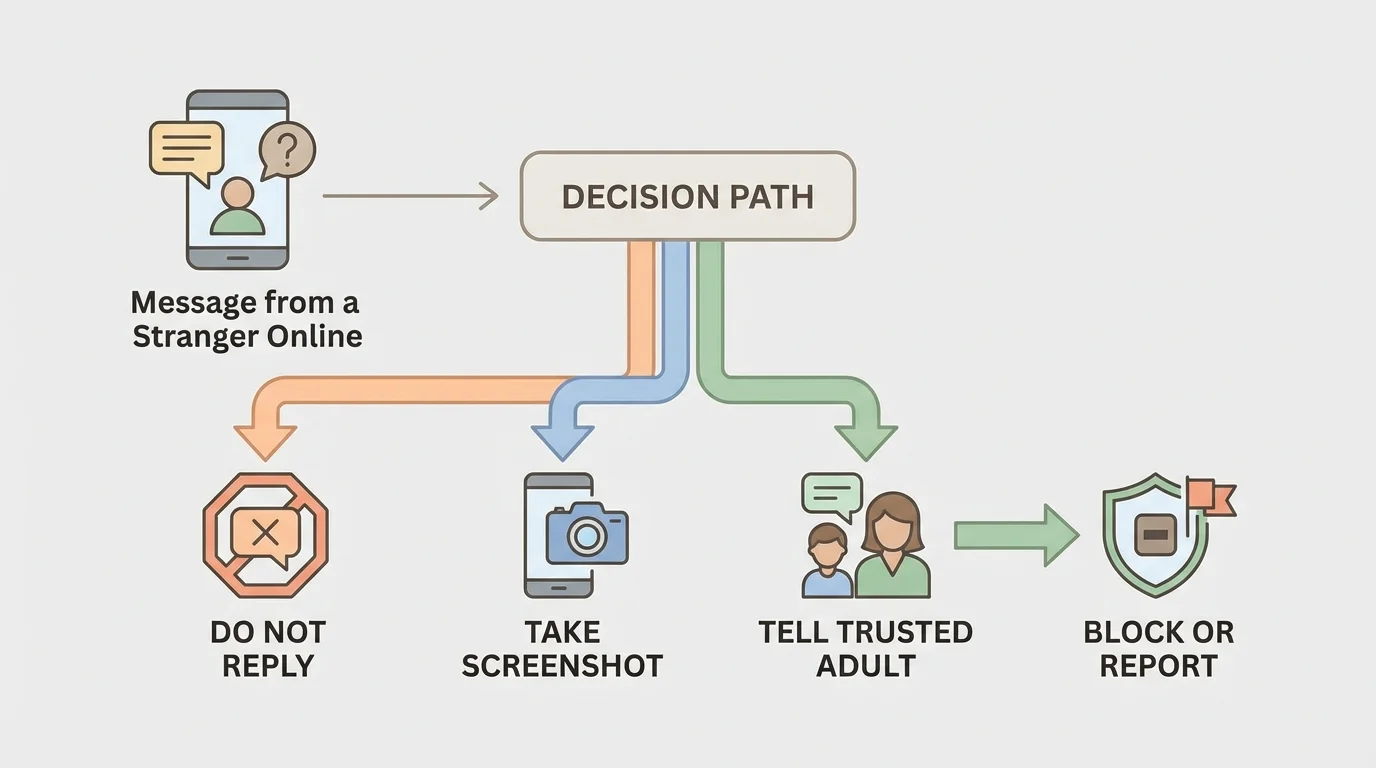
Some decisions are not just about getting along or staying on schedule. Some are about protection. Safety choices matter online, at home, and in your community. Clear next steps are especially important, as [Figure 3] shows in an online safety situation.
Online, one safety problem is getting a message from a stranger. The person might act friendly, ask personal questions, or want a photo, address, or password. That is a sign to stop right away. Do not answer. Do not share personal information. Save the message if needed, then tell a trusted adult.
Another safety problem is seeing something online that feels scary or wrong. You may feel curious, confused, or worried. The best decision is to leave the page, tell a trusted adult, and ask for help. You do not need to handle unsafe content by yourself.
Safety decisions also happen at home. If you smell smoke, see a broken cord, find medicine that is not yours, or notice a stranger at the door when you are home with family instructions, stop and think. The safest choice is often to get a trusted adult immediately rather than trying to fix the problem yourself.
The five-step process still works here, but sometimes safety problems need very fast action. In those moments, your first choices may be: move away, get help, and tell an adult. Later, you can think back and learn from what happened. Just like the order in [Figure 1], safety decisions work best when you have a plan ready before a problem starts.
Your brain gets better at making safe choices when you practice them ahead of time. Rehearsing what to do can make it easier to act quickly when something unexpected happens.
One more important rule: if a problem feels too big, too scary, or too confusing, get help. Strong decision-makers know when not to handle something alone.
Feelings are real, important, and powerful. But feelings can also make a problem look bigger or smaller than it really is. Anger can make a risky choice seem okay. Worry can make a small problem seem impossible.
That is why calming down is part of decision-making. You can breathe in slowly, count to \(5\textrm{ seconds}\), breathe out slowly, and repeat a few times. You can get a drink of water, stretch, or step away from the screen for a moment if an adult says that is okay.
Feelings and facts work together
Your feelings give you signals, and your facts help you choose. A strong decision uses both. You might feel angry about a message, but the facts may tell you it was a misunderstanding. You might feel excited to click a link, but the facts may tell you it comes from someone you do not know.
When you calm down, you can ask better questions: "What do I know for sure? What am I guessing? What choice is kind? What choice is safe?" Those questions turn a big emotional moment into a problem you can handle.
You do not need to remember long speeches. A few short tools can help you in real life.
Tool 1: The problem sentence. Say, "The problem is..." Then finish the sentence in one clear line.
Tool 2: The choice list. Name at least three choices, even if one is clearly a bad idea. Seeing choices helps you compare them.
Tool 3: The consequence questions. Ask, "What might happen now? What might happen later? Who could be helped? Who could be hurt?"
Tool 4: The help question. Ask, "Do I need a trusted adult?" If the answer might be yes, ask right away.
Tool 5: The check-back. After the problem is over, ask, "Did my choice work well?" Good decision-makers learn from past choices.
| Situation | Helpful question | Smart action |
|---|---|---|
| Homework feels overwhelming | What should I do first? | Break it into smaller parts and make a plan |
| Friend sends a hurtful message | Should I answer right now? | Pause, calm down, and reply kindly or get help |
| Stranger asks for personal information | Is this safe? | Do not reply; tell a trusted adult |
| You are confused about directions | What facts do I need? | Read again or ask for help |
Table 1. Examples of common problems, useful questions, and smart actions.
The more often you use these tools, the more natural they feel. Over time, your brain starts to pause and think before acting. That is a big step toward independence.
Strong choices are built from small habits. Finishing work before distractions, speaking kindly online, asking questions when confused, and getting help when something feels unsafe are all habits. Each good habit makes the next good choice easier.
You will not always choose perfectly. Everyone makes mistakes. What matters is noticing the mistake, learning from it, and trying again. That is how problem-solving skills grow.
When you use the decision-making process well, good things happen. Your work gets done with less stress. Your friendships get stronger. You stay safer. You also begin to trust yourself more, because you know you have a plan.
You do not need to solve every problem alone or instantly. A calm pause, a few careful questions, and support from a trusted adult can lead to much better choices.
Each day gives you more chances to practice. One smart choice may seem small, but many smart choices together can make a big difference in your life.
