Have you ever watched a video, thought, "I got it," and then forgotten most of it later that day? That happens to almost everyone. Your brain is amazing, but it does not keep every new idea all by itself. Learning gets stronger when you help your brain in three smart ways: by writing things down, by looking back at them, and by trying the skill again.
When you learn something new, it can feel clear at first because it is fresh. But if you do nothing with it, the idea can fade. That is why students who only listen once often forget, while students who use strong learning habits remember more. Note-taking helps you catch important ideas. Review helps you bring those ideas back before they disappear. Practice helps your brain and body get better at using what you learned.
Think about learning to tie your shoes, play a game, bake cookies, or remember the steps in a science video. If you only see the steps once, you may not remember them later. But if you write down the steps, look at them again, and try them yourself, the learning becomes stronger. These same habits help in online lessons, chores, hobbies, music, sports, and everyday problem-solving.
Note-taking means writing or drawing important information in a short, useful way. Review means going back to what you learned and thinking about it again. Practice means using the skill or information more than once so it becomes easier and stronger.
These three actions work like a team. Notes help you keep the important parts. Review wakes up the memory again. Practice teaches you how to use the learning, not just see it.
When you take notes, you are not supposed to copy every single word. Good notes are like a net that catches the most important parts. You might write a key word, a short sentence, a list of steps, or a tiny sketch. This helps you stay focused because your brain is choosing what matters most.
Note-taking is helpful during online videos, reading, directions from an adult, or instructions for a project. If you are learning how to care for a plant, your notes might say: "sunlight," "water when soil is dry," and "do not overwater." If you are learning a new math idea, your notes might include the rule, one example, and one reminder about a common mistake.
Taking notes also gives you something to return to later. Without notes, you may have to rewatch a whole video or reread a long page just to find one fact. With notes, you can quickly spot what you need.
Helpful notes are short and organized, as [Figure 1] shows. You do not need fancy words or perfect handwriting. You just need notes that make sense to you when you look back later.
Step 1: Write the topic. Put a title at the top, such as "Animal Habitats" or "How to Make a Smoothie."
Step 2: Listen or read for big ideas. Ask yourself, "What is the main point?"
Step 3: Write only the important parts. Use short phrases, not whole paragraphs.
Step 4: Add clues. Draw a star by something important, circle a hard word, or make a tiny picture.
Step 5: Leave a little space. You may want to add more during review.
Here are some things that belong in notes: main ideas, steps in order, important words, questions you still have, and reminders about mistakes to avoid. Here are some things to skip: long copied sentences, details that do not matter much, and words you do not understand but never plan to ask about.
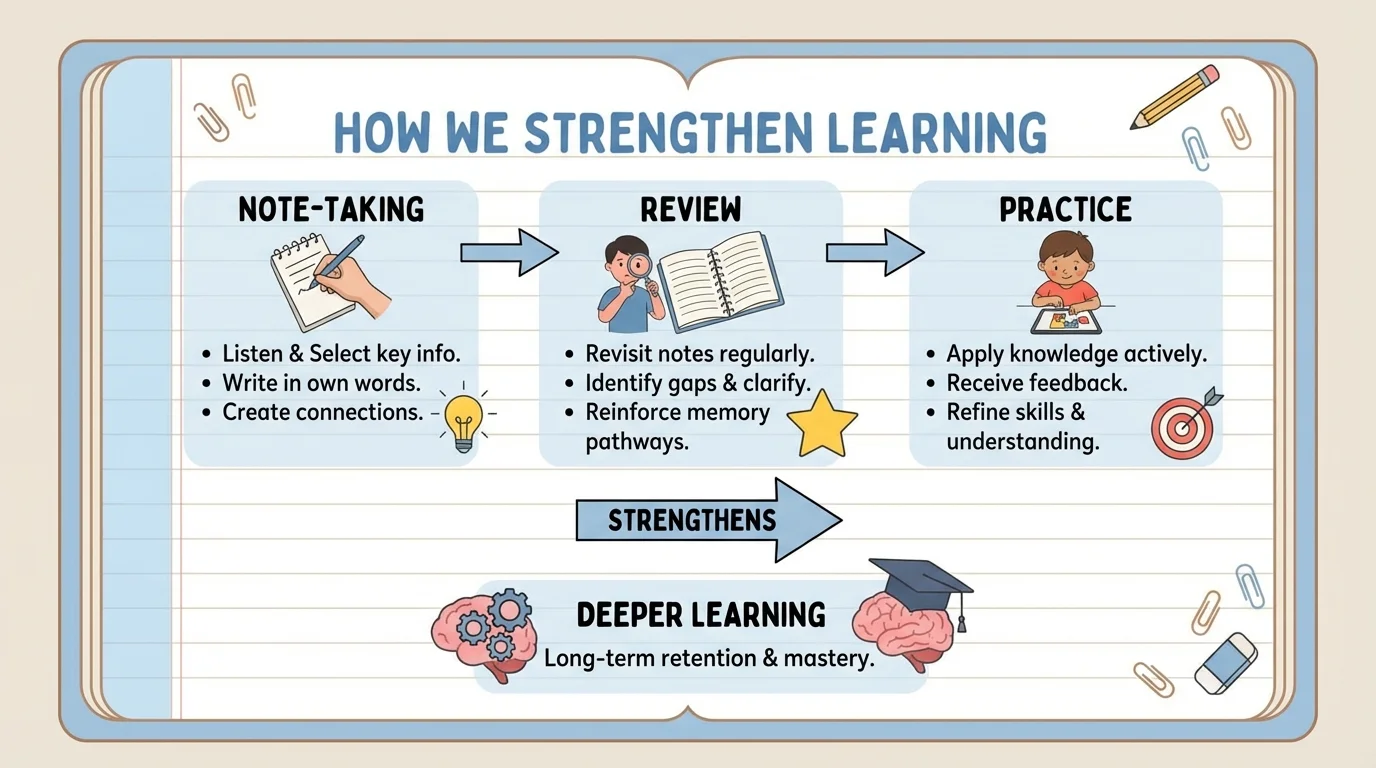
If you are learning from a video, pause at important moments and write a few words. If you are reading, stop after a small part and jot down the big idea. If someone is explaining directions, repeat the steps in your head and then write them as a short list.
A note-taking example from everyday life
You watch a short cooking video about making fruit salad.
Step 1: Find the main ideas
The main ideas are the ingredients, the order of the steps, and one safety rule.
Step 2: Write short notes
Your notes might say: "wash fruit," "ask adult before cutting," "mix in bowl," and "chill before eating."
Step 3: Add a clue
You put a star next to "ask adult before cutting" because that safety step matters a lot.
Now your notes are quick to read and easy to use later.
As you saw in [Figure 1], even simple notes can be powerful when they are clear, short, and easy to scan.
Your memory gets stronger when you return to learning over time, as [Figure 2] illustrates. Review is not just staring at your page again. Real review means waking the idea up in your mind. When you do that, your brain gets another chance to hold onto it.
A good time to review is soon after learning something new. Then review again later. A quick look the same day can help a lot. Looking back the next day helps even more. Another review a few days later makes the memory stronger still.
You can review in simple ways: read your notes out loud, cover them and try to remember, explain the idea to a family member, draw the steps from memory, or answer your own questions. These ways are stronger than only rereading because they make your brain recall the information.
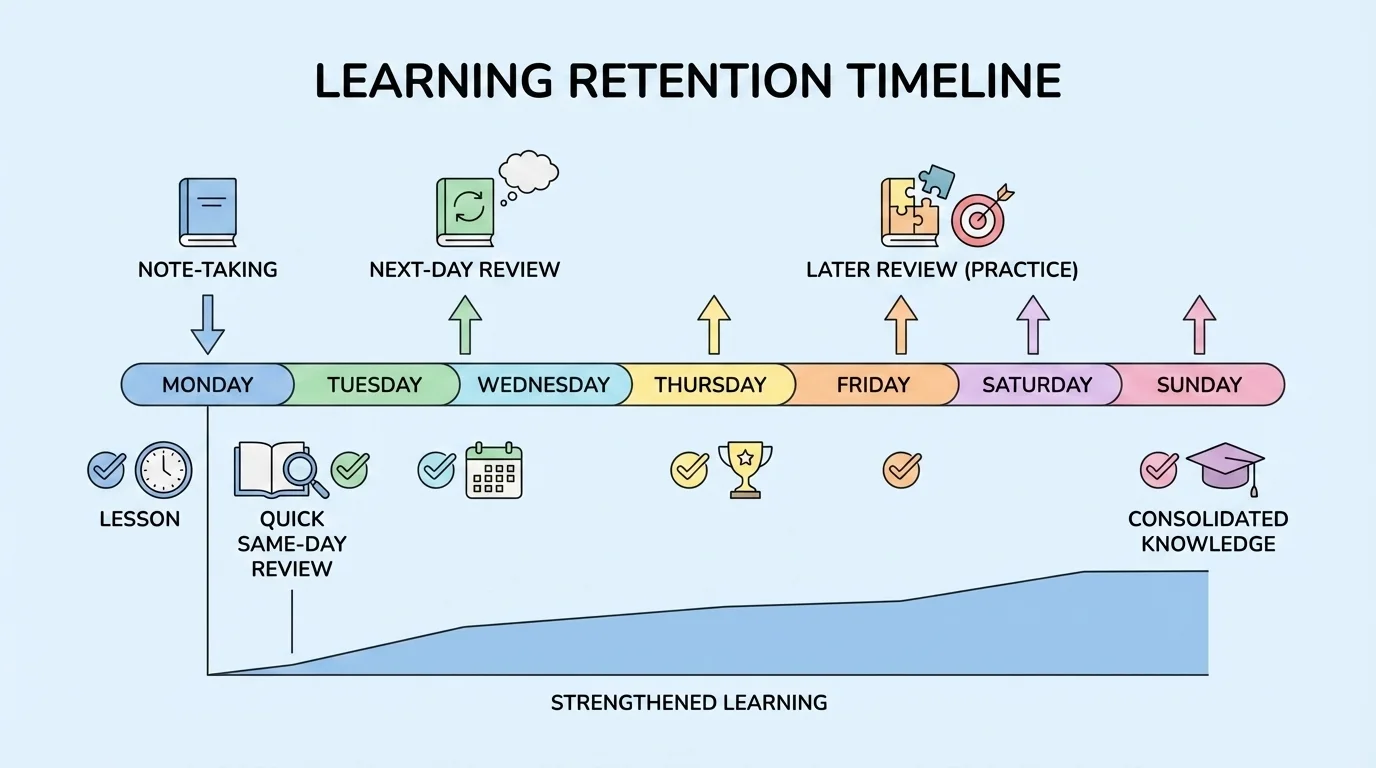
For example, if you learned how to solve a type of problem on Monday, you might review your notes for a few minutes on Monday afternoon, look again on Tuesday, and test yourself on Thursday. That does not have to take long. Even short review times help when they are regular.
Your brain often remembers better after several short reviews than after one very long study session. Small check-ins can be more powerful because they happen at different times.
If you skip review, you may feel like you learned something, but later you might only remember pieces of it. Each check-in helps the memory stay active instead of fading away.
Practice means using what you learned, not just looking at it. If review helps you remember, practice helps you perform. This matters when you solve problems, read harder words, type more carefully, play an instrument, follow exercise steps, or learn how to do a household task.
At first, practice can feel slow. That is normal. Your brain is building stronger pathways for the skill. The more you practice a skill the right way, the less hard your brain has to work to remember each tiny part. Then the skill starts to feel more fluent.
Practice works best when it is active practice. That means you are doing, saying, solving, building, or trying something. Watching someone else do it can help you start, but your own turn is what really grows the skill.
Mistakes are part of practice. A mistake is not proof that you are bad at something. It is feedback. It tells you what needs more attention. If you practice a piano song and miss the same note, you know where to slow down. If you mix up steps in a project, you know what to review.
Why practice changes learning
When you practice, your brain is not just storing information. It is learning how to use that information in the right order and at the right time. That is why practice helps with both school tasks and life skills like cooking, cleaning, organizing, and speaking clearly on a video call.
Here is the difference between weak and strong practice. Weak practice is rushing, guessing without checking, or doing the same mistake over and over. Strong practice is slowing down, noticing errors, fixing them, and trying again. Strong practice may feel harder, but it leads to better results.
The most effective learning routine uses all three tools in order, and [Figure 3] lays out that simple path. First, learn something new. Next, write short notes. Then review those notes later. After that, practice the skill or information yourself. Finally, check what went well and what still needs work.
This routine works in many real situations. If you learn pet-care rules, you write the important steps, review them later, and practice doing them correctly. If you learn how to send a respectful message online, you note the rules, review them before writing, and practice with real messages. If you learn exercise moves, you write the order, review the form, and practice safely.
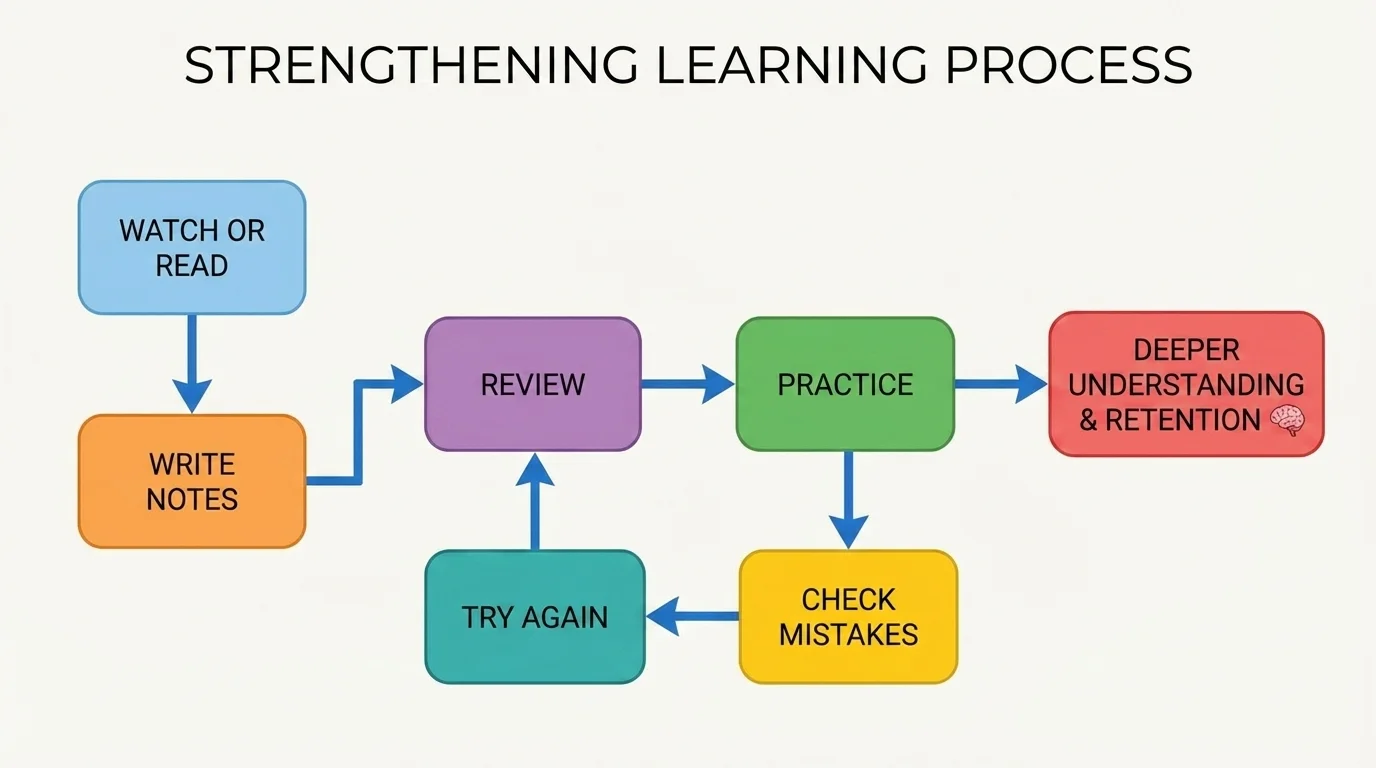
Notice that these tools do different jobs. Notes help you collect learning. Review helps you remember it. Practice helps you use it. When one part is missing, learning is weaker. If you practice without notes, you may forget the steps. If you take notes without review, your notes may sit there unused. If you review without practice, you may remember facts but still struggle to do the task.
Putting the routine together
You want to learn how to make your own simple morning checklist before logging into online school.
Step 1: Take notes
Write: "get dressed," "eat breakfast," "fill water bottle," "open computer," and "check first task."
Step 2: Review
Look at the checklist that afternoon and again the next morning.
Step 3: Practice
Follow the checklist for several days and notice which step you forget.
Step 4: Improve
If you keep forgetting water, put your bottle near your workspace as a reminder.
Now learning becomes a useful habit, not just a thought.
Later, when you build bigger routines, the same pattern still helps: learn, note, review, practice, check, and repeat.
Sometimes students think they are studying, but their method is weak. One common problem is writing too much. If your notes are too long, it becomes harder to find the important parts. A smart fix is to use short phrases and clear headings.
Another problem is rereading without thinking. Your eyes move across the page, but your brain stays passive. A smart fix is to stop and ask, "Can I say this in my own words?" or "Can I remember this without looking?"
Another problem is practicing only the easy part. That feels good, but it does not help much. A smart fix is to spend extra time on the part that feels tricky. That is usually where growth happens.
Some students give up because improvement is not instant. But learning is not magic. It grows step by step. A little effort today, plus review tomorrow, plus practice after that can make a big difference by the end of the week.
"The more you use a good skill, the stronger it becomes."
Another problem is losing notes or forgetting where they are. Keep them in one place: one notebook, one folder, or one digital file area. When your notes have a home, review is much easier.
You do not need a giant study plan. Start with a small habit you can really keep. After each lesson, write three important things. Later that day, take two or three minutes to review them. Then do one small practice task. That simple pattern can help a lot.
You can also use this habit outside schoolwork. If you are learning how to care for a younger sibling for a short time, help with laundry, memorize a recipe, or build a new game skill, the same idea works. Take notes on the steps, review them, and practice carefully.
Here is a simple guide you can follow:
| When | What you do | Why it helps |
|---|---|---|
| Right after learning | Write 3 to 5 short notes | Catches the most important ideas |
| Later the same day | Review for a few minutes | Helps memory stay active |
| Next day or later | Review again and test yourself | Makes remembering stronger |
| After review | Practice the skill | Helps you use what you learned |
| After practice | Fix mistakes and try again | Improves accuracy and confidence |
Table 1. A simple routine for using note-taking, review, and practice together.
If you keep this habit small and steady, it becomes easier to do. Strong learning is often built from little actions repeated many times.
You already know that habits grow through repetition. Learning habits work the same way. Small, helpful actions done often are stronger than doing nothing for a long time and then trying to do everything at once.
When you understand how note-taking, review, and practice work together, you gain more control over your learning. Instead of hoping you remember, you are using tools that help your brain succeed.
