People do not become trusted teammates by being the smartest person in the group. They become trusted because others know they will do what they say they will do. That matters in online school, in clubs, in sports, at home, and later in jobs. When you are responsible, work well with others, and finish what you start, people can count on you.
In online school, you may have a job in a class project, a shared presentation, a discussion group, or a home learning routine. Even though you are learning from home, your actions still affect other people. If you finish your part on time, the group can move forward. If you forget, stay silent, or quit halfway through, the whole project can slow down.
These skills are also part of adult responsibilities. Grown-ups use them at work every day. A person who shows up prepared, helps the team, and completes tasks is often seen as dependable. That means others trust them with bigger jobs. You can start building that kind of trust now.
Responsibility means taking care of your job and your choices.
Teamwork means working with other people toward the same goal.
Follow-through means finishing a job after you start it.
Role means the special part or job you have in a group.
Deadline means the time when work needs to be done.
When these three skills work together, good things happen. You know your job, you treat others well, and you finish what needs to be done. That is how projects get completed and how teams succeed.
[Figure 1] shows the key parts of understanding your job in a project. If you have a role in a project, your first job is to understand it clearly. You should know what your task is, what tools you need, when it is due, and how you will share it with your teacher or teammates. Responsibility starts with paying attention to the job in front of you.
A responsible student does not wait until the last minute to figure things out. Instead, you check the directions, read the messages, and ask for help early if something is confusing. For example, if your group is making a short online slide show about animal habitats and your part is the desert slide, you are responsible for finding facts, adding your slide, and letting the group know when it is done.
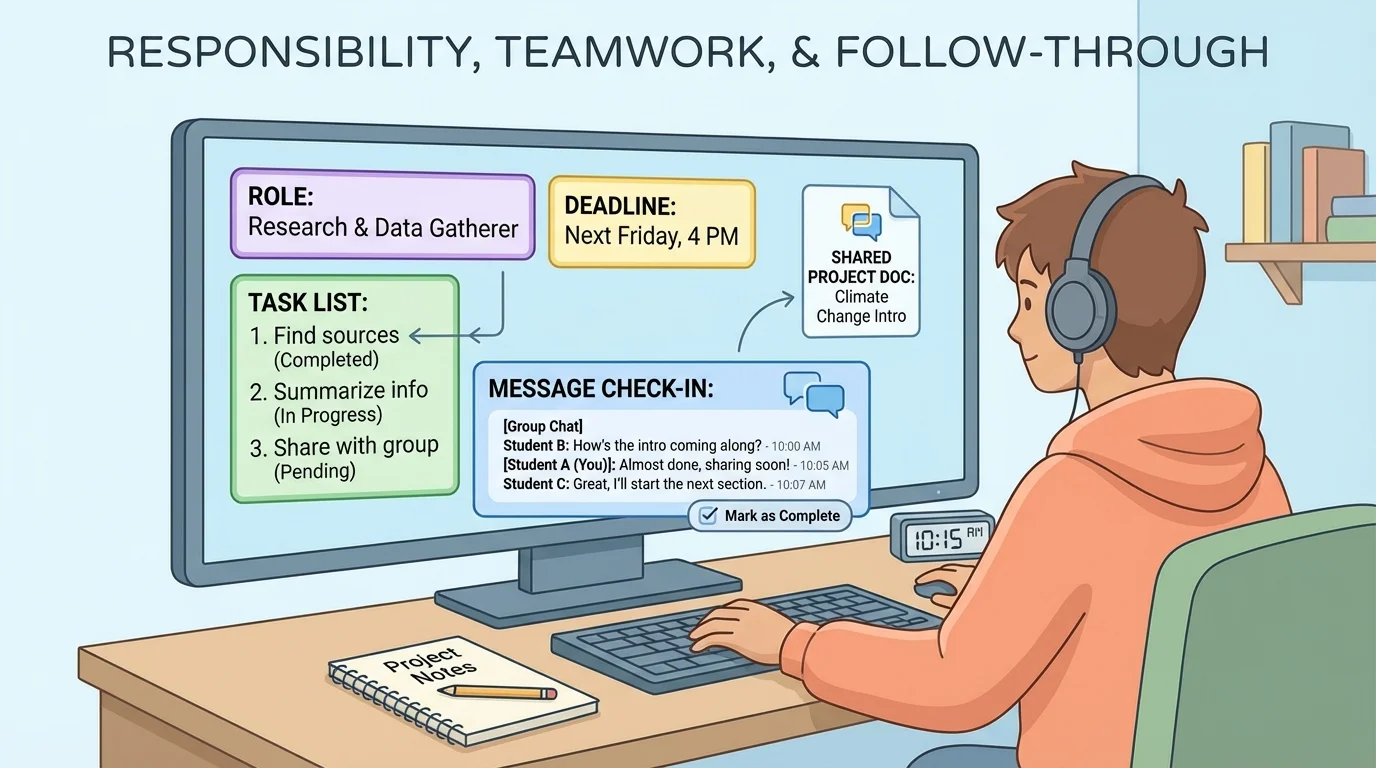
Responsibility also means being honest. If you forgot to do your part, it is better to say, "I'm sorry. I forgot, but I'm doing it now and I can send it by tonight," than to pretend everything is fine. Honest words help people solve the problem. Hiding the problem usually makes it worse.
Here are simple ways to take responsibility for a classroom role or project:
Step 1: Read or listen to the directions carefully.
Step 2: Say the job back in your own words so you know what to do.
Step 3: Gather what you need, such as notes, links, art supplies, or a charged device.
Step 4: Start early, even if you only do a small part first.
Step 5: Check your work before sending or sharing it.
Step 6: Tell the team or teacher when your part is complete.
Try This: Before you begin any project, say out loud: "My job is ____. It is due ____. I will finish the first part by ____." That quick plan helps your brain stay organized.
Teamwork is not just "being nice." It means helping a group reach a goal together. In online learning, that may happen through class messages, shared documents, recorded videos, or live video calls. Since you are not sitting in the same room, clear communication becomes even more important.
Good teamwork includes listening, taking turns, and respecting ideas. You do not have to agree with every idea, but you should respond kindly. Instead of saying, "That's bad," you can say, "I think another idea might work better because..." That keeps the group calm and focused.
Teamwork means sharing both effort and respect. A strong team is not a group where one person does everything. It is a group where each person does a fair part, communicates clearly, and helps fix problems. Even young students can be strong teammates by replying on time, being polite, and doing their own part well.
Sometimes teamwork means helping someone who is stuck. Maybe a classmate cannot upload a picture or is confused about the instructions. You can help without taking over. For example, you might write, "I can show you how I added my slide," instead of doing their entire job for them. Helping is kind. Doing someone else's whole task is usually not fair to the team.
Teamwork also means keeping promises. If you tell your group, "I'll send my paragraph after lunch," then try your best to do exactly that. When people keep small promises, others trust them with bigger ones later.
As you saw in [Figure 1], every team role connects to the larger project. Even one unfinished part can affect everyone else. That is why communication matters so much in team projects.
[Figure 2] illustrates the clear order of good follow-through. Follow-through means you do not stop after the exciting beginning. You understand the task, break it into smaller pieces, finish each piece, and then check that the full job is really complete.
Many students think, "I started it, so I'm basically done." But starting is only the first part. Follow-through means finishing carefully. If you open the shared document but never type your part, that is not follow-through. If you type one sentence but do not check it or tell the team, that is not complete either.
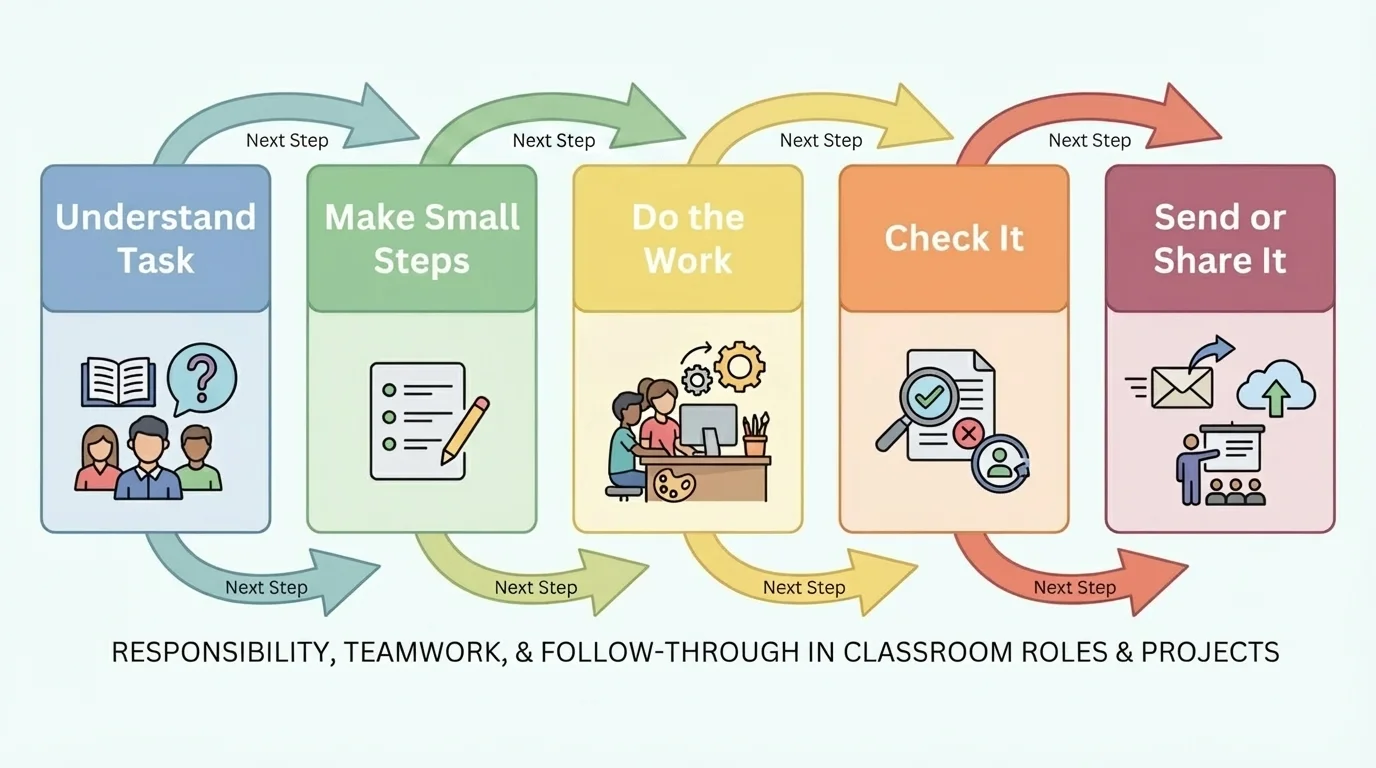
A simple follow-through plan can help with almost any project:
Understand: What exactly am I supposed to do?
Break it down: What are the smaller steps?
Do one step now: What can I finish today?
Check: Is it neat, complete, and correct?
Share: Did I turn it in or tell the group?
This process works because small steps feel easier than one giant task. If a report feels too hard, you can break it into smaller jobs: read directions, write title, find two facts, add one picture, reread, send. Doing one small part at a time helps you avoid giving up.
Example: Finishing a short online project
You need to record a one-minute video about your favorite book and send it by Friday.
Step 1: Understand the task
You need one minute of speaking, the book title, one reason you like it, and a clear recording.
Step 2: Break it down
Write notes on Wednesday, practice on Thursday, record and send on Friday morning.
Step 3: Check your work
Watch the video once. Make sure your voice is clear and the file is sent.
The job is not finished until the video is actually submitted.
Try This: Use a sticky note or digital checklist with three boxes: start, check, send. Mark each box when you complete it.
Even responsible people have hard days. The important skill is what you do next. Problems are normal. Quitting, hiding, or blaming others usually makes them bigger.
If you forget your task, admit it quickly and make a plan. If technology stops working, tell the teacher or team as soon as possible. If you are confused, ask a specific question. If a teammate is upset, stay calm and use kind words.
| Problem | Helpful response | Why it works |
|---|---|---|
| I forgot my part. | Say sorry, start now, give a new time. | It shows honesty and action. |
| My internet or device had trouble. | Send a message when you can and explain briefly. | It keeps others informed. |
| I do not understand the directions. | Ask one clear question. | It helps you get unstuck faster. |
| Someone disagrees with me. | Listen, stay respectful, suggest a solution. | It protects the team. |
Table 1. Common project problems, helpful responses, and reasons those responses work.
Sometimes students make excuses like, "I was going to do it," or, "It's not my fault." Those words do not fix the missing work. Better words are, "Here is what happened, and here is what I'm doing now." Problem-solving is a big part of responsibility.
Employers often say they value reliability just as much as talent. A person who consistently finishes tasks and communicates well is often chosen again for important work.
Later in life, the same idea appears in jobs, teams, and community activities. People trust those who handle mistakes honestly and keep working toward a solution.
Real situations help these ideas make sense. Think about how responsibility, teamwork, and follow-through look in everyday online school life.
Example: Shared slide presentation
You and two classmates are making slides about weather.
Step 1: Know your part
Your slide is about rain. You write two facts and add one picture.
Step 2: Communicate
You send a message: "I'm working on slide 2 and will finish by 6:00."
Step 3: Follow through
You finish the slide, reread it, and message the group that it is done.
This helps the team move forward without guessing.
Now think about a different situation. Your teacher gives you a weekly discussion post. No teammates are waiting on you, but you still have a role: managing your own learning. Responsibility means remembering the post. Teamwork still matters because you reply kindly to others. Follow-through means posting your answer and responding before the deadline.
As the project flow in [Figure 2] shows, every task gets easier when you move one step at a time instead of waiting until the last moment.
Example: Fixing a mistake
You were supposed to upload your drawing by the afternoon, but you forgot.
Step 1: Be honest
Write: "I'm sorry. I forgot to upload it."
Step 2: Take action
Finish the upload right away.
Step 3: Rebuild trust
Add: "It is uploaded now, and next time I will set a reminder."
This response is much stronger than making excuses.
A dependable person is someone others can count on. You do not become dependable by accident. You build it with habits.
One helpful habit is using reminders. You can use a calendar, a timer, a checklist, or a note on your desk. Another helpful habit is checking messages at a regular time each day. A third habit is completing small tasks before relaxing with games or videos.
Ask yourself these questions when you work:
Do I know my job?
Did I begin early?
Did I answer messages or directions?
Did I finish the whole task?
Did I let others know?
If you can answer yes to those questions most of the time, you are building strong habits.
"People can trust me to do my part."
— A strong goal for school, teamwork, and future jobs
You do not have to be perfect. Everyone forgets sometimes. What matters is learning to notice problems, fix them, and keep improving.
Right now, your projects may be small. Maybe you are sharing ideas in a discussion board, recording a video, or helping with a group document. But these small tasks are practice for bigger responsibilities later. Adults use the same skills when they work on teams, care for customers, help neighbors, and complete jobs at work.
Responsibility helps people trust you. Teamwork helps groups do more than one person can do alone. Follow-through helps ideas turn into finished results. These are not just school skills. They are life skills.
When you take your role seriously, communicate kindly, and finish what you start, you show that you are ready for bigger opportunities. That is how confidence grows. That is also how trust grows.
Try This: This week, pick one task and practice all three skills on purpose: know your job, send one clear message, and finish the task all the way. Small actions repeated often build big strengths.
