One online post can spread to thousands of people in just minutes. That means a silly rumor, a fake prize, or a made-up "fact" can travel fast. When you learn how to check information before you believe it or share it, you protect yourself and other people too.
You see information every day on videos, websites, apps, games, search results, and messages. Some of it is helpful and true. Some of it is a mistake. Some of it is made to trick people. If you believe false information, you might get scared for no reason, waste time, click something unsafe, or pass along a rumor that hurts someone.
Think about a message that says, "Your game account will disappear today unless you click this link now." If that message is fake and you click it, you could end up on an unsafe website. But if you stop and check first, you make a smart choice. That is a big part of being safe and responsible online.
Media literacy means using smart habits to understand, question, and check messages you see online or in other media.
Reliable information is information you can trust because it comes from a strong source and is supported by facts.
Misinformation is false or wrong information. Sometimes people share it by accident, and sometimes people share it on purpose.
Being careful does not mean you have to be worried all the time. It means you use your brain like a detective. You slow down, ask questions, and look for clues before deciding, "Yes, this seems true," or, "No, I should not trust this yet."
When you hear the phrase media literacy, think of it as a set of habits. It is not just one trick. It is a way of acting online. Instead of believing the first thing you see, you check who made it, why they made it, and whether other trusted places say the same thing.
You can use these habits with lots of things: a video about animals, a message about weather, a health tip, a post about a famous person, or a rumor in an online group. The goal is simple: do not let fast information fool you.
Some fake posts are designed to make people feel very excited or very scared, because strong feelings can make people share before they think.
That is why one of the best media-literacy habits is to pause. When something makes you want to shout, gasp, or instantly send it to someone, that is often the perfect time to slow down and check it more carefully.
You do not need a complicated system. A quick checking process, as shown in [Figure 1], can help you decide what to do with information you find online. These five steps work for videos, posts, websites, and messages.
Step 1: Pause. Do not click, share, or reply right away. Take a breath. Ask yourself, "Who wants me to believe this?" and "How do I know this is true?"
Step 2: Check the source. Look at where the information comes from. Is it from a library, museum, news source, official weather app, or another trusted group? Or is it from a random account you have never heard of?
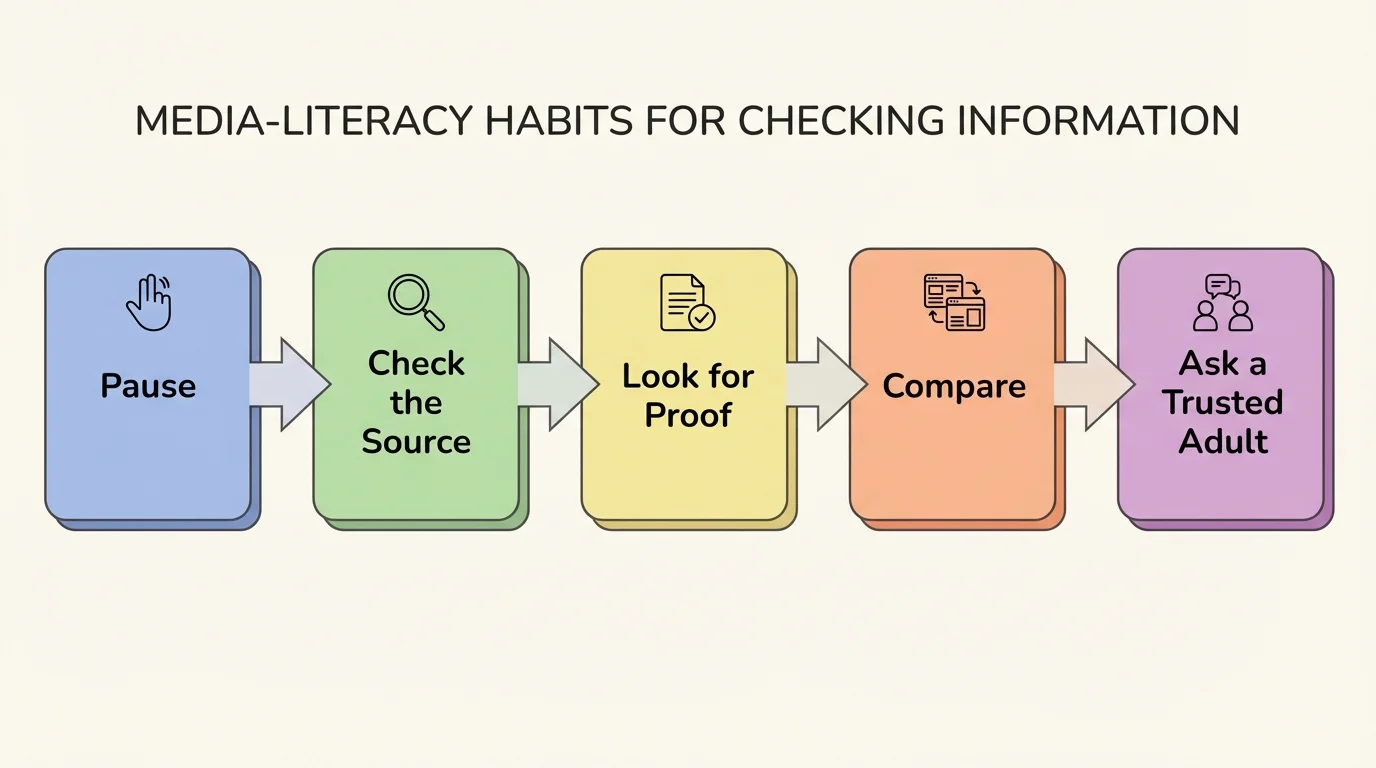
Step 3: Look for evidence. Good information usually gives proof. It may include facts, names, dates, photos from a trustworthy place, or links to real experts. If a post only says, "Trust me," that is not enough.
Step 4: Compare. See whether other trusted places say the same thing. If one random post says school-aged kids should eat only candy for breakfast, but health websites do not say that, the post is not reliable.
Step 5: Ask a trusted adult. If you are still unsure, show the information to a parent, caregiver, or teacher from your online school. Smart digital citizens know when to ask for help.
Using the 5-step check
You see a video title that says, "A giant storm will shut down every store in your town tonight."
Step 1: Pause instead of sharing it with everyone.
Step 2: Check the source. Is it from an official weather service or just a random channel?
Step 3: Look for proof. Does it name the storm, show a date, or link to real weather information?
Step 4: Compare it with a trusted weather app or local news source.
Step 5: Ask a trusted adult before believing it or acting on it.
This keeps you from spreading fear based on a rumor.
If you practice these steps often, they become a habit. Later, when you notice a strange claim, your brain will say, "Wait. Check first." That is exactly what you want.
Warning signs stand out when you know what to look for, and [Figure 2] highlights several common clues in one suspicious-looking post. A single clue does not always prove something is fake, but several clues together mean you should be very careful.
One clue is big, dramatic language. Watch out for headlines like "You will not believe this," "This secret changes everything," or "Share now before it gets deleted." These lines try to push your feelings more than your thinking.
Another clue is a strange web address or account name. A trusted site usually looks clean and clear. If the address has lots of odd letters, extra numbers, or words that copy a real company in a weird way, it may not be real. This is where checking the URL can help.
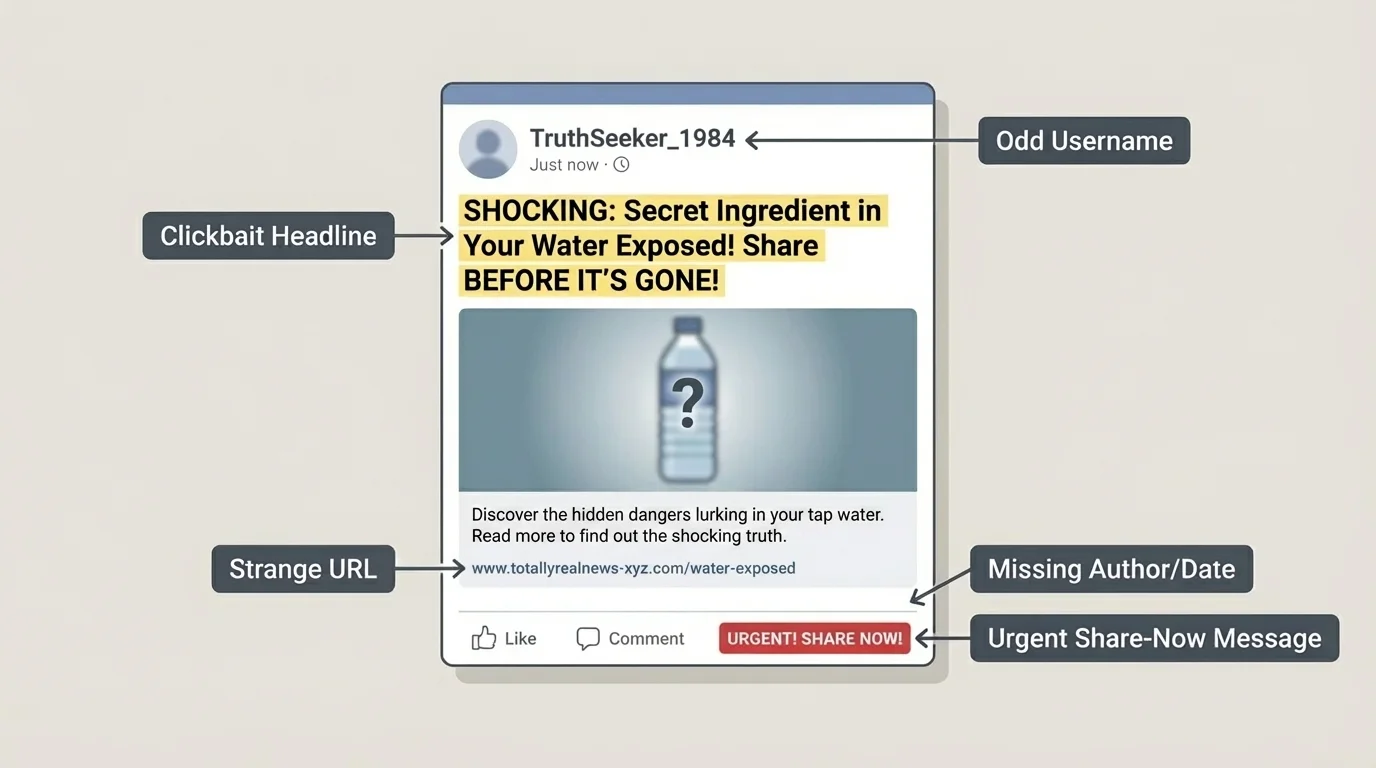
A missing author or date is another warning sign. If you cannot tell who made the post or when it was made, it is harder to trust. Old information can also be a problem. A weather warning from last year is not useful for today.
Pictures can fool people too. Some images are edited, and some are real photos used in the wrong way. A picture of flooding from one country might be shared as if it happened in your town. This is why a photo by itself is not always proof.
Be careful with messages that promise prizes, free game money, or "secret hacks" if you click a link. These often try to get your personal information, your password, or your attention. If something sounds too amazing to be true, it deserves extra checking.
Strong feelings can be a clue
When a post makes you feel sudden fear, anger, or excitement, your brain may want to react fast. Trick posts often count on that. A smart habit is to notice your feeling, then slow down and check instead of acting right away.
Later, when you review the five-step process in [Figure 1], you can see why these warning signs matter: they tell you when it is especially important to pause, check the source, and compare with trusted information.
Different online sources deserve different levels of trust, as [Figure 3] shows in a simple comparison. A message from an official weather app is not the same as a rumor in a comment section, even if both talk about the weather.
Suppose you read, "Drinking three cups of pickle juice cures every cold." That is a health claim. Health claims need strong proof. A trusted children's hospital website is much more reliable than a random video comment.
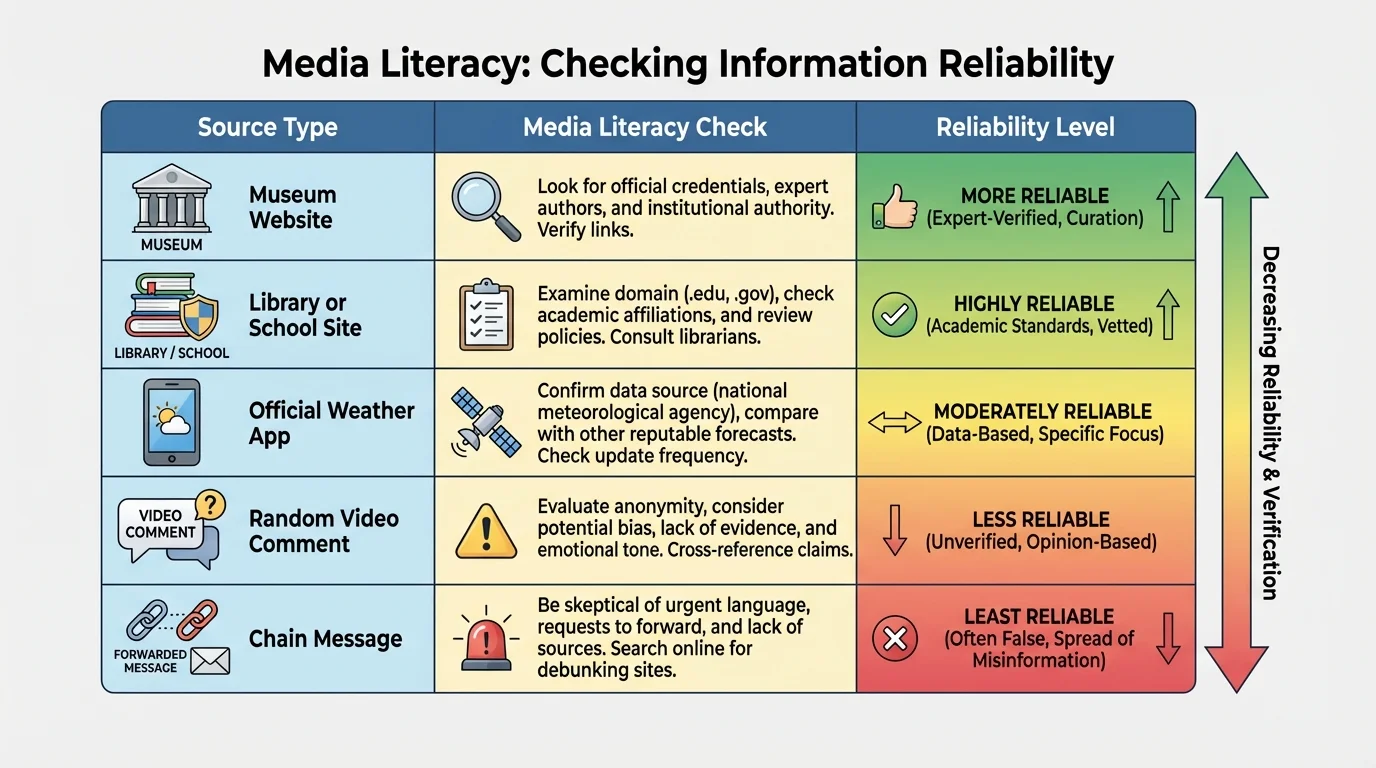
Now think about a game rumor: "This hidden code gives you unlimited coins forever." Kids often see claims like this in videos or chat spaces. Before trying it, check whether the game's official website or official account says the same thing. If not, it may be fake or even a trick to get you to download something unsafe.
Animal facts are another great example. A video may say, "Sharks can live in trees," and the speaker may sound confident. But confidence is not proof. You can compare the claim with a zoo website, science museum page, or encyclopedia made for kids.
Chain messages are also common. A chain message tells you to send it to many people right away. It might say, "Forward this to ten friends or your account will be locked." Real companies do not usually give important account warnings in chain-message style. That style itself is a clue to be careful.
| Source type | Usually more reliable? | Why |
|---|---|---|
| Official weather app | Yes | It gives updates from a known organization. |
| Museum or library website | Yes | It is often checked by experts. |
| Official game website | Yes | It speaks for the real game company. |
| Random video comment | No, not by itself | Anyone can write it without proof. |
| Chain message | No, not by itself | It often pushes people to share quickly. |
Table 1. A comparison of common online source types and how trustworthy they usually are.
When you compare sources this way, you become better at deciding what deserves trust, what needs checking, and what should be ignored.
Sometimes the answer is not "true" or "false" right away. Sometimes the best answer is, "I am not sure yet." That is a strong answer, not a weak one. It means you are being thoughtful.
If you are unsure, do these things: do not share it, do not click mystery links, save the name of the website or claim if you want to check later, and ask a trusted adult for help. You can also look for the same topic on trusted kid-friendly websites.
Good choices when you are unsure
Step 1: Stop and keep your personal information private.
Step 2: Read the claim again and notice any warning signs.
Step 3: Search for the same topic on a trusted source.
Step 4: Ask a trusted adult if the claim could affect your safety, health, money, or account.
These actions keep one uncertain moment from becoming a bigger problem.
This is especially important for topics about health, safety, weather, money, or anything asking for a password. For big topics, you should expect stronger proof.
Remember the suspicious post in [Figure 2]: the point is not to become scared of every post. The point is to notice clues, stay calm, and choose a safe next step.
Media literacy is strongest when it becomes part of your everyday routine. Before you like, share, repost, or comment, ask yourself a few quick questions: Who made this? What proof do they show? Can I check it somewhere else? Should I ask an adult first?
Another good habit is to follow trustworthy sources for important topics. If you want weather updates, use a real weather service. If you want animal facts, use zoos, museums, or science websites. If you want game news, use the game's official page. This makes checking easier because you already know where to look.
"Pause first. Check next. Share last."
It also helps to notice how information travels. When one person shares something false, other people may share it again without checking. Soon it feels true just because it appears many times. But repeated information is not the same as proven information.
As the comparison of sources in [Figure 3] makes clear, trust grows when information comes from strong sources and matches what other reliable places say. Popular does not always mean true.
Every time you stop, check, and think, you become a safer and smarter digital citizen. You do not have to know everything right away. You just need strong habits and the courage to say, "I will check before I trust."
