Have you ever spent a long time looking for one small thing, like a charger, a library book, or your favorite pencil case? It can feel like your stuff has disappeared. Usually, it has not vanished at all. It just does not have a clear place, or it was packed in a hurry. Learning to pack, organize, and care for your belongings helps you save time, protect your things, and feel more ready for the day.
Your belongings are the things you use in daily life: clothes, books, art supplies, toys, sports gear, headphones, devices, and special keepsakes. When you take care of them, they often last longer. When you pack well, you can find what you need faster. When you organize your space, cleaning up becomes easier.
These skills are also part of being responsible. Being responsible means you do what you are supposed to do and you take care of what has been trusted to you. If you toss your tablet onto the couch, it might fall and crack. If you put it away safely, it is ready the next time you need it for online learning or a video call with family.
Packing means putting items together in a neat and useful way so they are ready to carry or store.
Organizing means arranging things so they are easy to find and easy to put away.
Caring for belongings means keeping your items clean, safe, and in good shape.
Doing these things well helps in big and small moments. You might be getting ready for a club activity, a sleepover at a cousin's house, a family trip, or just a normal day at home. Good systems make life smoother.
Before you can organize anything, you need to know what you have. A simple way to start is to sort your things into groups. You can group them by type, like books, clothes, art tools, and electronics. You can also group them by purpose, like schoolwork items, hobby items, outdoor items, and bedtime items.
This is called sorting. Sorting helps you notice what belongs together. It also helps you see if something is missing, broken, or no longer needed. For example, if all your drawing supplies are in one bin, you can quickly tell whether your markers still have caps and whether your sketchbook is full.
Another smart idea is to make categories for where items belong. Your categories might be: use every day, use sometimes, and keep safe. Everyday items should be easy to reach. Sometimes-used items can go in a basket, drawer, or shelf. Very special or breakable items should go in a safer place.
Real-life example: Sorting a mixed-up drawer
You open a drawer and find socks, batteries, crayons, stickers, and a game card all mixed together.
Step 1: Take everything out and place it where you can see it.
Step 2: Make small groups: clothing, art supplies, game pieces, and household items.
Step 3: Put back only the things that belong in that drawer.
Step 4: Move the other items to their correct places.
Now the drawer is easier to use, and the items are less likely to get lost.
When you sort, it is also helpful to ask three questions: Do I use this? Where does it belong? Does it need care? A rain jacket may belong near the door. A puzzle with many pieces may need a container with a lid. A stuffed animal may need a gentle wash or repair.
Packing is not just stuffing items into a bag. Smart packing means choosing the right things, putting them in the right order, and protecting them as [Figure 1] shows. A well-packed bag feels balanced, keeps items from getting crushed, and helps you find things quickly.
Start by thinking about where you are going and what you will do there. If you are packing for an art class, you may need paper, pencils, and a smock. If you are packing for a soccer practice, you may need shin guards, a water bottle, and a change of clothes. If you are packing for one night away, you need clothes, pajamas, a toothbrush, and any comfort item you use at bedtime.
A helpful skill is making a checklist. A checklist is a list of what you need. It helps you remember important items and check them off as you pack. You do not need a long fancy list. A short one on paper or in a notes app works well.
When putting items into a bag, place heavier things at the bottom or close to the back if it is a backpack. Put flatter items, like folders or books, along the back. Keep liquids standing up if possible, and make sure lids are closed tightly. Fragile things should be wrapped or placed in a small case. Tiny items, like earbuds or hair ties, should go in a pouch so they do not disappear at the bottom.
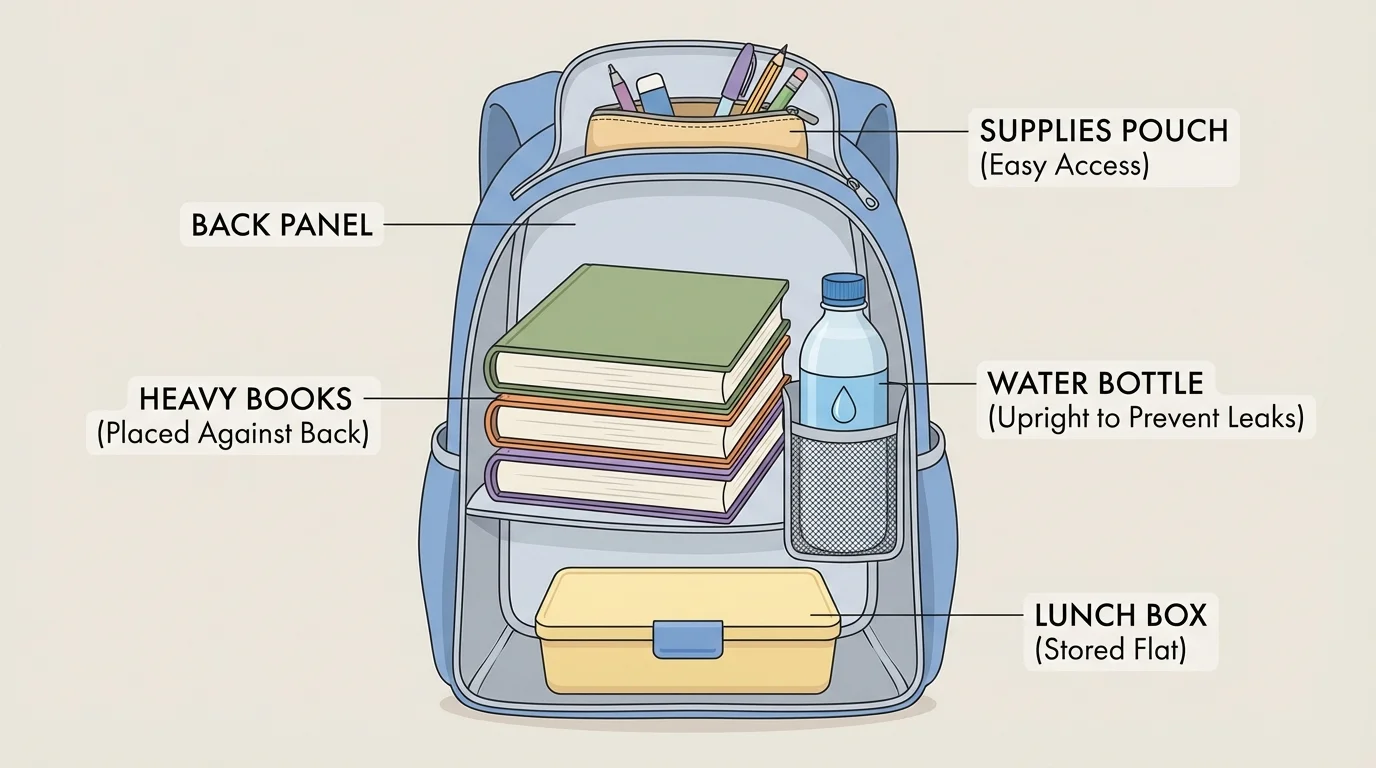
Here is a simple packing order you can use again and again. Step 1: Gather everything in one spot. Step 2: Check your list. Step 3: Put in large items first. Step 4: Add smaller items in pouches or side pockets. Step 5: Zip the bag and do a final check.
If you rush, you may forget something important. If you pack carefully, you are more likely to be prepared. This matters even for small trips. Forgetting socks for a sleepover or leaving a charger behind can be annoying. Packing smart saves stress later.
Many people waste time every week looking for misplaced items. A few minutes spent packing and putting things in the right place can save much more time later.
Another smart habit is to unpack when you get home. Put dirty clothes in the laundry, return supplies to their spots, and throw away trash. If you leave everything in your bag, the bag becomes messy fast. As we saw in [Figure 1], each item works best when it has its own place inside the bag.
Good organization means giving your things a home. A storage space is the place where something is kept. This could be a shelf, drawer, box, basket, hook, or bin. A strong organizing rule is: a place for every item, and every item in its place. You can see this clearly in [Figure 2], where different kinds of belongings each have their own spot.
You do not need a huge room or expensive containers. Small systems work well. One basket for books, one tray for chargers, one drawer for socks, and one bin for art supplies can make a big difference. Labels help too. A label can be a word, a picture, or both.
It helps to organize by zones. For example, near your bed you might keep bedtime items. Near your desk you might keep school and craft items. Near the door you might keep shoes, a jacket, and a bag. When things are close to where you use them, it is easier to put them back.
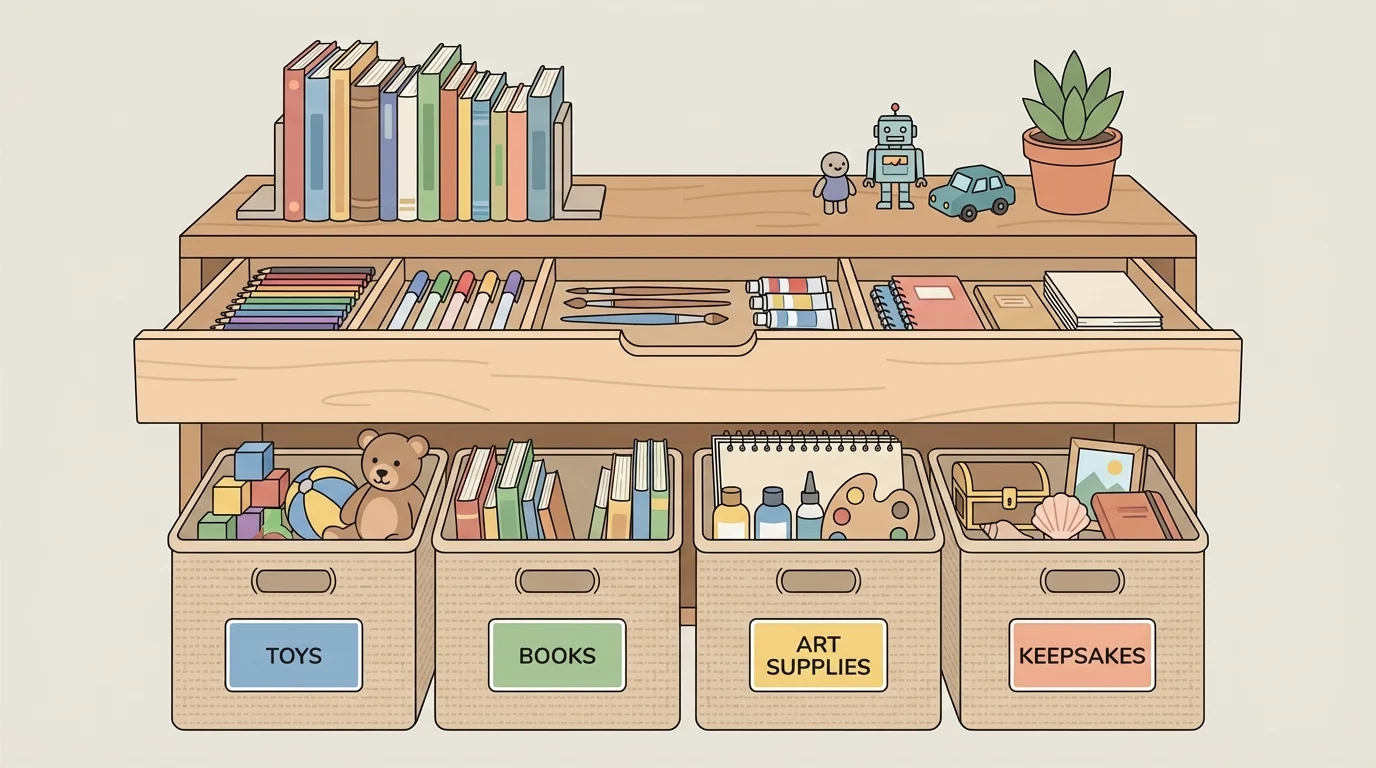
If a shelf or drawer is too full, it becomes harder to use. Try leaving a little extra space. Crowded places make it easier for papers to bend, toy pieces to spill, and clothes to wrinkle. Neat spaces are not about making everything look perfect. They are about making your daily life easier.
You can also organize by how often you use something. Items used every day should be the easiest to reach. Items used once in a while can go higher up or farther back. Special items that you want to protect can go in a safer box or drawer. Looking back at [Figure 2], notice how the bins and shelves create easy-to-remember zones.
Why simple systems work
The best organizing system is usually not the fanciest one. It is the one you can use again and again. If putting something away takes too many steps, you may stop doing it. A simple bin, hook, or labeled drawer is easier to keep up with every day.
Try This: Pick one tiny area today, such as one drawer, one shelf, or one backpack pocket. Clear it, group the items, and give each group a home. Small wins build strong habits.
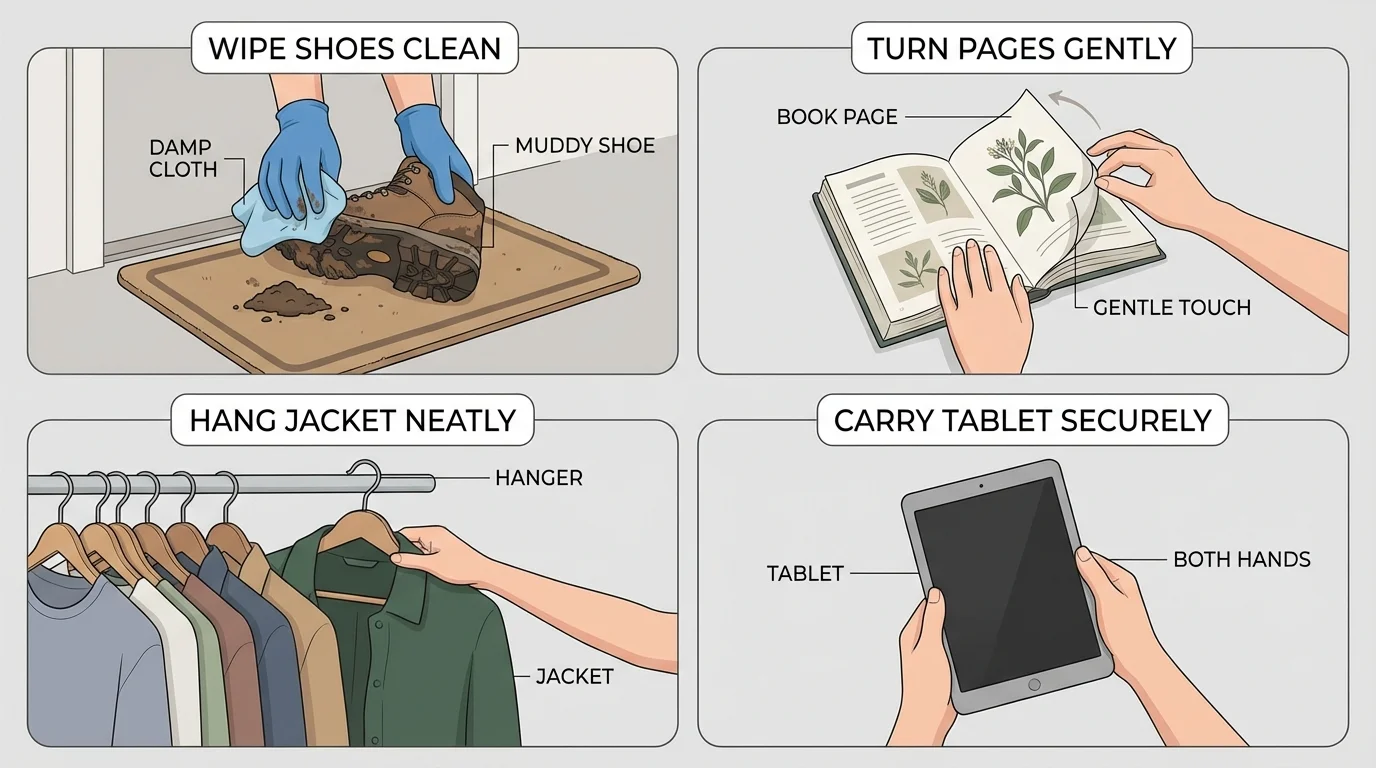
Your belongings need care just like a bike needs air in its tires or a plant needs water. Daily care keeps your items working well, as [Figure 3] illustrates with books, clothes, shoes, and electronics. Caring for things also shows respect for the work, money, and time it took to get them.
Some care habits are simple. Close markers so they do not dry out. Turn book pages gently. Put caps back on bottles. Hang up jackets instead of dropping them on the floor. Wipe dirt off shoes before putting them away. Keep food and drinks away from devices whenever possible.
For electronics, carry them with two hands if needed, keep cords untangled, and put them on a safe surface. For clothes, check whether they should be folded, hung up, or placed in the laundry. For toys and games, make sure all the pieces go back into the box or bag. For sports gear, let sweaty items air out if an adult says that is safe and helpful.
It is also important to notice damage early. A loose button, a torn backpack seam, or a cracked case can get worse if ignored. Tell a trusted adult if something needs repair. Fixing a small problem early is usually easier than dealing with a big problem later.
Clean items often work better and feel better to use. A clean water bottle is safer to drink from. A clean paintbrush lasts longer. A dust-free screen is easier to see. The actions in [Figure 3] remind you that care is made of small habits, not one giant job.
Real-life example: Caring for a favorite book
You want your favorite book to stay in good shape for a long time.
Step 1: Keep it in a dry place, not on the floor where it can get stepped on.
Step 2: Use a bookmark instead of folding the corners of pages.
Step 3: Turn pages gently and keep snacks away while reading.
Step 4: Put the book back on the shelf when you finish.
These small choices help the book last longer and stay neat.
Sometimes caring for belongings also means knowing when not to use them. If something is wet, cracked, or unsafe, stop and ask an adult for help. Responsibility includes being careful, not just being tidy.
Not everything you use belongs only to you. Some things are shared items, such as family board games, kitchen tools, blankets for guests, or sports equipment used by a team or club. Shared items need extra care because other people use them too.
If you borrow something, ask first when needed, use it the right way, and return it on time and in good condition. Do not leave it somewhere random and expect someone else to find it. If something gets damaged, be honest right away. Telling the truth quickly gives adults a chance to help fix the problem.
Special items may also need special care. A keepsake from a grandparent, a musical instrument, or a piece of jewelry may need a case, a specific shelf, or adult help when cleaning. The more special or breakable an item is, the more carefully you should handle and store it.
"Take care of your things, and your things can take care of you."
Being careful with belongings also helps in friendships and community activities. If you bring supplies to a club, keep track of them and put them away neatly. If you use borrowed gear at a park or center, return it properly. These actions build trust.
The easiest way to stay organized is to build short routines. A routine is something you do regularly in the same order. A short routine can keep messes from growing into giant problems.
Here are some helpful routines you can practice:
These routines do not need to be long. Even spending about 10 minutes can help. In numbers, that is about \(5 + 5 = 10\) minutes, split into two short tidy times. Small bits of effort add up.
You already know that habits become easier with practice. The same is true here. Repeating a simple system helps your brain remember what to do without much extra effort.
Try This: Choose one routine for this week. Maybe it is hanging up your jacket every day, returning chargers to one tray, or unpacking your bag each afternoon. One repeated action can make a surprising difference.
When packing, organizing, and caring for belongings become normal habits, you spend less time searching, less time replacing lost things, and more time doing what you enjoy. That is a real-life skill you can use every day.
