Have you ever noticed that a group works better when people can trust each other? Whether you are helping at home, joining a sports team, chatting in an online club, or spending time with neighbors, communities become stronger when people do what is right, treat others fairly, and keep their promises.
A community is a group of people who live, work, help, or spend time together. Your community can include your family, neighbors, teammates, people at a library club, kids in a dance class, or people you talk with in safe online groups. A happy community is not built only with buildings or rules. It is built with choices.
Three important choices are integrity, fairness, and reliability. These big words describe actions you can practice every day. When people use these traits, others feel safer, more respected, and more willing to help. When these traits are missing, people may feel hurt, left out, or unsure about whom to trust.
Integrity means doing the right thing, even when no one is watching.
Fairness means treating people in a just and respectful way.
Reliability means being someone others can count on.
These traits are connected. If you tell the truth, share chances, and do what you say you will do, people begin to trust you. Trust is like the glue that helps a community stay together.
Integrity means your actions match what is right and honest. It includes telling the truth, returning something that is not yours, and admitting a mistake instead of hiding it. Integrity matters at home, in public places, and online too.
Suppose you accidentally delete a shared family photo from a tablet. You might feel nervous. A person with integrity says, "I made a mistake. I'm sorry. Can we fix it together?" That can feel hard in the moment, but honesty helps people solve the problem faster.
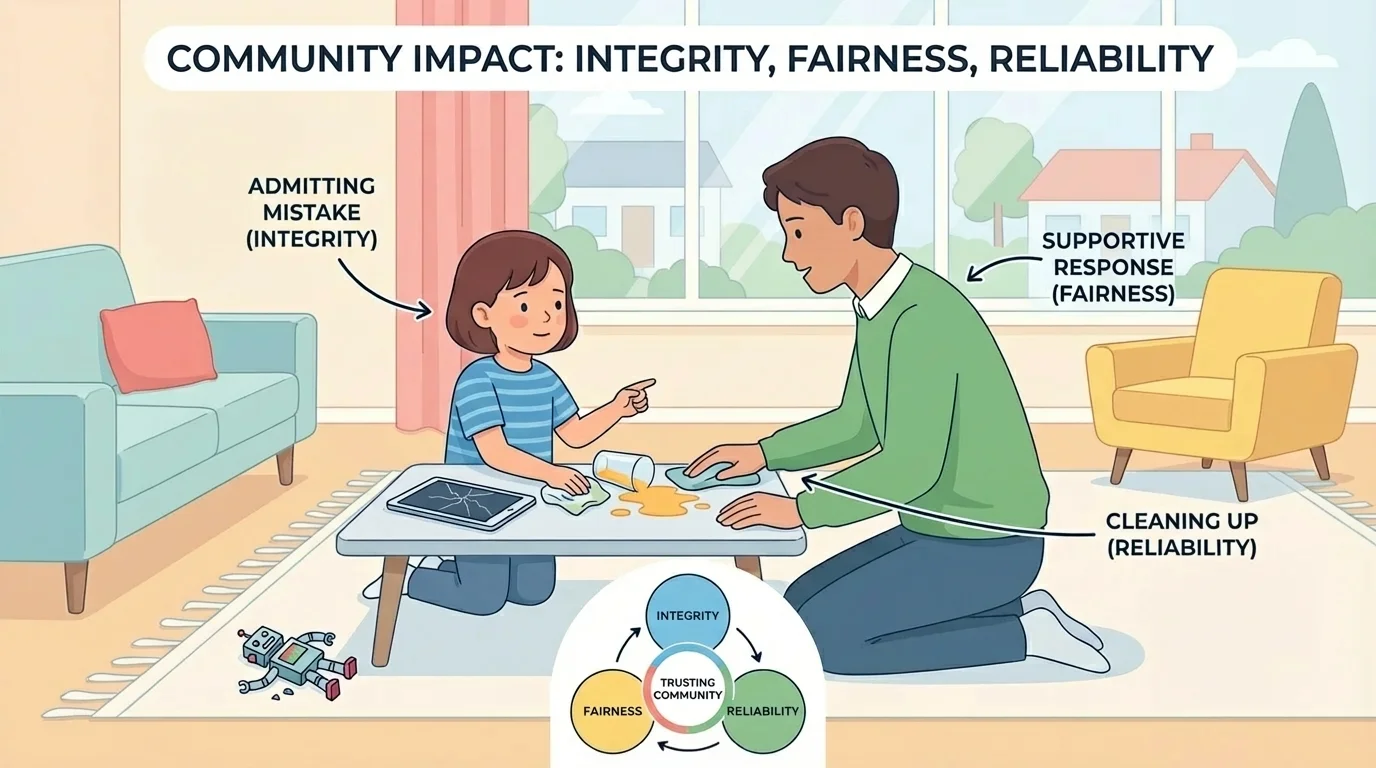
Integrity also means being truthful online. If you copy someone's art, joke, or writing and pretend it is yours, that is not honest. If you say something mean in a chat when you would never say it face-to-face, that is not acting with integrity either. Your character should stay strong in every place, including on screens.
Another part of integrity is owning your choices. Blaming someone else may seem like an easy way to escape trouble, but it damages trust. Telling the truth and taking responsibility shows courage. Over time, people learn that your words can be believed.
Real-life example: showing integrity at home
Step 1: Notice the problem.
You break a measuring cup while helping bake.
Step 2: Tell the truth.
You say, "I dropped it by accident."
Step 3: Help fix what you can.
You help clean up safely and ask what to do next.
This honest response builds trust much more than hiding the broken piece under a towel.
When people around you act with integrity, the whole community feels more secure. You do not have to wonder if they are tricking you or hiding important facts. That makes teamwork easier.
Fairness does not always mean everyone gets the exact same thing. It means people are treated with respect and given a fair chance. In a community, fairness helps people feel included and valued.
Think about a game night with neighbors or cousins. If one person always picks the game, always gets the first turn, and never lets others choose, the group starts to feel upset. A fair person takes turns, listens, and thinks about what is best for everyone, not only for themselves.
Fairness also matters in conversations. If two people are speaking during a group video call, fairness means listening to both sides before deciding what happened. It means not picking favorites just because one person is your close friend.
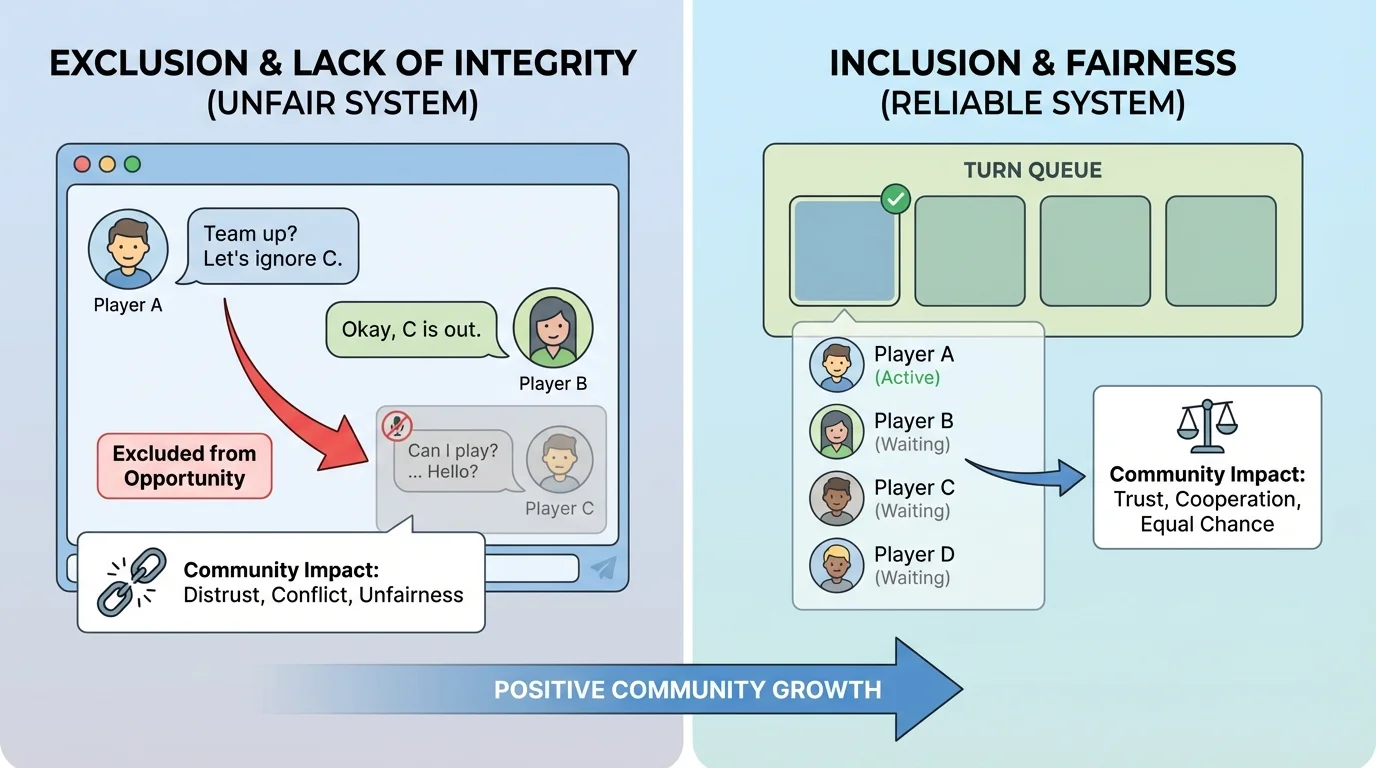
Being fair can include changing plans so everyone can join. Maybe one friend needs instructions repeated more slowly, or a younger child needs a simpler job during a community clean-up. Fairness is not being bossy or selfish. It is looking for a way that respects each person's needs.
Fairness is especially important online. If a group chat leaves one person out on purpose, spreads rumors, or laughs at mistakes, that is unfair and harmful. Fair behavior means using kind rules, not teasing, and making sure others have a chance to be part of the group.
| Situation | Unfair Choice | Fair Choice |
|---|---|---|
| Playing a game | One person always goes first | Players take turns |
| Group decision | Only one opinion matters | Everyone gets a chance to speak |
| Sharing supplies | Keeping the best items for yourself | Sharing based on need and turns |
| Online chat | Leaving someone out on purpose | Including others kindly |
Table 1. Examples comparing unfair and fair choices in everyday community situations.
When fairness is present, people are more likely to cooperate. They believe their voice matters. That helps a community solve problems with less arguing and more kindness.
Reliability means people can depend on you. If you say you will feed the pet, join the call on time, or bring supplies for a neighborhood project, reliability means you follow through.
Reliable people do not have to be perfect. Sometimes plans change. What matters is that they try their best, remember responsibilities, and communicate when there is a problem. Saying, "I will be 10 minutes late, but I am still coming," is more reliable than saying nothing at all.
Reliability helps communities run smoothly. Families count on each other for chores. Teammates count on each other in practice. Neighbors count on each other during events. If many people forget, quit, or disappear without telling anyone, the group has trouble finishing even simple jobs.
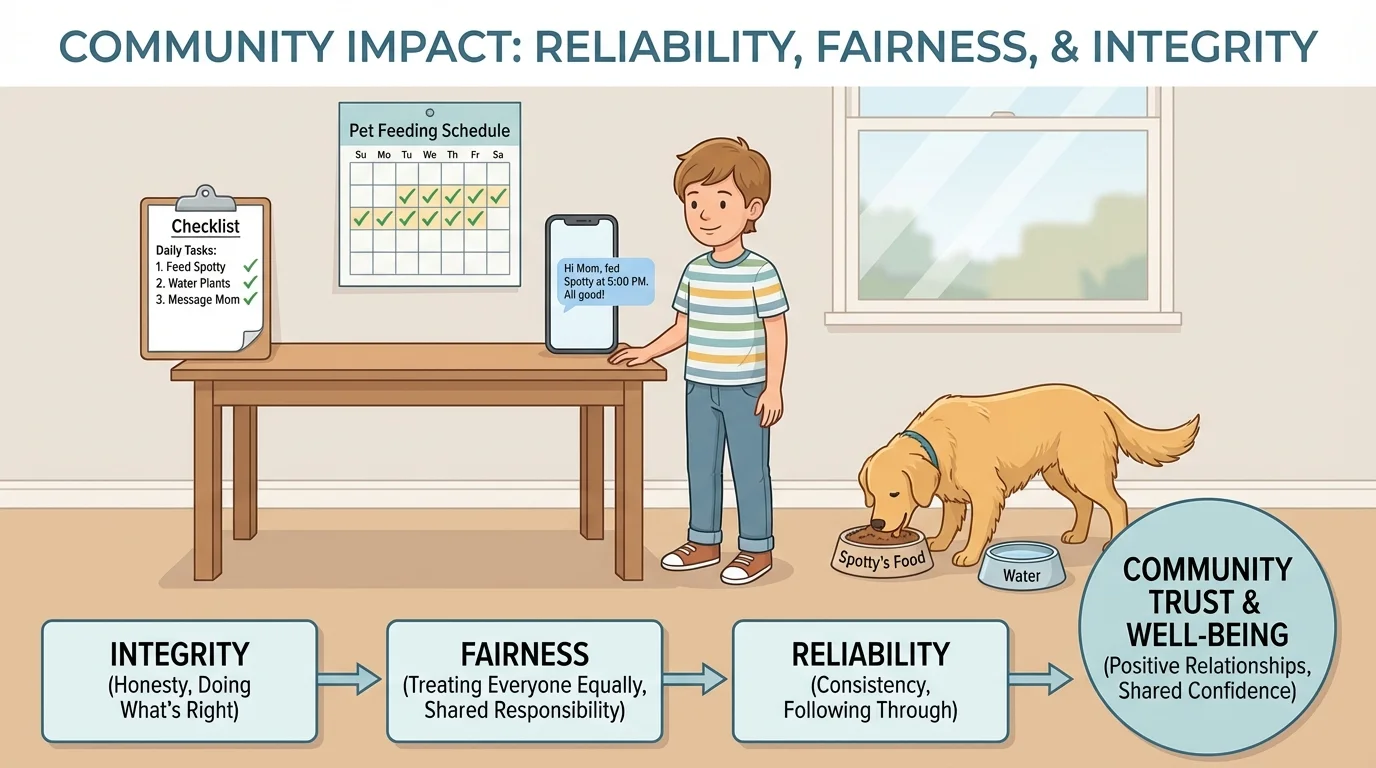
One way to build reliability is to use tools. A checklist, a calendar, or a reminder alarm can help you remember what you promised. That is not cheating. It is a smart way to become more dependable.
Why reliability builds trust
When you keep your word again and again, people start to relax. They do not need to chase you, remind you, or worry that the job will be forgotten. This saves time, lowers stress, and helps the whole group work better together.
If you cannot finish something, reliability still matters. You can speak up early, ask for help, or offer a new plan. Being dependable includes honest communication, not disappearing without saying anything.
Integrity, fairness, and reliability are stronger together than alone. A community needs honest people, but honesty without fairness can feel harsh. A community needs fair rules, but rules do not help much if people never follow through. A community needs reliable helpers, but reliability without integrity could mean someone keeps a promise for the wrong reason or hides the truth.
These three traits create trust. Trust means people believe you will be honest, kind, and dependable. We can see this connection again in [Figure 1], where telling the truth after a mistake opens the door to solving the problem together instead of creating more trouble.
Fair treatment also supports trust. As we saw in [Figure 2], people want to join in when they know they will not be ignored or pushed aside. And dependable actions matter too. The planning tools in [Figure 3] show that reliability often grows from good habits, not just good wishes.
Communities do not only mean neighborhoods. A family, a sports team, a faith group, a volunteer club, and even a well-managed online group can all be communities when people work together and care about one another.
When these traits work together, people share more, argue less, and solve problems faster. They know what to expect from each other, and that helps everyone feel safer.
It is easier to understand these traits when you also see what happens without them. If people are dishonest, others start to doubt their words. If people are unfair, some members feel left out or mistreated. If people are unreliable, jobs stay unfinished and plans fall apart.
Think about a small neighborhood garden project. One child says they watered the plants but did not. Another keeps choosing the biggest vegetables only for their own family. A third promises to bring tools and never arrives. Soon the garden is dry, people are upset, and nobody feels like working together.
The same thing can happen online. If someone lies in a group chat, makes unfair jokes, or never does their part in a shared project, the group becomes frustrated. People may stop participating because the space no longer feels respectful or dependable.
"Trust takes time to build, but it can break quickly."
That is why everyday choices matter. Small moments, like telling the truth about a mistake or giving someone else a turn, can protect a community from bigger problems later.
You do not need to wait until you are older to help your community. You can practice these traits right now in simple ways.
To practice integrity: tell the truth, even when it feels uncomfortable; return things you borrow; admit mistakes; and match your online behavior to your real-life values.
To practice fairness: take turns; listen before judging; include others; use kind rules; and think, "Would this feel fair if it happened to me?"
To practice reliability: keep your promises; use reminders; finish tasks; be on time when you can; and let people know early if something changes.
A quick choice guide
Step 1: Stop and think.
Ask yourself, "What is the right thing to do?"
Step 2: Check for fairness.
Ask, "Does everyone get respect and a chance?"
Step 3: Check for reliability.
Ask, "Can people count on me to do this?"
Step 4: Make the best choice.
If needed, speak honestly, fix your mistake, or ask for help.
This simple check can help in many situations, from sharing snacks with siblings to working in a community club.
Here are a few ways these traits show up in ordinary life.
At home: You promise to set the table. Reliability means you do it. Integrity means you tell the truth if you forgot. Fairness means everyone shares jobs in a reasonable way.
On a team: You cheer for others, not only yourself. Fairness means everyone gets respect. Reliability means coming prepared. Integrity means playing by the rules, even when an adult is not watching.
In a neighborhood: If a neighbor drops groceries, integrity helps you return the items that rolled away instead of keeping one. Fairness means helping kindly, not pushing ahead. Reliability means doing your part if you signed up to help at an event.
In an online club or chat: Integrity means using honest words and not pretending to be someone else. Fairness means not excluding or teasing others. Reliability means replying when expected, doing your share in a project, and following safe group rules.
You already practice community skills when you share space, follow family expectations, wait for your turn, or help with a group job. This lesson adds names to those good habits and shows why they matter.
Try This: Pick one promise today that you can keep all the way through. It could be putting away your art supplies, feeding a pet, or replying kindly in a group message.
Try This: The next time there is a choice about turns, speak up for fairness by saying, "Let's make sure everyone gets a chance."
Try This: If you make a mistake this week, practice integrity by telling the truth quickly and helping fix what happened.
Every strong community is built one choice at a time. When you act with integrity, fairness, and reliability, you help create a place where people feel respected, included, and able to trust one another.
