One small choice can change a whole day. If you copy an answer, leave a chore unfinished, or send a mean message, the problem may start small but grow bigger. If you tell the truth, help fairly, and treat people kindly, trust grows instead. Ethical choices are the choices that help you do what is right, even when no one is watching.
Every day, you make choices at home, online, and in your community. These choices show your character, which means the kind of person you are becoming. People learn whether they can count on you by watching what you do again and again. A good choice can build trust. A poor choice can weaken trust.
Ethical choices matter because they affect community. A community is a group of people who live, learn, work, or spend time together. Your family is a community. A sports team is a community. An online club is a community. When people act honestly and respectfully, everyone feels safer and more included.
Ethics means thinking about what is right and wrong and choosing actions that are honest, fair, respectful, and responsible.
Responsibility means doing what you are supposed to do and taking ownership of your actions.
Trust means people believe you will do the right thing and tell the truth.
Being ethical does not mean being perfect. It means trying to do what is right, fixing mistakes, and learning from them. Sometimes the right choice is easy. Sometimes it is hard, especially when you are frustrated, rushed, or worried about getting in trouble.
Ethics is not just a big word. It shows up in simple moments: telling the truth about whether you finished your reading, giving credit when someone helps you, speaking kindly in a group chat, or cleaning up your part of a shared space. These moments may seem small, but they add up.
Four helpful guides can point you toward an ethical choice: honesty, fairness, respect, and responsibility. Honesty means being truthful. Fairness means not cheating or taking more than your share. Respect means treating people and things with care. Responsibility means doing your part without always being reminded.
Right choices often protect both people and trust. A choice is usually ethical when it helps you tell the truth, avoids harm, treats others fairly, and shows you can be trusted. Sometimes you may not get the easiest result, but you build something more important: strong character and healthy relationships.
You can ask yourself simple questions like: Is it true? Is it kind? Is it fair? Is it safe? Would I feel okay if a parent or teacher saw this choice? These questions can help when you feel unsure.
When you learn online, many schoolwork choices happen quietly at home. That is why ethics matters so much. In schoolwork, [Figure 1] shows a common moment of decision: you may feel tempted to copy, peek at someone else's work, or let someone else do the thinking for you. Honest schoolwork helps you really learn, and it shows others they can trust your effort.
Doing your own work does not mean doing everything alone. It is ethical to ask for help when you need it. You can ask someone to explain directions, read a question with you, or help you understand a hard part. It is not ethical to have someone give you the answers and pretend the work is yours.
Here are some ethical choices for schoolwork:
If you are taking a quiz and a friend messages you the answers, the ethical choice is not to use them. You might get a higher score for one moment, but you lose something important: honesty and real learning. Later, when the work gets harder, you may feel more confused because you skipped the chance to learn.
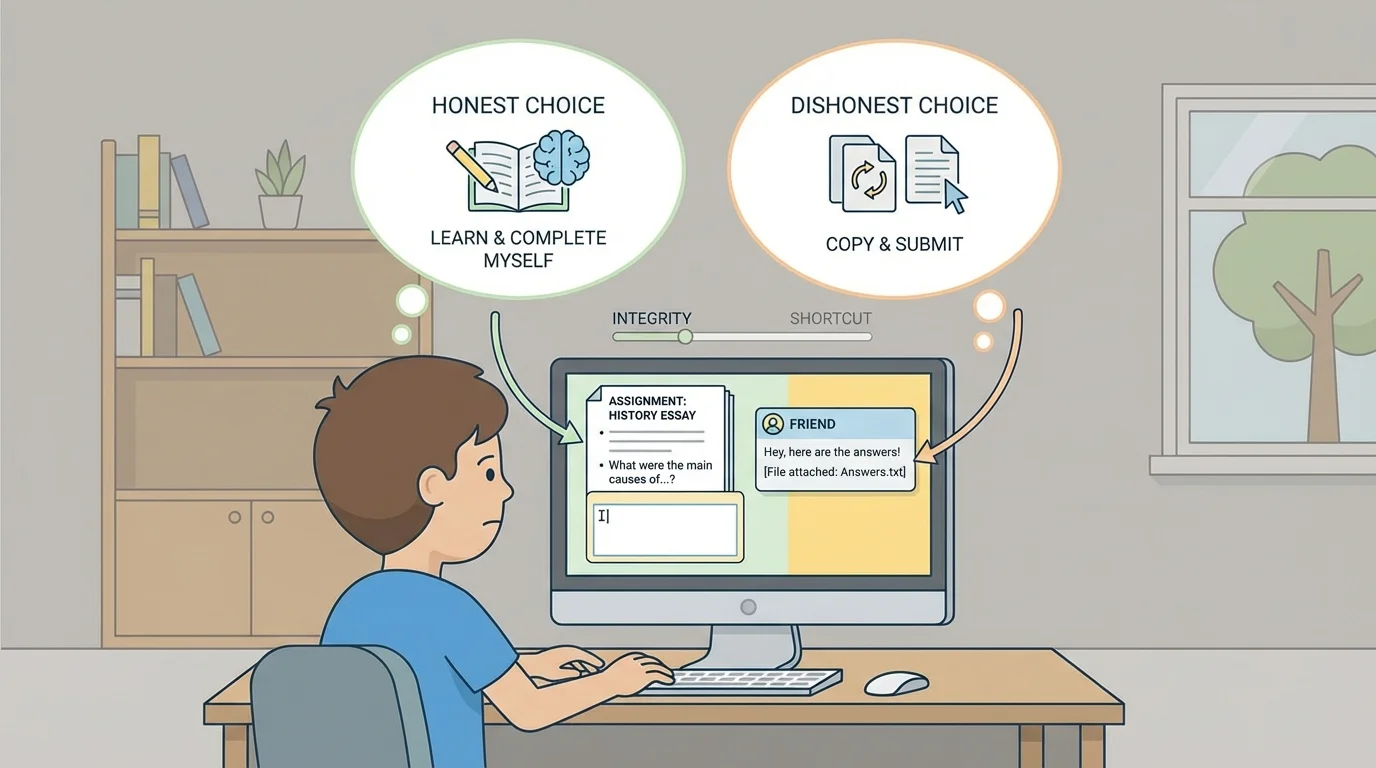
Sometimes students think, "I only copied a little." But even small cheating is still cheating. Ethical choices are not only about big problems. They are about small actions repeated over time.
Schoolwork example: asking for help the right way
Step 1: Say what you understand.
You might say, "I know the story is about a storm, but I do not understand the last question."
Step 2: Ask for support, not answers.
You might ask, "Can you explain what the question means?" instead of "Tell me what to write."
Step 3: Finish the thinking yourself.
After you get help, write your own answer in your own words.
This keeps your work honest and helps your brain grow stronger.
Good digital behavior matters too. If you post someone else's project picture as if it were yours, that is dishonest. If you share private class information without permission, that is not respectful or safe. As we saw earlier in [Figure 1], online choices often happen when no one is standing nearby, so self-control is very important.
Friendship needs care. In online friendships, your words can help someone feel included, or they can hurt deeply. [Figure 2] illustrates how the same kind of chat can feel very different depending on whether people are respectful or unkind. Ethical friendship choices include honesty, kindness, listening, and standing up for what is right.
Being a good friend does not mean agreeing with everything. It means telling the truth kindly, keeping safe secrets and not unsafe secrets, and treating others with respect. For example, if a friend says something mean about another person in a group chat, an ethical choice is not to join in.
Online messages can move fast. A joke that seems funny to one person may feel cruel to someone else. Before you send a message, pause and reread it. Ask: Would I say this kindly in a video call? Could this embarrass someone? Once words are sent, they can be hard to take back.
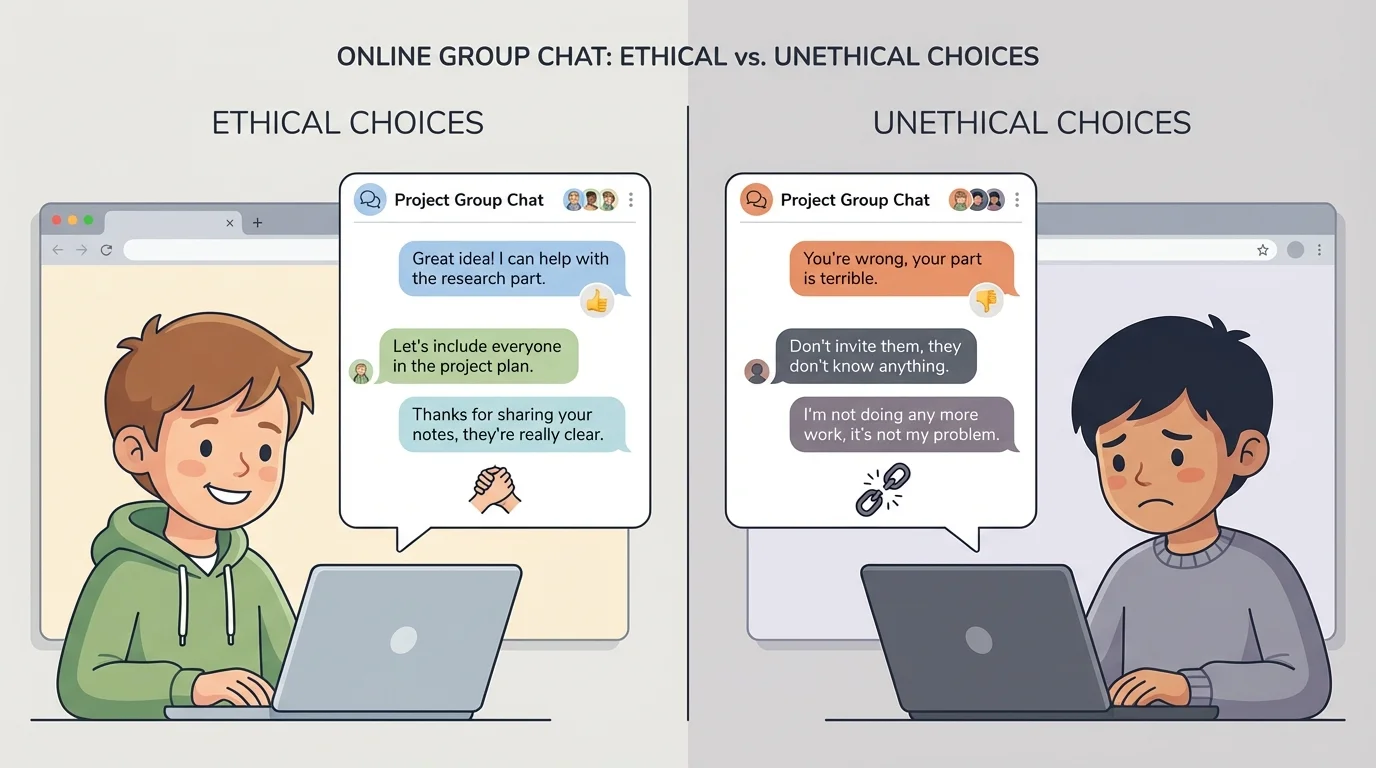
Ethical friendship choices can look like this:
Sometimes the right choice feels uncomfortable. You may worry that others will be annoyed if you say, "That is not kind," or "Please stop." But speaking up can protect someone. Respect is not only about being nice when things are easy. It is also about doing the right thing when it matters.
People often feel braver saying unkind things behind a screen than face-to-face. That is one reason pausing before posting is such an important ethical habit.
Healthy friendships also include fairness. If you always choose the game, always talk over others, or expect help but never give help, the friendship can feel one-sided. Fair friendships make room for both people.
Later, when you think about online behavior again, [Figure 2] reminds you that words can either build belonging or create hurt. Your message, comment, or reply is a real action with real effects.
Shared responsibilities are jobs, spaces, or items used by more than one person. At home, this might mean feeding a pet, helping clean the kitchen, putting away art supplies, or taking turns with a device. In a club or team, it might mean bringing what you promised or helping set up and clean up.
Ethics matters here because shared jobs only work well when people do their part. If one person keeps saying, "Someone else will do it," the work becomes unfair. When you follow through, you show responsibility.
Here are examples of ethical choices with shared responsibilities:
Suppose your family agrees that you will water the plants on certain days. If you forget, an unethical choice is to say, "My brother must have done it wrong." An ethical choice is to say, "I forgot. I will do it now, and next time I will set a reminder." That answer shows honesty and problem-solving.
Shared responsibility example: using a shared tablet fairly
Step 1: Follow the agreed turn time.
If the plan is 30 minutes each, stop when your turn is over.
Step 2: Leave it ready for the next person.
Charge it if needed and close your apps.
Step 3: Speak up honestly if there is a problem.
If the device froze or you need extra time for schoolwork, explain calmly and ask instead of taking more time without permission.
Fair sharing helps everyone feel respected.
Doing your part now also helps prepare you for the future. As you grow, people will trust you with bigger jobs. Responsibility at age eight can become reliability later in school, work, and family life.
When a choice feels tricky, a simple guide can help. [Figure 3] presents an easy path you can use: ask whether the choice is honest, kind, fair, safe, and something you would be proud to share with a trusted adult. If the answer is "no" to one of these, stop and think again.
You do not have to solve every problem in one second. Taking a pause is smart. Ethical choices often get easier when you slow down.
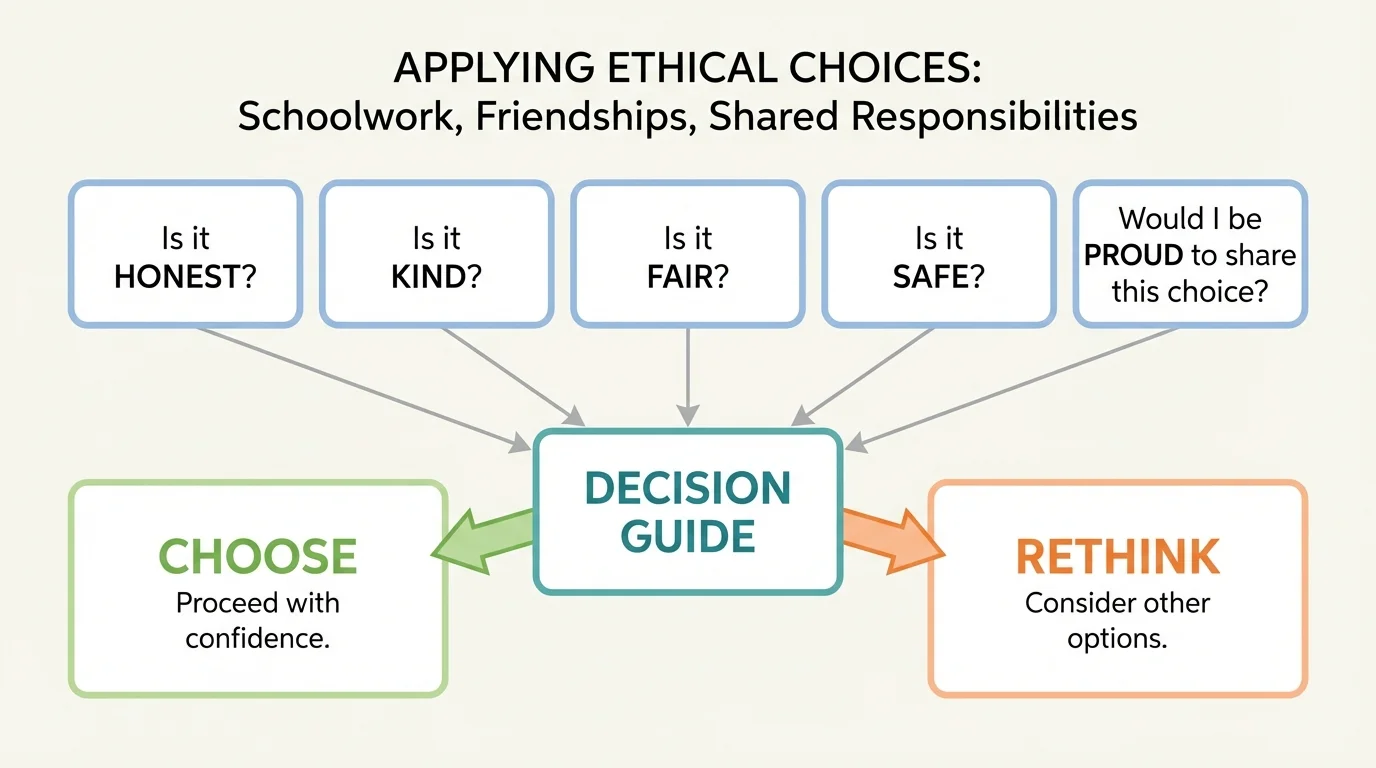
Step 1: Stop. Do not rush.
Step 2: Name the choice. What am I about to do or say?
Step 3: Check honesty. Am I telling the truth?
Step 4: Check kindness and respect. Could this hurt someone?
Step 5: Check fairness. Am I taking more than my share or breaking a rule on purpose?
Step 6: Check safety. Does this put someone in danger or break privacy?
Step 7: Decide. If the choice passes these checks, go ahead. If not, pick a better action.
This guide works in many situations. You can use it before sending a message, before answering a test question, before blaming someone, or before skipping a chore. The flow in [Figure 3] helps you remember that one pause can prevent a bigger problem.
Everyone makes mistakes. Maybe you were unkind in a message, copied part of an answer, or ignored your job at home. An ethical person does not pretend nothing happened. An ethical person tries to repair the harm.
A good repair often has four parts. First, tell the truth. Second, say you are sorry. Third, fix what you can. Fourth, make a plan to do better next time. For example: "I sent a rude message. I am sorry. I deleted it and checked on my friend. Next time I will pause before I post."
"Doing the right thing matters, even when it is hard."
Sometimes rebuilding trust takes time. If someone is disappointed, they may need to see better choices again and again. That is normal. Trust grows through repeated actions.
You build ethical strength the same way you build many skills: with practice. Small habits help. Put devices away when it is time to work. Use reminders for chores. Reread messages before sending. Tell the truth quickly. Return borrowed things. Clean up after yourself. Say thank you when others help.
Integrity means doing what is right even when no one is watching. That may sound like a big idea, but you practice it in small ways every day. When you choose honesty in private, kindness in messages, and fairness in shared jobs, you are building integrity.
You already know that choices have consequences. Good choices often bring trust, peace, and stronger relationships. Poor choices often bring confusion, hurt feelings, extra problems, or lost privileges.
Try this in daily life: before schoolwork, ask, "Will this help me learn honestly?" Before messaging a friend, ask, "Are my words kind and respectful?" Before leaving a shared space, ask, "Did I do my part?" These tiny check-ins can become powerful habits.
Your future self benefits from the ethical choices you make now. People who can be trusted, who care about others, and who take responsibility are often the people others want on their team, in their family, and in their community.
