Have you ever noticed that adults use school skills all day long, even when they are not sitting in school? A nurse reads instructions carefully. A chef measures ingredients. A mechanic follows steps in order. A college student listens, takes notes, and asks questions. The skills you practice now are not just for finishing assignments. They are tools you will keep using as you grow.
When you learn from home in an online school, you are already building important habits for the future. You are learning how to manage your time, use technology, speak clearly online, and stay focused without someone standing beside you. These are powerful skills for later learning, future jobs, and life at home and in your community.
Future learning means the new things you will study later, such as more advanced classes, job training, or college courses.
Life roles are the different jobs and responsibilities people have, such as being a student, worker, helper, family member, neighbor, or leader.
School skills connect to your future because they help you do real tasks. They also help people trust you. When you can follow directions, finish what you start, and work kindly with others, you are building a strong foundation for the future.
Some students think, "Why do I need this?" That is a smart question. The answer is that many things you do in school are really practice for life. A reading assignment helps you understand instructions later. A writing task helps you send clear messages. A math problem helps you make wise financial decisions. A class discussion helps you share ideas and listen to others.
Even small habits matter. Logging in on time, keeping track of assignments, and staying organized are not only school tasks. They are early forms of the same habits adults use when they go to work, pay bills, care for children, or take college classes online.
Many adults still learn online long after they finish school. People take training classes, watch video lessons, and earn certificates for new jobs, so the learning habits you build now can keep helping you for many years.
This means your school life and your future life are connected. You are not just learning facts. You are practicing how to be a person who can learn, solve problems, and take responsibility.
Many school skills connect directly to everyday grown-up tasks, as [Figure 1] shows through clear links between what students practice now and what people do later in jobs, training, and daily life. These skills may look simple today, but they become very important over time.
Reading helps you understand directions, recipes, safety rules, emails, signs, and forms. If you can read carefully, you are less likely to miss something important. For example, if a person reads medicine directions too fast, they may use it the wrong way. Careful reading keeps people safe and informed.
Writing helps you explain your ideas, send messages, fill out applications, and keep notes. Clear writing helps other people understand you. If you write a confusing message to a coach, club leader, or future boss, they may not know what you need. Good writing saves time and prevents mistakes.
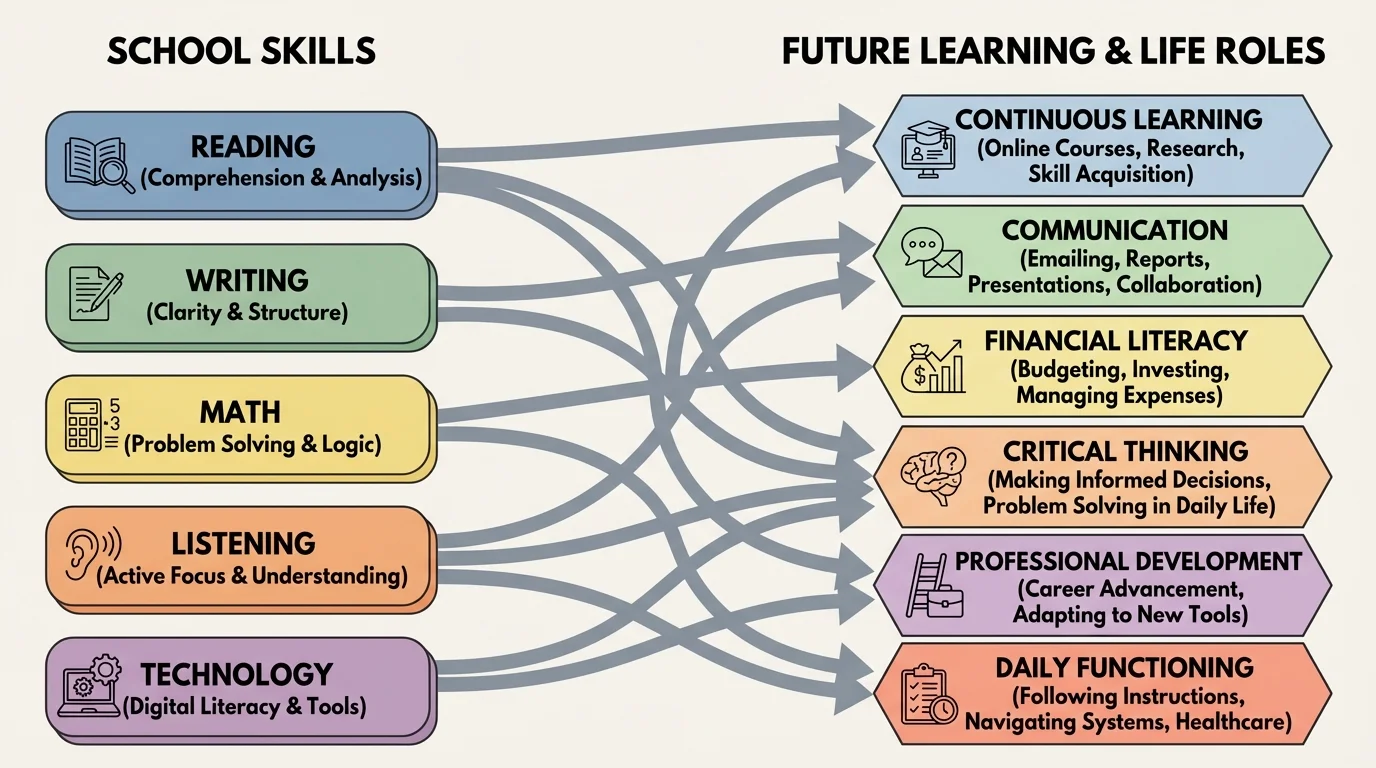
Math helps you count money, compare prices, measure ingredients, tell time, and plan ahead. You might use math to split a snack recipe in half, save for a game, or check if you have enough money to buy two items. If one item costs $6 and another costs $4, you can figure out that the total is \(6 + 4 = 10\). That kind of thinking matters in daily life.
Listening helps you learn from teachers, coaches, family members, and future supervisors. Good listening means you hear the whole message instead of just part of it. That helps you follow directions correctly the first time.
Technology skills are especially important in online school. Knowing how to log in, type, upload work, and communicate respectfully online prepares you for future digital learning. Many jobs and college programs use computers every day. The skill of being able to learn and work online gives you a real advantage.
When you look again at [Figure 1], you can see that one school skill often connects to many future uses. Reading is not only for books. Writing is not only for assignments. Math is not only for worksheets. These are life tools.
Responsibility means doing what you are supposed to do, even when it is not easy. It includes being honest, prepared, and dependable. People trust responsible students because they can count on them.
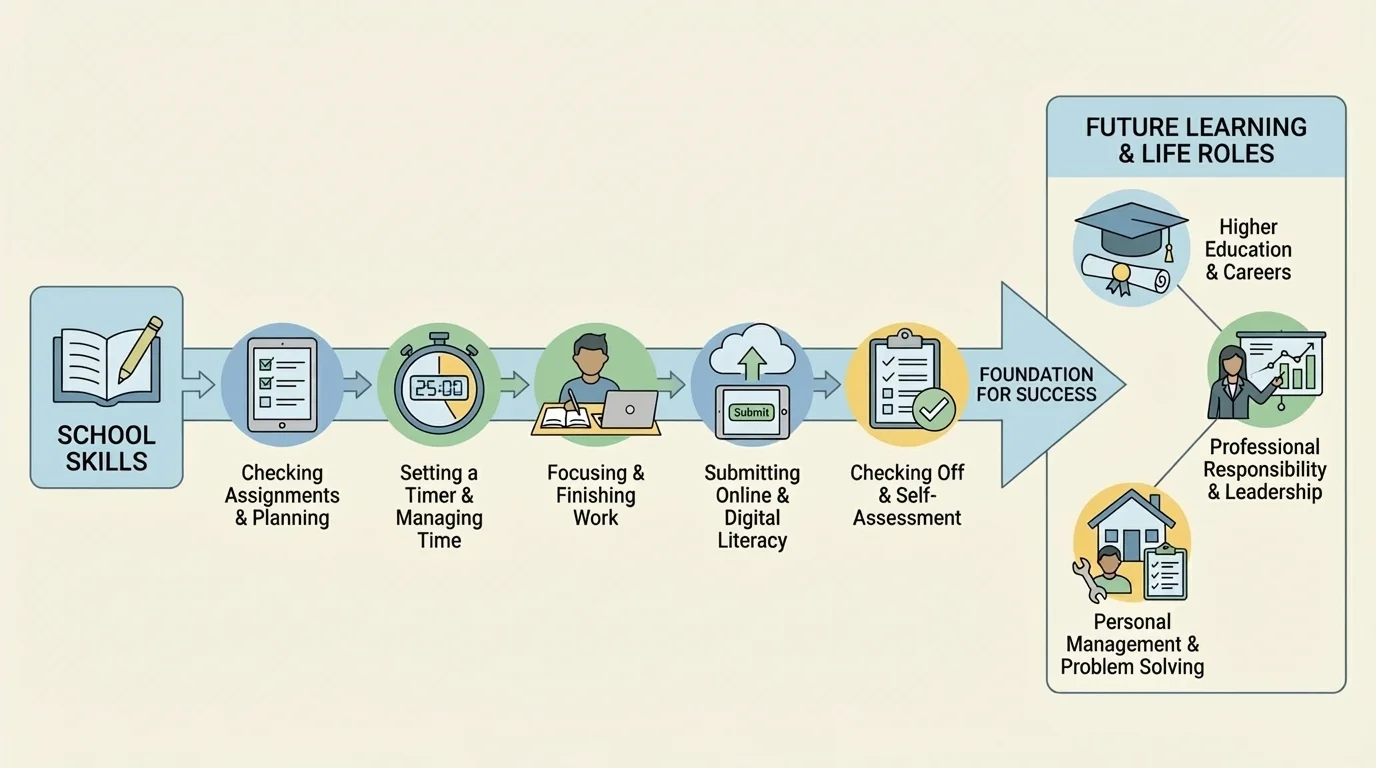
Responsibility grows through small repeated actions, and [Figure 2] shows a simple routine that turns good intentions into daily habits. You build responsibility when you check your work, meet deadlines, tell the truth, and fix mistakes instead of hiding them.
Why trust matters
Trust is built when your actions match your words. If you say you will finish something and then do it, people learn they can rely on you. Trust is important in school, college, friendships, teamwork, and jobs.
Here is a simple responsibility routine you can use in online school. Step 1: Check what you need to do. Step 2: Pick one task to start. Step 3: Work until it is done or until your timer ends. Step 4: Check your work. Step 5: Submit it. Step 6: Mark it complete.
This kind of routine matters because it turns a big job into smaller parts. If an assignment feels hard, you do not have to solve everything at once. You just take the next step.
Responsibility also means using your time well. If you keep putting off work, problems can pile up. One late assignment can become several. Then stress grows. But if you do a little at a time, the work stays manageable.
It also means being honest. If you forget an assignment or make a mistake, the best choice is to tell the truth and ask how to fix it. Honest people are trusted more than people who make excuses or blame others.
Real-life example: Responsibility at home
Maya has two online assignments and wants time to play later.
Step 1: She checks her online class list and writes down the two tasks.
Step 2: She chooses the shorter task first so she can get started quickly.
Step 3: She sets a timer for \(20\) minutes and works without opening games.
Step 4: She rereads her answers, submits the task, and checks it off.
Step 5: She begins the second task with a calm mind because she already made progress.
Maya feels proud, and later she has free time without worrying about unfinished work.
Later, when you take more advanced classes or have a job, this same kind of routine will help you meet expectations. That is why responsibility is more than a school rule. It is a life skill.
Even in online school, community skills matter, and [Figure 3] illustrates how respectful digital communication helps people learn and work together. Community skills are the ways you treat other people when you share space, time, goals, or conversations.
These skills include kindness, patience, taking turns, and using respectful words. They also include asking for help in a clear way and offering help when you can. In video calls, chats, clubs, sports teams, and neighborhood activities, people want to work with someone who is calm and respectful.
Good online communication is part of this. You can show respect by reading a message carefully before answering, using polite words, and staying on topic. If you disagree, you can still be kind. You can say, "I see it differently because..." instead of saying something rude.
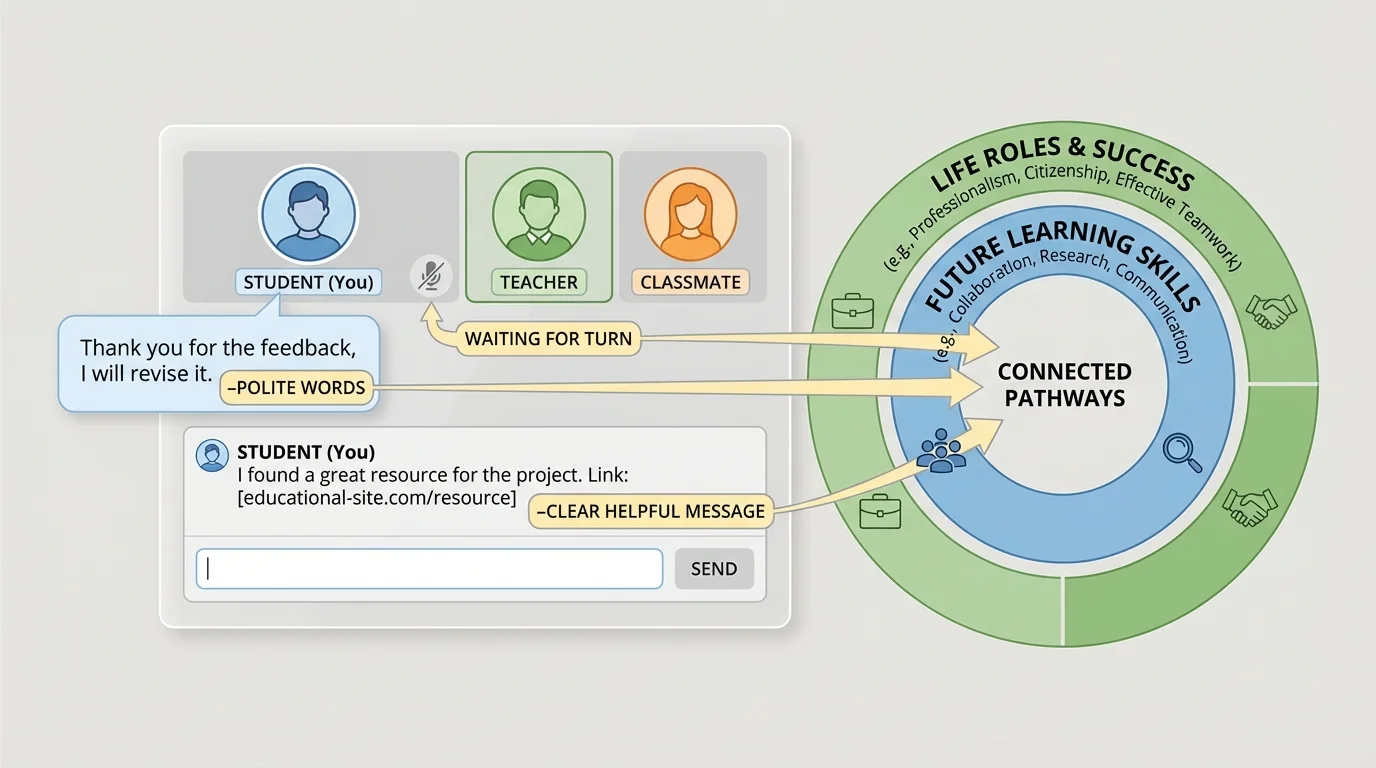
Listening is a community skill too. When someone speaks, listening shows that their words matter. If you interrupt, ignore directions, or answer without paying attention, teamwork becomes harder.
Community skills are important in future learning because colleges, training programs, and jobs often involve group projects, meetings, and shared responsibilities. Looking back at [Figure 3], you can see that even simple choices such as waiting for your turn or writing a clear message can make teamwork smoother.
"The way you treat people is part of what people learn about you."
That idea is powerful. People remember whether you were helpful, respectful, and dependable. Your behavior becomes part of your reputation.
Your current habits shape how ready you will be for future learning. Someday you may take advanced classes, join a job-training program, earn a certificate, or go to college. Those paths may be different, but they all require similar habits: paying attention, staying organized, asking questions, and keeping going when something is difficult.
Post-secondary learning is any learning after high school, such as college, trade school, certificate programs, or special training. Students who are prepared for it often know how to manage assignments, communicate with teachers, and study without needing constant reminders.
You already practice some readiness skills now when you log in independently, keep track of work, and solve simple problems before asking for help. These are signs that you are growing as a learner.
One important future-learning skill is asking good questions. A good question is clear and specific. Instead of saying, "I don't get it," you might say, "Can you explain what I should do after I read the story?" That makes it easier for the other person to help you.
Another important skill is sticking with hard things. Not understanding something right away does not mean you cannot learn it. Strong learners try again, use notes, ask questions, and practice. That persistence will help you in every future learning setting.
Technology skills also matter more and more over time. Many adults complete forms online, join meetings online, and take classes online. The digital habits you build now can support your future success.
The same school habits can support many future roles. [Figure 4] shows how one student can grow into many paths such as learner, worker, helper, and leader. You do not need to know your whole future right now to start preparing for it.
You may be a role model for a younger child, a teammate on a sports team, a volunteer in your community, a worker with a job, a college student, or a family helper who takes care of responsibilities at home. Each role uses some of the same skills: responsibility, communication, problem-solving, and respect.
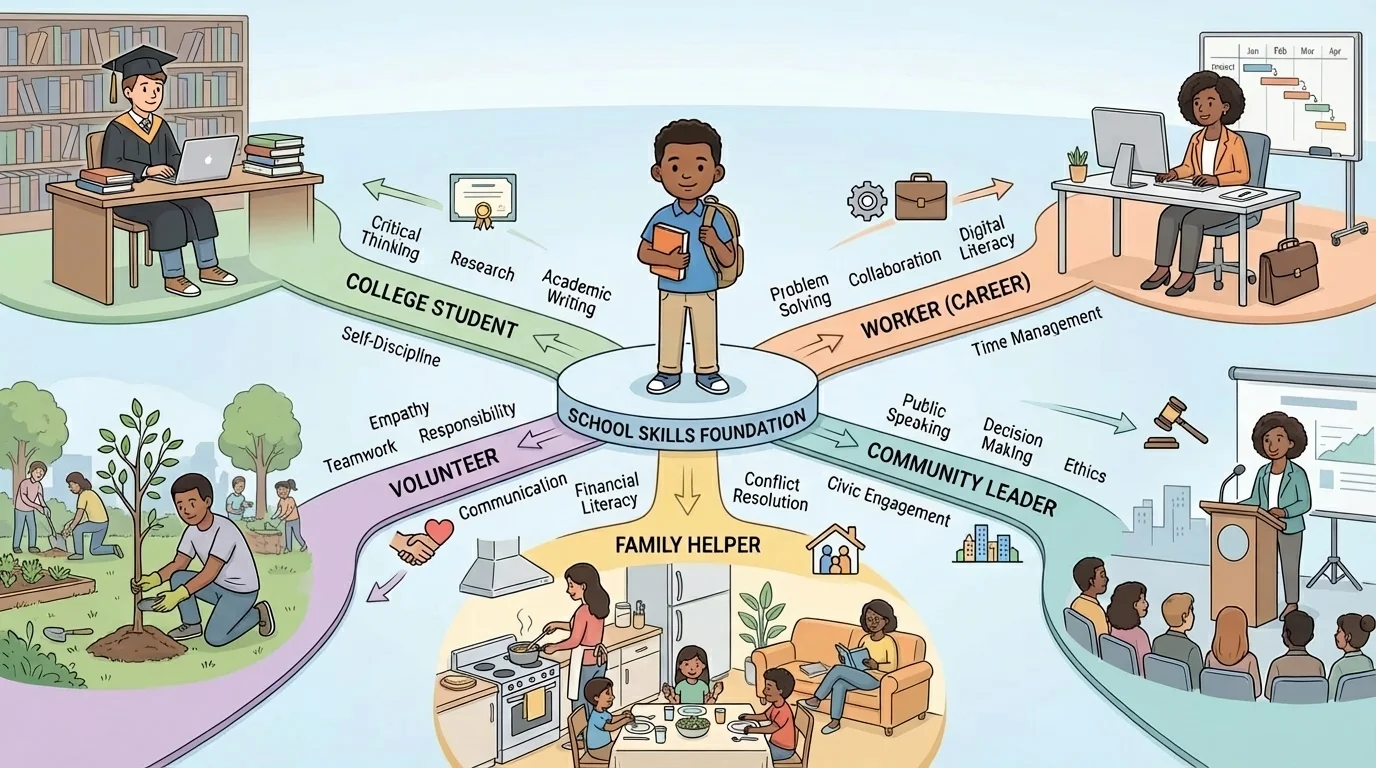
For example, a family helper may need to remember chores, read directions, and manage time. A worker may need to arrive prepared, listen carefully, and complete tasks. A college student may need to take notes, ask questions, and stay organized. A leader may need to speak clearly, make fair choices, and help others feel included.
When you look back at [Figure 4], notice that no matter which path a person takes, basic school skills still matter. The future may change, but strong habits keep helping.
| School skill | Future learning use | Life role use |
|---|---|---|
| Reading | Understanding directions and assignments | Reading forms, recipes, rules, and messages |
| Writing | Taking notes and answering questions | Sending emails, making lists, filling out applications |
| Math | Solving problems in later classes | Budgeting, measuring, shopping, planning time |
| Listening | Learning from teachers and trainers | Following instructions at work or home |
| Responsibility | Meeting deadlines and staying organized | Being dependable and trusted |
| Community skills | Working in groups and asking for help | Being a good teammate, neighbor, and leader |
Table 1. Connections between common school skills, future learning, and everyday life roles.
You do not have to wait until you are older to build these skills. You can practice them now in small ways every day.
Try This: Before your school day starts, look at your tasks and choose the first one you will do. Starting with a plan helps you feel calmer and more prepared.
Try This: Keep a simple checklist. Each time you finish a task, check it off. This helps you see progress and remember what is done.
Try This: Practice sending clear messages. If you need help, include the problem and one detail. For example: "I finished question \(1\), but I do not understand question \(2\)."
Try This: Use a timer. Work for \(15\) or \(20\) minutes, then take a short break. This can help you stay focused.
Try This: Help at home by following directions for a task like setting the table, organizing materials, or helping measure ingredients. Those are real ways to practice responsibility and careful listening.
Real-life example: Using school skills during a home task
Jordan helps make sandwiches for lunch.
Step 1: Jordan reads the steps in order.
Step 2: Jordan listens when a family member explains where the ingredients are.
Step 3: Jordan counts how many plates are needed.
Step 4: Jordan cleans up afterward without being reminded.
That one task uses reading, listening, counting, and responsibility all at once.
Practicing in small ways is important because skills grow through repetition. A person does not become responsible in one day. They become responsible by making good choices again and again.
It helps to understand the real-world consequences of these skills. When skills are strong, life often runs more smoothly. When skills are weak, problems can grow.
If you read carefully, you are more likely to follow directions correctly. If you write clearly, others understand you. If you listen well, you miss fewer important details. If you manage your time, work is less likely to pile up. If you are respectful online, people are more willing to help and work with you.
But when these skills are weak, the opposite can happen. A student who ignores directions may redo work. A person who sends rude messages may lose trust. Someone who keeps delaying tasks may feel rushed and stressed. A worker who does not listen may make mistakes. A learner who never asks questions may stay confused longer than necessary.
Small choices grow into big patterns
One choice may seem tiny, but repeated choices shape habits. Habits shape your reputation and your readiness for future learning and life. That is why everyday actions matter.
The good news is that skills can improve. If something is hard for you now, that does not mean it will always be hard. You can practice. You can ask for help. You can build stronger habits one step at a time.
Your future is not built in one giant moment. It is built in many small moments: reading carefully, speaking kindly, finishing tasks, telling the truth, and trying again. Those school skills are also life skills, and they can open doors for you later.
