Have you ever said, "I want to do better," but then felt unsure what to do next? That happens to lots of people. A goal helps turn a big idea into something you can actually do. When you know your goal, your steps, and how to check your progress, you are more likely to finish what you started.
A short-term goal is something you want to reach soon. It might take a day, a week, or a few weeks. Short-term goals are useful because they help you practice responsibility. They help you remember what matters, use your time wisely, and keep going even when you feel distracted.
Short-term goals show up in real life all the time. You might want to read for 15 minutes each day this week, save money for a small item, finish a chore chart, learn to tie your shoes more quickly, or practice being kind in online chats with a club or gaming group. These are not just school ideas. They are life skills you can use at home and in your community.
Short-term goal means something you want to achieve in a short amount of time.
Progress means the forward steps you make as you work toward your goal.
Adjust means to change your plan in a smart way when needed.
When goals are used well, they help you feel proud and confident. When people do not use goals, they may forget important tasks, quit too soon, or feel upset because they do not know what to do first. A goal gives your effort a direction.
A goal is not the same as a wish. A wish sounds like, "I wish my room stayed clean." A goal sounds like, "I will put away toys and books for 10 minutes each night this week." The second one tells what you will do.
Good short-term goals are specific. That means they are clear, not fuzzy. "Be better at reading" is not very clear. "Read one chapter book for 10 minutes each evening for 7 days" is much clearer. If you can tell what to do, you are more likely to do it.
A good goal should also be realistic. You want a goal that stretches you a little, but does not feel impossible. If a goal is too big, your brain may say, "That is too much," and you may stop. If a goal is just right, you can get started and keep moving.
Many athletes, musicians, and artists use short-term goals all the time. They do not just hope to improve. They choose one skill, practice it, check their progress, and make changes when needed.
You do not need a perfect plan. You just need a clear next step.
Start with one goal, not five. If you try to work on too many things at once, it gets confusing. Picking one goal helps you focus your energy.
Ask yourself these questions: What do I want to do soon? Why does it matter to me? Can I work on it in small steps? Can I finish it in a short time?
Here are some strong goal ideas for your age:
Now make the goal clear. You can use this simple pattern: I will + action + how often + by when. For example: "I will feed the dog every morning for 7 days."
Turning a wish into a goal
Step 1: Start with the wish.
"I want my art space to be neat."
Step 2: Add the action.
"I will put crayons, paper, and glue away."
Step 3: Add the time plan.
"I will put crayons, paper, and glue away every afternoon for 1 week."
The wish becomes a clear goal.
If your goal has numbers, that can help too. For example, reading for 15 minutes a day for 7 days means a total of \(15 \times 7 = 105\) minutes of reading in one week. That makes the goal easier to picture.
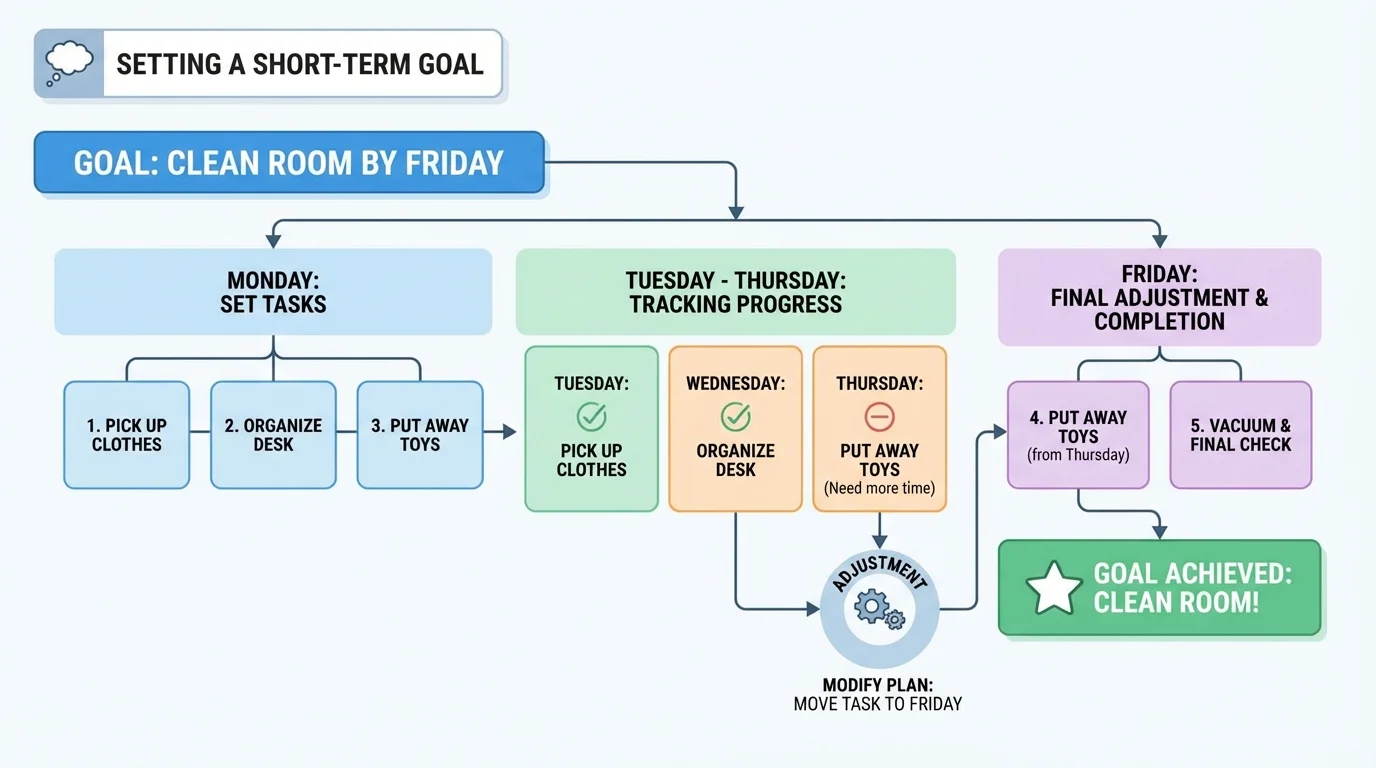
Once you choose your goal, make a plan. A plan is the path you will follow. Big jobs feel much easier when they are broken into smaller parts, as [Figure 1] shows with a goal split into steps across several days.
Think about what needs to happen first, next, and last. If your goal is to keep your room cleaner for one week, your plan might be: pick up toys, place books on a shelf, put clothes in the basket, and spend 10 minutes checking the room each night.
You can also choose when you will work on the goal. Morning, afternoon, or evening? Before screen time? After breakfast? A goal is easier to remember when it is connected to something you already do.
It helps to gather what you need before you begin. If your goal is to read daily, keep your book in the same place. If your goal is to save money, put a jar or envelope where you can see it. If your goal is to practice a skill, keep the supplies ready.
Sometimes another person can help. A family member can remind you, check in with you, or celebrate with you when you finish. That does not mean they do the goal for you. It means they support you while you do the work.
Small steps build big success
Your brain often feels calmer when it sees one small action instead of one giant task. "Clean everything" can feel overwhelming. "Put away the books first" feels possible. Each small step helps you move forward.
A simple written plan might look like this:
| Goal | Small step | When |
|---|---|---|
| Read daily | Choose book | Sunday night |
| Read daily | Read for 15 minutes | After dinner |
| Read daily | Mark tracker | Right after reading |
Table 1. A simple plan showing one goal, the smaller steps, and when each step happens.
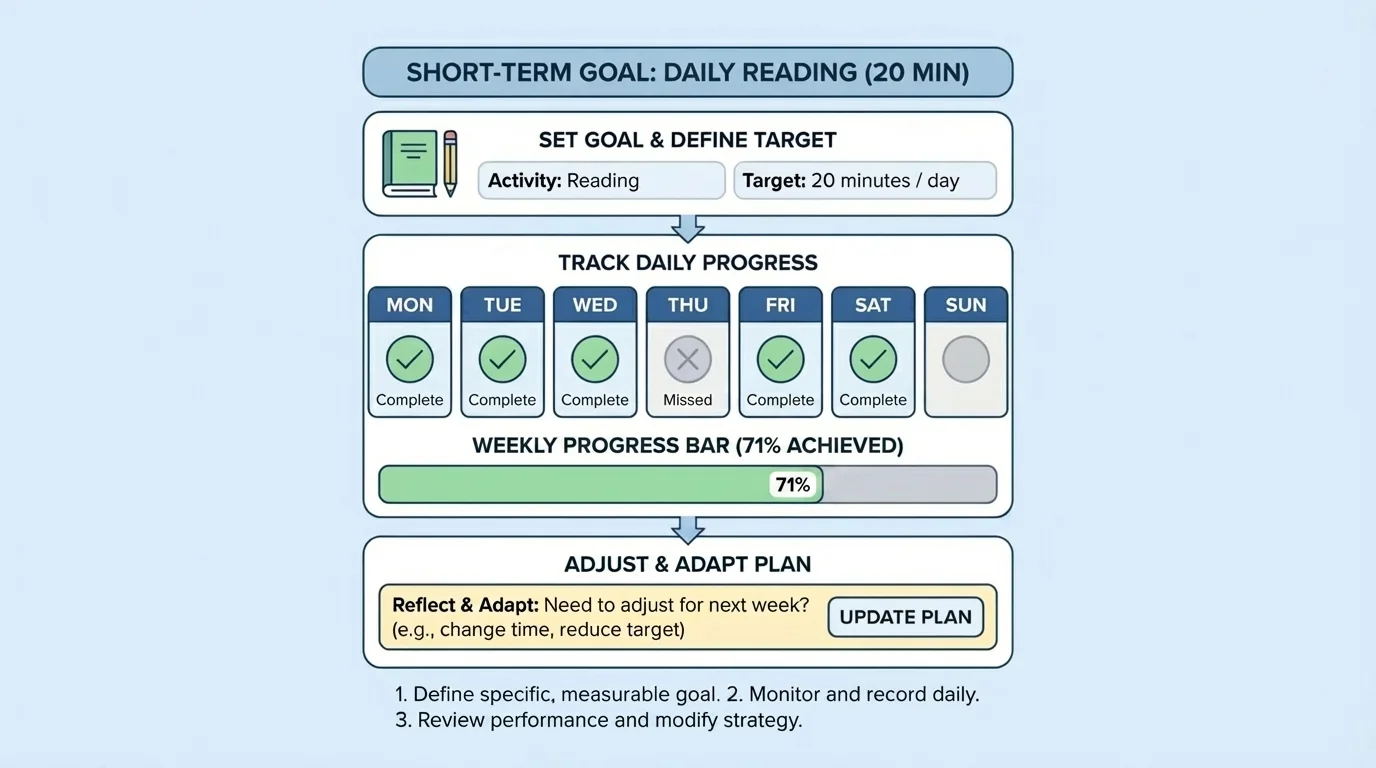
Tracking means paying attention to what you have done. A tracker helps you see your progress clearly, and [Figure 2] shows one easy way to mark daily steps with check boxes.
You can track with a paper chart, a calendar, sticky notes, or a simple checklist on a device with help from an adult. Every time you complete a step, mark it. That tiny action matters. It tells your brain, "I am moving forward."
For example, if your goal is to practice piano for 10 minutes on 5 days, your tracker can have 5 boxes. Each time you practice, check one box. If your goal is to save money, you can write down each amount. After four weeks, if you save $1 each week, you have $4. In math, that is \(1 + 1 + 1 + 1 = 4\).
Tracking also helps you notice patterns. Maybe you do your goal better in the morning. Maybe you forget when supplies are hard to find. Maybe a reminder helps. Progress is not just about finishing. It is about learning what works for you.
You can ask yourself simple check questions: Did I do my step today? Was it easy, medium, or hard? Do I need help? Should I keep the same plan tomorrow?
Tracking example
A child wants to drink water with lunch every day for 5 days.
Step 1: Make a tracker with 5 spaces.
One space for each day from Monday to Friday.
Step 2: Mark each day the goal is done.
If water is chosen on Monday, Tuesday, and Thursday, then 3 spaces are checked.
Step 3: Count the checks.
The child completed \(3\) out of \(5\) days.
The tracker shows both success and what still needs work.
Tracking is not about being perfect. It is about being honest. If you miss a day, do not erase the whole goal. Just notice it and keep going.
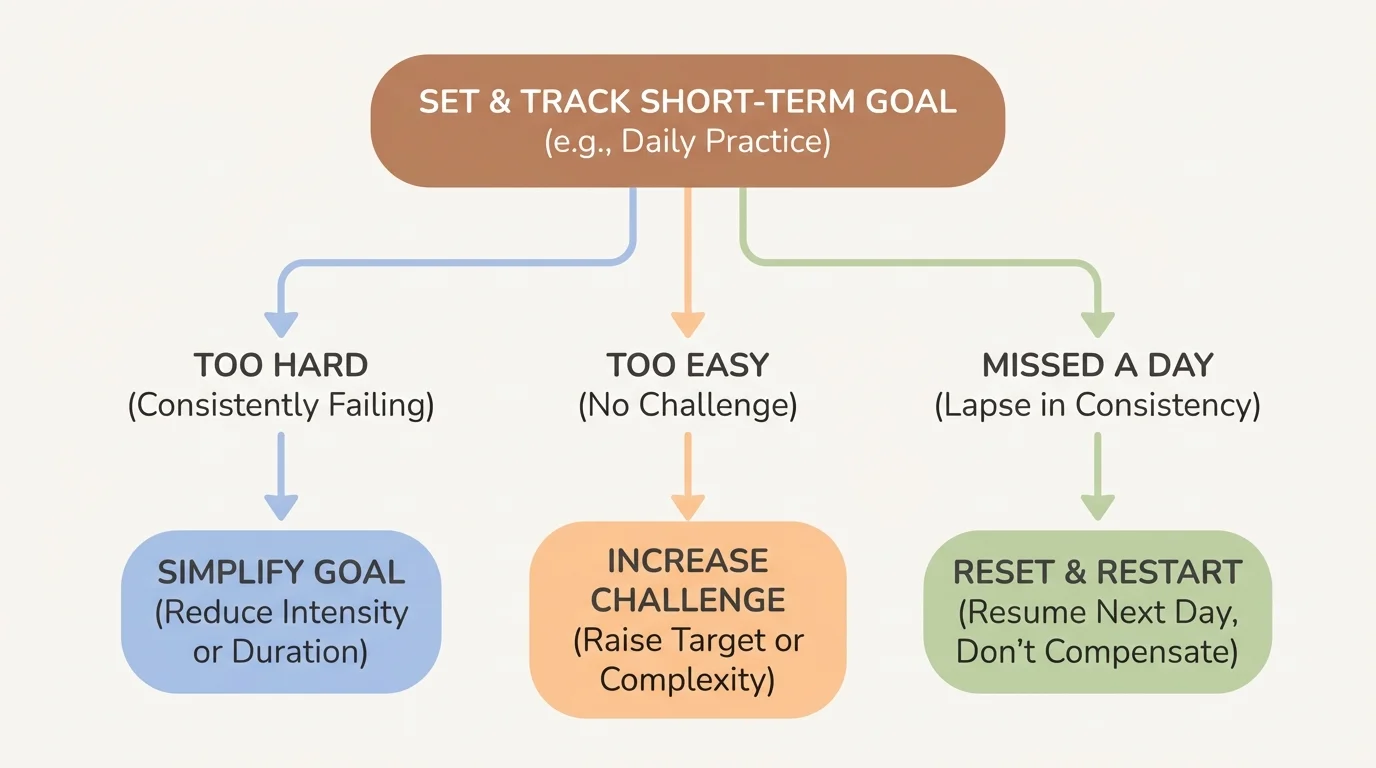
Sometimes a plan needs to change. That is normal. Maybe the goal is too hard, too easy, or your schedule changed. Smart goal-setters notice this and adjust, as [Figure 3] illustrates with different choices for different situations.
Adjusting does not mean giving up. It means you are solving a problem. If reading 20 minutes feels too long, you might change it to 10 minutes. If saving money each day is hard, you might save money once a week instead. If you miss one day, you can restart the next day without quitting.
Here are smart ways to adjust a goal:
Suppose your goal is to clean up for 15 minutes each night, but by day 2 you are tired and keep forgetting. You might adjust to 10 minutes right after lunch. That small change can make the goal much easier to finish. As you saw earlier in [Figure 1], the steps stay small and manageable when the plan fits your real routine.
"A good plan can change. A strong goal keeps going."
Sometimes a goal is too easy. That can happen too. If you finish early every day, you can make it a little more challenging. If you read for 10 minutes easily all week, maybe next week you read for 12 minutes. Small growth is still growth.
When you reach your goal, take a moment to notice it. Finishing a goal is important. It shows that your choices and effort matter.
Celebrating does not have to be big. You might tell someone, put a star on your tracker, choose a fun activity, or write, "I did it." A small celebration helps your brain connect effort with success.
Then reflect. Reflection means thinking back on what happened. Ask: What helped me? What was hard? What should I do the same next time? What should I change?
This matters because every goal teaches you something about yourself. Maybe you learned you do better with reminders. Maybe you learned short tasks work better than long ones. Maybe you learned that checking a chart every day keeps you motivated, just like the daily marks in [Figure 2] make progress easy to see.
Finish-and-reflect example
A child sets a goal to save $1 each week for 4 weeks.
Step 1: Follow the plan.
The child puts away $1 each Friday.
Step 2: Count the total.
After 4 weeks, the total is \(1 + 1 + 1 + 1 = 4\), so the child has $4.
Step 3: Reflect.
The child notices that saving on the same day each week made the goal easy to remember.
The goal is finished, and the child learns a smart habit for the future.
Reflection turns one success into a skill you can use again.
Short-term goals can help in many parts of life. They can help with health, home routines, money, hobbies, and relationships.
Here are different kinds of goals:
| Area | Short-term goal | Why it helps |
|---|---|---|
| Home | Put dishes in the sink after lunch for 7 days | Builds responsibility |
| Reading | Read 15 minutes each day for 1 week | Builds a steady habit |
| Money | Save $1 each week for 4 weeks | Teaches patience and planning |
| Health | Stretch for 5 minutes on 5 days | Supports body care |
| Community | Do one helpful act each weekend for 3 weeks | Shows care for others |
Table 2. Examples of short-term goals in different parts of daily life.
A community goal is important too. You might help a neighbor carry light items, write a thank-you note to a librarian, or speak kindly in an online group. Goals are not only about improving yourself. They can also help you make your home and community better.
Many people make goals that are too big or too unclear. That does not mean they are bad at goals. It usually means they need a smarter plan.
Here are some common mistakes:
And here are matching fixes:
You already know how to follow steps when you do things like brushing teeth, making a snack with help, or getting ready for bed. Goal setting uses that same idea: one step at a time, in order, with a check to see how you are doing.
When you make smart fixes, you become more independent. You learn that problems are not stop signs. They are signals to think and adjust.
Every short-term goal teaches a future skill. When you choose a goal, make a plan, and stick with it, you are practicing self-control, planning, and follow-through. These skills help with hobbies, home jobs, friendships, and future responsibilities.
Short-term goals also connect to the future because small actions add up. If you practice a skill for 10 minutes a day for 6 days, that is \(10 \times 6 = 60\) minutes of practice. One small step does not seem huge, but many small steps create real growth.
Helping others can be part of goal setting too. A goal like "I will check if my younger sibling needs help cleaning up toys on Saturday for 3 weeks" supports your family. A goal like "I will greet people kindly during online club meetings" strengthens community. Your goals shape the kind of person you are becoming.
You do not need to wait until you are older to use goals. You can start now with one clear idea, one simple plan, and one small step today.
