Have you ever known what you wanted to say, but the words got stuck? Maybe someone interrupted you in a video call, pushed you to do something you did not want to do, or ignored your idea when a group was making a plan. Knowing how to speak up in a calm, clear way is a powerful life skill. It helps you protect your feelings, solve problems, and be treated with respect.
Assertive communication means saying what you think, feel, or need in a respectful and honest way. It is not about being bossy. It is not about staying silent, either. It is the middle ground: clear, calm, and kind. When you use assertive communication, you stand up for yourself while also showing respect for other people.
Every day, you make choices with other people. You may text a friend, join a club, play on a team, talk with siblings at home, or work with others online. Problems can happen anywhere people have different ideas. If you stay quiet all the time, people may not know what you need. If you yell or blame, the problem may grow. But if you speak assertively, you have a better chance of being heard and finding a solution.
Assertive communication matters during conflict, when people disagree or feel upset. It also matters during peer pressure, when someone tries to get you to do something you do not want to do. It matters in team choices too, especially when a group needs to decide what to do next.
Assertive communication is speaking honestly, calmly, and respectfully about what you think, feel, or need.
Conflict is a disagreement or problem between people.
Peer pressure is when other people your age try to influence your choices.
Compromise is an agreement where each person gives a little so the group can move forward.
When assertive communication goes well, people understand each other better. Trust grows. Problems can be solved faster. When it goes poorly, people may feel hurt, confused, left out, or angry. That is why learning this skill now can help you in friendships, activities, and family life for many years.
Being assertive starts with knowing that your thoughts and feelings matter. Other people's thoughts and feelings matter too. Assertive communication respects both. It sounds like, "I do not like that joke. Please stop," or "I want a turn to share my idea," or "No thanks, I am not doing that."
Assertive communication often uses a steady voice, clear words, and calm body language. If you are on a video call, this may mean looking at the camera, waiting your turn, and speaking in a regular voice. If you are texting, it may mean using direct words instead of rude jokes, all caps, or messages meant to hurt someone.
The goal is not to win every time. The goal of assertive communication is to express yourself clearly, protect your boundaries, and work toward a respectful solution. Sometimes the solution is agreement. Sometimes it is a calm "no." Sometimes it is deciding to walk away and get help from a trusted adult.
Assertive communication does not mean you always feel brave. Sometimes your heart beats fast, your face feels warm, or you worry that others will not like your answer. That is normal. Being assertive means you choose respectful honesty even when it feels hard.
There are three common ways people respond when something is bothering them. As [Figure 1] shows, the same situation can sound very different depending on the communication style. Learning to notice these styles helps you choose words that are respectful and strong.
Passive communication means staying too quiet, giving in, or hiding your real feelings. A passive response might be, "It is fine," when it is not fine. This can lead to hurt feelings or bigger problems later.
Aggressive communication means speaking in a hurtful, blaming, or mean way. An aggressive response might be, "You never listen! You are so annoying!" This may scare others or start a bigger fight.
Assertive communication means being direct and respectful. An assertive response might be, "I was still talking. Please let me finish." That message is clear without being rude.
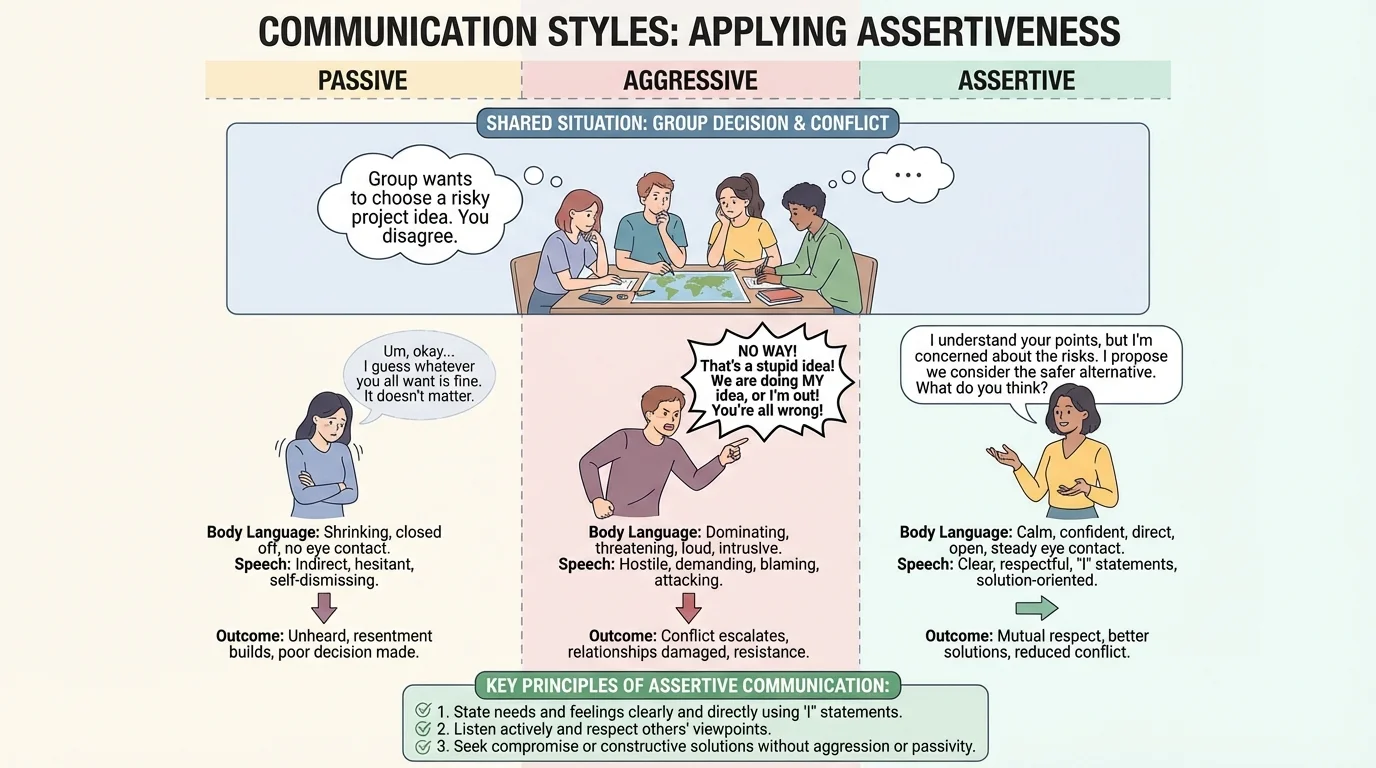
Think about this example: you are in a group video chat planning a game. Someone keeps talking over you. A passive answer is to say nothing and feel upset. An aggressive answer is to snap back and insult them. An assertive answer is to say, "I want to share my idea too. Please let me have a turn."
Notice that assertive communication is not weak. It is strong because it tells the truth clearly. It also does not try to hurt anyone. That balance is what makes it useful in so many situations.
When emotions get big, it helps to have a plan. [Figure 2] shows a simple way to handle hard moments without freezing, exploding, or giving in too fast.
Step 1: Pause. Take one slow breath before you answer. This tiny pause helps your brain think instead of reacting.
Step 2: Notice your feeling. Are you angry, embarrassed, confused, left out, or pressured? Naming a feeling can help you choose better words.
Step 3: State the problem clearly. Say what happened without adding mean labels. For example: "You interrupted me," not "You are rude."
Step 4: Say what you need. You might need space, a turn, an apology, more time, or for someone to stop.
Step 5: Listen to the other person. Assertive communication includes listening, not just talking.
Step 6: Choose the next step. You might agree, compromise, say no, or ask an adult for help.
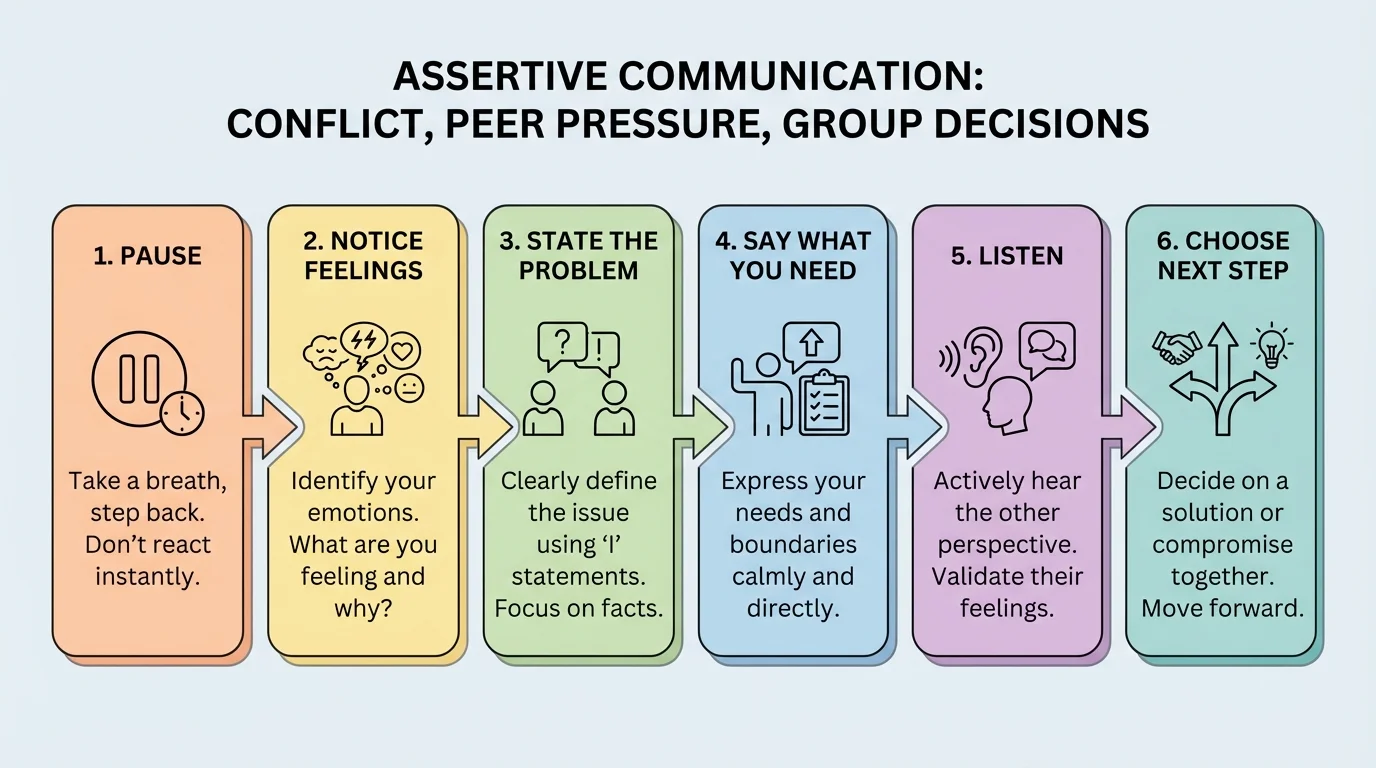
This plan is useful because it turns a big emotional moment into smaller actions you can handle one at a time. If you forget a step, that is okay. Even pausing and clearly saying what you need can make a big difference.
Example: someone posts a mean comment in a group chat
Step 1: Pause before typing back.
You feel angry and embarrassed, but you do not answer right away.
Step 2: State the problem.
You write, "That comment was hurtful."
Step 3: Say what you need.
You add, "Please delete it and talk to me respectfully."
Step 4: Choose the next step.
If it continues, you leave the chat, save the messages, and tell a trusted adult.
This response is clear, calm, and safe.
Sometimes the best assertive choice is short. You do not need a long speech every time. A few calm words can be enough.
Conflict happens when people want different things, misunderstand each other, or feel hurt. Conflict is not always bad. In fact, some conflict helps people solve problems and understand each other better. The key is how you handle it.
Start by talking about the action, not attacking the person. Say, "I felt left out when you started without me," instead of, "You are a bad friend." This keeps the problem smaller and easier to solve. It also lowers the chance that the other person will get defensive right away.
Use "I" statements when possible. For example, "I feel frustrated when my idea is ignored. I want a chance to explain it." "I" statements help you own your feelings without putting all the blame on someone else.
If the other person is upset too, listening matters. Listening does not mean you agree with everything. It means you give the other person a chance to explain. You might say, "I hear that you thought I was not ready," or "I understand you wanted to go first." After listening, you can still say what you need.
"Clear is kind."
— A helpful reminder for honest communication
If a conflict gets too heated, take a break. You can say, "I want to solve this, but I need a few minutes to calm down." That is assertive too. Walking away for safety or self-control is different from avoiding the problem forever.
Later in the lesson, the same respectful balance we noticed in [Figure 1] still matters. You do not have to choose between silence and meanness. There is a calm middle choice.
Peer pressure can happen in many ways. Someone might dare you to share private information, post something unkind, join in teasing, pretend to be older online, or break a rule at home or in an activity. Sometimes peer pressure is loud, but sometimes it is sneaky. It can sound like, "Come on, everybody is doing it," or "If you were really my friend, you would do it."
When this happens, remember: you are allowed to say no. You do not need to do something unsafe, unkind, or uncomfortable just to fit in. Assertive communication protects your choices and your boundaries.
A boundary is a limit that protects your body, feelings, time, and values. A boundary might sound like, "I do not share passwords," or "I am not posting that," or "I am leaving this chat if the teasing keeps going."
Many kids and adults find it easier to hold a boundary when they practice the words ahead of time. A short script can make a hard moment feel much easier.
Here are some assertive ways to respond to peer pressure: "No thanks." "I am not doing that." "Stop asking." "That is not okay with me." "I said no." "I am leaving now." These responses are short on purpose. Long explanations can sometimes invite more pressure.
If the pressure continues, use the broken record technique. Calmly repeat your answer. "No, I am not doing that." "No, I am not doing that." "No, I am leaving." You do not have to invent a new answer every time.
If a situation feels unsafe, get help right away from a trusted adult. Assertive communication is important, but safety comes first. If someone is threatening, bullying, or trying to trick you, stop responding and tell an adult you trust.
Example: pressure to join mean teasing online
Step 1: Name the problem to yourself.
You notice that the group is making fun of someone.
Step 2: Respond clearly.
You say, "I am not joining that."
Step 3: Add a boundary if needed.
You say, "If this keeps going, I am leaving the chat."
Step 4: Follow through.
You leave and tell an adult if the behavior is serious or repeated.
This protects both you and the person being targeted.
Sometimes saying no feels lonely at first. But protecting yourself and doing what is right often builds stronger trust over time.
Group decisions happen when people need to choose one plan together. This might happen during a club meeting, a sports practice, a family activity, a volunteer project, or an online hangout. Group decisions work best when everyone has a chance to speak, as [Figure 3] illustrates with turn-taking, respectful disagreement, and a shared plan.
Being assertive in a group means sharing your idea clearly without trying to control everyone. You might say, "I think option two would work best because we all have the supplies for it," or "I like your idea, but I have a different suggestion." This helps the group hear your thinking.
You also need to disagree respectfully. Instead of saying, "That idea is dumb," try, "I do not think that plan will work because we only have a short time," or "I see your point, but I am worried about the cost." Respectful disagreement keeps the conversation focused on the idea, not the person.
Sometimes a group cannot choose everyone's first idea. That is where compromise helps. One person may choose the game, another may choose the snack, or the group may vote and agree to try a different idea next time. Compromise is not losing. It is helping the group move forward fairly.
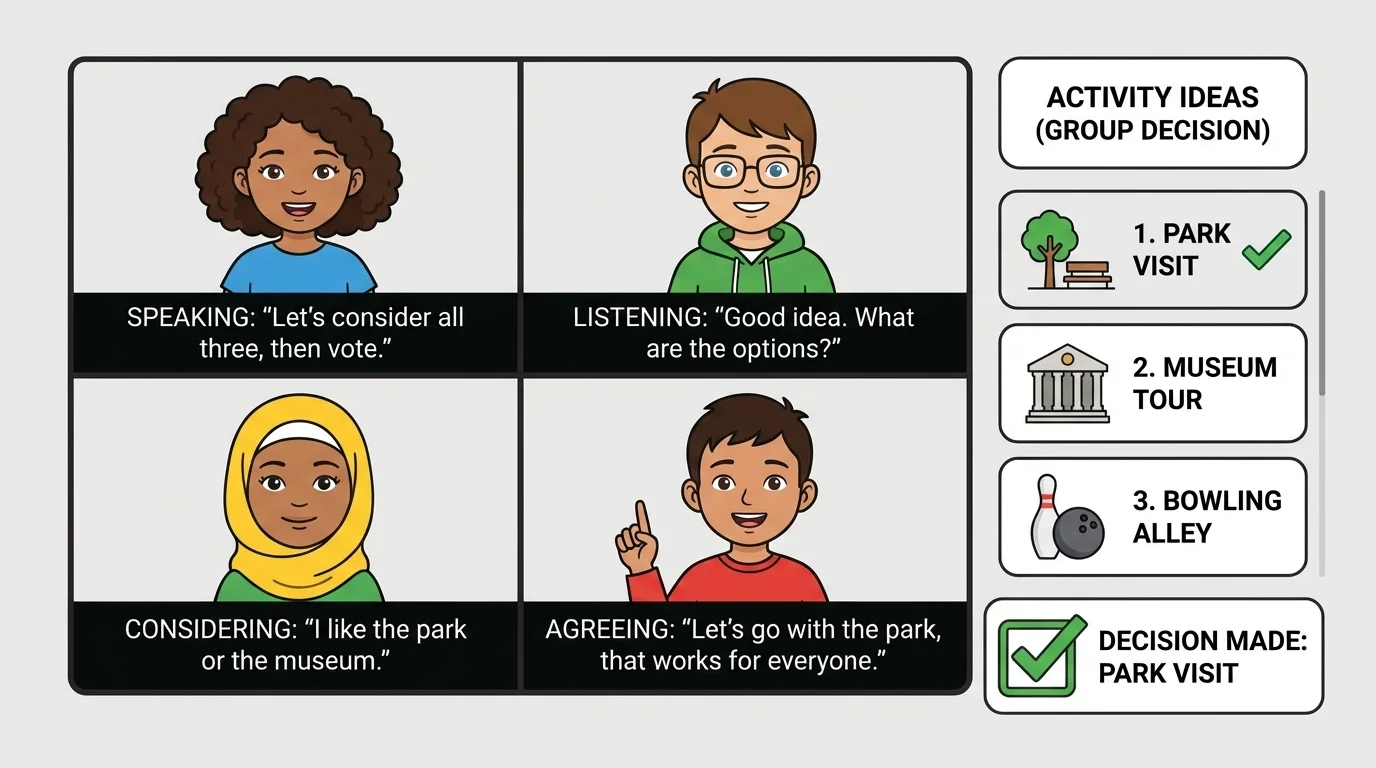
If someone is being left out, assertive communication can include speaking up for fairness. You might say, "We have not heard Maya's idea yet," or "Let's let everyone vote before we decide." This shows leadership in a respectful way.
| Situation | Less Helpful Response | Assertive Response |
|---|---|---|
| Someone interrupts you | Stay silent or snap back | "Please let me finish my idea." |
| You disagree with a plan | "That is a terrible idea." | "I disagree because I think we need something simpler." |
| You want fairness | Complain later | "Can we hear from everyone first?" |
| The group is stuck | Argue in circles | "Should we vote or combine the two best ideas?" |
Table 1. Examples of how assertive communication can improve group decisions.
Later, when you think about teamwork again, the balanced approach in [Figure 3] still applies. Good group decisions are not about the loudest voice. They are about clear speaking, listening, and fair next steps.
When words are hard to find, sentence starters can help. You do not have to use these exact words every time, but they give you a strong place to begin.
For conflict: "I felt upset when..." "I want to solve this." "Please do not talk to me like that." "I need a turn to explain."
For peer pressure: "No thanks." "I am not comfortable with that." "Stop asking me." "I said no." "I am leaving now."
For group decisions: "I have an idea." "I agree with part of that, but..." "Can we hear everyone's thoughts?" "What if we combine these two ideas?" "I can compromise."
You already know that emotions can affect choices. Calm breathing, pausing, and naming your feeling can help you use assertive words instead of reacting too fast.
These sentence starters are tools. The more you use them, the more natural they feel. Over time, you may change the words to fit your own style while keeping the same respectful message.
One common mistake is waiting too long to speak. If you stay silent when something keeps bothering you, the problem may grow. Instead, speak up early in a calm way.
Another mistake is using blame words like "always" and "never." These words often make people defensive. Instead of "You never listen," try "I do not feel heard right now."
Sarcasm can be another trap, especially in text messages where tone is hard to read. What sounds funny to one person may feel mean to another. Instead, be direct and respectful.
Some people think assertive communication means having the perfect words. It does not. It just means being honest, respectful, and clear enough to be understood.
Try This
Pick one short assertive sentence to practice this week. It could be "Please stop," "I need a turn," or "No thanks, I am not doing that." Say it out loud when you are alone so the words feel more natural when you really need them.
If you make a mistake, that does not mean you failed. You can repair it. You might say, "Let me try that again more calmly," or "I was too harsh. What I meant was..." Repairing a conversation is also a strong communication skill.
Assertive communication gets stronger with practice. At first, it may feel awkward. That is normal. Many important skills feel strange before they feel natural.
You can build this skill by noticing moments when you wish you had spoken up. Think about what you could say next time. The step-by-step process in [Figure 2] helps because it gives you a simple path: pause, name the problem, say what you need, listen, and choose a next step.
It also helps to notice when other people communicate assertively. You may hear a coach, family member, or community leader say, "I understand your point, but here is what I need." That is a great model to learn from.
Most of all, remember this: your voice matters. You can be kind and still be firm. You can disagree and still be respectful. You can say no and still be a good friend. Assertive communication helps you protect yourself, solve problems, and work well with others.
