Have you ever sent a message when you were upset and then wished you could take it back one minute later? That happens to a lot of people, including adults. When feelings get big, judgment can get small. You might act before you think, guess something that is not true, or choose a response that makes the problem worse instead of better. The good news is that this is a skill you can practice. You can learn to notice your feelings, slow down, and make wiser choices even when things feel hard.
Good judgment means making choices by thinking about what is true, what is safe, and what might happen next. During conflict or stress, that can be harder. Conflict means a disagreement or problem between people. Stress is the pressure you feel when something seems difficult, upsetting, or urgent. Neither conflict nor stress automatically means something bad will happen. But both can make your brain rush, and rushed choices often cause new problems.
Emotions are not the enemy. They are signals. Anger can tell you that something feels unfair. Fear can warn you about danger. Sadness can show that something matters to you. But a signal is not the same as a command. A feeling can tell you something important without telling you exactly what action to take.
For example, if your sibling uses your tablet without asking, you may feel angry. That feeling is real. But if you yell, throw something, or send a mean message to a family group chat, your choice may create a bigger problem. If you pause and say, "I'm upset because you used my things without asking," you are still listening to your feeling, but you are using better judgment.
Judgment is your ability to think about a situation and choose a sound, safe, and fair response.
Conflict is a disagreement or struggle between people.
Stress is the pressure or strain you feel when something seems hard, fast, or overwhelming.
Strong feelings can change your judgment because they grab your attention. Instead of noticing the whole situation, you may focus on one part only. You may think, "That was so mean," and miss the fact that the other person may have made a mistake. Or you may think, "I have to answer right now," when waiting a few minutes would lead to a better choice.
Your stress response is the body's quick reaction to a challenge, and [Figure 1] shows how that reaction can push you toward acting fast instead of thinking carefully. Your heart may beat faster. Your muscles may tighten. Your breathing may get quicker. Your body is trying to help you get ready. That can be useful in real danger, but in an argument or upsetting message, it can also make you overreact.
When this happens, careful thinking can weaken for a little while. You may interrupt, assume, blame, or quit too quickly. You may forget to ask, "What else could be true?" or "What will happen if I do this?" That does not mean you are bad at decision-making. It means you are human, and your brain needs a moment to settle.
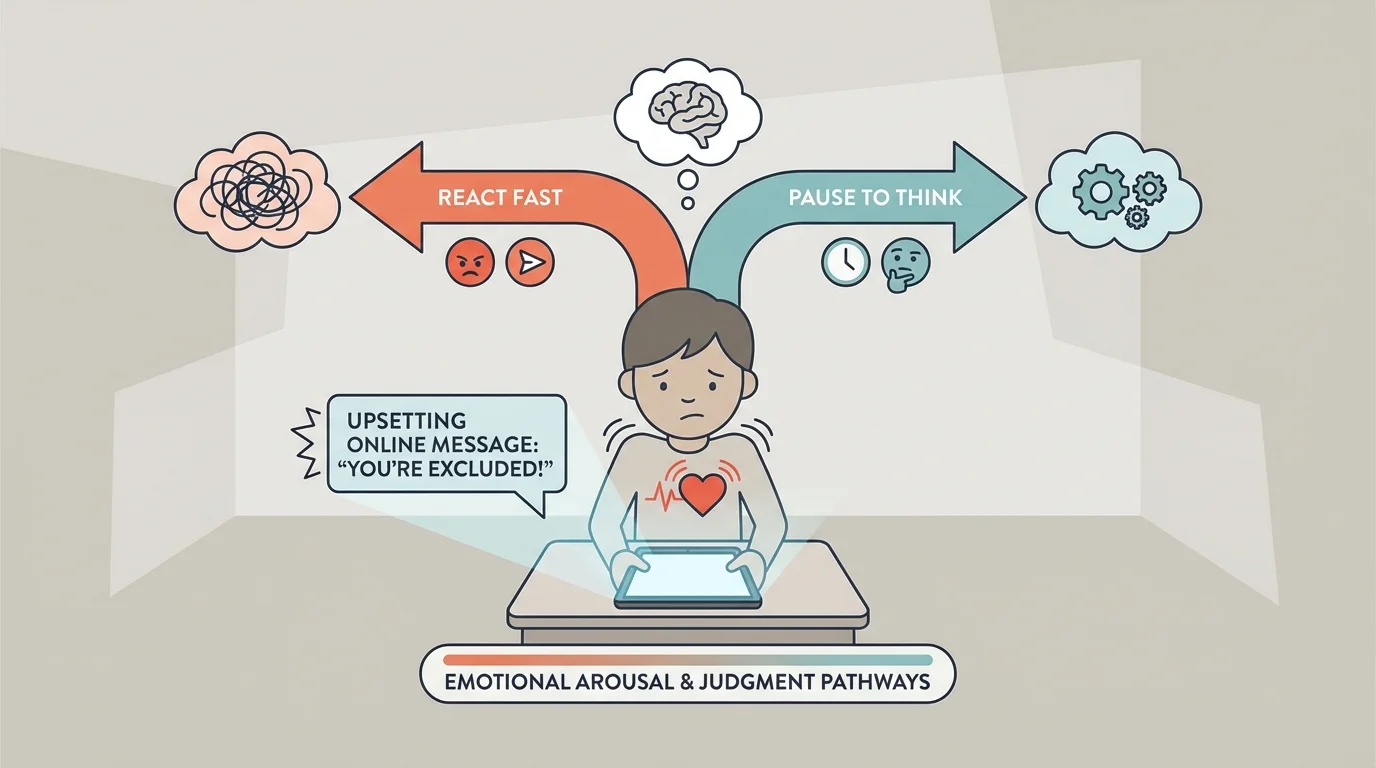
A useful way to think about it is this: big feelings make the volume louder. When the feeling volume is high, your thinking voice can be harder to hear. You do not lose the ability to think well, but you may need to turn the feeling volume down first. That is why calming strategies matter. They give your thinking time to catch up.
Your body can react to a stressful message on a screen almost as if the problem is happening right in front of you. That is one reason online arguments can feel so intense so quickly.
Later in the lesson, the pause tools connect back to the same idea we saw in [Figure 1]: when your body feels alarmed, your first reaction is not always your best decision.
Some emotions often change judgment during conflict or stress more than others. Anger can make you want to punish, shout, or "win" instead of solve. Fear can make you hide, lie, or agree to something just to make the problem stop. Sadness can make you believe nothing will help, even when help is available. Embarrassment can make you defend yourself quickly or blame someone else. Frustration can make small problems feel huge.
Even excitement can affect judgment. If you are very excited, you may skip important details. You might join an online challenge without checking if it is safe, or promise something before thinking it through. Strong emotions are not only the uncomfortable ones.
A useful skill is trigger spotting. A trigger is something that starts a strong emotional reaction. Your trigger might be being ignored, being teased, losing a game, getting blamed, or feeling rushed. If you know your triggers, you can prepare for them instead of getting surprised by them.
Feelings give information, but they do not make the decision for you. A strong emotion can point to a problem, but sound decision-making comes from combining that feeling with facts, safety, fairness, and possible results.
Suppose you are in an online game and another player types, "You're terrible." If that is a trigger for you, you may instantly want to insult them back. But if you stop and notice, "I feel embarrassed and angry," you gain power. Naming the feeling can help you control the next step.
It helps to notice warning signs before a choice turns into a mistake. Your body can send clues: hot face, tight jaw, shaky hands, stomach ache, fast breathing, or a pounding heart. Your thoughts can send clues too: "I don't care," "I'll show them," "Nobody understands," or "I have to do something right now."
Your actions can also be clues. Maybe you type in all caps, slam a door, talk over people on a video call, quit a task without trying, or blame someone before hearing the full story. These are signs that your judgment may be getting pushed around by emotion.
| Type of clue | What it may look like | Why it matters |
|---|---|---|
| Body clue | Fast heartbeat, tense muscles | Your stress level may be rising |
| Thought clue | "This is all their fault" | You may be missing other facts |
| Behavior clue | Sending a mean text right away | A rushed action can increase the conflict |
Table 1. Warning signs that emotions may be interfering with clear decision-making.
The earlier you notice these clues, the easier it is to reset. It is much easier to pause when your stress level is about \(3\) or \(4\) out of \(10\) than when you are already at \(9\). You do not need perfect control. You just need to catch yourself a little sooner.
When emotions rise, use a pause plan. This is not about ignoring your feelings. It is about giving yourself enough time to choose your response instead of letting the feeling choose for you. The steps below help you slow the moment down.
Step 1: Stop. Do not send the message, say the hurtful words, or make the fast decision yet.
Step 2: Breathe. Take slow breaths. You might inhale for \(4\) counts and exhale for \(4\) counts a few times.
Step 3: Name the feeling. Say to yourself, "I feel angry," "I feel left out," or "I feel nervous."
Step 4: Check the facts. Ask, "What do I know for sure? What am I guessing?"
Step 5: Choose a safe response. Pick the option that is calm, respectful, and smart.
Step 6: Ask for help if needed. If the problem feels too big, tell a trusted adult.
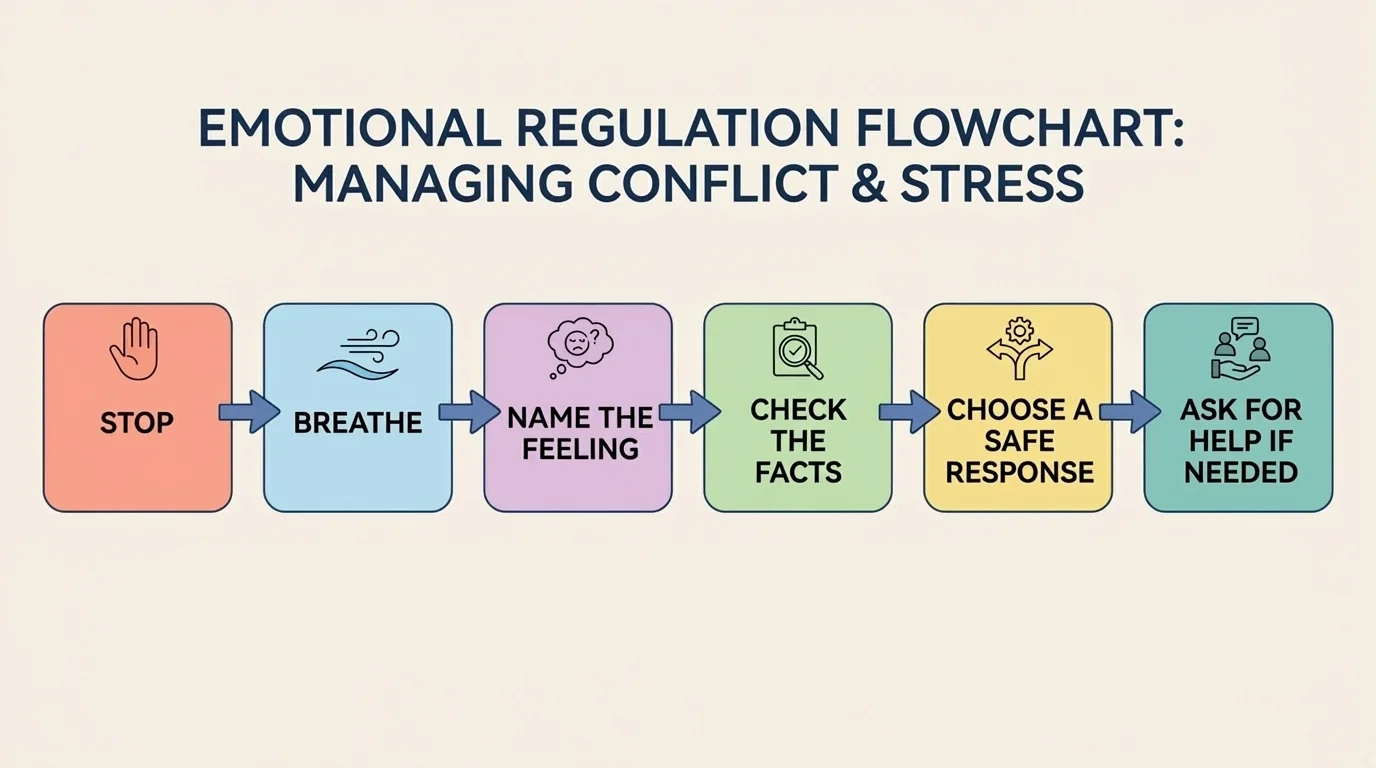
This plan works because it gives your body time to settle and your brain time to think. It also reminds you that there is usually more than one possible response. In conflict, the first idea that pops into your head is not always the best one.
Using the pause plan in a real situation
You see that a friend left you out of a group video call, and you feel hurt and angry.
Step 1: Stop
Do not send, "Fine, I don't want to be your friend anyway."
Step 2: Breathe and name the feeling
Say, "I feel left out and upset."
Step 3: Check the facts
Ask yourself, "Do I know they left me out on purpose, or could there be another reason?"
Step 4: Choose a better response
Send, "I noticed I wasn't in the call. Was it planned ahead, or was it last minute?"
This response is calmer and gives you a chance to learn what really happened.
Notice how the pause plan does not erase your feelings. It helps you act with self-control. That same shift from quick reaction to better judgment is the key idea shown earlier in [Figure 2].
Here are a few everyday situations where emotions can influence choices.
Situation 1: Family stress. You are asked to stop playing and help with dinner right when you are about to finish a level. You feel frustrated. Poor judgment sounds like, "You always ruin everything!" Better judgment sounds like, "I'm frustrated because I wanted to finish. Can I help in two minutes?"
Situation 2: Community activity. During soccer practice, a teammate says you missed an easy shot. You feel embarrassed. Poor judgment is pushing, insulting, or quitting the team. Better judgment is taking a breath and saying, "That comment bothered me. I'll keep trying."
Situation 3: Safety problem. You are nervous because other kids in the neighborhood dare you to do something unsafe on your bike. Fear of being laughed at may hurt judgment. Better judgment is saying no, leaving, and telling an adult if needed. Feeling pressure is real, but safety comes first.
When you compare these examples, a pattern appears. Big feelings often push people toward one of three mistakes: reacting too fast, assuming too much, or trying to escape the feeling instead of solving the problem.
"Pause first. Then choose."
— A strong rule for conflict and stress
You can even make a quick mental checklist: Is it true? Is it kind? Is it safe? Will it help? If the answer is no to even one of those, you probably need another choice.
Screens can make conflict tricky because you cannot always hear tone of voice or see facial expressions. That means you may misunderstand what someone meant, and [Figure 3] illustrates how easy it is to fire back too quickly. A short message like "wow" might mean surprise, annoyance, or even a joke. If you read it while upset, you may choose the worst possible meaning.
Another problem is speed. Online, it takes only a second to post, comment, or send. But once a message is out, it can be copied, shared, or remembered. A few angry seconds can create a problem that lasts much longer.
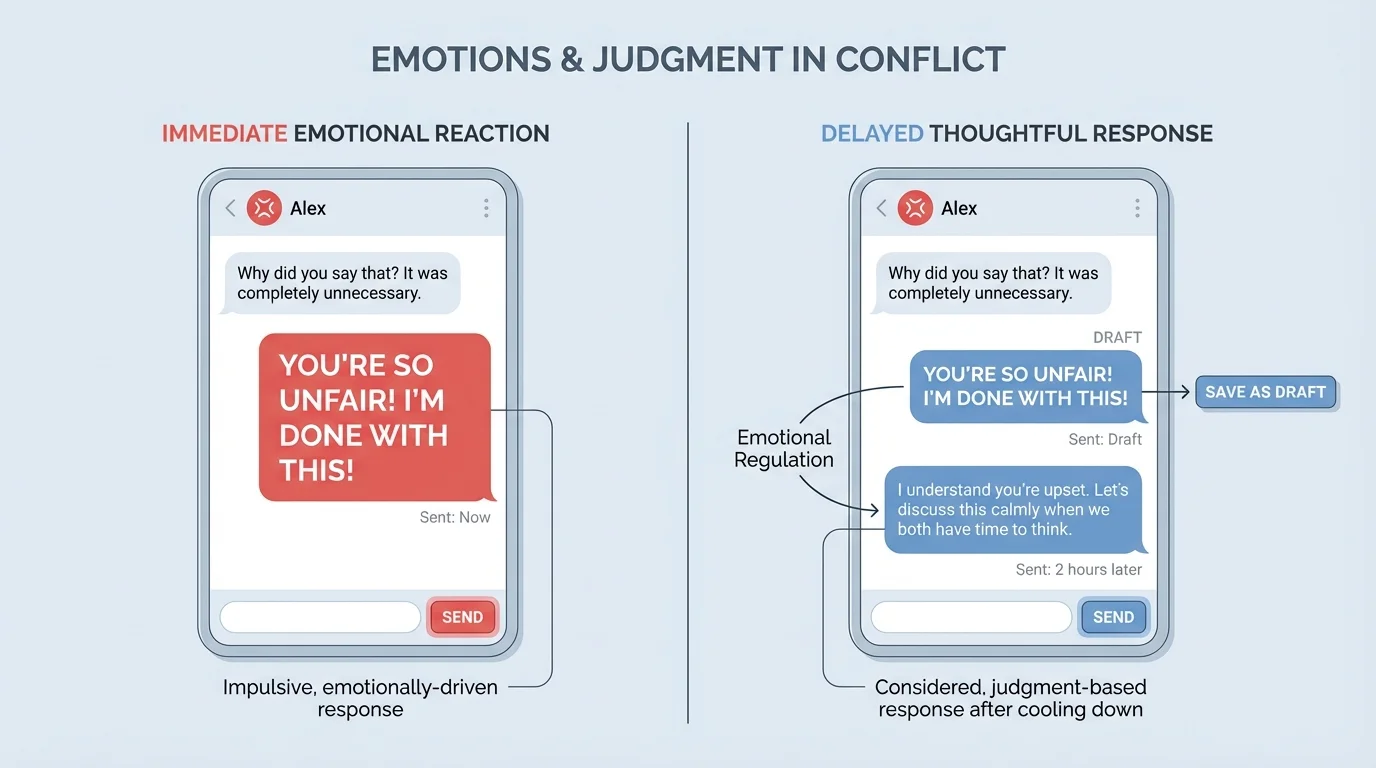
Here are smart online habits: do not answer mean messages right away, reread before sending, avoid all caps when upset, and never post private information when angry. If a message feels hurtful, ask for meaning before assuming. You can say, "I'm not sure how to read that. What did you mean?"
If someone is bullying, threatening, or repeatedly bothering you online, this is bigger than ordinary conflict. Save evidence, block if needed, and tell a trusted adult. Good judgment includes knowing when a problem is not yours to handle alone.
Draft first, send later
If you are very upset, type what you want to say in a notes app instead of sending it. Wait a few minutes, then read it again.
Step 1: Write the first angry version privately.
Step 2: Remove insults, blame words, and threats.
Step 3: Keep only the facts and what you need.
Step 4: Send a calm message, or decide no reply is best.
This is one practical way to use self-control online, just like the calmer side of the choice in [Figure 3].
Sometimes emotions win, and you make a poor choice. That happens. What matters next is what you do about it. Repair means trying to fix harm after a mistake. You may need to apologize, replace something broken, correct false information, or admit that you overreacted.
A strong apology is simple and honest: "I was angry, but it was not okay to say that. I'm sorry." Notice that this does not blame the other person for your behavior. You can explain your feeling without using it as an excuse.
If you are not sure how to fix a mistake, ask a trusted adult questions like: "What should I do now?" "How can I make this better?" or "Can you help me say this calmly?" Asking for help is not weakness. It is sound decision-making.
Good problem-solving often includes two parts: dealing with the problem itself and dealing with your reaction to the problem. Both matter.
Sometimes you also need to protect yourself. If conflict becomes unsafe, includes threats, or keeps happening after you try respectful solutions, step away and get adult support. You do not have to solve every conflict by yourself.
Better judgment under stress is like a muscle. The more you practice, the stronger it gets. Small daily habits help a lot. Sleep, food, water, movement, and breaks can all affect emotional control. When your body is exhausted or hungry, it is harder to think clearly.
You can also practice calm thinking when there is no conflict. Before a game, performance, or hard conversation, plan a sentence you can use: "I need a minute," "Let's try again," or "I feel upset, so I'm going to pause." The more you practice calm words, the easier they are to use when feelings get big.
Try This: Choose one signal that tells you stress is rising, such as tight shoulders or fast typing. The next time you notice it, stop and take three slow breaths before doing anything else.
Try This: Make a short list of your top triggers. Then write one calm response for each trigger. For example, if being corrected makes you defensive, your planned response could be, "Okay, let me think about that."
Try This: Put a reminder near your device that says, "Pause first." Tiny reminders help because emotions often make people forget what they already know.
