Have you ever read something, felt sure you understood it, and then forgotten it a few minutes later? Or maybe you sat down to do one assignment and somehow ended up looking at three other tabs, your snack, and your pet instead. That happens to lots of students. The good news is that school success is not only about being smart. It is also about using good habits that help your brain work better.
When you learn from home, you have more freedom, but you also need more responsibility. No teacher is standing right next to you reminding you to begin, keep going, and turn in your work. Good study habits help you do those jobs for yourself. They make learning easier, calmer, and more successful.
If your habits are weak, school can feel frustrating. You may forget directions, lose track of time, rush through work, or leave tasks unfinished. If your habits are strong, you are more likely to remember what you learned, stay focused longer, and complete your work on time. That means less stress and more confidence.
Memory is your brain's ability to keep and use information later.
Focus means paying attention to one important thing instead of getting pulled away by other things.
Task completion means starting a job, working through the steps, and finishing it.
These three skills work together. If you focus better, you usually remember more. If you remember directions, it is easier to finish the task. If you finish tasks regularly, you feel more confident and ready for the next one.
Your study space affects your attention more than you may think. A helpful space makes it easier to keep your eyes and mind on your work. You do not need a perfect room. You just need a spot that tells your brain, "It is time to learn."
[Figure 1] Try to choose one main place for schoolwork. It might be a desk, a table, or a quiet corner. Keep the things you need close by: your device, charger, notebook, pencils, and water. If possible, move toys, games, and other distracting items somewhere else while you work.
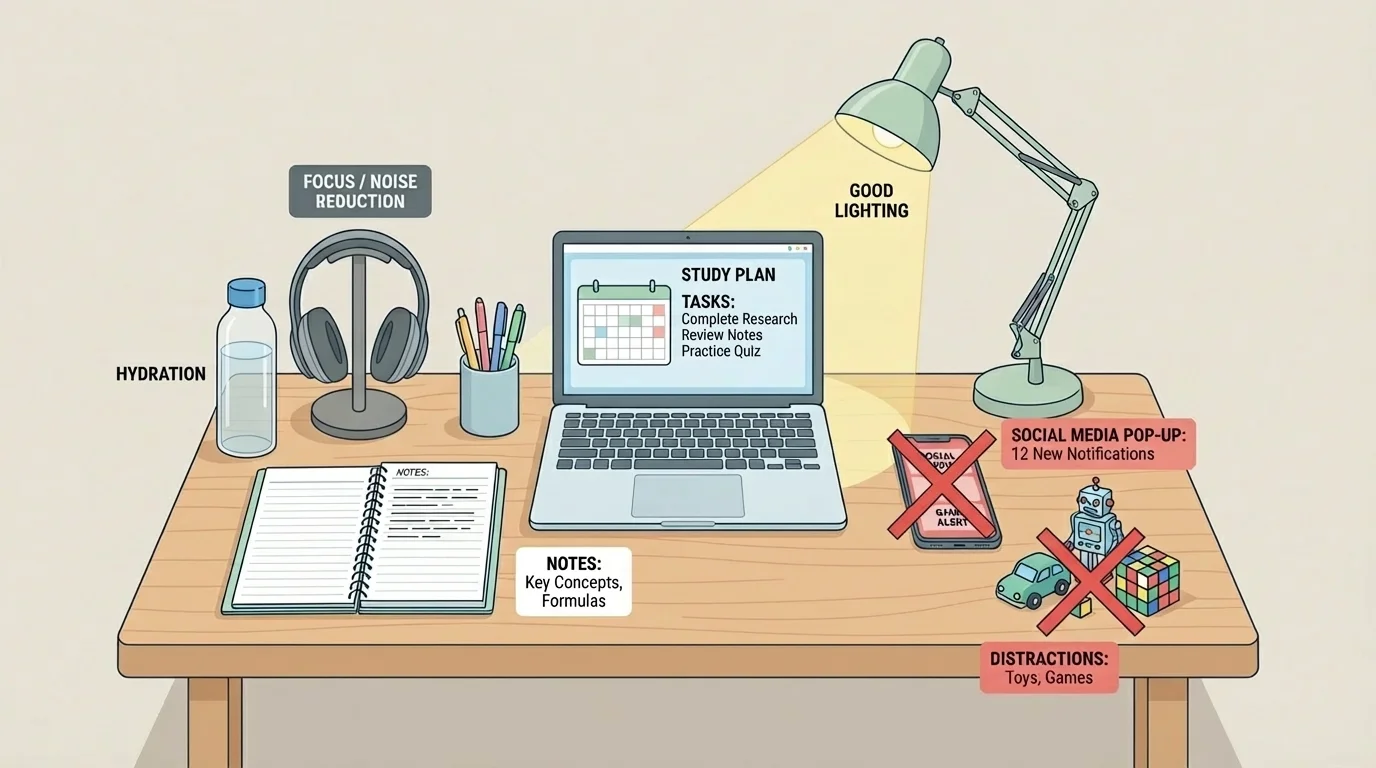
Light matters too. If your area is too dark, your eyes may feel tired. Sitting in a chair that supports your body can also help. When your body feels uncomfortable, your brain has a harder time focusing.
Before you begin, do a quick space check. Ask yourself: Do I have what I need? Is this area quiet enough? Is anything here likely to pull my attention away? A one-minute setup can save a lot of wasted time later.
Your brain notices movement, noise, and alerts very quickly. That is why a buzzing phone, a loud TV, or a game open on another tab can break your attention even if you think you are ignoring it.
One helpful habit is to silence notifications during work time. If you need your device for school, close extra tabs and apps first. If you use headphones, choose them to block noise, not to play distracting songs with lyrics when you need to read carefully.
A big assignment can feel overwhelming, but it becomes easier when you break it into smaller parts. This skill is called chunking. Instead of thinking, "I have to do all of this," you think, "First I do this small step, then the next one."
[Figure 2] Start by reading the directions all the way through. Then ask: What is the final job? What smaller jobs do I need to do first? For example, if you have to complete a science slide, your steps might be: open the assignment, read the question, find your notes, write your answer, check spelling, and submit.
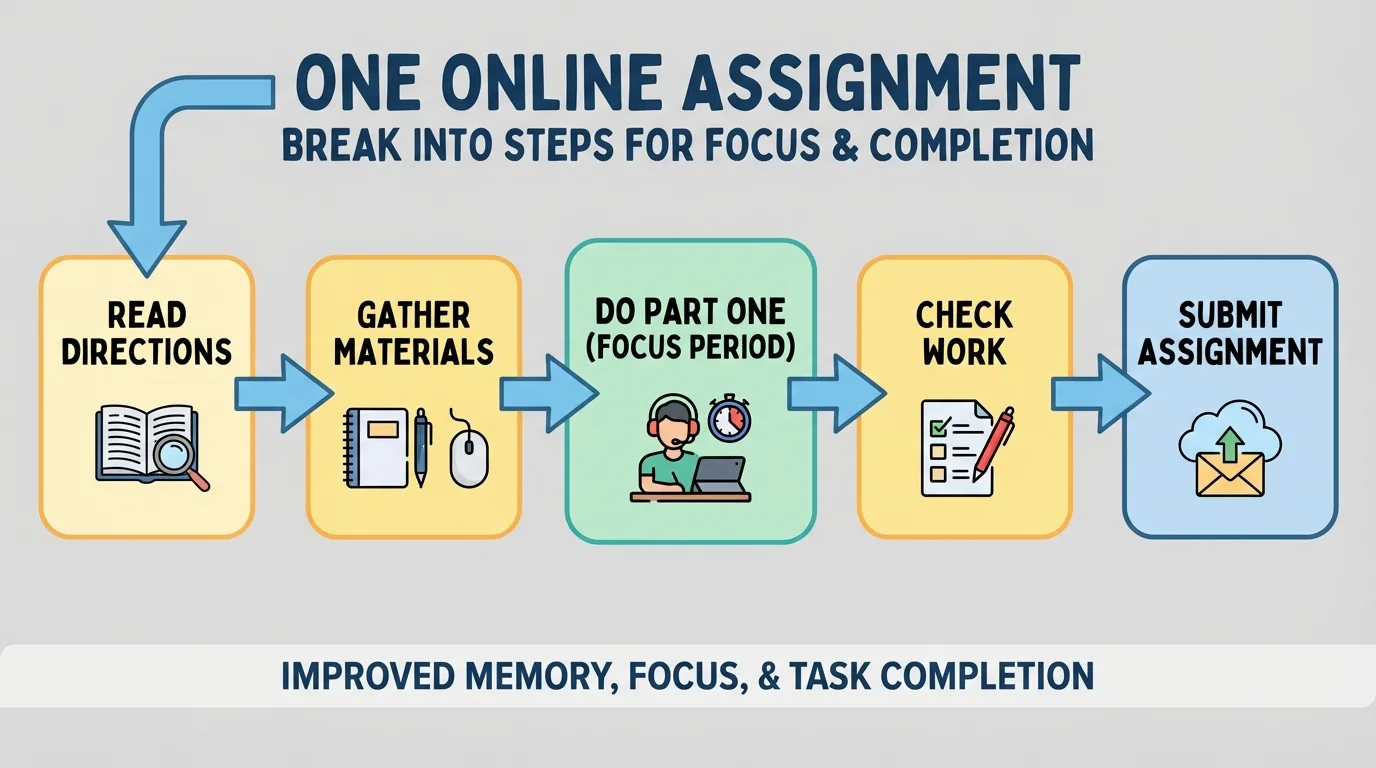
Another helpful habit is using short work blocks. You might work for 15 or 20 minutes, then take a short break, and then return. Short blocks can help your brain stay fresh. They also make it easier to begin, because "I can do this for 15 minutes" feels easier than "I have to work forever."
You can also choose your priority. A priority is the most important task to do first. If you have more than one thing to do, pick the task that is due soonest, needs the most focus, or is most important. Doing your priority first protects your best energy.
Example: Turning one big job into smaller steps
You need to finish an online reading assignment and answer questions.
Step 1: Read the directions.
Find out exactly what the teacher wants.
Step 2: Gather materials.
Open the reading passage, notebook, and question page.
Step 3: Do one part at a time.
Read one section, then answer one question.
Step 4: Check your work.
Make sure every question has an answer.
Step 5: Submit it.
Finishing includes turning it in, not just completing it.
Notice how the job feels less scary when it is divided into pieces. That is one of the strongest study habits you can build.
Lots of students think memory means reading the same page again and again. But memory gets stronger when your brain has to use the information, not just look at it. One strong habit is active recall. That means trying to remember the information without looking first.
For example, after reading a short section, close the page and say what you remember. You can write three facts, tell them to a family member, or explain them out loud to yourself. Reviewing a little at a time over several days, as shown in [Figure 3], helps even more. This is called spaced review.
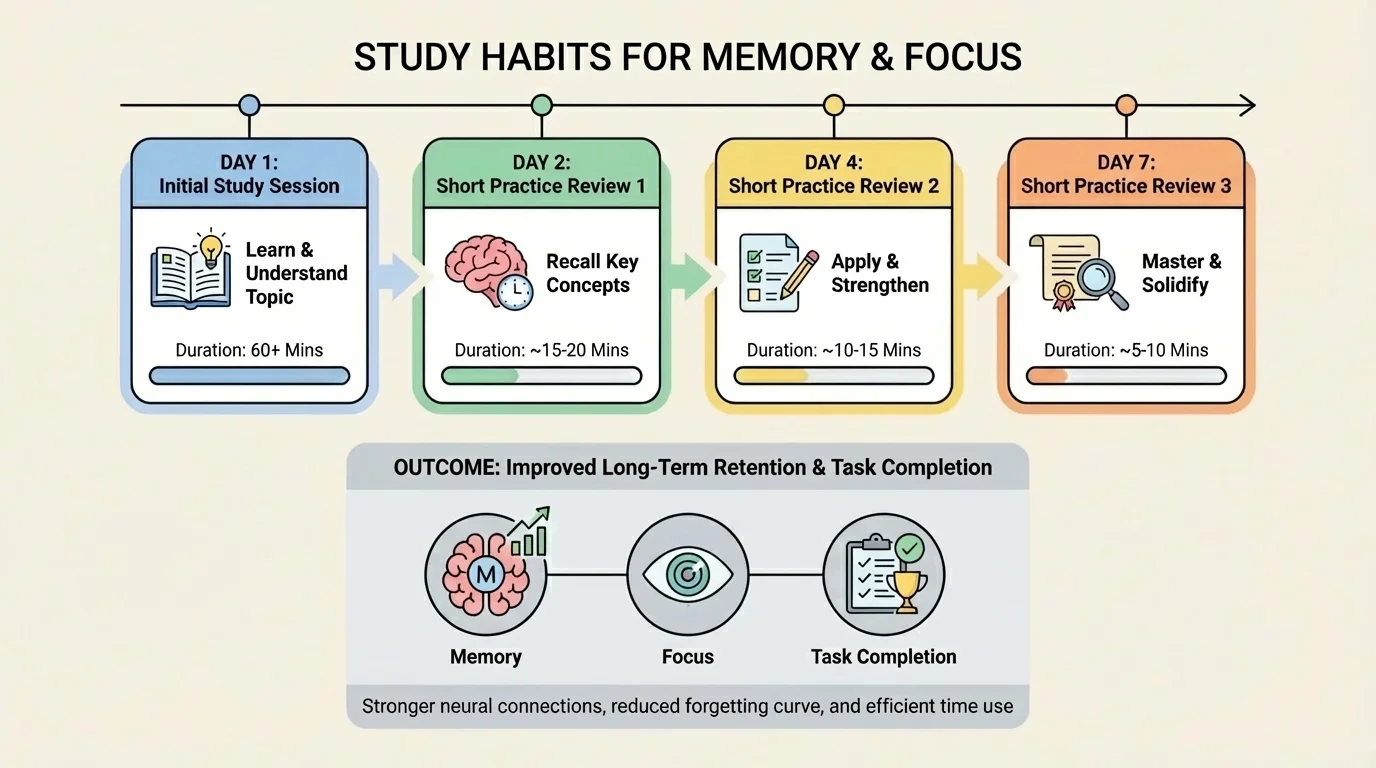
Here is why spaced review works: if you study something once for a long time, your brain may forget much of it soon after. If you study it for a shorter time on several different days, your brain gets repeated chances to keep it. It is like watering a plant more than once instead of pouring all the water on one day.
Summarizing also helps memory. After a lesson, try saying the main idea in one or two sentences. If you can explain it simply, you probably understand it well. If you cannot explain it yet, that tells you what to review.
Sleep matters too. Your brain does important memory work while you sleep. Staying up too late can make learning harder the next day. So a memory habit is not just what you do during study time. It also includes healthy rest.
Why memory improves with effort
Your brain remembers better when it has to pull information out, connect ideas, and use them again later. Easy-looking study is not always strong study. Harder thinking, like recalling, summarizing, and explaining, often helps information stay longer.
Later, when you need to review for a quiz or complete a project, the pattern in [Figure 3] still helps: a few short reviews across several days often work better than one long cram session.
Your attention is powerful, but it can also be pulled away very fast. Your brain often focuses better when you choose one task at a time and use short breaks. This is called single-tasking. It means doing one important thing instead of trying to do several things at once.
[Figure 4] If you are reading, just read. If you are solving problems, just solve problems. Switching back and forth between schoolwork, messages, videos, and games makes your brain keep restarting. Restarting wastes time and energy.
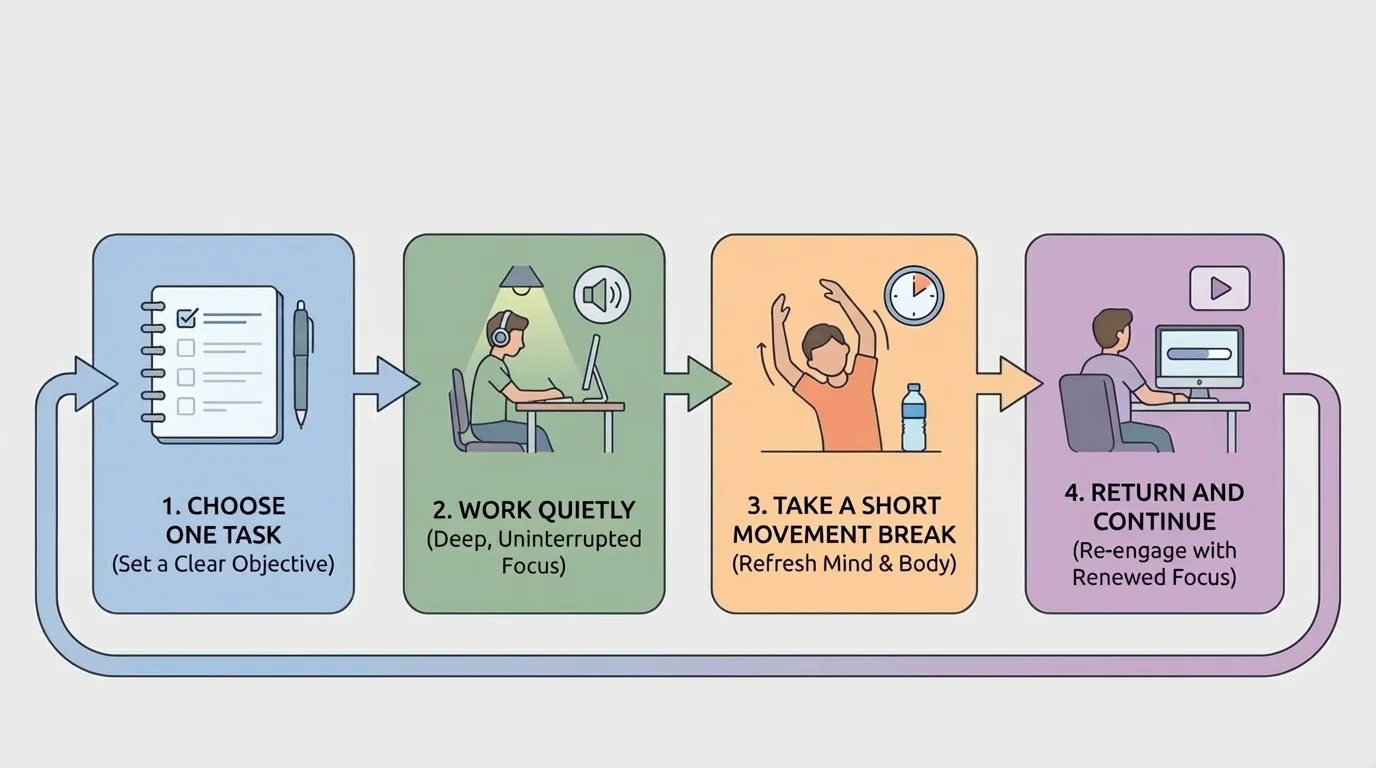
Breaks help, but the kind of break matters. A good break is short and refreshing. You might stand up, stretch, get water, or look away from the screen for a moment. A poor break is one that pulls you so far away that returning feels hard, like starting a long game or watching many videos.
Another focus habit is noticing when your mind wanders. Everyone loses focus sometimes. The key is to catch it kindly and return. You can say to yourself, "My brain drifted. Now I am coming back." That small reset is a skill.
"Small steps, repeated often, can do big things."
If you know you are easily distracted by noise, use a quieter room or headphones. If you get distracted online, keep only the school tab open. As with the workspace in [Figure 1], your environment can either support your focus or fight against it.
Sometimes the hardest part is simply starting. You may look at the assignment, feel unsure, and wait too long. A helpful trick is to begin with a very small action: open the page, write your name, read the first question, or answer the easiest item first. Starting creates movement.
A checklist is another strong tool. When you write down the steps, your brain does not have to keep holding them all in memory. You can look at the list, do one item, and check it off. That feels good and keeps you moving.
It also helps to decide what "finished" means. Finished is not "I did some of it." Finished might mean: I answered every question, checked my work, saved the file, and submitted it. Clear endings help you avoid almost-finished work that never gets turned in.
Example: A finish-the-task checklist
Suppose you are completing a writing assignment online.
Step 1: Open the assignment page.
Step 2: Write the first sentence, even if it is not perfect.
Step 3: Complete one paragraph at a time.
Step 4: Reread and fix missing words or mistakes.
Step 5: Click submit and make sure it uploaded.
Using steps from [Figure 2] can help here too. Planning and finishing are connected. When you know the steps, you are less likely to get stuck in the middle.
Getting stuck does not mean you are bad at learning. It means you need a strategy. First, pause and name the problem. Are the directions confusing? Are you tired? Did you forget what to do next? Knowing the problem helps you choose the right solution.
Next, try a reset. Stand up, breathe slowly, sip water, and return to the first step you understand. If the work is still confusing, ask for help. In online school, that might mean sending a message to your teacher, joining office hours on video, or asking a trusted adult at home to help you understand the directions.
When you ask for help, be specific. Instead of saying, "I don't get it," say, "I understand the reading, but I do not know how to answer question 3." Specific questions get better answers.
You do not have to do school perfectly on the first try. Strong learners often stop, notice what is not working, and change their strategy.
Sometimes being stuck is really about emotions. You might feel frustrated, worried, or annoyed. Those feelings are real. A calm routine helps: pause, breathe, take a short break, then return to one small step.
Routines make good habits easier. When you do the same helpful actions in the same order, you spend less energy deciding what to do. That leaves more energy for learning.
Here is a simple routine you can adjust for your day. First, get your materials ready. Next, check your tasks. Then choose your priority. Work in a short block, take a brief break, and come back. After each task, check whether it is fully finished and submitted.
| Time | Habit | Why it helps |
|---|---|---|
| Before work | Set up your space | Reduces distractions |
| Start of work | Read directions | Prevents mistakes |
| During work | Do one step at a time | Makes big jobs manageable |
| After a work block | Take a short break | Refreshes focus |
| End of task | Check and submit | Helps you truly finish |
| Later that day | Review for a few minutes | Strengthens memory |
Table 1. A simple daily routine that supports memory, focus, and task completion.
You do not need a giant plan. Even a few repeated habits can make a big difference. The goal is not to make school feel strict and stressful. The goal is to make it smoother and more successful.
Some habits feel easy in the moment but make learning harder later. For example, rereading notes without checking what you remember can feel productive, but active recall usually teaches your brain more. Working with many tabs open may feel normal, but single-tasking often helps you finish faster.
Another common mistake is waiting until you "feel ready" to start. Often, readiness comes after you begin. Action builds momentum. A tiny first step is better than a long delay.
| Less helpful habit | Better habit | Result |
|---|---|---|
| Trying to remember everything in your head | Use a checklist | You miss fewer steps |
| Studying one topic for a long time once | Use spaced review | You remember more later |
| Doing many things at the same time | Single-tasking | You focus more clearly |
| Stopping when the hard part begins | Break the task into chunks | You keep moving forward |
| Leaving work almost done | Check and submit | You complete the full task |
Table 2. A comparison of less effective study habits and stronger choices.
You do not need to fix everything in one day. Pick one or two habits and practice them until they start to feel normal. Maybe this week you focus on setting up your study space and using a checklist. Next week you add active recall or spaced review.
Good habits grow through repetition. If a strategy does not work well at first, that does not mean it is wrong for you forever. Adjust it. Maybe your work blocks should be shorter. Maybe your break needs to be more active. Maybe your study space needs fewer distractions.
The most important thing is consistency. A small helpful habit done often can be more powerful than a big plan done only once. Bit by bit, you can train your brain to remember better, focus longer, and finish what you start.
