Have you ever noticed that two people can do the same activity and feel totally different about it? One person might love planning a family game night. Another might enjoy building the game pieces. Someone else might be happiest explaining the rules. That matters because careers often grow from the things you do well, the things you enjoy, and the habits you build every day.
When you explore careers, you are not picking your whole future forever. You are learning about yourself. The better you know yourself, the easier it becomes to notice jobs that could be a good fit. Your strengths, interests, and habits act like clues. They do not force you into one job, but they help you discover choices that make sense for you.
Career exploration means learning about different kinds of work and thinking about which ones might fit you. Strengths are things you do well. Interests are things you enjoy, care about, or want to learn more about. Habits are actions you do regularly, often without thinking much about them.
These three parts of you matter in real life. If you know your strengths, you can build confidence. If you know your interests, you can stay curious. If you build good habits, you can be ready when opportunities come. People who ignore these clues may choose activities that feel frustrating or draining. People who pay attention to them often make smarter choices over time.
Many adults change jobs more than once. That means no one needs to know everything at age 9. What you can do now is start noticing patterns. Maybe you are the person who remembers details, calms people down, tells great stories, solves tech problems, or keeps going even when something is tricky. Those patterns are useful.
Knowing yourself also helps you ask better questions. Instead of only asking, "What job sounds cool?" you can also ask, "What kind of work fits the way I like to think, learn, and help?" That is a stronger way to explore. It helps you look past job titles and focus on what people actually do.
Many jobs use the same personal qualities in different ways. A person who is organized might do well in event planning, running a small business, computer programming, or helping in a medical office.
This is important because jobs are not just costumes or titles. A chef plans, practices, and stays calm. A veterinarian cares for animals and talks clearly with people. A game designer uses creativity and problem-solving. A mechanic pays attention to detail. Different careers may share some of the same inner skills.
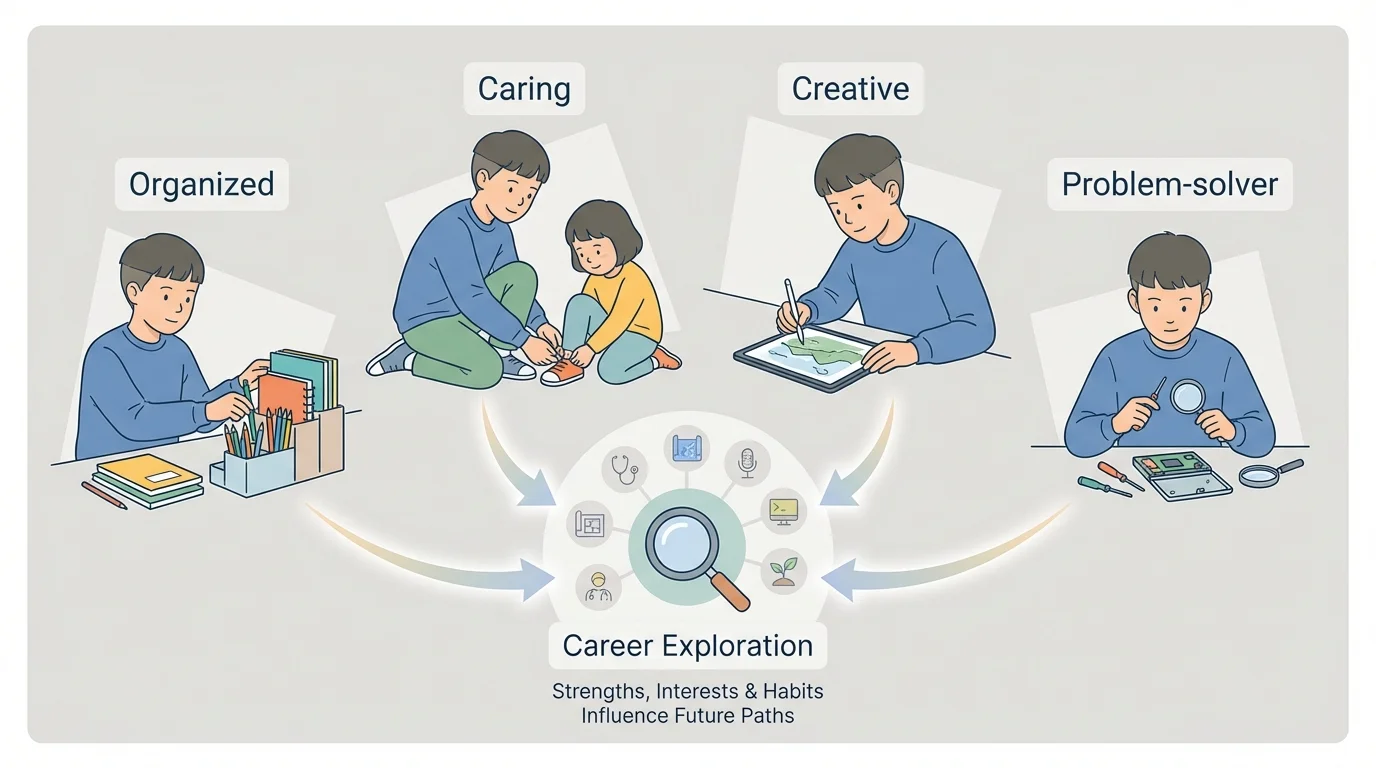
Your strengths are not only school subjects or talents people clap for. Strengths can show up in everyday life, as [Figure 1] illustrates through tasks like organizing, helping, creating, and fixing. You might be patient with younger kids, good at noticing mistakes, fast at learning apps, skilled at drawing, or brave about trying again after a mistake.
Some strengths are easy to see. If you sing beautifully or build amazing models, people notice right away. Other strengths are quieter. Maybe you listen carefully on video calls, follow directions well, or keep your room and supplies organized. Quiet strengths matter in careers too.
There are many kinds of strengths. Here are a few:
| Type of strength | What it can look like | Career examples it may connect to |
|---|---|---|
| Creative strength | Drawing, designing, inventing, storytelling | Artist, designer, writer, game creator |
| People strength | Listening, comforting, leading, explaining | Teacher, counselor, nurse, coach |
| Thinking strength | Solving problems, noticing patterns, asking good questions | Engineer, scientist, programmer, detective |
| Practical strength | Building, fixing, organizing, following steps | Chef, mechanic, electrician, event planner |
| Performance strength | Speaking, acting, presenting, entertaining | Actor, broadcaster, lawyer, tour guide |
Table 1. Different types of strengths and examples of careers they may connect to.
A strength does not mean you are perfect. It means something feels possible and worth growing. For example, if you are good at explaining game rules to friends online, that could connect to teaching, training, or making how-to videos. If you like sorting items and remembering what goes where, that could connect to inventory work, library work, or planning events.
To notice your strengths, pay attention to what people often thank you for. Also notice what feels easier for you than for some others. As we saw in [Figure 1], strengths appear in normal moments, not only in big achievements. You do not need an award to have a real strength.
Real-life example: Finding strengths from daily life
Step 1: Think about your week.
You helped your grandparent set up a tablet, finished a craft project, and reminded your family about an appointment.
Step 2: Name the strengths.
Setting up the tablet shows problem-solving. Finishing the craft shows focus. Remembering the appointment shows responsibility.
Step 3: Connect them to careers.
Problem-solving can connect to technology jobs. Focus can connect to art, design, or cooking. Responsibility can connect to healthcare, business, or public service.
The big idea is that ordinary actions can reveal important strengths.
Sometimes students think, "I do not have any strengths." Usually that means they are only looking for flashy ones. Start smaller. Can you calm yourself when upset? Can you keep trying? Can you follow a recipe? Can you explain something clearly? Those are all useful strengths in work and life.
Your interests are the things that pull your attention. You may enjoy animals, sports, coding, baking, music, weather, fashion, building, caring for others, nature, space, or making videos. Interests matter because they give you energy. When you care about something, you are often more willing to practice and learn.
Interests do not have to become your job, but they can point you toward jobs you may want to explore. A student who loves animals might learn about veterinarians, pet groomers, wildlife photographers, or animal shelter workers. A student who loves drawing might explore animation, architecture, illustration, or product design. One interest can connect to many paths.
Interests can also change. That is normal. Maybe you loved dinosaurs at age 6, then robotics at age 8, and now cooking videos at age 9. Changing interests do not mean you are confused. They mean you are learning more about the world and yourself.
Interests help you start exploring, not lock you in. If something catches your attention, that is a signal to learn more. Watch a kid-friendly interview, read about the work, ask an adult questions, or try a small related activity. Exploration is about testing possibilities.
It is also important to notice the difference between liking the idea of a job and liking the real tasks in the job. Someone might think being a chef is only about decorating desserts, but chefs also plan, clean, practice, and work carefully. Someone might think being a YouTuber is only about being on camera, but it also includes writing, editing, and staying organized.
That is why career exploration should go deeper than "That looks fun." Ask, "What does this person actually do every day?" The answer helps you see whether the job matches not only your interests, but also your strengths and habits.
A habit is something you do regularly. Habits matter because they shape how ready you are for many kinds of work. Good habits can make your strengths stronger. Weak habits can make a strong interest harder to turn into success.
For example, maybe you love art. That interest is important. But if you never finish projects, lose your supplies, and quit whenever something is hard, your habits will get in the way. On the other hand, if you practice often, clean up your workspace, and keep learning from mistakes, your habits support your future goals.
Strong habits for career growth include being on time, listening, practicing, staying organized, being kind, finishing tasks, and asking for help when needed. These habits work in almost every career. A pilot, baker, nurse, coder, and park ranger all need good habits, even though their jobs look very different.
Some habits can slow you down. These include giving up quickly, ignoring directions, interrupting others, leaving messes for other people, or avoiding responsibility. Everyone has habits to improve. The goal is not to feel bad. The goal is to notice what helps and what hurts.
You already know that practice helps you improve skills. Habits are the actions that make practice happen over and over again.
Think of habits like the wheels on a bike. Your strengths and interests may tell you where you want to go, but habits help you keep moving. Without strong habits, progress feels shaky. With strong habits, you can keep growing even when something is difficult.
[Figure 2] shows how the best career exploration happens when you look at all three areas together with overlapping circles. A good fit often appears where your strengths, interests, and habits meet. You might be good at explaining, interested in science, and in the habit of practicing presentations. That combination may lead you to explore teaching, science communication, or healthcare.
Here is another example. Maybe you are strong at building, interested in how machines work, and in the habit of following steps carefully. That could connect to engineering, repair work, robotics, or construction. None of those choices is final right now, but they are smart directions to explore.
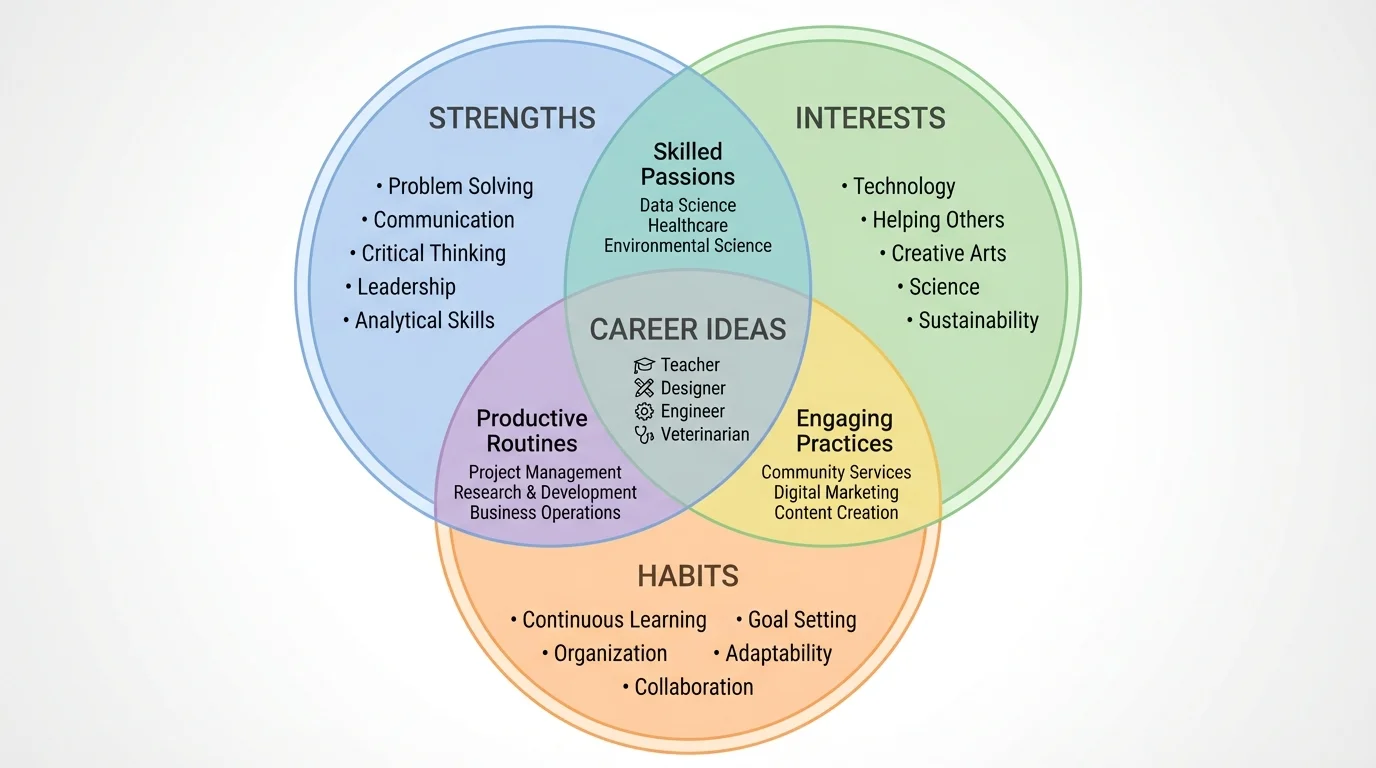
When one part is missing, the fit may feel weaker. If you are interested in something but do not yet have the habits to support it, you can still grow. If you have strengths in an area but no interest in it, that may not be the best path for you. If you have a strong interest and good habits but not much skill yet, practice can help you build strength over time.
This is good news because you are not stuck. Interests can grow. Strengths can improve. Habits can change. As you learn more, the picture becomes clearer. The overlap in [Figure 2] is not about being perfect. It is about noticing where things work well together.
| Student pattern | Possible meaning | Career exploration ideas |
|---|---|---|
| Good at drawing, loves stories, practices often | Strong creative match | Illustrator, animator, book designer |
| Likes animals, gentle with pets, remembers routines | Strong care-and-responsibility match | Veterinarian, pet care worker, animal trainer |
| Enjoys gadgets, solves tech problems, keeps trying | Strong problem-solving match | Programmer, engineer, technician |
| Likes helping people, listens well, stays calm | Strong people-helping match | Teacher, nurse, counselor, social worker |
Table 2. Examples of how strengths, interests, and habits can combine into career exploration ideas.
Case study: Three students exploring different paths
Step 1: Maya notices she enjoys baking.
She also follows recipes carefully and likes making food look nice.
Step 2: Jordan notices he loves helping people with devices.
He is patient, curious, and keeps testing solutions.
Step 3: Lila notices she cares deeply about animals.
She is gentle, dependable, and remembers feeding schedules.
Maya might explore baking or food design. Jordan might explore technology support or engineering. Lila might explore animal care. Each student uses a different mix of strengths, interests, and habits.
You may also discover careers that surprise you. A student who likes gaming might enjoy coding, storytelling, sound design, or online community management. A student who likes sports might explore physical therapy, sports journalism, coaching, or equipment design. Looking beyond the obvious opens more possibilities.
You do not need to wait until you are grown up to start career exploration. You can begin now with simple steps, and [Figure 3] lays out a clear path. The goal is not to choose one forever. The goal is to gather clues.
Step 1: Notice yourself. What activities make you lose track of time? What kinds of problems do you like solving? What do people ask you to help with?
Step 2: Make three short lists: strengths, interests, and habits. Keep your list honest. You do not need to impress anyone. This is for learning.
Step 3: Explore jobs connected to those lists. Read articles, watch safe and age-appropriate videos, visit career websites for kids, or ask adults about the work they do.
Step 4: Try small experiences. Cook a simple recipe, create a digital poster, care for a plant, organize a family shelf, record a how-to video, or help plan an event at home or in your community group.
Step 5: Reflect. After trying something, ask, "What part did I enjoy? What was hard? What strength helped me? What habit do I need to improve?"
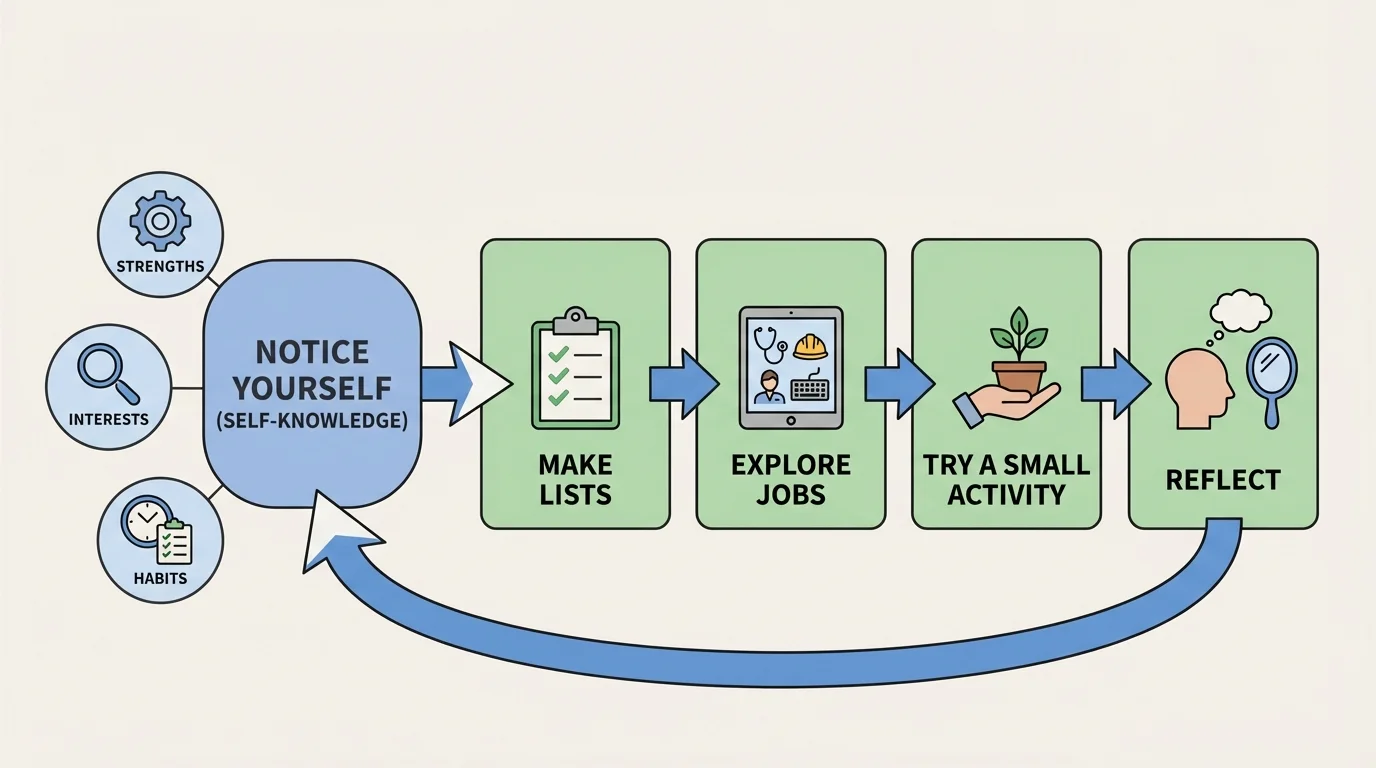
This process helps you move from guessing to learning. For example, you might think you want to be a baker, then realize you enjoy decorating more than measuring. That clue could lead you toward design. Or you might think you want a tech job, then discover your favorite part is helping people understand devices. That could point you toward teaching or support work. The path in [Figure 3] works because it asks you to test ideas instead of only dreaming about them.
"The more you know about yourself, the better choices you can make."
You can also learn by talking with adults you trust. Ask questions like: What do you do each day? What skills help you most? What habits matter in your work? What part is fun? What part is hard? These questions give you a clearer picture than just hearing a job title.
Another smart idea is to notice jobs in your community and online spaces. Think about delivery workers, nurses, artists, coders, store managers, mechanics, photographers, librarians, and pet groomers. The world depends on many kinds of work. Career exploration helps you see more of those possibilities.
You are still growing, and that is a good thing. You do not need one perfect answer right now. Instead, you can keep collecting evidence about who you are. If you stay curious, your choices will become wiser over time.
Try to avoid two mistakes. The first mistake is choosing based only on what looks cool. The second mistake is deciding you cannot do something before you have really explored it. Good career exploration works best when you stay open, honest, and active.
You may be interested in something today and discover a related path tomorrow. For example, liking animals might lead to veterinary care, wildlife photography, dog training, or creating products for pets. Liking music might lead to performing, teaching, writing songs, recording sound, or planning events. A single interest can branch into many careers.
Pay attention to how your habits affect your future choices. If you want more options later, build habits now that help in almost any job: finish what you start, speak kindly, practice regularly, listen well, and be responsible with tools and time. Those habits make it easier to use your strengths and follow your interests.
You are building your future a little at a time. Every time you practice, help someone, solve a problem, or stick with a task, you learn more about what kind of work may fit you. Career exploration is not about rushing. It is about noticing, trying, and growing.
When you understand your strengths, interests, and habits, you become better at making choices that fit your real life. That can help you feel more confident now and more prepared later. You are not choosing a label. You are learning how to notice your own clues and use them wisely.
