Have you ever seen two things that look almost the same, but one costs much more? That can feel confusing. If one water bottle is $4 and another is $12, should you always pick the cheaper one? Not always. Smart money choices are not just about spending the least. They are about choosing what works well, lasts longer, and gives you the best value for your money.
When you learn how to compare choices, you become a stronger shopper. That matters when you spend birthday money, spending money, chore money, or savings. It also helps when you talk with a parent or caregiver about family purchases. If you know how to look at price, quality, and long-term value, you can avoid wasting money on things that break fast, do not work well, or need to be replaced again and again.
Buying something without thinking can lead to disappointment. Maybe you buy cheap earbuds that stop working in one week. Maybe you choose a tiny snack bag because it looks fun, but it costs more for less food. Maybe you order a game accessory online and forget to notice the shipping cost. These are real money mistakes, and they happen when people only look at one part of the choice.
Good financial choices help you stretch your money. Stretch your money means making your money do more for you. If you choose carefully, you may get something that lasts longer, works better, and saves money later. That means fewer regrets and more confidence.
A low price can be a great deal, but only if the item still does the job well. A bargain is not really a bargain if you need to replace it right away.
Think of shopping like being a detective. You do not just glance at the price tag and decide. You gather clues. You ask: How much does it cost? How well is it made? How long will it last? Will I need to spend more money on it later?
When you compare products, you are making a financial choice. A financial choice is a decision about money. Smart shoppers compare all three parts together, as [Figure 1] shows, because one part alone does not tell the whole story.
Price is how much something costs right now. This is the amount you pay at the time you buy it. Price matters because you only have a certain amount of money to spend. If you have $15, you cannot buy a $20 item unless you save more first.
Quality is how well something is made and how well it works. A high-quality item may feel stronger, fit better, work more smoothly, or last longer. A low-quality item may tear, break, leak, or stop working quickly.
Long-term value means how good the choice is over time. It asks, "What do I get for my money after days, weeks, or months?" A product with good long-term value may cost more at first, but if it lasts much longer, it can be the smarter choice.
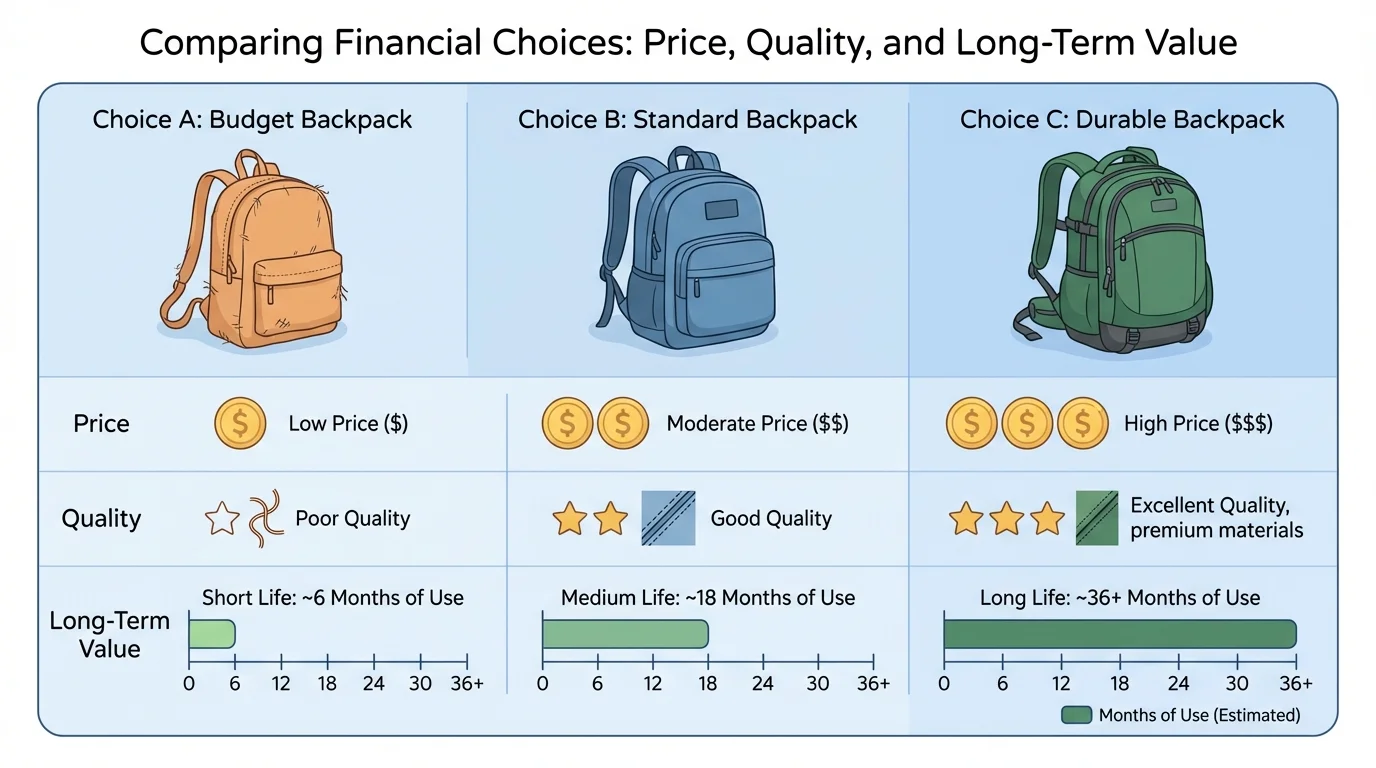
For example, suppose Backpack A costs $18 and lasts about 3 months. Backpack B costs $25 and lasts about 10 months. Backpack C costs $35 and lasts about 12 months. Backpack A has the lowest price, but it may not have the best long-term value. Backpack B might be the smarter choice because it lasts much longer without costing a huge amount more.
Looking back at [Figure 1], you can see why comparing columns helps. Your goal is not always to pick the cheapest or the most expensive item. Your goal is to choose the option that fits your money and gives you the most useful, lasting result.
Price is the amount of money you pay now.
Quality is how well something is made and how well it works.
Long-term value is how worthwhile something is over time compared with what you paid for it.
Sometimes one product wins in one area but loses in another. That is normal. A smart buyer balances the three. You may choose a lower-priced item if it still has good quality. You may also choose a higher-priced item if it will save money later.
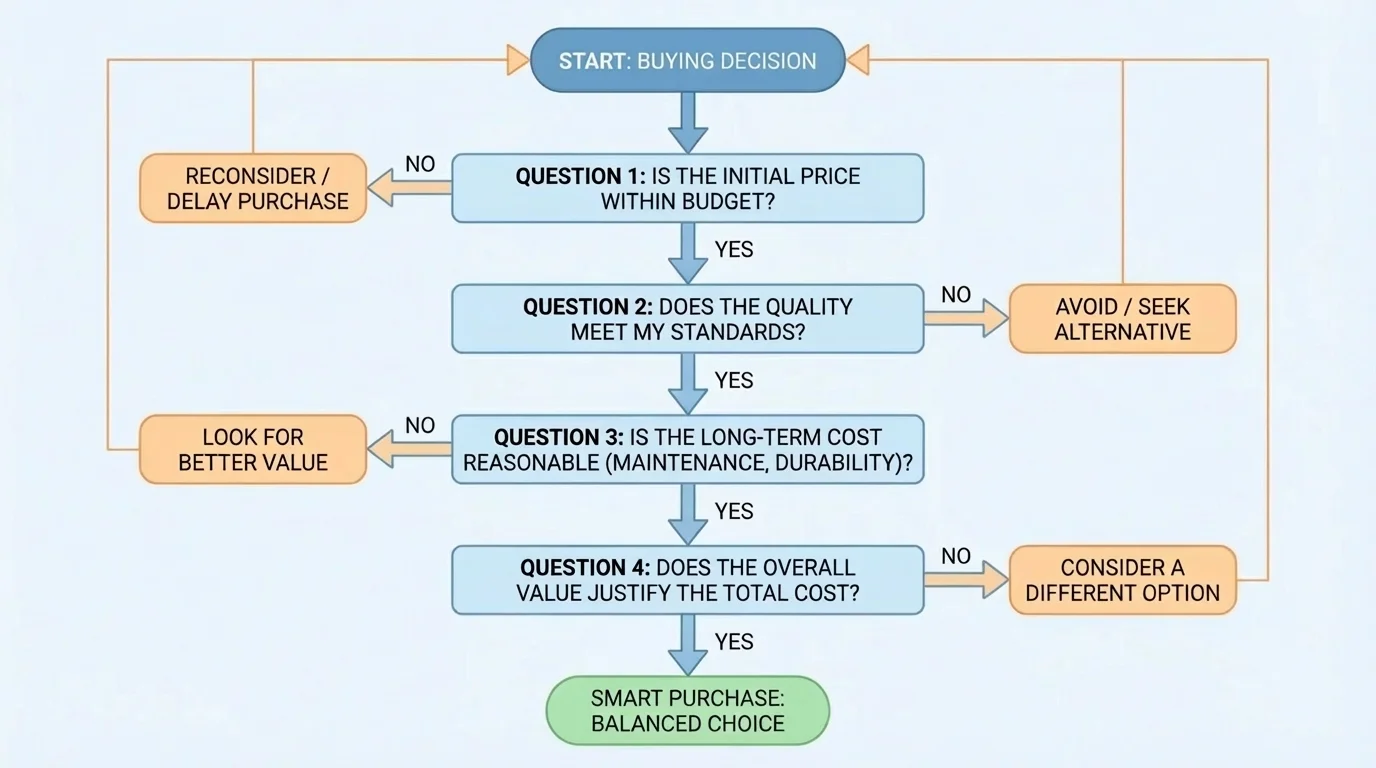
You do not need to guess when you shop. You can follow a simple buying plan, and [Figure 2] lays out the order clearly. This plan helps whether you are choosing a notebook, a lunch container, a pair of sneakers, or an online subscription.
Step 1: Ask, "Do I need this, or do I just want it?" Wants are okay, but needs should usually come first.
Step 2: Check the price. Ask, "Can I afford this with the money I have?"
Step 3: Check the quality. Ask, "Does this seem strong, useful, and reliable?"
Step 4: Think ahead. Ask, "Will this last, or will I need to replace it soon?"
Step 5: Compare at least two or three choices before deciding.
If you skip these steps, you may make a fast choice that feels good for one minute but wastes money later. If you follow them, you give yourself time to notice details.
Using the decision plan for markers
You want a pack of markers for art projects at home. You find two choices.
Step 1: Compare the price.
Pack A costs $3. Pack B costs $5.
Step 2: Compare the quality.
Pack A has fewer colors and dries out quickly in reviews. Pack B has more colors and stronger caps that keep the markers from drying.
Step 3: Think about long-term value.
If Pack A dries out fast, you may need another set soon. Pack B may last longer.
Step 4: Make the choice.
If you can afford $5, Pack B may be the better value. If your budget is smaller, Pack A may still work for now, but you know the trade-off.
That is what smart comparison looks like. You are not just asking, "Which one is cheaper?" You are asking, "Which one makes the most sense?"
Let's look at everyday examples you might actually face. These examples help you practice thinking like a careful shopper.
Budget means the amount of money you can spend. If your budget is $10, a $14 item is outside your budget unless you wait and save more.
| Item | Choice A | Choice B | Smarter question to ask |
|---|---|---|---|
| Water bottle | $4, thin plastic | $10, sturdy metal | Which one will survive drops and daily use? |
| Headphones | $8, poor sound | $15, better sound and stronger cord | Will the cheaper pair break quickly? |
| Shoes | $20, thin sole | $32, stronger sole | Which pair will feel good and last longer? |
| Notebook | $1, few pages | $3, many pages and thick cover | Will the cheaper one run out too fast? |
Table 1. Examples of comparing everyday products by price, quality, and usefulness over time.
Suppose you buy the $1 notebook, but it fills up in one month. Then you buy another $1 notebook the next month, and another after that. In 3 months, you spend \(1 + 1 + 1 = 3\) dollars. The $3 notebook may have cost more at first, but if it lasts all 3 months, the total money spent is the same and the stronger cover may make it the better value.
Now think about shoes. Shoes are a good example because comfort matters too. If one pair is cheaper but hurts your feet or wears out fast, it is not a good choice. Sometimes quality affects your health, comfort, and daily life, not just your wallet.
Good value is not always the lowest price. A smart purchase matches your budget, works well, and lasts a reasonable amount of time. The best value sits where price, quality, and long-term use come together.
This same idea can help with digital choices too. If a game add-on is cheap but only works for one day, while another costs a little more and can be used many times, the second one may be a better use of your money.
Quality can be tricky because you cannot always tell just by looking quickly. But there are clues. Learning these clues helps you make stronger choices.
First, look at the durable parts of an item. Durable means able to last a long time without breaking easily. Thick fabric, strong seams, firm lids, and sturdy zippers can be signs of better quality. Thin plastic, loose parts, and weak handles can be warning signs.
Second, read or listen to reviews when shopping online or talking with trusted adults. A review is someone's opinion about how well a product works. One review is not enough, but many similar reviews can give useful clues. If many people say, "It broke in one week," that matters.
Third, check if there is a warranty or return policy. A warranty is a promise from a company that they will fix or replace something if it stops working within a certain time. Products with a warranty can feel safer because the company stands behind them.
Fourth, think about the job the item needs to do. A low-cost item may be fine for light use, but not for heavy use. For example, a simple folder may work well for a few papers, but a stronger binder may be better if you use it every day.
You already know how to compare and sort things by their features. Shopping uses that same skill, but now the features matter because they affect your money.
As you compare quality, remember that a fancy look does not always mean a better product. Bright packaging and cool designs can be distracting. Focus on how well the item works, not just how exciting it looks.
One of the most important money skills is understanding long-term value. This means looking beyond today's price. Sometimes an item that seems cheap now actually costs more over time.
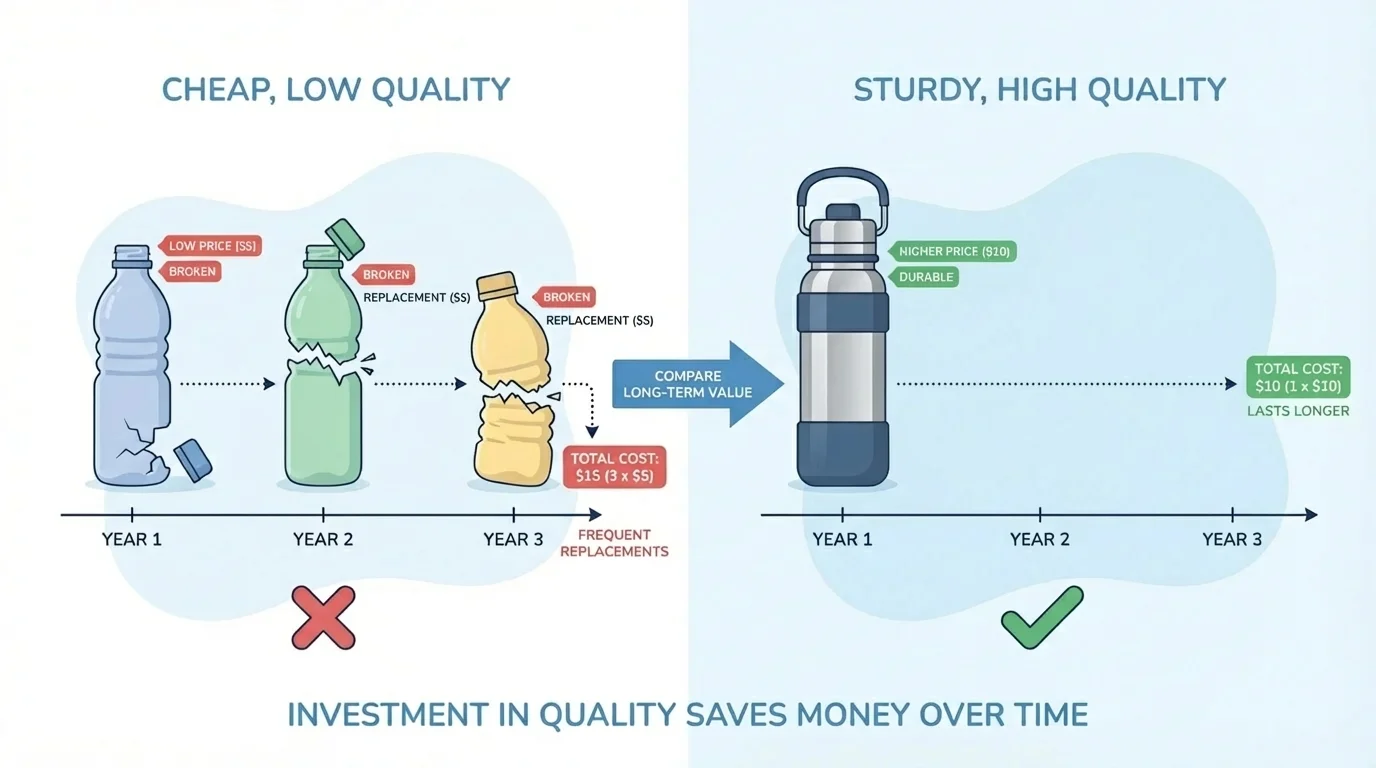
Suppose a cheap water bottle costs $3, but it cracks every month. A sturdier bottle costs $9 and lasts 3 months or longer. If you buy the cheap bottle 3 times, the total is \(3 + 3 + 3 = 9\). As [Figure 3] shows, that means both choices can cost the same after 3 months, but the sturdier one may be less frustrating and better quality.
Here is another example. A snack-size pack of crackers costs $1 for 5 crackers. A larger box costs $4 for 30 crackers. The bigger box has a higher price, but you get more food for your money. If you bought 6 snack packs, you would spend \(6 \times 1 = 6\) dollars for the same 30 crackers. In that case, the larger box gives better value if you will use it before it goes stale.
Comparing cost over time with pencils
You need pencils for home learning and drawing.
Step 1: Look at Choice A.
Choice A costs $2 for a pack that breaks easily, so you buy a new pack every month for 3 months.
Step 2: Add the total cost.
After 3 months, the total is \(2 + 2 + 2 = 6\) dollars.
Step 3: Look at Choice B.
Choice B costs $5 for stronger pencils that last all 3 months.
Step 4: Compare the totals.
\(\$5 < \$6\), so Choice B costs less over time and may work better too.
This is why patient shoppers think ahead. Looking back at [Figure 3], repeated buying can quietly use up your money. Spending a little more once can sometimes save money later.
Smart financial choices also depend on whether something is a need or a want. A need is something important for daily life, learning, health, or safety. A want is something you would enjoy but can live without.
If you need new shoes because yours no longer fit, that may come before buying a toy or game item. If two needed items are available, compare price, quality, and long-term value so your money covers the most important things first.
Sometimes the smartest choice is not buying anything yet. If the better-quality item costs more than you have, waiting and saving can be a wise move. For example, if you have $8 and the stronger pair of headphones costs $14, you might save \(14 - 8 = 6\) more dollars instead of buying a weaker pair that may break fast.
"Being smart with money means thinking about tomorrow, not just today."
Saving up can feel hard, but it gives you more power. It lets you choose from better options instead of only the cheapest ones available right now.
Shopping online can be convenient, but you have to check details carefully. The big sale number is not the whole story.
Always look for extra costs. An item might cost $7, but if shipping is $4, then the total is \(7 + 4 = 11\) dollars. That changes the comparison. Also check delivery time. If you need something soon, waiting weeks may not work.
As [Figure 4] shows, read the size, amount, or package details. A photo can make something look bigger than it really is. A bag of snacks that seems like a good deal may be tiny. A set may include fewer pieces than you expect.
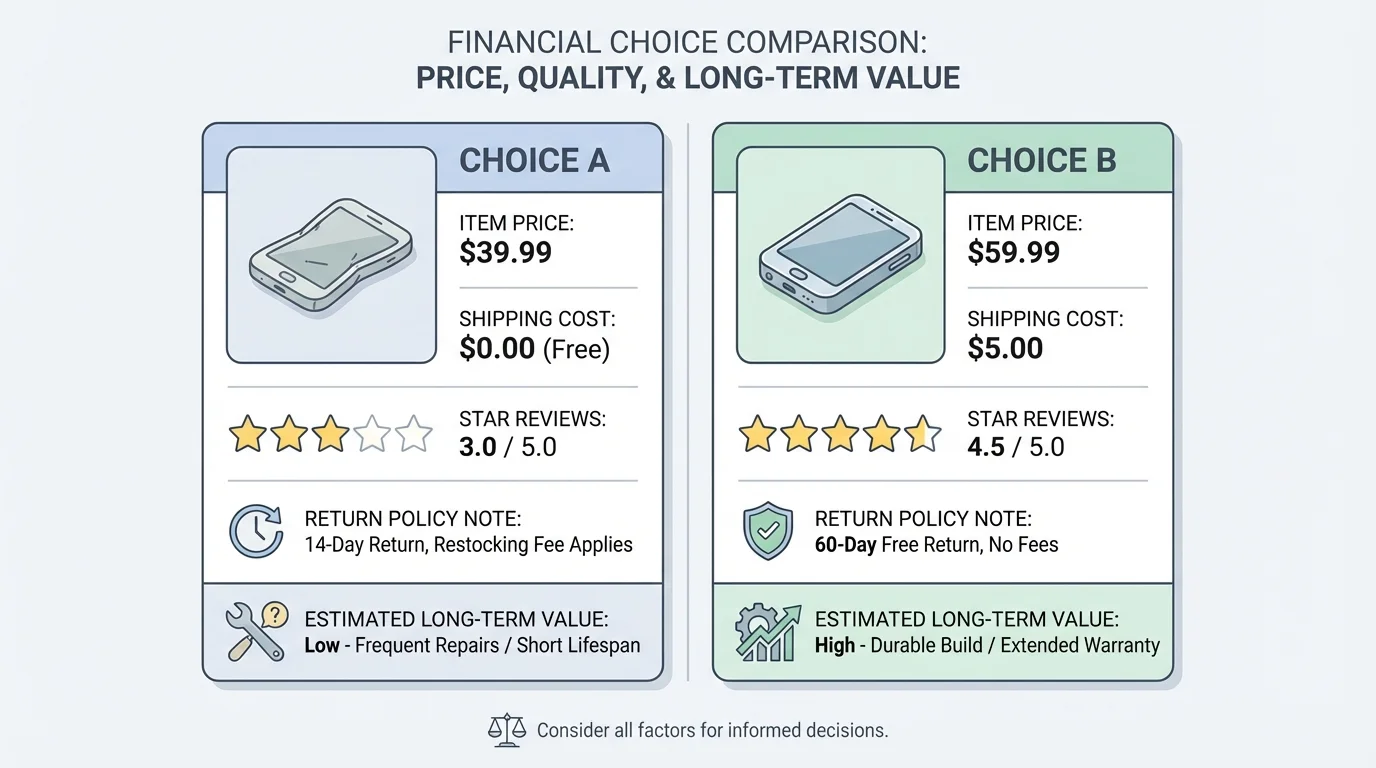
Reviews matter here too. Stars and comments give clues, but you should still read carefully. Some people care about color while others care about strength, so focus on comments about how the item works and lasts.
In stores, compare products side by side when possible. Hold them, look at the material, and check how they are built. If you are buying food or household supplies, adults sometimes compare unit price, which means the cost for one amount, like one ounce or one item. Unit price helps people see which size gives more for the money.
For younger shoppers, a great habit is to pause before buying and ask a trusted adult one smart question, such as "Do you think this will last?" or "Is this a good value?" That question alone can save money.
Stores and websites often try to catch your attention with bright sale labels. A sale can be helpful, but the item is only a good deal if you actually need it and the quality is still good.
Another smart tip is to compare at least two places when you can. One website may have a lower price, but another may include free shipping or a better return policy. Good shoppers compare the full deal, not just one number.
This skill is useful far beyond one purchase. It can help when choosing a reusable lunch container, a sports ball, art supplies, a tablet case, a backpack, or a music subscription. It even helps with family decisions like whether to buy reusable items instead of disposable ones.
For example, a reusable water bottle may cost more than one disposable drink at first. But if you buy drinks again and again, the total keeps growing. That is the same idea we saw earlier with replacements in [Figure 3]. Long-term thinking helps you notice patterns that save money.
You can also use this skill when spending gift cards or chore money. Before buying, stop and ask yourself three quick questions: What is the price? What is the quality? What is the long-term value? If you can answer all three, you are making a stronger decision.
Over time, these small choices build a big habit. People who compare carefully often waste less money, feel more satisfied with what they buy, and become more confident about handling money in daily life.
