Have you ever felt excited about a toy, nervous after watching a video, or suddenly wanted to try a trend after seeing it online? That is not an accident. Messages and media are often designed to grab your attention fast and make you feel something. When you understand how that works, you become stronger, calmer, and smarter online.
Every day, you see media: videos, ads, photos, game screens, news clips, online posts, text messages, and even product packaging. Some media helps you learn, laugh, or stay informed. Some media tries to sell you something. Some media tries to get clicks, likes, or shares. Some media may even try to make you angry or scared because strong feelings keep people watching longer.
Your feelings matter because feelings can lead to actions. If a video makes you feel left out, you might beg for an item you do not need. If a headline makes you feel scared, you might share it before checking if it is true. If a funny challenge makes a risky action look harmless, you might want to copy it. Understanding this link helps you stay in charge of your choices instead of letting a screen make choices for you.
Message means the main idea or signal being sent. A message might say something directly, like "Buy this now," or indirectly, like "People who have this are cool."
Influence means to affect what someone thinks, feels, or does.
Audience means the group a message is meant for.
Not every message is bad. A weather alert can help you stay safe. A kind video can cheer you up. A reminder app can help you finish homework. The important skill is noticing how a message affects you and deciding what to do next.
Most messages are created for a reason. Sometimes the reason is to inform. Sometimes it is to entertain. Sometimes it is to persuade, which means trying to change your mind or behavior. When you spot the purpose, the message becomes easier to understand.
A game ad might show only the most exciting moments so you will want to download it. A creator might use a dramatic title so more people click. An online store might say an item is "almost gone" so you feel rushed. A friend might forward a rumor because it seems shocking. Each message has a purpose, and each purpose can affect your feelings in a different way.
Here are four helpful questions to ask when you see something online:
These questions are simple, but they are powerful. They help you notice the difference between a useful message and a message that is trying to push you too hard.
Pictures and videos can affect you before you even read the words. Color, size, facial expression, background, sound, and camera angle all send signals, as [Figure 1] illustrates with the same basic message shown in two different styles. A bright image with smiling faces can feel safe and fun. A dark image with sharp letters can feel serious or scary.
Think about a poster for a missing dog. One version might use warm colors, a clear photo, and calm words that help people focus. Another version might use huge red letters, dramatic shadows, and many exclamation marks. Both are about the same dog, but they can create very different feelings in the person looking at them.
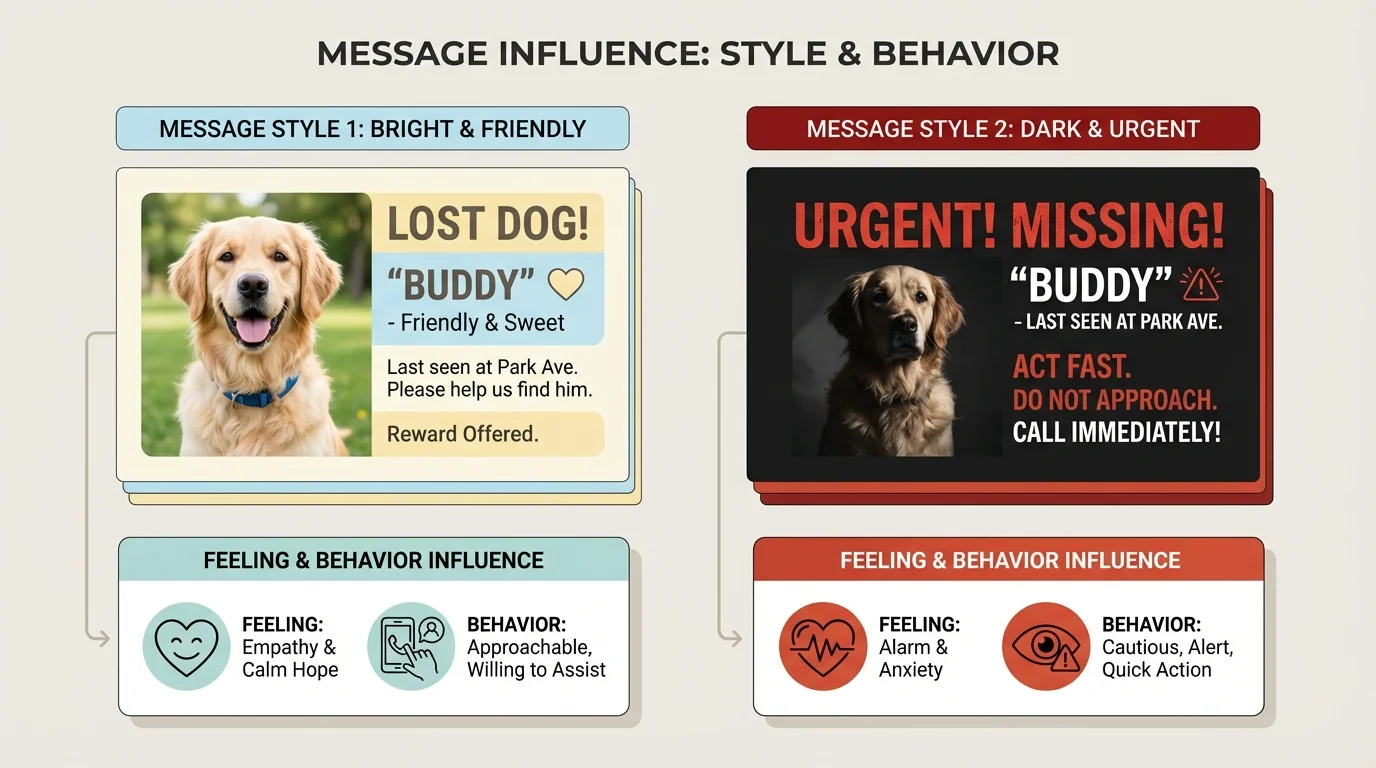
Videos add even more influence. Fast music can make a scene feel exciting. Slow music can make it feel sad. Quick cuts can create energy. Close-up shots can make emotions feel stronger. Even the order of clips matters. If a creator shows only a few dramatic moments, the whole situation may seem bigger than it really is.
This is called framing. Framing is the way information is presented. The facts might stay the same, but the presentation changes how people understand them. Later, when you notice a post that feels extra urgent or dramatic, think back to [Figure 1]. Often, the image style is doing part of the work.
Your brain often reacts to pictures faster than to full sentences. That is one reason thumbnails, logos, and big headlines can affect your mood so quickly.
That does not mean you should distrust every picture. It means you should slow down and notice what parts of the image are guiding your feelings.
Feelings often lead to choices. If a message makes you feel excited, you may click right away. If it makes you feel afraid, you may rush to warn others. If it makes you feel like everyone else has something, you may ask for it too. This is where media influence becomes part of daily life.
Here are some common ways media can change behavior:
Sometimes the change is small, like wanting a snack after seeing a food commercial. Sometimes it is bigger, like believing a rumor, spending too much time online, or feeling worse about yourself after comparing your life to polished photos.
Advertisements are a common example. An ad may not only show a product. It may also show happy friends, exciting music, or a cool room setup. The real message becomes: "If you get this, you will feel like this." That is a powerful idea, even when it is not fully true.
[Figure 2] Some persuasion tools show up again and again in posts, ads, videos, and headlines. When you notice these clues, you can stop and think instead of reacting automatically.
Watch for these signs:
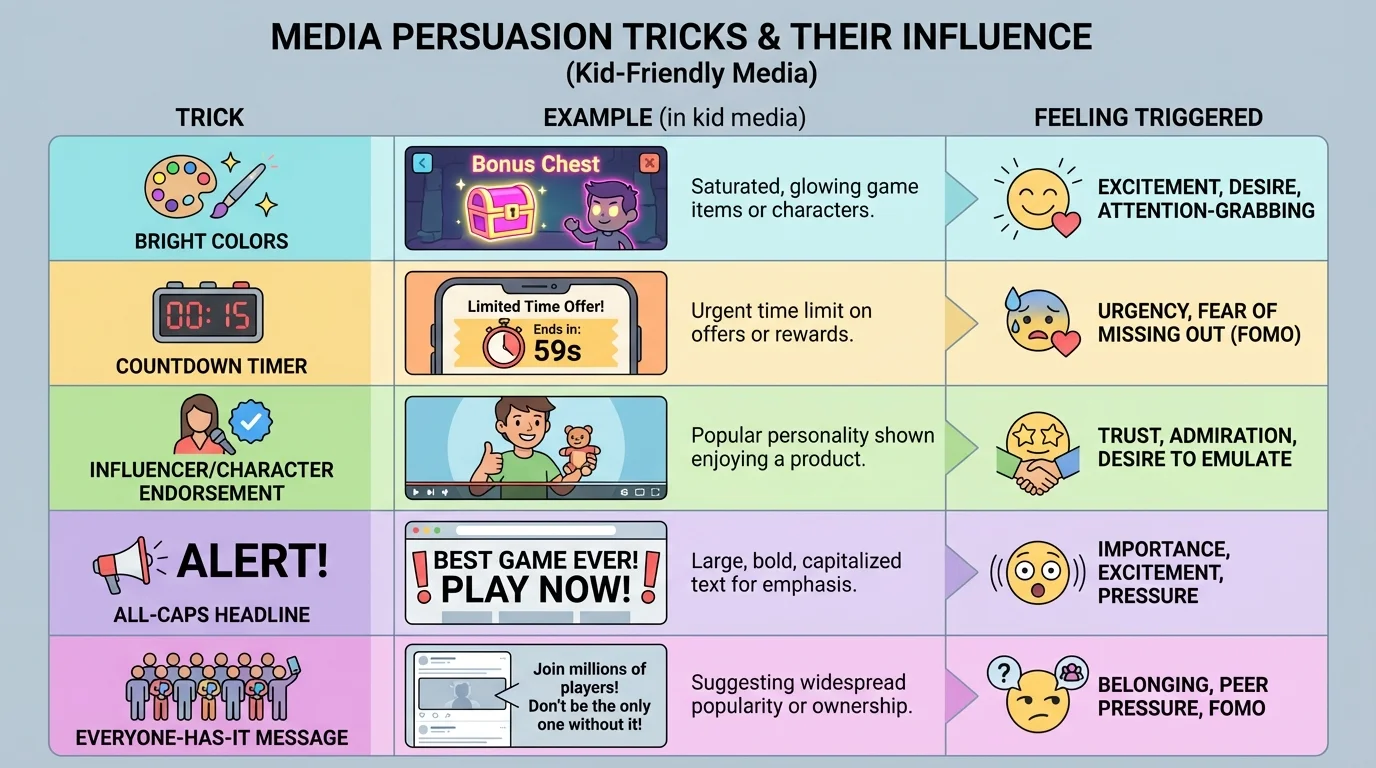
These clues do not always mean a message is false. They mean you should look more carefully. A real sale might exist. A warning might be important. But strong pressure is a clue to pause.
Another clue is when a message makes you feel bad about yourself first and then offers a solution. For example, an ad may suggest you are not stylish, popular, or skilled enough unless you buy something. That is not a healthy way to communicate. Good messages can inform you without tearing you down.
Real-world case: The urgent game skin ad
You see a game ad that says a special skin is available for a very short time.
Step 1: Notice the feeling
You feel rushed and worried you will miss out.
Step 2: Spot the clue
The countdown timer and "last chance" words are pressure tools.
Step 3: Ask smart questions
Do you really want it, or do you just hate the feeling of missing it? Is it worth the money or screen time?
Step 4: Choose your action
Wait, talk with a trusted adult if money is involved, and decide later when you feel calm.
This turns a rushed reaction into a thoughtful choice.
When you use this kind of thinking, you protect both your money and your emotions.
[Figure 3] You do not need to study every post like a detective. You just need a quick plan for the moments when something feels strong, urgent, or confusing. The four-step pause plan helps you do that.
Step 1: Stop. Keep your finger or mouse still for a moment. Do not click, share, or comment yet.
Step 2: Notice. Ask yourself, "What am I feeling right now?" Maybe you feel excited, angry, scared, jealous, or rushed.
Step 3: Check. Look at the source, the purpose, and the clues. Is this trying to inform me, or mostly trying to control my reaction?
Step 4: Choose. Decide what action matches your values. You might close it, save it to check later, ask an adult, or continue carefully.
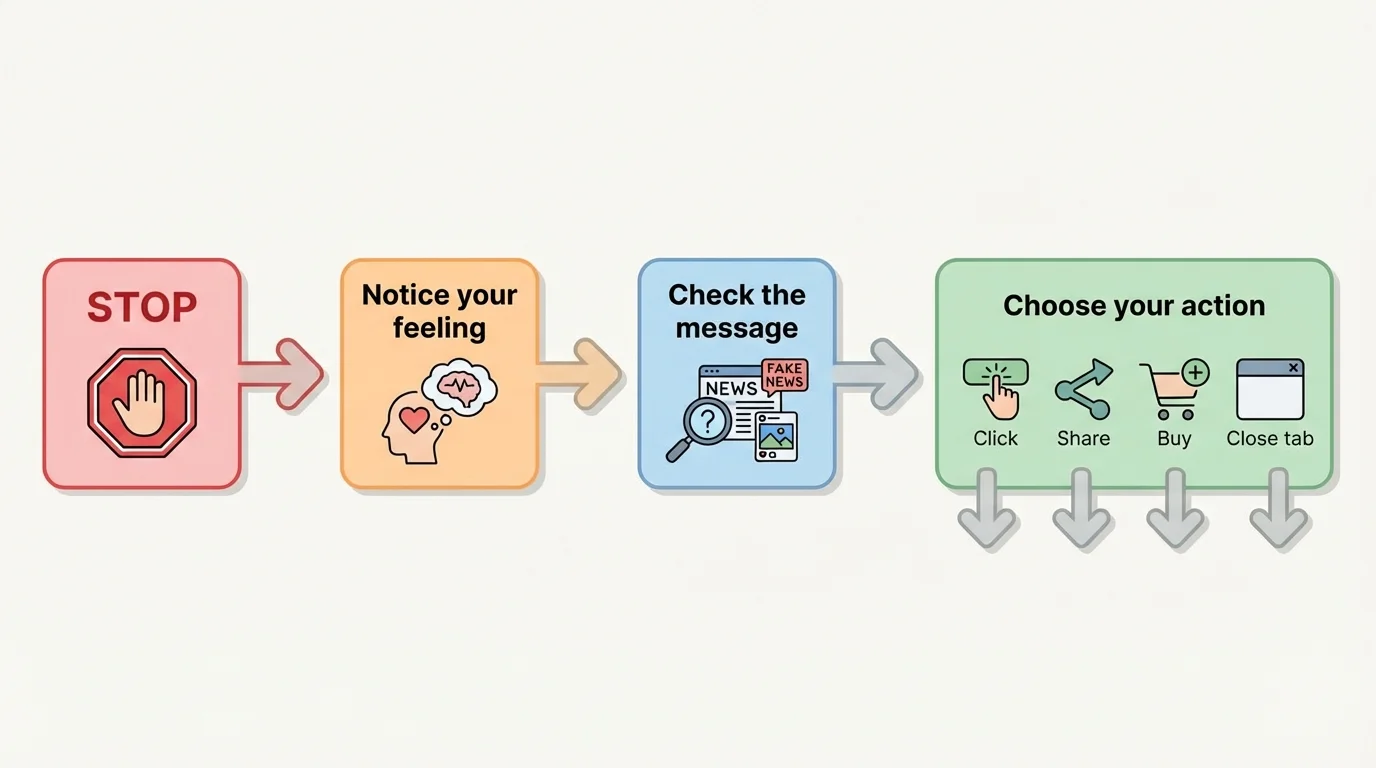
This plan works because feelings are fast, but wise choices take a little longer. The short pause gives your brain time to catch up. Later, when you are scrolling and feel pressure, remember [Figure 3]. A few calm seconds can prevent a lot of trouble.
"Strong feelings are important signals, but they should not be the only boss of your choices."
If the message involves money, personal information, or safety, add one more rule: talk to a trusted adult before acting.
Let's look at a few situations you might face online.
Situation 1: A scary headline. You see a post with a headline that says a common food is "extremely dangerous." The picture looks dramatic. You feel worried and want to send it to family right away. Smart move: pause, check whether the source is trustworthy, and see if other reliable sources say the same thing. One dramatic headline is not enough.
Situation 2: A perfect room setup. A creator shows a beautiful desk, expensive lights, and matching accessories. You start feeling like your own space is not good enough. Smart move: remember that creators often choose the best angle, best lighting, and best moment. Real life includes mess, mistakes, and ordinary days that are not shown.
Situation 3: A prank video. The video makes risky behavior look hilarious. Comments say everyone should try it. Smart move: ask what is missing from the video. Was someone hurt? Was the scene edited? Was it done by trained adults? Online attention is not worth real-world injury.
Situation 4: A friend sends a rumor. A message says a game is being shut down tonight. Everyone seems upset. Smart move: do not spread it yet. Look for the official game account or website. Rumors grow fast when people share first and check later.
Why comparison can hurt your mood
Many online posts show highlights, not the whole story. When you compare your normal day to someone else's best moment, you may feel less happy with your own life. That feeling is real, but the comparison is often unfair because you are not seeing the full picture.
These situations show that media influence is not just about products. It also affects mood, confidence, safety, trust, and relationships.
Good habits make smart choices easier. You do not have to be perfect. You just need habits that help you stay aware.
Try these habits in daily life:
One more helpful habit is to ask, "Would I make the same choice if I felt calm?" If the answer is no, wait. That question works for buying, posting, sharing, and replying.
Not everything online is true, fair, or complete. A smart digital citizen checks information, protects personal feelings, and makes thoughtful choices instead of fast reactions.
You also influence other people. The messages you share, the comments you write, and the photos you post can affect someone else's feelings and behavior. That means media literacy is not only about protecting yourself. It is also about being responsible with your own voice.
Try This: The next time a post gives you a strong feeling, pause and name the feeling before you do anything else. Then ask what the post wants you to do. That tiny habit can change the whole way you use media.
Try This: If you see an ad, say out loud what tools it is using: bright colors, music, pressure words, or popularity. Once you notice the tools, they often become less powerful.
Try This: Choose one creator, channel, or app you use often. Pay attention for one day to how it affects your mood. Does it leave you inspired, informed, relaxed, worried, or upset? Use that information to make healthier choices.
