A tiny scrape can stay tiny or turn into a bigger problem, depending on what you do next. The same is true for many everyday safety situations. When you know a few smart habits and simple first-aid steps, you can protect yourself, help calmly, and make better choices before trouble starts.
First aid means the safe help given right away when someone is hurt or suddenly feels unwell. At your age, first aid is not about doing everything by yourself. It is about knowing what you can do safely, what you should never do alone, and when to get a trusted adult immediately.
First aid is the immediate care given to help a person until a trusted adult, caregiver, or medical professional can take over.
Prevention means taking steps ahead of time to stop injuries or illness from happening.
Emergency is a serious situation that needs fast adult or medical help right away.
Being helpful starts with being safe. If you rush in without thinking, you could get hurt too. Good first aid is calm, careful, and smart.
You probably have everyday moments when safety matters: riding a bike, helping in the kitchen, playing sports, walking a dog, using scissors for a project, or communicating online with people from an activity group. In all of these situations, your choices matter. Small habits like wearing a helmet, washing a scrape, or telling an adult quickly can make a big difference.
When safety is handled well, a problem is often smaller, pain may be reduced, and healing can begin sooner. When safety is ignored, a small cut can get infected, a burn can get worse, or a serious danger sign can be missed.
Your skin is one of your body's best protectors. Even a small cut matters because it opens a path for germs to get in, which is why cleaning and covering it can be important.
One of the most important habits is to notice what kind of problem you are dealing with. Some situations are minor, and some are emergencies. Knowing the difference helps you act wisely.
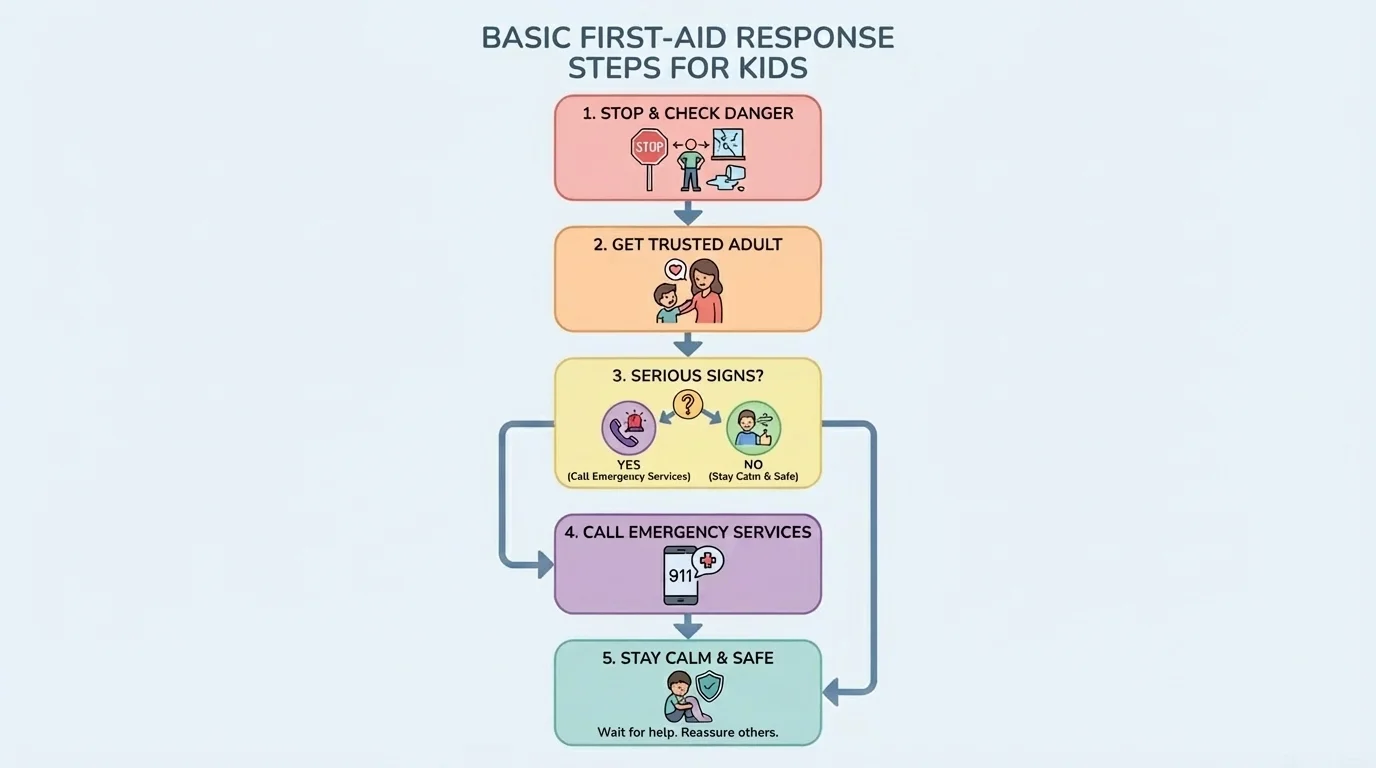
When someone is hurt, a simple action order helps you respond safely, as [Figure 1] shows. Your first job is not to be a hero. Your first job is to slow down, look around, and decide what is safe.
Step 1: Stop and take a breath. If you panic, it is harder to think clearly. Even one slow breath can help your brain focus.
Step 2: Check for danger. Is there broken glass, a hot pan, a loose dog, a road nearby, smoke, electricity, deep water, or something else unsafe? If the area is dangerous, do not go closer. Move away and get an adult right away.
Step 3: Call for a trusted adult. This could be a parent, grandparent, caregiver, coach, group leader, neighbor you know well, or another responsible adult nearby.
Step 4: If the person is not waking up, has trouble breathing, is bleeding heavily, may have been poisoned, or seems badly hurt, tell the adult to call emergency services right away. If you are alone and have been taught how, call emergency services yourself and speak clearly.
Step 5: Stay with the person if it is safe. Talk calmly. Do not give food, drink, or medicine unless a trusted adult or medical professional says to.
Here is a simple sentence you can use when asking for help: "I need help now. Someone is hurt. We are at home in the kitchen." or "My friend fell off a scooter at the park and cannot stand." Clear words help adults act faster.
Real-life example: You find your younger cousin crying after falling
Step 1: Look around first
You notice the floor is wet. You do not run across it. You move carefully so you do not slip too.
Step 2: Check what kind of problem it is
Your cousin is awake, talking, and has a scraped knee. That suggests a minor injury, but an adult still needs to know.
Step 3: Get a trusted adult
You call a caregiver right away and say where you are and what happened.
Step 4: Help only in safe, simple ways
You stay nearby, speak calmly, and wait for the adult to guide the next steps.
If the person might have a neck, back, or leg injury after a hard fall, do not try to move them unless there is immediate danger like fire or traffic. That warning remains important later too, as we saw in [Figure 1].
A first-aid kit is most useful when you already know what is inside. A kit should be stored where a trusted adult says it belongs, and you should ask to look through it together.
Some common items in a home first-aid kit are listed below.
| Item | Purpose | Safety Note |
|---|---|---|
| Adhesive bandages | Covering small cuts and scrapes | Use clean hands first |
| Gauze pads | Covering larger scrapes or helping press on a wound | Ask an adult for help |
| Medical tape | Holding gauze in place | Do not wrap too tightly |
| Antiseptic wipes | Cleaning around minor wounds | Use as directed by an adult |
| Instant cold pack | Cooling bumps or swelling | Wrap in cloth, do not place directly on skin |
| Disposable gloves | Protecting from blood and germs | Adults often use these first |
| Thermometer | Checking body temperature | Use with adult guidance |
Table 1. Basic items often found in a first-aid kit and their safe uses.
You should not play with first-aid supplies or medicines. A kit is not a toy box. It is a tool for health and safety.
Common minor injuries follow clear routines, and [Figure 2] illustrates the steps so they are easier to remember. If you get a small cut or scrape, the main goals are to clean it, stop minor bleeding, and protect it from dirt.
For a small cut or scrape: First, tell a trusted adult. Wash your hands with soap and water. If the scrape is dirty, rinse it gently with clean water. A caregiver may use mild soap around it. Press gently with clean gauze or a cloth if there is light bleeding. Once it is clean, cover it with a bandage if needed. Keep watching it over the next days. If it becomes very red, swollen, warm, or has pus, tell an adult because those may be signs of infection.
For a nosebleed: Sit up and lean slightly forward, not backward. Pinch the soft part of your nose gently and breathe through your mouth while a trusted adult times it. Leaning forward matters because it helps keep blood from going down your throat.
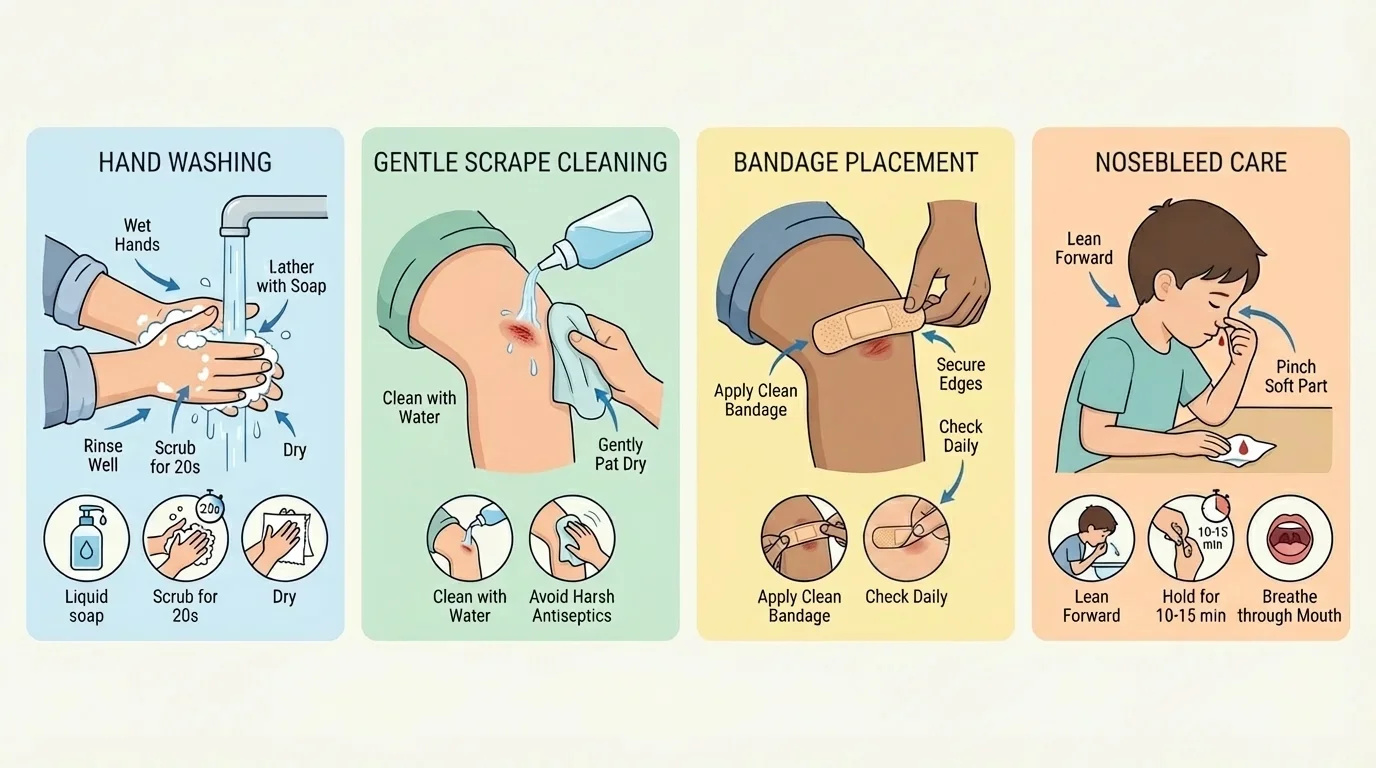
There are also things not to do. Do not blow your nose hard during a nosebleed. Do not tilt your head back. Do not pick at a scab on a healing scrape, because that can reopen the skin.
Why clean wounds matter
Your body starts repairing a cut right away, but dirt and germs can slow healing. Cleaning a minor wound and keeping it covered when needed helps your skin do its repair job.
If a cut will not stop bleeding, if it is very deep, or if something is stuck in it, get adult help immediately. That is no longer a simple home fix. The wound-care routine shown in [Figure 2] is only for minor injuries.
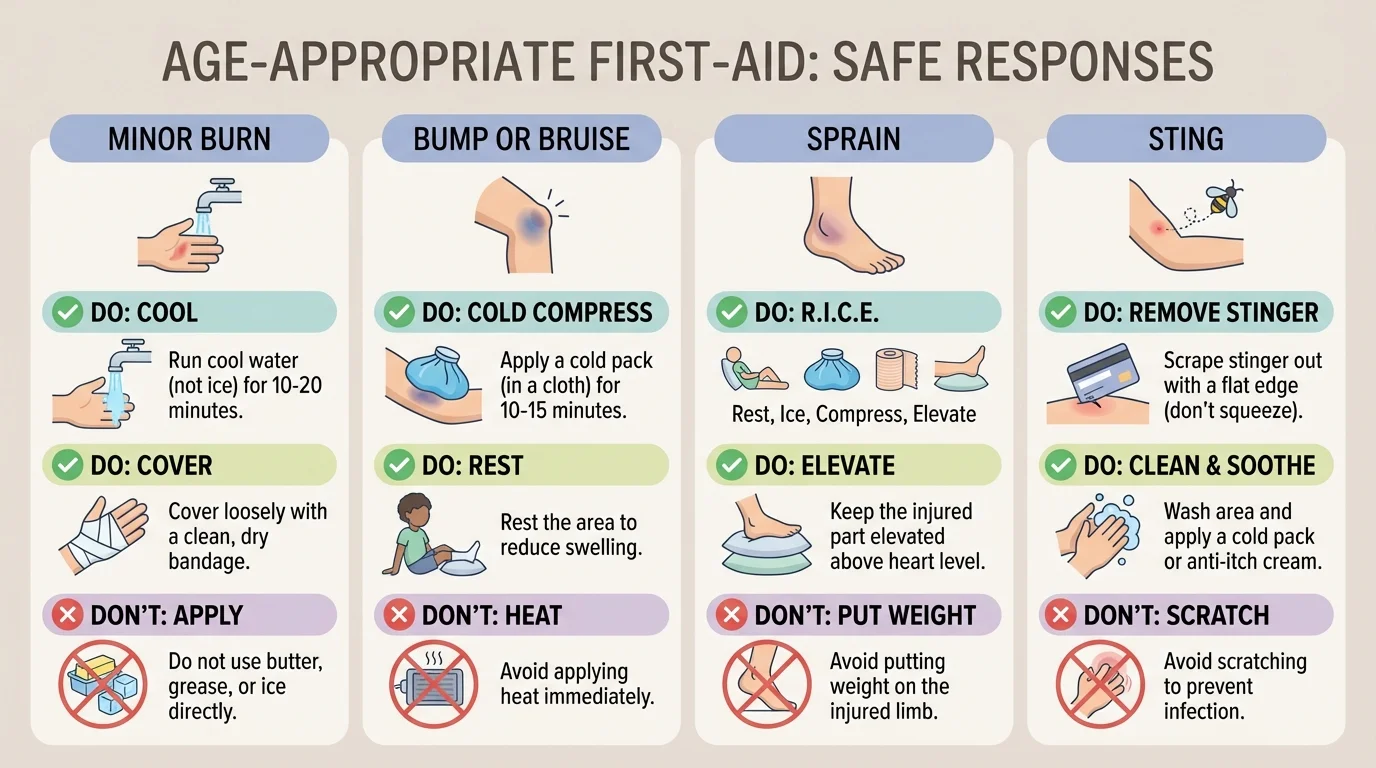
Each kind of injury needs a different response, as [Figure 3] shows. Knowing the right action helps because the wrong action can make an injury feel worse.
Minor burn: If you touch something hot and get a small burn, move away from the heat source and tell an adult immediately. Cool the area with cool running water for several minutes. Do not use ice directly on a burn, and do not put butter, oil, or toothpaste on it.
Bump or bruise: A wrapped cold pack can help reduce pain and swelling. Put a cloth between the cold pack and the skin. Rest the area.
Sprain: A sprain happens when a joint is twisted or stretched too far. The ankle is a common place. Resting the area, using a wrapped cold pack, and having an adult help you keep it raised can help. If the person cannot walk or the swelling is severe, they need adult attention quickly.
Sting: Tell an adult right away. Wash the area gently if told to. A cold pack may help with swelling. If the person has trouble breathing, swelling of the face, or feels dizzy, that is an emergency and adult help must happen fast.
One important safety word is allergic reaction. Some people have strong body reactions to food, stings, or medicines. Trouble breathing, sudden swelling, or feeling faint are signs that emergency help is needed right away.
Real-life example: You burn your finger on a baking tray
Step 1: Move away from the hot object
You do not touch the tray again, and you alert the adult you are cooking with.
Step 2: Cool the burn
You place the finger under cool running water as the adult helps you.
Step 3: Avoid common mistakes
You do not put ice, butter, or lotion on it unless the adult or doctor says to.
Step 4: Watch for severity
If the burn is large, severely blistered, or on the face, hands, or genitals, an adult should seek medical care.
The comparison in [Figure 3] helps you remember that cooling is best for a minor burn, while rest and cold packs are more useful for bumps and sprains.
Some signs mean you should stop thinking about simple first aid and get emergency help. You are not expected to solve these situations alone.
Get a trusted adult and emergency help right away if someone:
A poisoning emergency can happen from swallowing medicine, cleaning products, vape liquid, or other harmful substances. Never taste something to figure out what it is. Never smell a mystery chemical closely. Get an adult immediately.
Medicines can help only when the right person takes the right amount at the right time. A medicine that helps one person can seriously harm another person, especially a child.
If you call emergency services, give the important facts: your name, the location, what happened, and whether the person is awake and breathing. Stay on the line unless the operator says you can hang up.
Prevention is often the best first aid, and many daily habits help keep accidents from happening in the first place. Strong prevention habits do not make you scared. They make you ready.
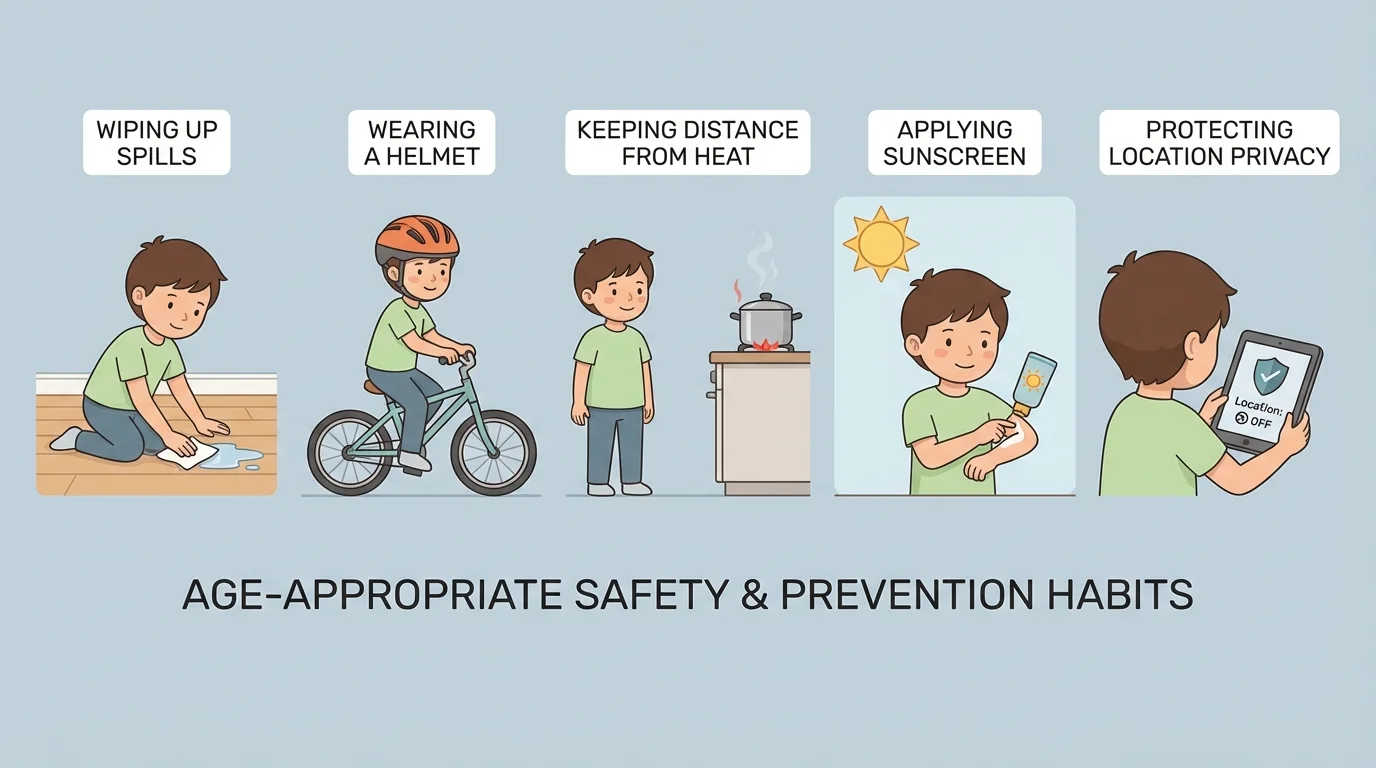
[Figure 4] At home:
At home: Wipe up spills so no one slips. Walk, do not run, near stairs. Keep fingers away from door hinges. Use scissors correctly. Stay back from hot stove tops, boiling water, and sharp knives unless an adult is directly teaching and watching. Keep cords tidy so nobody trips.
Outdoors: Wear a helmet when biking, skating, or riding a scooter if your family and local rules require it. Use sunscreen and drink water when it is hot. Watch for traffic before crossing driveways and streets. Wear shoes where there may be sharp objects, hot pavement, or insects.
In sports and play: Warm up your body. Use the right gear, like shin guards, mouth guards, or pads when needed. Follow rules because many rules are really safety rules. Stop playing if you feel sharp pain.
In digital life: Do not share your home address, live location, or personal health information with people online unless a parent or caregiver says it is okay. If someone online asks you to meet in person, asks for private details, or makes you uncomfortable, tell a trusted adult right away. Personal safety includes digital choices too.
One useful habit is to do a quick safety scan before starting an activity. Ask yourself: What could go wrong here? What safety gear do I need? Where is the adult? What is my exit plan if something feels unsafe?
"The safest choice is often the smartest choice."
The prevention scenes remind you that safety is not one big action. It is many small choices repeated every day.
Safety is not only about accidents. It is also about health habits that help your body stay strong and ready. Getting enough sleep, drinking water, washing hands, brushing teeth, and eating balanced meals all lower the chances of some health problems.
Handwashing is one of the simplest prevention habits. Wash before eating, after using the bathroom, after touching animals, after coughing into your hands, and after treating a small scrape. Soap and water help remove germs.
Hydration means having enough water in your body. On hot days or active days, you may need more water. Signs you need a break include feeling dizzy, very tired, or getting a headache during heat and exercise.
Sun safety matters too. Use sunscreen with adult help, wear a hat when needed, and take shade breaks. A sunburn is an actual burn, not just "too much sun."
Medicine safety is a major rule: never take medicine unless a trusted adult gives it to you exactly as directed. Gummies and flavored medicines can look harmless, but they can be dangerous when misused.
Your brain makes safer decisions when you are rested. Being very tired can make you miss warning signs, forget rules, or act too quickly.
Good prevention habits make first aid needed less often. That is one reason health and safety belong together.
Safety also depends on communication. If something hurts, feels wrong, or seems unsafe, speak up early. Waiting because you do not want to bother someone can let a problem grow.
It helps to know a few pieces of important information: your full name, your home address, a caregiver's phone number, any major allergies you have, and which trusted adults you can contact. Practice saying this information clearly.
You can also make a family safety plan. Ask where the first-aid kit is kept, where emergency phone numbers are posted, what to do in a fire, where to meet outside, and which neighbor or relative is a trusted backup adult.
Simple safety plan checklist
Step 1: Learn key information
Memorize your address, at least one caregiver phone number, and your full name.
Step 2: Know your helpers
Name the trusted adults you can call if a caregiver is unavailable.
Step 3: Find safety tools
Know where the first-aid kit, flashlight, and emergency contact list are stored.
Step 4: Use clear words
Practice saying what happened, where you are, and what help is needed.
Being prepared does not mean expecting bad things all the time. It means you are building confidence. You know how to notice danger, protect yourself, help in small safe ways, and get the right adult support when it matters most.
