Your body is always sending messages. A headache before a big test, a stomachache before a sports game, or trouble sleeping after an upsetting online message can all be signs that your body feels pressure. That pressure is called stress. Stress is a normal part of life, but when you understand it, you can take better care of yourself.
Stress is not always a bad thing. Sometimes it helps you get ready, pay attention, or react quickly. If a dog runs into the street in front of you while you are riding your bike, your body needs to react quickly so you can stop safely. But when stress feels too big, lasts too long, or happens too often, it can make your body and mind feel worn out. That is why learning to cope in healthy ways is part of staying well.
Stress is the body and mind's response to a challenge, change, or worry. Coping means the actions you take to handle stress. Wellness means taking care of your whole self, including your body, mind, feelings, and safety.
You might feel stress when schoolwork piles up, when plans change suddenly, when you argue with a sibling, when you are nervous about a performance, or when something upsetting happens online. Even exciting events, like a vacation or a birthday party, can cause stress because they change your routine.
Your brain and body work together all the time. When something feels challenging or scary, your body gets ready to act. This can happen very quickly. You may not choose it on purpose. It is an automatic response that helps protect you.
At your age, stress can come from many places: a hard assignment, not understanding directions, trying to keep up with chores, feeling left out in a group chat, worrying about a family member, or having too many activities in one day. Stress can also come from inside you, like wanting everything to be perfect or being afraid to make a mistake.
Your body cannot always tell the difference between a truly dangerous problem and a regular everyday worry. That is why your heart might beat faster before reading aloud on a video call, even though you are safe at home.
Knowing what causes your stress helps you make a plan. If you can name the problem, you are more likely to choose a helpful coping step instead of reacting without thinking.
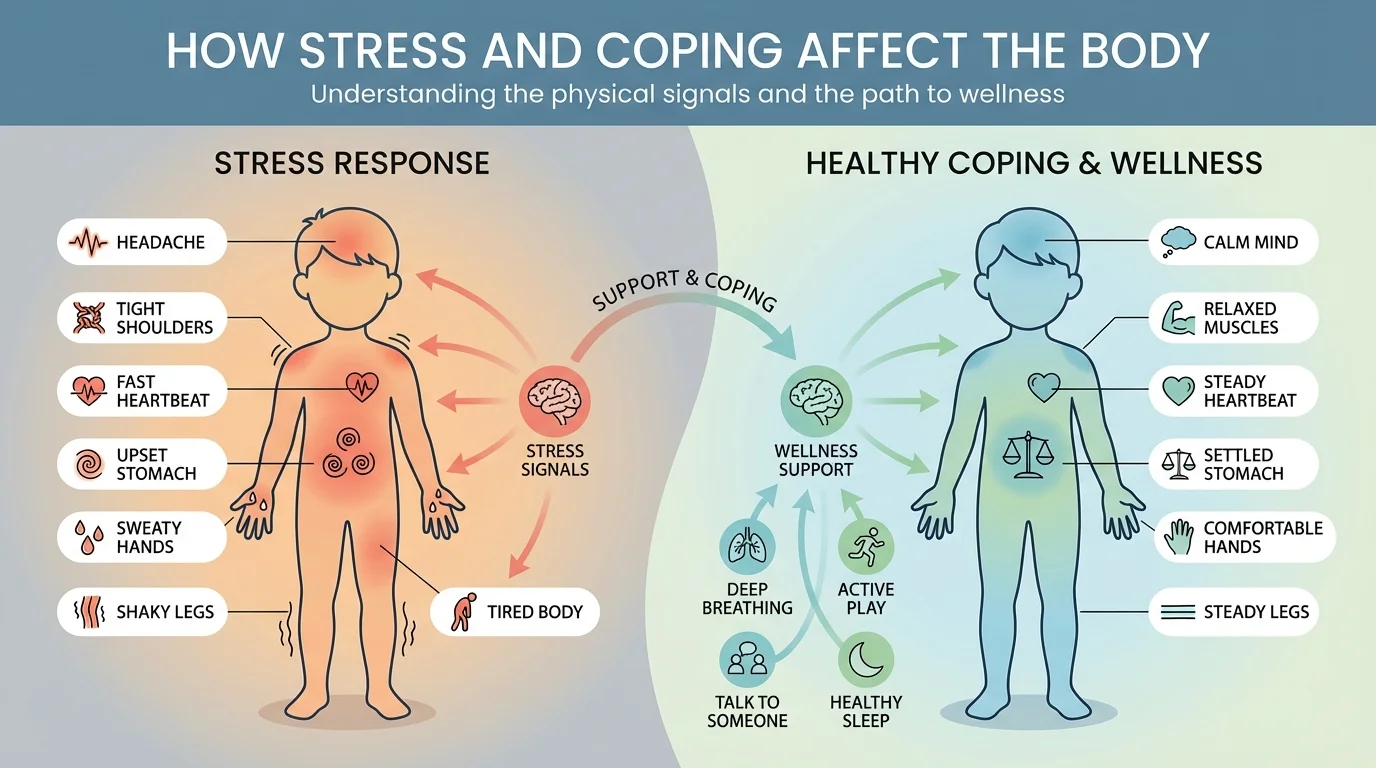
Stress can affect many parts of your body, as [Figure 1] shows. Even though stress starts with how your brain reacts to a challenge, the signs can appear in your head, chest, stomach, muscles, skin, sleep, and energy level.
Some common body signs of stress are a fast heartbeat, sweaty hands, a headache, a tight jaw, tense shoulders, shaky legs, feeling hot, a stomachache, feeling like you need to cry, or feeling very tired. Some kids get quiet. Others get snappy or restless. Some feel like they cannot sit still, and some want to hide under a blanket and be alone.
Stress can also affect your thoughts. You may have trouble focusing, forget directions, or think, "I can't do this," even when you really can. When your brain feels stressed, it is harder to stay calm and solve problems clearly.
Your body may also react through sleep and appetite. You might find it hard to fall asleep, wake up in the night, or feel too tired in the morning. Some people eat less when stressed. Others want to snack more than usual. These changes are clues that your body needs care.
Why body signals matter
Body signals are like warning lights on a dashboard. They do not mean something is wrong with you as a person. They mean your body is asking for support. When you notice the signs early, you can use a healthy coping skill before stress grows bigger.
Think about how different this can look from person to person. One person may get a stomachache before piano practice. Another may get grumpy before a game. Another may feel frozen and unable to start homework. These are all possible stress signals.
Some stress lasts a short time. This is short-term stress. It might happen before a spelling quiz, a dentist visit, or a dance recital. After the event is over, your body usually settles down again.
Other stress lasts longer. This is long-term stress. It can happen when worries keep coming back day after day, like problems at home, ongoing friendship trouble, being overscheduled, or not getting enough sleep for many nights in a row. Long-term stress can make you feel cranky, exhausted, worried, or sick more often.
Short-term stress is like carrying a heavy backpack for a few minutes. Long-term stress is like wearing that heavy backpack all day. Your body can handle some pressure for a little while, but carrying too much for too long can wear you down.
That is why healthy coping is important. It gives your mind and body chances to rest, reset, and recover.
The first step in coping well is noticing what stress looks like in you. You may not have the same signs as someone else. Learning your own clues helps you act sooner.
Ask yourself these questions: What happens in my body when I feel worried? Do my shoulders get tight? Does my stomach hurt? Do I talk louder? Do I feel like crying? Do I rush, freeze, or avoid things?
Example: noticing a stress pattern
Talia has a weekly online music lesson. Before the lesson, she often says she does not feel well.
Step 1: Notice the clues.
She feels a stomachache, picks at her shirt, and keeps asking what time the lesson starts.
Step 2: Name the feeling.
She realizes she is nervous about making mistakes.
Step 3: Choose a healthy coping action.
She takes slow breaths, drinks water, and reminds herself, "I am learning. I do not have to be perfect."
By noticing the pattern early, Talia can help her body calm down before the lesson begins.
You can also pay attention to what happens after stress. Do you crash on the couch? Get mad quickly? Cry over something small? Those reactions may mean your body has been holding a lot inside.
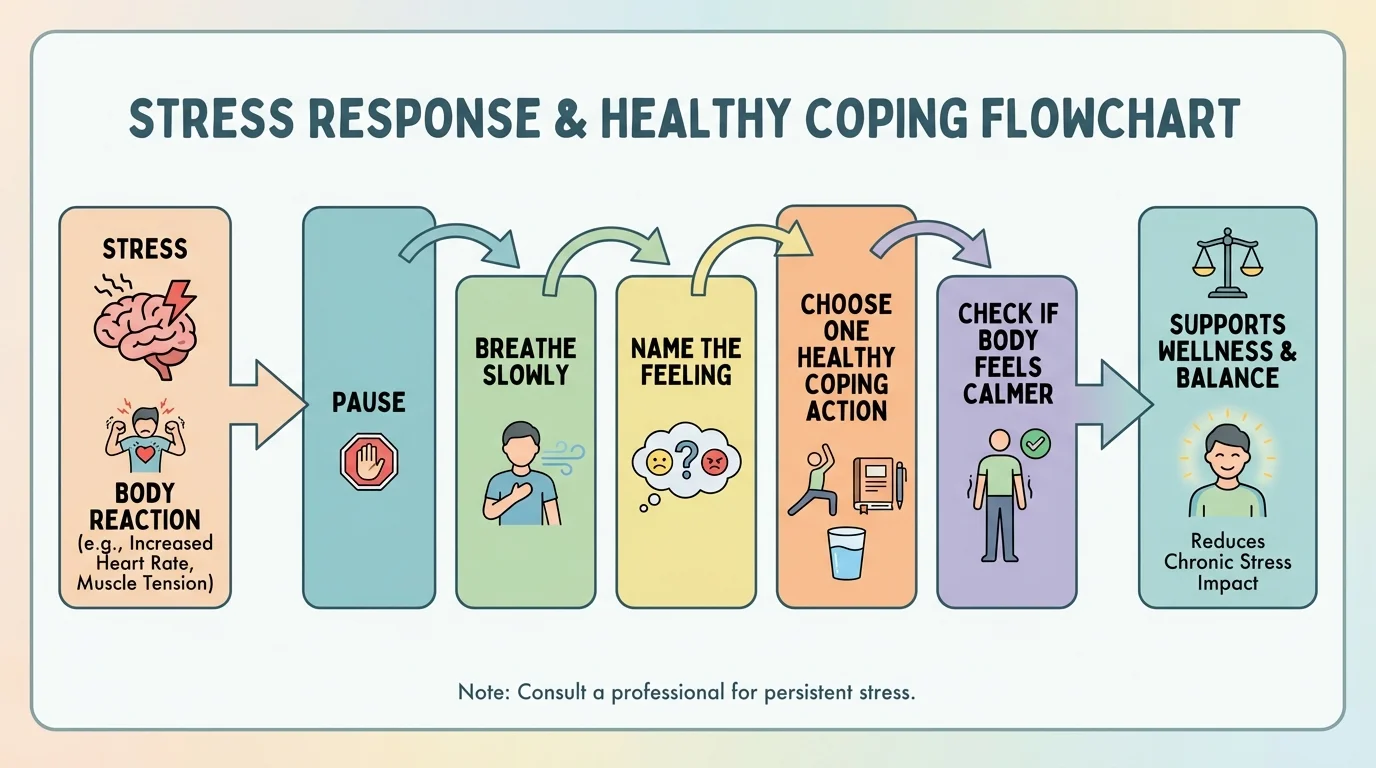
Healthy coping means choosing actions that help your body and mind feel safer, calmer, or more supported. A simple calm-down plan, shown in [Figure 2], can help you remember what to do when stress starts rising.
One of the fastest ways to help your body is to slow your breathing. When you are stressed, breathing often gets quick and shallow. Slower breaths can tell your body, "I am safe enough to calm down." Try breathing in through your nose, then breathing out slowly through your mouth.
You can also move your body. Stretching, walking, dancing, riding a bike, or even shaking out your hands can release some of the tight, jumpy energy stress creates. Movement is not about being the best at sports. It is about helping your body reset.
Talking to a trusted adult is another strong coping skill. This could be a parent, guardian, grandparent, counselor, coach, or another safe adult. You do not need a perfect speech. You can say, "My body feels really stressed," or "I need help with a worry."
Other healthy coping ideas include drinking water, taking a short break from a screen, listening to calm music, drawing, writing feelings in a notebook, cuddling a pet, reading, resting in a quiet space, or breaking a big task into smaller parts. These choices support coping skills that truly help.
Try This: a one-minute reset
Step 1: Put both feet on the floor.
Step 2: Breathe in slowly for a count of four.
Step 3: Breathe out slowly for a count of four.
Step 4: Relax your shoulders and jaw.
Step 5: Say to yourself, "I can handle this one step at a time."
This short reset can help before homework, a performance, a hard conversation, or an upsetting message online.
Healthy coping does not always make stress disappear right away. Sometimes it simply lowers the stress enough so you can think clearly and choose what to do next.
When people feel stressed, they try to make the feeling stop. But not every coping choice helps. Some choices calm the body and solve problems over time, while others may add more stress later, as [Figure 3] makes clear.
Helpful coping choices might include breathing, stretching, asking for help, taking a break, using kind self-talk, and making a simple plan. Unhelpful coping choices might include yelling, slamming doors, doom-scrolling, skipping sleep, hiding every feeling, or being mean to others. Those actions may feel powerful for a moment, but they usually do not solve the real problem.
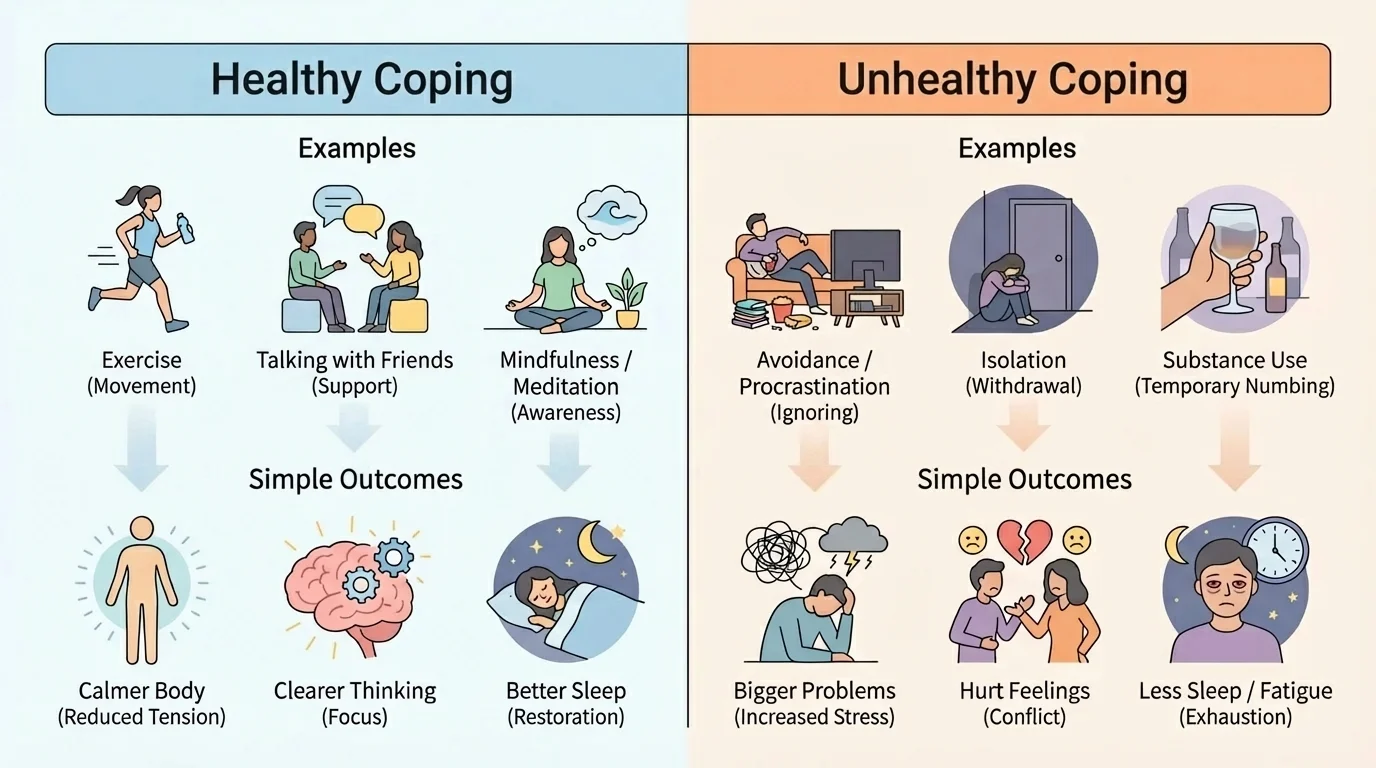
| Situation | Healthy coping | Likely result | Unhealthy coping | Likely result |
|---|---|---|---|---|
| Big homework task | Break it into small parts | Work feels more manageable | Avoid it all evening | More worry at bedtime |
| Mean comment online | Tell a trusted adult and log off | Better support and safety | Keep reading comments for an hour | Stress gets bigger |
| Nervous before a game | Breathe and stretch | Body feels steadier | Yell at teammates | More conflict and guilt |
| Feeling overwhelmed | Rest and ask for help | Mind clears up | Stay up very late | More tired and cranky tomorrow |
Table 1. A comparison of healthy and unhealthy coping choices in everyday situations.
Notice that healthy coping is not about pretending everything is fine. It is about choosing actions that care for your body, protect relationships, and help you solve the problem in a safe way.
"Feelings are real, but they are also signals. You can listen to them without letting them run the whole show."
As we saw earlier in [Figure 1], stress often shows up in the body first. That means body-based coping, like breathing, movement, water, or rest, can be a smart first step before trying to talk through the problem.
It helps to have a plan before you need it. Then, when stress appears, you do not have to invent a solution in the moment.
Step 1: Stop and notice. Say, "My body feels stressed." Naming it gives you a tiny bit more control.
Step 2: Check your body. Are you hot, shaky, tense, tired, or tearful? This helps you choose a matching coping skill.
Step 3: Choose one healthy action. You might breathe, stretch, get water, step away from the screen, or ask for help. The calm-down flow in [Figure 2] reminds you that simple steps work best.
Step 4: Handle the problem in small pieces. If your stress is about homework, do one part. If it is about a friendship problem, write down what happened and talk to a trusted adult. If it is about being too busy, ask for help making a schedule.
Step 5: Check in again. Ask, "Do I feel a little better? Do I still need help?" Sometimes one coping skill is enough. Sometimes you need support from another person.
Example: using the plan after an upsetting message
Jordan reads a rude message during an online club chat and feels his chest get tight.
Step 1: He notices the body signal.
He says to himself, "I am getting stressed."
Step 2: He pauses instead of typing back right away.
This prevents the stress from leading to a bigger argument.
Step 3: He takes slow breaths and puts the device down for a minute.
Step 4: He shows the message to a trusted adult.
Because Jordan uses healthy coping, he stays safer and gets help handling the situation.
This is practical self-care. Small choices can protect your body, your feelings, and your relationships.
Sometimes stress is too big to handle alone. You should tell a trusted adult right away if stress causes intense panic, nonstop crying, trouble breathing that does not settle, chest pain, repeated nightmares, or if you feel unsafe. Also get help right away if someone is bullying, threatening, or hurting you online or in person.
You also need help if you keep feeling worried or sad for many days, cannot sleep well, stop wanting to do normal activities, or feel like you might hurt yourself or someone else. Those are not problems to carry by yourself.
If your body feels seriously sick or unsafe, wellness includes getting medical help. Stress can cause real body symptoms, but strong or unusual symptoms should always be shared with a trusted adult so they can decide what help is needed.
Asking for help is not weakness. It is a smart safety skill. Strong people use support.
Healthy coping works best when it is not only used during emergencies. Daily habits can lower stress before it builds up. This is how wellness grows over time.
Sleep matters. A tired brain has a harder time handling stress. Try to keep a steady bedtime routine. Put screens away before sleep when possible, because exciting or upsetting content can make your brain stay awake.
Food and water matter too. Your body needs fuel. If you skip meals or do not drink enough water, stress may feel stronger. Movement helps as well. A walk outside, stretching, or active play can improve your mood and lower body tension.
Connection matters. Spending time with caring people, laughing, talking, or doing something calm with family can help your body feel more secure. Quiet time matters too. Rest is not being lazy. Rest helps your body recover.
Wellness is built by routines
Healthy routines make stress easier to handle because they support your body before problems show up. Sleep, movement, food, water, breaks, and connection are like tools you keep ready in your toolbox.
Here is a simple checklist you can remember: notice, breathe, move, rest, talk, and plan. These are not magic tricks, but they are powerful because they work with your body instead of against it.
Stress is part of life, but it does not have to be in charge. When you notice your signals, use healthy coping skills, and ask for help when needed, you support your body and protect your overall health.
