One of the strongest things you can do is ask for help. That may sound surprising, because some people think being strong means handling everything alone. But in real life, strong people know when something feels wrong and they speak up. If a situation is uncomfortable, unsafe, or confusing, getting help fast can protect your body, your feelings, your privacy, and your future choices.
You do not need to solve scary or confusing problems by yourself. Adults who care about you are supposed to help. Your job is to notice warning signs, use safe actions, and tell a trusted adult what happened. If one person does not help, you keep telling another safe adult until someone does.
Uncomfortable means something makes you feel uneasy, worried, embarrassed, or pressured.
Unsafe means there is a real chance of harm to your body, feelings, privacy, or safety.
Confusing means you are not sure what is happening, what a person means, or what you should do next.
Help-seeking means taking action to get support from a trusted person when you need it.
These three kinds of situations can overlap. Something might begin as confusing, then become uncomfortable, and then feel unsafe. That is why it helps to learn how to notice problems early instead of waiting until they get bigger.
When you ask for help early, small problems are easier to handle. For example, if someone in an online game keeps asking personal questions, telling an adult right away can stop the problem before the person gets more information. If you stay silent because you feel awkward, the situation may continue or get worse.
Speaking up also helps you protect your boundaries. A boundary is a rule about what feels okay and not okay for your body, feelings, time, space, and private information. Healthy relationships respect boundaries. Unsafe or disrespectful relationships try to push past them.
"If it feels wrong, it matters."
You never have to keep a problem secret just because someone told you to. Safe adults do not ask kids to hide uncomfortable or unsafe things from caregivers or trusted helpers. Secrets that make you feel worried, trapped, or scared should be told to a trusted adult.
These kinds of situations are easier to sort out when you compare them side by side, as [Figure 1] shows. You do not need perfect labels in the moment. You just need to notice that something is not right and take it seriously.
An uncomfortable situation might be when someone stands too close, keeps teasing after you said stop, asks a rude question about your body, or pressures you to join a video chat you do not want. You may not be in immediate danger, but your feelings are telling you that a boundary is being pushed.
An unsafe situation is more serious. This could be someone trying to touch you in a way you do not want, asking you to keep harmful secrets, telling you to meet alone, threatening you, asking for your address, or trying to get private photos. Unsafe situations need fast action and adult help right away.
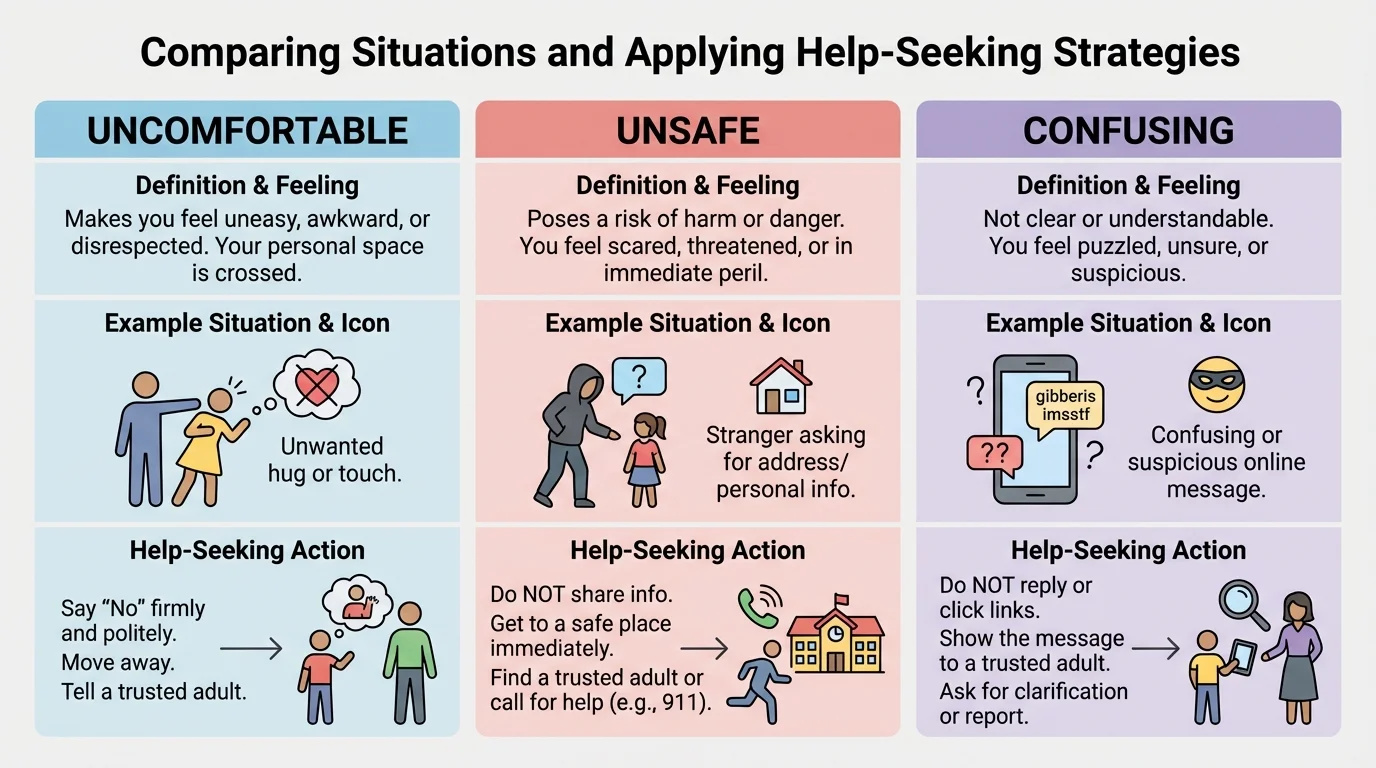
A confusing situation can happen when a message, action, or request does not make sense to you. Maybe someone online says, "Don't tell your family, this is just between us," and you are not sure what that means. Maybe an older kid asks you to do something that feels odd, but you cannot explain why. Confusing situations still matter. If you are unsure, ask a trusted adult.
Sometimes students think, "It's probably nothing," or "Maybe I'm overreacting." But confusion itself is a reason to get help. When something is hard to understand, a trusted adult can help you figure out whether it is safe, respectful, and appropriate.
Your body often notices danger before your brain has words for it. You might feel a tight stomach, a fast heartbeat, sweaty hands, shaky legs, a lump in your throat, or the sudden urge to leave. You might feel frozen, like your mind goes blank. These are warning signs.
Those clues are sometimes called your instinct or your "uh-oh feeling." Instinct is not magic. It is your brain and body noticing details quickly. You should not ignore these signals just because you worry about being polite.
Body clues are safety clues
Many unsafe situations do not begin with obvious danger. They may start with pressure, secrecy, guilt, or confusing behavior. When your body reacts strongly, pause and ask yourself: "Do I feel safe? Do I want this? Do I need help?"
Being polite is never more important than being safe. If you need to move away, end a call, leave a chat, close a device, or go find an adult, you can do that. You do not owe anyone your time, your attention, a hug, a reply, or private information.
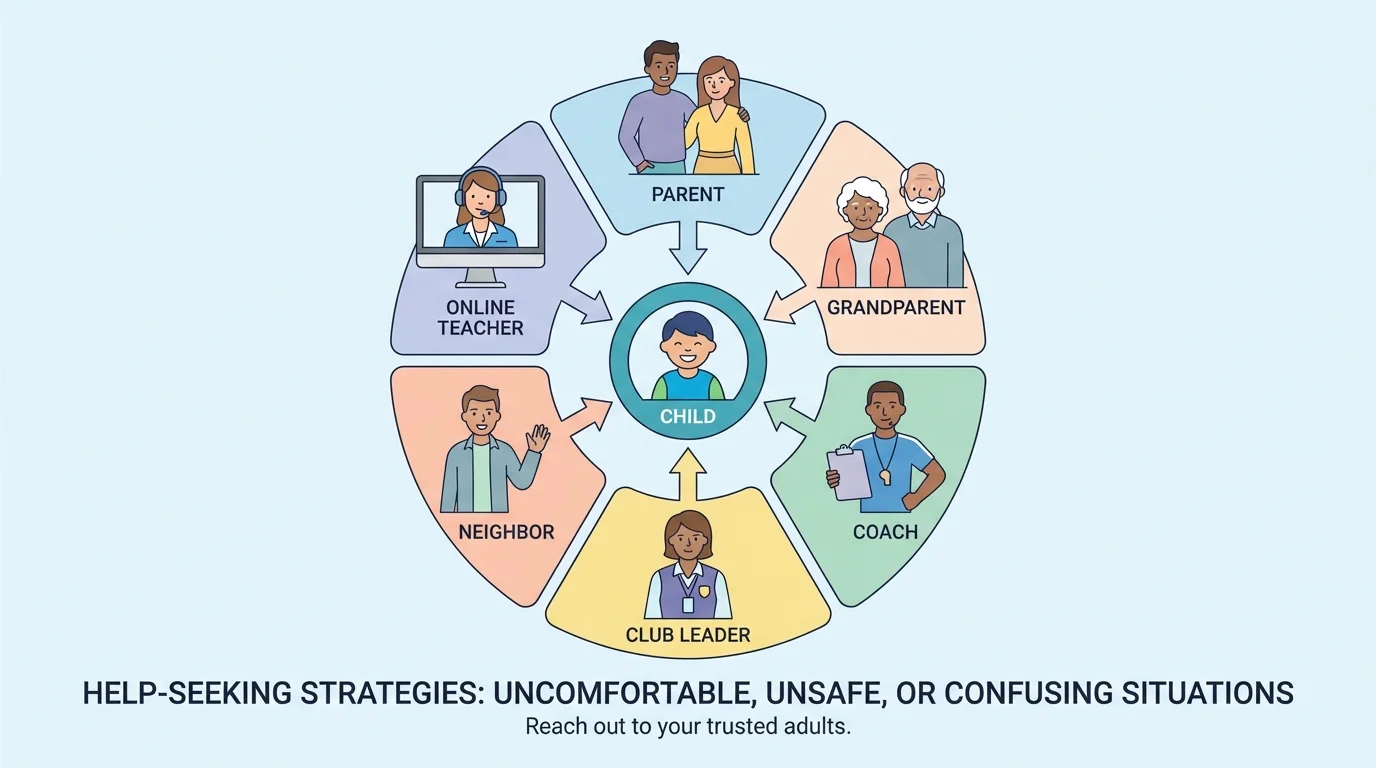
A good safety plan includes several trusted adults, not just one, as [Figure 2] illustrates. A trusted adult is a grown-up who listens, takes concerns seriously, tries to keep you safe, and does not blame you for asking for help.
Your safe adults might include a parent, grandparent, aunt, uncle, older sibling who is an adult, family friend, neighbor you know well, coach, club leader, counselor, doctor, or your online teacher. The exact people may be different for every family, but the idea is the same: choose adults who are calm, responsible, and likely to act.
It is smart to build a support circle of at least three adults. If one person is asleep, busy, traveling, or does not understand right away, you have other options. Help-seeking works best when you already know who you can contact.
You can even make a personal list: names, phone numbers, and how to contact each person. Keep it somewhere easy to find. In an emergency, it is much easier to use a plan you already made than to think of one while scared.
Later, when you think about who belongs in your support circle, look back at [Figure 2]. The center idea is simple: safety gets stronger when more than one caring adult knows how to help you.
When something feels wrong, use a simple plan like a roadmap. You do not have to remember every word perfectly. The goal is to protect yourself and get adult help.
As [Figure 3] shows, here is a practical plan you can use in many situations.
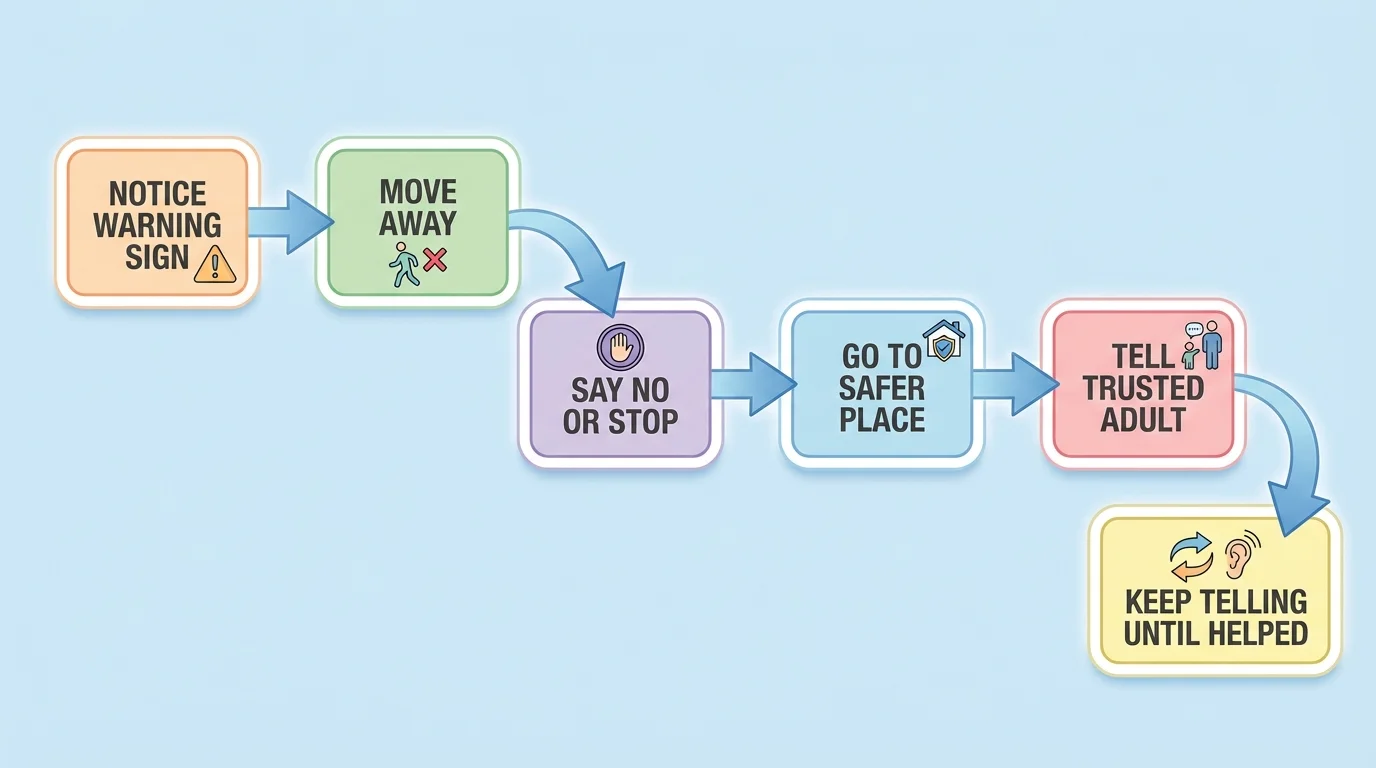
Step 1: Notice the warning sign. Ask yourself, "Do I feel uncomfortable, unsafe, or confused?" If the answer is yes, take it seriously.
Step 2: Pause and create space. Move away if you can. End the chat. Leave the room. Put down the device. Go where other safe people are nearby.
Step 3: Use clear words if it is safe to do so. You can say, "Stop." "No." "I don't like that." "Do not ask me that." "I'm leaving now." Short, strong words work well.
Step 4: Get to a safer place. This might mean standing near a caregiver, going into a room with other people, calling a trusted adult, or logging off and handing the device to an adult.
Step 5: Tell what happened. Share the facts: who, what, where, when, and how it made you feel. If it happened online, show the message if possible.
Step 6: Keep telling until someone helps. If the first adult is busy, confused, or does not act, go to the next person on your list. This step matters a lot. You are not bothering people. You are protecting yourself.
Quick action example
Step 1: A kid in a game chat asks, "What's your full name and where do you live?"
Step 2: You notice the question feels wrong and unsafe.
Step 3: You stop replying, leave the chat, and take a screenshot.
Step 4: You tell a trusted adult: "Someone online asked for my personal information."
That is strong help-seeking. You noticed, acted, and told.
If you freeze in the moment, that does not mean you did anything wrong. Freezing is a common body response. If it happens, focus on the next safe step you can take now: move away, call for help, or tell a trusted adult as soon as possible.
Sometimes the hardest part is starting the conversation. You do not need fancy words. Simple and direct is best. You can say:
If you are texting or messaging, you can write: "Can you call me now? This is important." If the adult answers, tell the facts clearly. If you are too upset to explain everything, start with one sentence: "I do not feel safe," or "Someone is pressuring me." That gives the adult a clear signal that help is needed.
If you ever learned how to report a problem by sharing the basic facts, use that skill here too: who was involved, what happened, where it happened, and when it happened.
It can help to tell the truth in short pieces. You do not need every detail all at once. Start with the most important part. Then answer questions one by one. The important thing is to begin.
Online situations can be uncomfortable, unsafe, or confusing too, as [Figure 4] shows. Because online school, games, apps, and messages happen through screens, it can be harder to read someone's intentions. That is why digital boundaries matter.
A personal information request is a big warning sign. Personal information includes your full name, address, phone number, passwords, school schedule, private photos, or live location. You should not share these with people unless a trusted adult says it is safe and appropriate.
Other warning signs include someone asking you to chat in secret, asking for pictures, trying to move you to a private app, making you feel guilty for not replying, or saying things like "Don't tell anyone." These are not safe relationship behaviors.
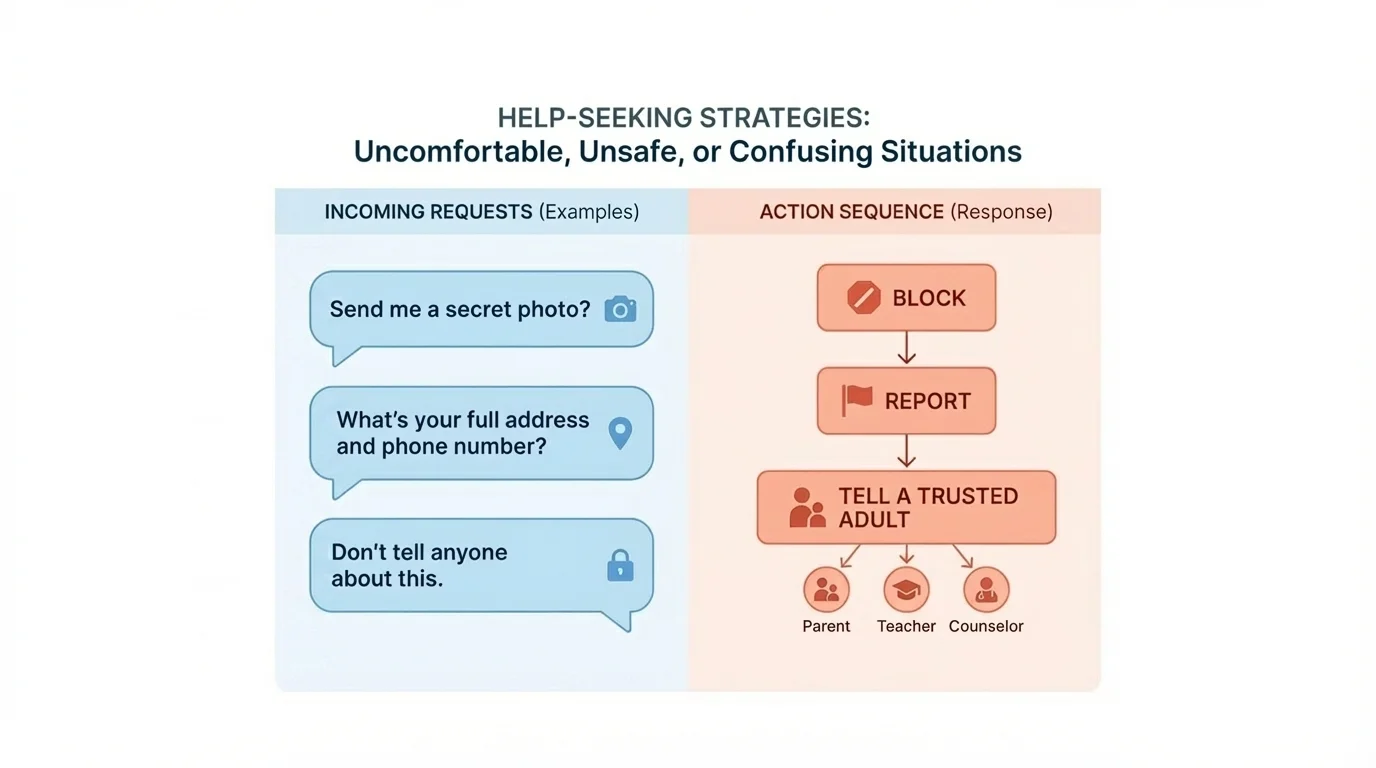
If something happens online, do not argue with the person. Instead, stop responding, block if possible, report on the app if possible, save evidence like screenshots, and tell a trusted adult. Saving evidence can help adults understand what happened and decide the next step.
When you compare risky online messages to the examples in [Figure 4], notice the pattern: unsafe people often push for secrecy, speed, and privacy. Safe adults and safe friends do not need to pressure you that way.
This part is very important: if one adult does not help, you tell another one. Sometimes adults misunderstand. They may think a situation is less serious than it is. That does not mean your feelings are unimportant. It means you need another helper.
You might say, "I told someone already, but I still need help." Those words are powerful. They let the next adult know this problem is ongoing.
Keep telling until you are safe
Help-seeking is not just one try. It is a process. If the first adult does not listen, choose another trusted adult, then another if needed. Problems involving threats, touching, stalking, requests for private photos, or fear of immediate harm need urgent adult action.
If you are in immediate danger and no trusted adult is nearby, call emergency services right away or ask another nearby adult to call. If you are not sure whether it is an emergency, it is still okay to seek urgent help. Safety comes first.
Let's look at how these strategies work in everyday life.
Scenario 1: Pressure on a video call
Step 1: During a group call, someone keeps asking you to turn on your camera even after you said no.
Step 2: You feel uncomfortable because your boundary is not being respected.
Step 3: You say, "I said no. Stop asking."
Step 4: If it continues, you leave the call and tell a trusted adult what happened.
This situation may not start as dangerous, but it still deserves action because someone ignored your boundary.
Another example is when an older kid in the neighborhood asks you to go somewhere alone and says not to tell anyone. That is not just uncomfortable. It is unsafe. You do not go. You move toward safe people and tell an adult immediately.
Scenario 2: Confusing secret
Step 1: A person you know says, "This is our special secret. Don't tell your family."
Step 2: You feel confused and nervous.
Step 3: You remember that secrets that cause worry should be told.
Step 4: You tell a trusted adult exactly what the person said.
You do not need to decide on your own whether the secret was "bad enough." The right move is to tell.
One more common case is rough play or joking that goes too far. If someone keeps touching, grabbing, or bothering you after you say stop, that is a problem. It does not matter if they say they were "just joking." Your body and your boundaries still matter.
Help-seeking gets easier when you practice small parts of it before a big problem happens. You can practice using a strong voice to say "No," "Stop," or "I need space." You can memorize two or three adult phone numbers. You can decide which adults are in your support circle. These small actions build confidence.
You can also practice noticing the difference between safe and unsafe behavior in stories, videos, or everyday life. Ask yourself: "Was that respectful? Was there pressure? Was there secrecy? Did the person listen to 'no'?" Those questions help you spot warning signs earlier.
Many people think they must be completely sure before asking for help. They do not. Being unsure is actually one of the best reasons to check with a trusted adult.
Remember, you are allowed to protect your body, your privacy, your feelings, and your space. You are allowed to end conversations, leave chats, refuse secrets, and tell adults when something feels wrong. Asking for help is not tattling when safety is involved. It is a smart life skill.
