Have you ever noticed that the same little jobs seem to come back every day? Dishes appear again, clothes need washing again, and somehow people get hungry again. That is exactly why routines matter. A routine is not about making life boring. It is about making life easier. When you know what to do and when to do it, your home can feel calmer, cleaner, and more ready for the day.
Home routines are repeated ways of doing important jobs. They help people remember tasks without waiting for someone to remind them every time. If no one has a routine, food may go bad, clean clothes may stay in a basket, and one person may end up doing almost everything. That can feel frustrating.
A good routine helps in three big ways. First, it saves time. Second, it keeps things organized. Third, it helps everyone share the work. When each person knows a job, the whole home runs better. Even small actions, like putting dirty clothes in one place or checking the fridge before planning dinner, can make a big difference.
Routine means a job or action you do regularly in a planned way. Responsibility means a job you are trusted to do. Plan ahead means thinking about what you will need before you need it.
You do not have to do everything. You just need to learn how to help in smart, steady ways. That is what practical independent living starts with: noticing needs, making a plan, and following through.
Meal planning means deciding ahead of time what food your household will eat. As [Figure 1] shows, this works best as a simple repeatable process, not a random guess at the last minute. Food planning can include breakfast, lunch, dinner, and snacks. It can also include checking ingredients, helping make a list, and preparing simple foods safely.
A smart first step is to look at what is already at home. Check the fridge, freezer, and pantry with an adult. Ask questions like: What needs to be used soon? What foods do we already have enough of? What ingredients are missing for the meals we want to make?
This step matters because it helps prevent food waste. Food waste happens when food is forgotten, spoiled, or thrown away. If a family already has pasta, rice, apples, and eggs, they may not need more of those right away. Planning with what you already have is helpful and respectful.
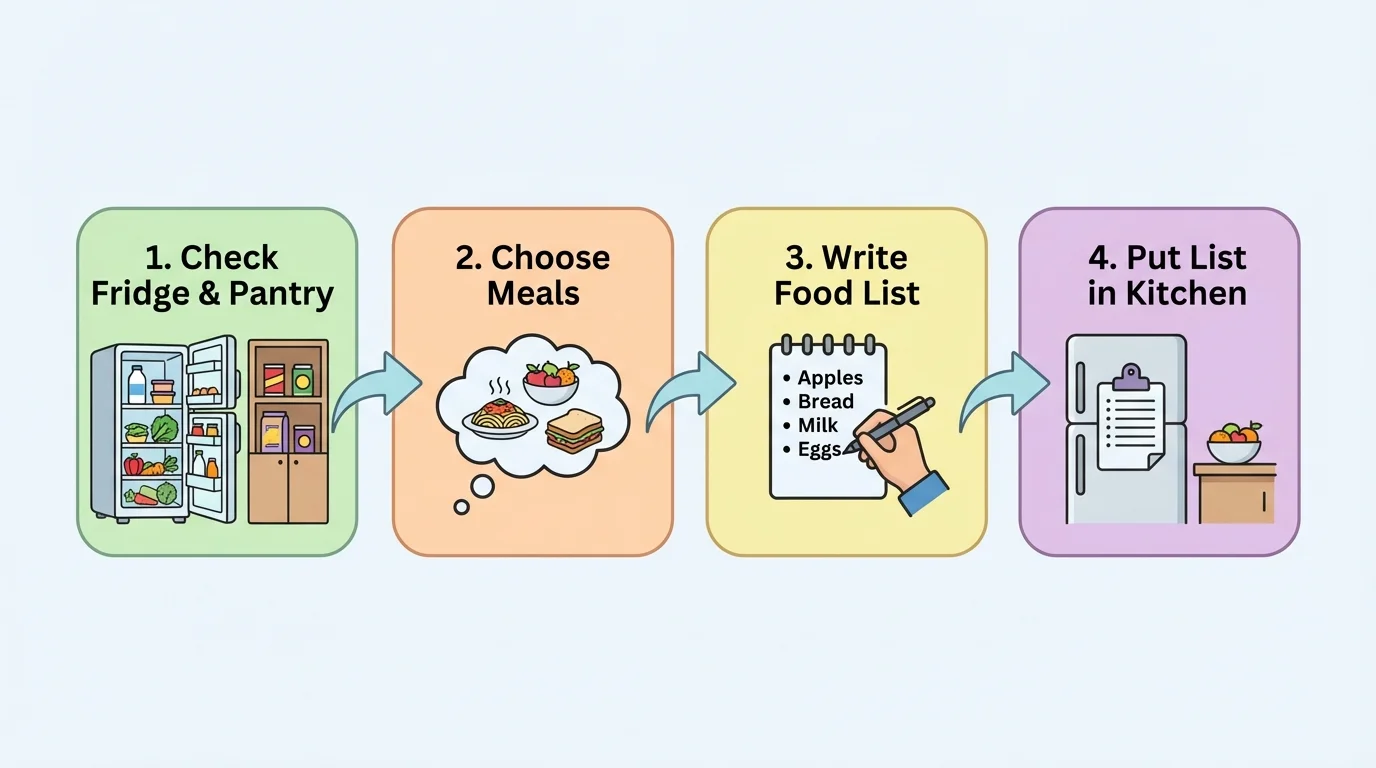
After checking supplies, choose simple meals. For example, one week might include oatmeal and fruit for breakfast, sandwiches or leftovers for lunch, and tacos, soup, pasta, or baked chicken for dinner. Snacks might include yogurt, carrot sticks, crackers, or bananas. Meals do not have to be fancy. They just need to fit the people in the home, the time available, and the food on hand.
It also helps to think about balance. A balanced meal often includes a protein food, a grain or starch, and fruits or vegetables. For example, a turkey sandwich with apple slices is more balanced than chips alone. Pasta with vegetables and beans is more balanced than noodles with butter only.
When you help make a food list, be specific. Instead of writing "fruit," write "5 bananas" or "1 bag of apples." If your home needs enough yogurt for one person to eat one each day for a week, you can estimate the number. One each day for 7 days is \(1 \times 7 = 7\), so the list would say 7 yogurts. This kind of simple calculation helps make lists more useful.
Example: Making a simple food plan
A family wants to plan snacks for 5 days.
Step 1: Check what is already at home.
There are 2 apples and 4 yogurt cups.
Step 2: Decide what is needed.
The plan is 1 fruit and 1 yogurt each day for 5 days, so that is 5 fruits and 5 yogurts.
Step 3: Compare what is needed to what is already there.
Fruit: \(5 - 2 = 3\) more fruits are needed. Yogurt: \(5 - 4 = 1\) more yogurt is needed.
The list can say 3 more fruits and 1 more yogurt.
Try This: With an adult, check one shelf in the fridge or pantry and name three foods that should be used soon. Then think of one meal or snack that could use them.
A weekly food routine can be very simple. Choose one day to check food supplies. Choose one day to help write or update the shopping list. Choose one or two safe kitchen jobs you can do, such as washing fruit, putting napkins on the table, stirring ingredients with help, or packing a snack.
Here is an easy food routine to follow. Step 1: Look for foods that need to be used soon. Step 2: Help choose meals for a few days. Step 3: Add missing foods to the list. Step 4: Help put groceries away in the right places. Step 5: Clean up after snacks or meals.
When routines are followed, good things happen: less food is forgotten, mealtimes feel less rushed, and everyone knows how to help. When routines are not followed, a family may realize too late that there is no bread for lunch or no fruit left for snacks. Planning ahead prevents many small problems.
Food routines also connect to safety. Wash hands before handling food. Keep cold foods cold. Put leftovers away. Ask an adult before using knives, the stove, or other appliances. Being helpful also means being careful.
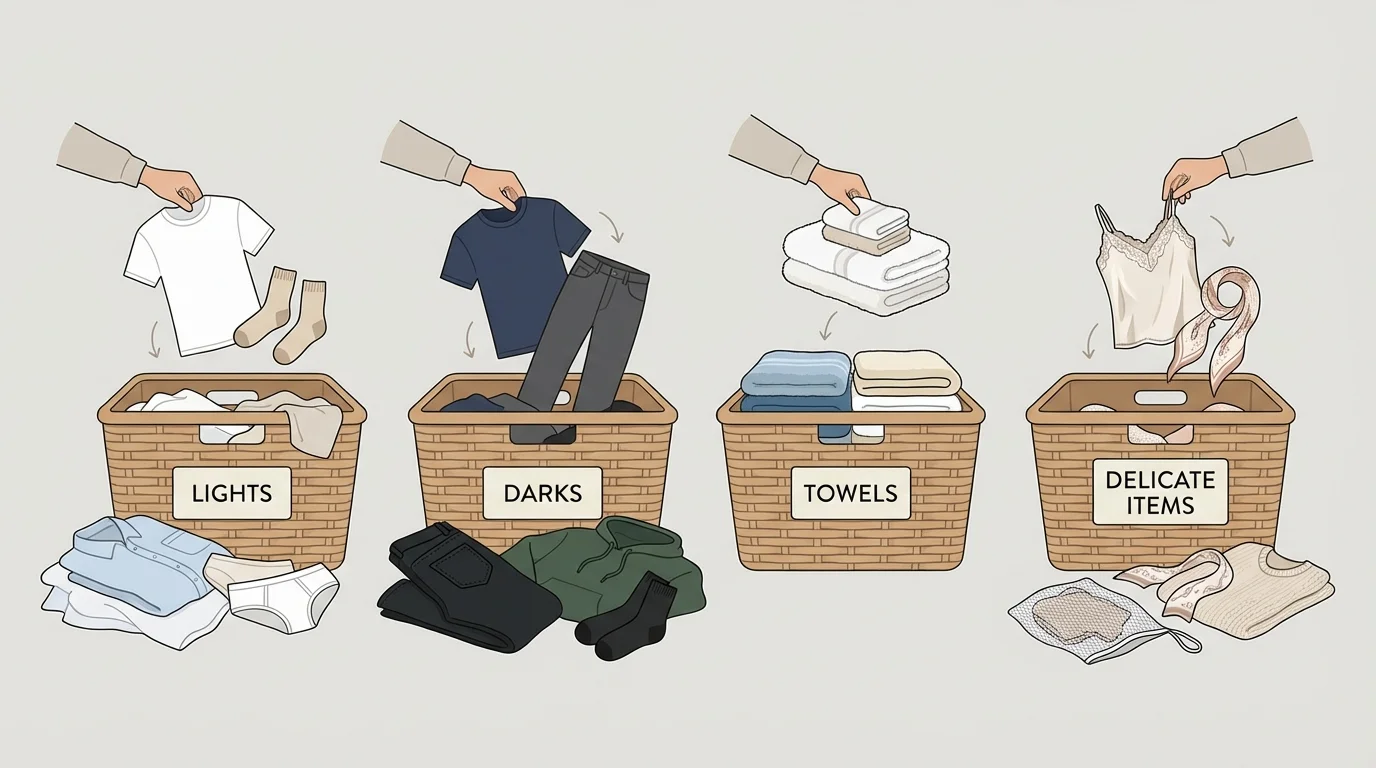
Laundry is more than tossing clothes into a machine. Good clothing care starts before washing. As [Figure 2] illustrates, sorting clothes into groups helps protect them. Some clothes can shrink, some colors can spread, and some soft items can be damaged if they are mixed with rough items.
A useful first step is to gather dirty clothes into one place, such as a hamper. Then sort them. Common groups are light colors, dark colors, towels, and delicate items. Delicate items are clothes that need gentle care. They may have softer fabric, special decorations, or labels with special washing directions.
You can also learn to check a care label. A care label is the tag inside clothing that gives washing and drying instructions. It may tell you whether an item should be washed in cold water, dried on low heat, or laid flat to dry. Reading the label helps clothes last longer.
After washing, clothes still need care. Move them out of the washer soon so they do not smell musty. Hang or dry them the right way. Then fold or hang them and put them away. Clean clothes do not help much if they stay in a basket all week.
Simple clothing care jobs for your age can include matching socks, folding towels, putting clean clothes in drawers, bringing the hamper to the laundry area, or helping sort clothes by color. Over time, you can learn more steps with adult support.
Why clothing care matters
Clothing care saves time, money, and stress. When clothes are washed and put away properly, it is easier to find what you need. Clothes can also last longer, which means your family may not need to replace them as often.
If clothes are not cared for, there can be real problems. A favorite shirt may wrinkle badly, socks may get lost, or wet towels may start to smell. But when you return clothes to the same place each time, mornings become easier because you already know where things are.
As shown in [Figure 2], sorting before washing is one of the smartest habits because it prevents mistakes before they happen. It is easier to sort first than to fix a problem later.
A clothing routine should match real life. Some families wash clothes on certain days. Others do smaller loads more often. The routine that works best is the one people can actually follow.
One easy routine is this: each day, put dirty clothes in the hamper. Once or twice a week, sort clothes with an adult. After washing, fold and put away clean clothes on the same day if possible. Before the week starts, check whether you have enough socks, shirts, and weather-right clothes ready.
You can also get ready the night before. Pick out the next day's clothes and place them in one spot. This takes only a minute, but it can make the next morning calmer. If rain is expected, choose clothes that fit the weather. If you have an online club meeting, choose something clean and comfortable.
Try This: Pick one clothing habit to do every day this week, such as putting dirty clothes in the hamper or folding one small group of clothes.
A home works best when people share jobs. As [Figure 3] later shows, shared responsibilities can be organized clearly so everyone knows what to do. These are shared responsibilities. Shared responsibilities are tasks that family members divide so one person is not stuck doing everything. These jobs can include feeding a pet, setting the table, wiping counters, taking out recycling, folding laundry, or checking whether something needs to be refilled.
Sharing work does not always mean every person does the exact same job. Fair does not always mean equal. A taller or older person may do one task, while a younger person does another. What matters is that each person helps in a way that fits their age and ability.
Good teamwork starts with communication. If you are not sure what your job is, ask. If you finish early, look around and notice whether something small needs doing. This is called taking initiative. It means doing the helpful thing without waiting to be told every single time.
Families often argue less when jobs are clear. When people know who is doing what, there is less guessing, less reminding, and less blaming.
It also helps to use respectful words. You can say, "I finished folding the towels. What should I do next?" or "I noticed the fruit bowl is empty. Should I add bananas to the list?" These are responsible ways to speak.
When responsibilities are ignored, small problems pile up. A full trash bin becomes messy. Clean dishes do not get put away. No one checks what food is running low. But when responsibilities are shared, home feels more peaceful, and everyone benefits.
A visual plan can help everyone remember their jobs. A simple chart can organize tasks by day and person. A chart does not need to be fancy. It just needs to be clear enough for everyone to understand.
You can make a routine chart on paper, on a whiteboard, or in a shared digital note. Include jobs that happen every day and jobs that happen only on certain days. Examples include packing snacks, feeding the pet, folding towels, checking the laundry hamper, and helping set out meal items.
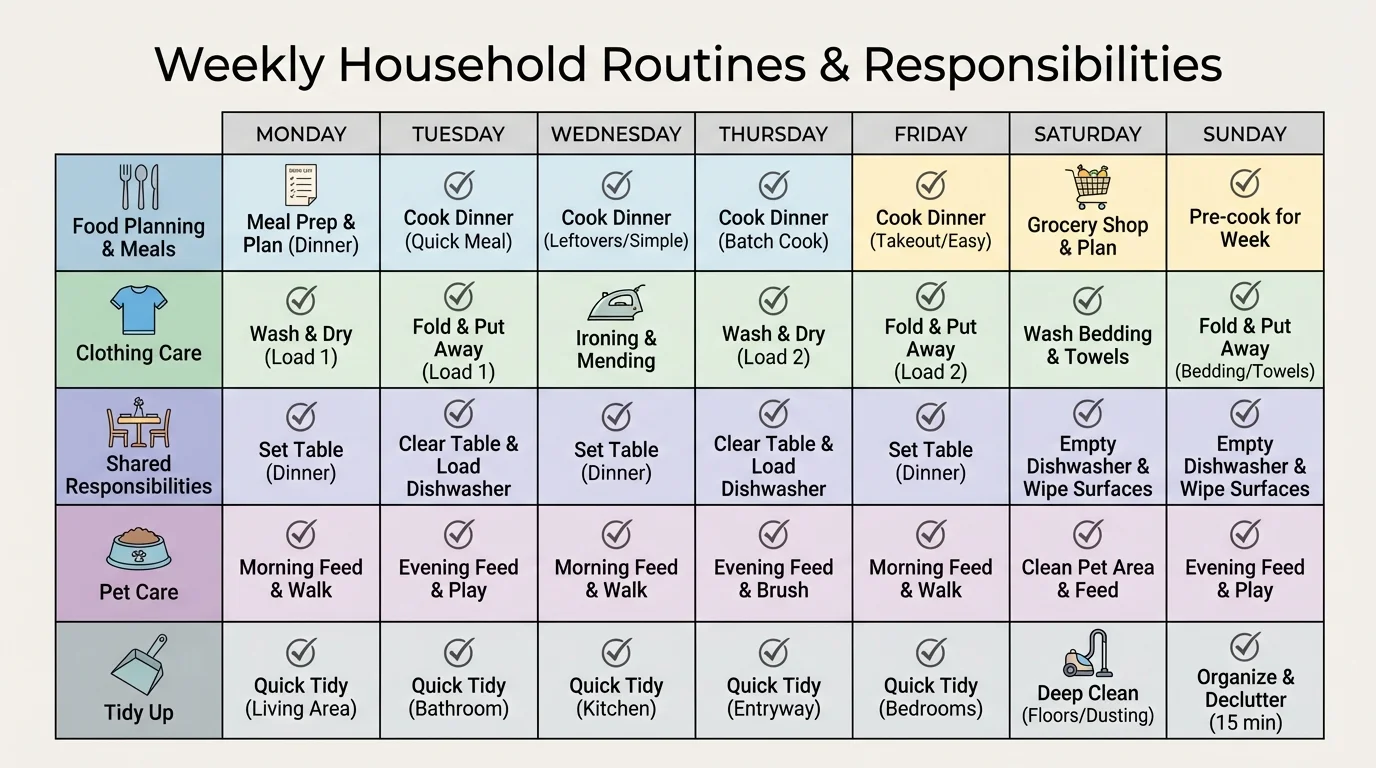
Here is one way a chart might be organized:
| Task | When | Who Helps |
|---|---|---|
| Put dirty clothes in hamper | Every day | You |
| Check fruit and snack supply | Sunday | You and an adult |
| Fold towels | Wednesday | You |
| Set table | Dinner time | You |
| Update food list | When something runs low | Anyone who notices |
Table 1. A sample weekly household routine chart showing tasks, timing, and who helps.
A chart works best when it is realistic. If too many jobs are added, people may stop paying attention. Start small. Pick a few important jobs and do them consistently. You can always add more later.
Example: Making a fair job plan
A home has 3 daily jobs: set the table, feed the pet, and sort socks. Three people can each take 1 job because \(3 \div 3 = 1\).
Step 1: List the jobs.
Set the table, feed the pet, sort socks.
Step 2: Count the helpers.
There are 3 helpers.
Step 3: Share the jobs.
Each helper starts with 1 job. If someone cannot do a job that day, another person can switch.
This plan is simple, fair, and easy to remember.
Later, when your family adjusts the plan, [Figure 3] stays useful because it gives everyone one place to check instead of asking over and over.
Real life is not the same every day. Some days are busy. Someone might feel sick. A family member may travel. Power may go out, or plans may change suddenly. Good routines are strong, but they also need to be flexible.
If a routine changes, do not give up on it completely. Instead, shrink it to the most important parts. Maybe full laundry cannot happen today, but dirty clothes can still go in the hamper. Maybe a big dinner cannot happen, but a simple sandwich, fruit, and milk can still be prepared. The routine bends instead of breaking.
This is a smart way to think: ask, "What is the smallest helpful version of this job?" If the answer is "Put leftovers away," "Fold just the towels," or "Write milk on the list," that still counts as being responsible.
"Small helpful actions, done often, make a big difference at home."
Learning this helps you now, and it will help you later too. People who can keep basic routines during busy times often feel more prepared and less overwhelmed.
Many strong routines are built from tiny habits. Put things back where they belong. Wipe up small messes before they become big messes. Carry your dish to the sink. Tell an adult when food is running low. Put clean clothes away instead of dropping them on a chair.
Another important habit is noticing. Look around your space and ask: What needs attention? Is the hamper full? Are there only 2 apples left? Are towels clean? Noticing turns you from someone who only reacts into someone who helps prevent problems early.
You also need to know when to ask for help. Some tasks, like using hot appliances, lifting heavy baskets, or handling cleaning products, require adult support. Being responsible does not mean doing unsafe things alone. It means making good choices.
Try This: Choose one food routine, one clothing routine, and one shared responsibility you can practice this week. Keep them simple enough that you can really do them.
When you build these habits, you are learning more than chores. You are learning how to care for yourself, help others, and make everyday life run more smoothly. That is a powerful skill in any home.
