Some teams finish faster, argue less, and do better work—not because they are full of the smartest people, but because they know how to work together. That is a powerful skill. Whether you are making a shared slide show online, helping plan a family event, joining a club, or working on a community project, teamwork helps people do more together than they can do alone.
Teamwork is not just "being in a group." It means using smart actions that help everyone succeed. You need to know how to share jobs, listen carefully, speak kindly, stay organized, and keep going when problems show up. These are life skills you can use now and later in jobs, sports, volunteer work, and friendships.
When people work well together, each person brings a different strength. One person may be great at organizing. Another may explain ideas clearly. Another may notice details others miss. A team can become stronger when each person contributes in a helpful way.
Good teamwork also builds trust. If people know you will finish your part, tell the truth, and respond kindly, they feel safe working with you again. That matters in online school projects, neighborhood activities, video-call clubs, gaming communities with shared goals, and family responsibilities at home.
Many adults say teamwork is one of the most important job skills. People in health care, technology, construction, restaurants, and community service all depend on teams every day.
When teamwork goes badly, the results are easy to notice. Messages get ignored. Jobs are repeated or forgotten. One person does too much while another does very little. People feel frustrated, and the final task may be rushed or incomplete. Learning teamwork strategies now helps you avoid those problems.
Collaboration means working together to reach a shared goal. A shared goal is something everyone is trying to achieve, like finishing a group presentation, cleaning up after dinner, or planning supplies for a service project.
Communication is how people share ideas, questions, and updates. Strong communication is clear, respectful, and useful. It helps everyone know what is happening.
Responsibility means doing the part you agreed to do. It also means being honest if you are stuck and getting help before the problem grows.
Initiative means noticing what needs to be done and taking action without waiting to be told every single step. A teammate with initiative might say, "I can make the checklist," or "I noticed we still need pictures for our slide."
Teamwork is people working together toward a shared goal by communicating clearly, doing their parts, helping solve problems, and supporting one another.
Good teamwork does not mean everyone does the same thing. It means everyone helps in a fair and useful way. Sometimes jobs are different, but they still matter equally.
Strong teams begin with a plan, and [Figure 1] shows a simple way to move from a big goal to clear tasks. If your team skips planning, people may guess what to do, forget deadlines, or do the same job twice.
The first step is to make sure everyone understands the goal. Ask: What are we trying to finish? What does "done" look like? When is it due? If the task is "make a video about recycling," the team should know how long the video should be, who the audience is, and what parts must be included.
Next, break the big task into smaller jobs. Small jobs are easier to assign and finish. For example, a team making a digital poster might split the work into title, facts, images, design, and final review.
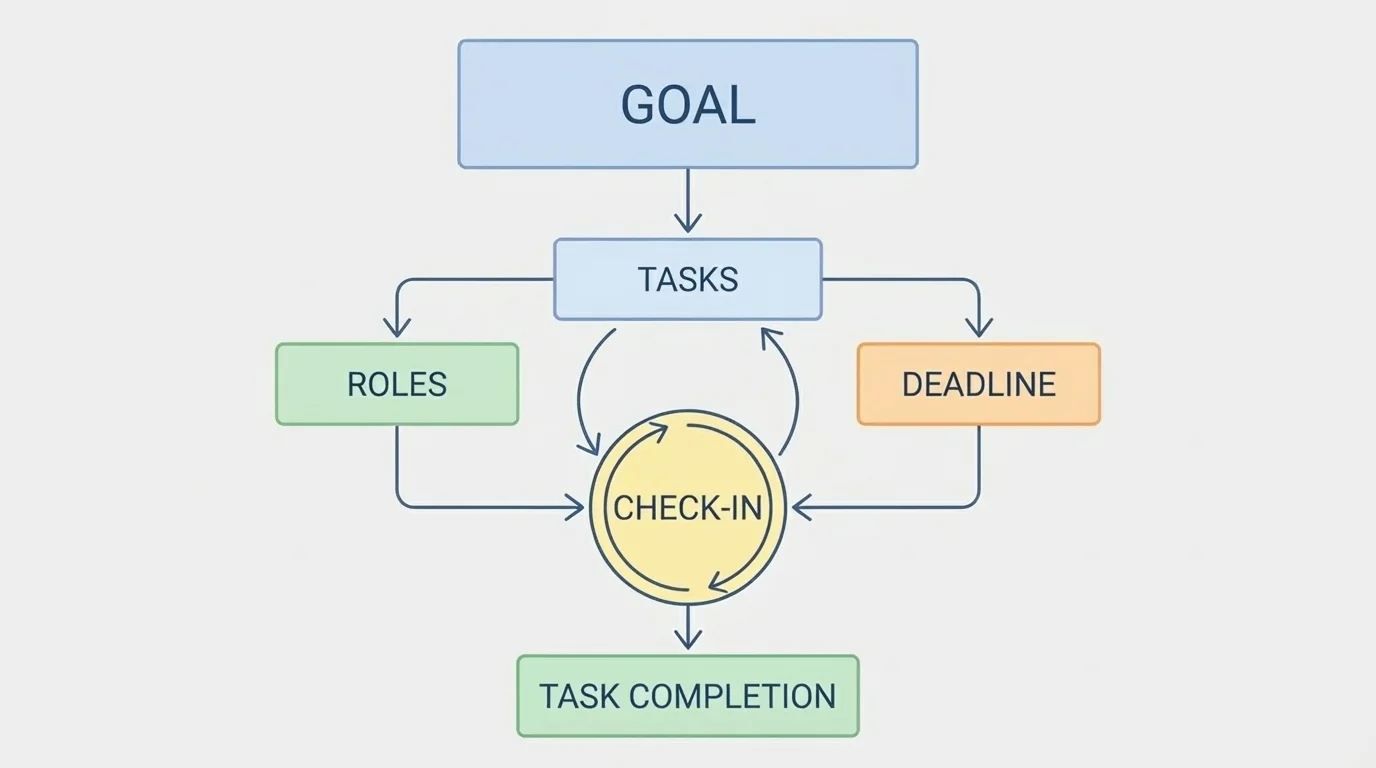
After that, choose roles. A role is the job a person is mainly responsible for. One teammate may gather facts. Another may design the slides. Another may check spelling and order. Roles help people stay organized, but everyone should still understand the whole project.
Set deadlines for each part, not just the final due date. If a project is due on Friday, you might decide that research is due by Tuesday, images by Wednesday, and final edits by Thursday. Smaller deadlines make the work feel manageable.
Teams also need check-ins. A check-in is a short time to ask, "How is it going?" and "What still needs to be done?" In online teamwork, this might happen through a message thread, shared document comments, or a quick video call. Later, when you need to adjust the plan, the flow in [Figure 1] still helps: check the goal, check the tasks, and check who is doing what.
Example: Planning a group slideshow
A team of three students needs to make a short slideshow about animal habitats.
Step 1: Set the goal
The team agrees to make a slideshow with one title slide, three habitat slides, and one ending slide.
Step 2: Split the work
Student A finds pictures, Student B writes facts, and Student C puts the slides together.
Step 3: Set mini-deadlines
Pictures are ready by Tuesday, facts by Wednesday, and the slideshow is checked on Thursday.
Step 4: Add a check-in
The team sends updates in the shared chat each afternoon.
This plan makes it much more likely that the slideshow is complete and not rushed.
A good plan is simple, not complicated. Even a short checklist can save time and reduce stress.
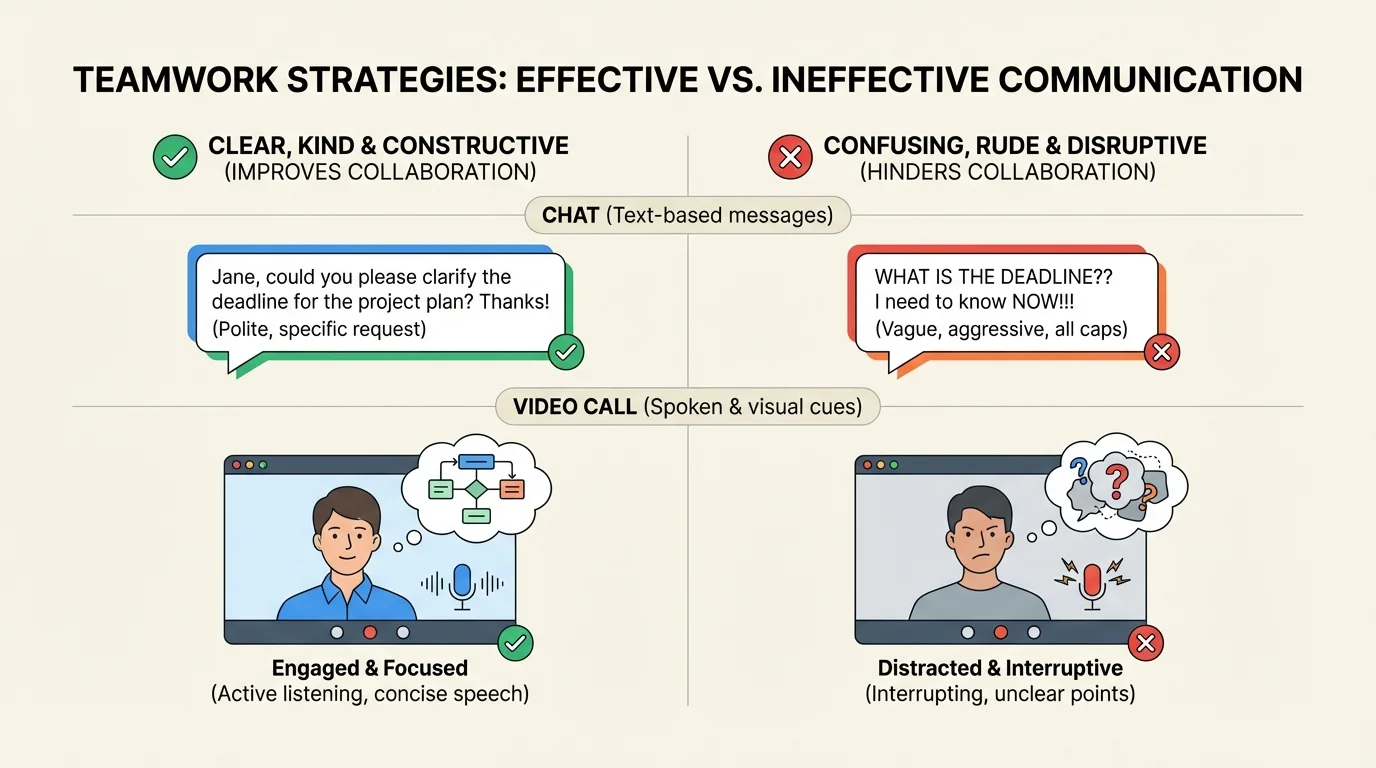
The words you choose can make teamwork easier or harder, and [Figure 2] compares helpful messages with confusing or unkind ones. Strong communication is not about talking the most. It is about helping people understand.
Start by listening. In online teamwork, listening may mean reading messages carefully, paying attention during a video call, or checking comments before answering. When you listen well, you avoid mistakes and show respect.
Speak and write clearly. Short, direct messages are usually best. Instead of saying, "I did some stuff," say, "I finished the title slide and found two pictures." Clear messages save time.
Use a kind tone. It is possible to disagree without being rude. Saying, "I think we should move this picture because the text is hard to read," is more helpful than saying, "This slide looks bad."
Ask questions when something is unclear. Questions are not a weakness. They prevent bigger problems later. You might ask, "Do you want me to make one slide or two?" or "Are we using the same colors on every slide?"
Give updates before someone has to chase you down. A quick message like, "My part is almost done, but I need one more day," is much better than saying nothing and missing the deadline.
When you give feedback, focus on the work, not the person. For example, "This paragraph needs one more fact," is useful. "You are bad at this," is hurtful and does not solve anything. In fact, the helpful side of [Figure 2] shows that clear and respectful messages keep the team moving forward.
Clear communication makes teamwork faster
When teammates understand the task, the deadline, and each other's progress, they waste less time guessing. Clear communication lowers confusion, helps people trust one another, and makes it easier to finish on time.
Good online manners matter too. Read messages fully. Do not type in all capital letters unless it is truly needed. Respond within a reasonable time. If you cannot answer right away, send a short message to let the team know.
Being a good teammate means more than being nice. It means finishing your work. If you say you will do something, other people will count on you. That is why responsibility is one of the most important parts of teamwork.
First, know exactly what your job is. If the task feels fuzzy, ask for details. It is hard to be responsible for a job you do not fully understand.
Second, manage your time. A big reason team tasks fail is that someone waits too long to begin. Starting early gives you time to fix mistakes, ask questions, and improve your work.
Third, aim for quality. Doing your part does not mean rushing through it just to say it is done. If you are making a slide, check the spelling. If you are recording audio, listen to it once before sending it. If you are writing directions for a family project, make sure they are easy to follow.
Fourth, be honest if you are behind. People usually get more upset by silence than by the truth. Saying, "I'm not finished yet, but I can send what I have by tonight," shows honesty and effort.
"Many hands make light work."
— Old proverb
That proverb is only true when people actually use their hands. If one person does most of the work, the team is not really working as a team.
Responsibility also includes helping the group protect shared materials. In an online project, that may mean naming files clearly, not deleting someone else's work, and keeping links in one safe place.
Even strong teams have problems. People get confused, miss deadlines, disagree, or forget to communicate. The important thing is not pretending problems never happen. The important thing is having a calm way to handle them, as [Figure 3] illustrates.
When a problem comes up, pause before reacting. If you answer while angry, you may make the situation worse. A short pause can help you choose respectful words.
Then listen to each side. Maybe one person misunderstood the directions. Maybe another person had a family emergency. Listening does not mean every choice was okay. It means you gather facts before deciding what to do next.
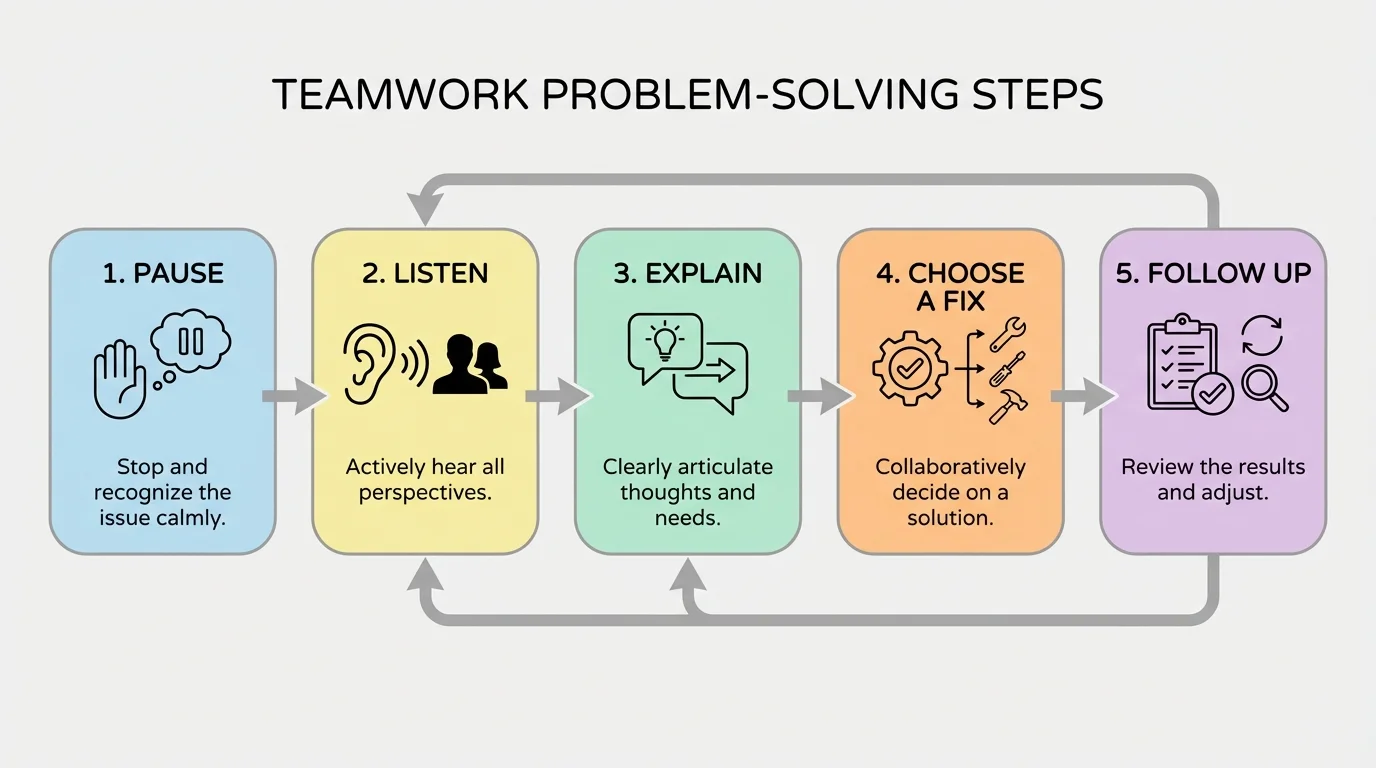
Next, explain the problem clearly. Use simple facts. You could say, "We still do not have the pictures, so the slideshow cannot be finished," instead of blaming with, "You never do anything." Facts make solutions easier.
After that, choose a fix. Maybe jobs need to be switched. Maybe the team needs a new deadline for one section. Maybe a person needs help breaking a task into smaller parts. The steps in [Figure 3] remind you that solving a problem is a process, not a fight.
Finally, follow up. Ask later, "Did our solution work?" If not, adjust again. Good teams do not quit after one rough moment.
Example: A missed deadline
Your teammate said they would upload pictures by Wednesday, but Thursday morning arrives and nothing is there.
Step 1: Stay calm
Send a respectful message instead of an angry one.
Step 2: State the problem
"We still need the pictures to finish the project today."
Step 3: Ask what happened
"Are you able to upload them soon, or do you need help?"
Step 4: Make a plan
If needed, another teammate can help find pictures while the first teammate does a different task.
This approach solves the problem faster than blaming.
Sometimes the best solution is compromise. That means each person gives a little so the team can move ahead fairly.
Leadership is helping a group move toward its goal. It does not always mean being "the boss." A strong leader can organize, encourage, listen, and help the team stay focused.
You can show leadership in small ways. You might start a shared checklist, remind everyone of the deadline, notice when someone is confused, or suggest a simple solution. These actions help the whole team.
Good leadership is not bossy. Bossiness sounds like commands without respect: "Just do it my way." Leadership sounds like teamwork: "Here is one idea. What do you think?"
Initiative and leadership often work together. If you see that no one has written down the plan, take initiative and write it. If the team is stuck, offer to help move things forward. If a teammate does a good job, say so. Encouragement is also leadership.
Remember: Being responsible for yourself comes first. It is hard to lead others if you do not complete your own part, tell the truth, or manage your time.
Another important part of leadership is making space for others. Invite quieter teammates to share ideas. Ask, "What do you think?" A strong team leader helps everyone contribute.
Teamwork shows up in many parts of life, not just school assignments. At home, family members may work together to prepare a meal, clean up a room, or plan a weekend activity. If no one communicates, the same chore may be done twice while another chore gets skipped.
In sports or clubs, teamwork helps people use different strengths. One player may defend well, another may pass well, and another may encourage teammates. In a music group or robotics club, people may each handle different parts, but they still depend on one another.
In community service, teamwork matters because the goal often helps other people. If a small group is packing care bags, someone may count supplies, someone may label bags, and someone may check that each bag has the same items. Clear teamwork means more people get the help they need.
Even online spaces use teamwork. If you work with others to create a video, moderate a kid-safe community group, or build something together in a digital platform, the same rules still matter: plan, communicate, take responsibility, and solve problems calmly.
Example: Teamwork at home
A family wants to get ready for guests coming over that evening.
Step 1: Set the goal
The home should be clean, snacks ready, and the table set by a certain time.
Step 2: Assign jobs
One person tidies the living room, one prepares snacks, and one sets out plates and cups.
Step 3: Check progress
Halfway through, everyone checks if any job needs extra help.
Step 4: Finish together
If one person finishes early, they help another person instead of waiting around.
This is teamwork because people share responsibility and support the same goal.
Real-life teamwork often feels ordinary, but it is a major part of being dependable and helpful in a community.
When you are part of a team, you do not need a complicated system. A few smart habits can make a big difference.
Step 1: Know the goal. Be sure everyone can explain what the team is trying to finish.
Step 2: Split the task. Break the job into smaller parts.
Step 3: Choose roles fairly. Give each person a clear job.
Step 4: Set mini-deadlines. Do not wait for the final due date.
Step 5: Communicate clearly. Share updates, ask questions, and use a respectful tone.
Step 6: Do your part well. Finish your job with care.
Step 7: Ask for help early. Small problems are easier to fix than big ones.
Step 8: Solve conflicts calmly. Focus on facts and solutions.
Step 9: Show initiative. Notice what needs attention and help move the team forward.
Step 10: Support the group. Encourage others and celebrate progress.
Why these strategies work
Each strategy removes a common teamwork problem. Planning reduces confusion. Clear communication reduces mistakes. Responsibility prevents unfairness. Calm problem-solving keeps the team moving. Leadership and initiative help the team improve instead of getting stuck.
You do not have to be perfect to be a strong teammate. You just need to keep practicing useful habits. Every time you plan clearly, respond respectfully, finish your part, or help solve a problem, you grow as a teammate and as a leader.
Try This: The next time you work with other people—even for a simple home task—pick one teamwork habit to focus on, such as giving clear updates or asking one helpful question before you start.
