One small choice can change your whole day. If you forget an assignment, you can hide it and hope no one notices, or you can tell the truth and make a plan. Both choices start with the same problem, but they lead to very different results. That is why responsibility matters so much. It is not about being perfect. It is about what you do next.
In online school, nobody is standing right beside you all day. That means you often make choices on your own. You choose whether to log in on time, whether to pay attention, whether to ask for help, and whether to be honest. These choices show your character, which means the kind of person you are becoming.
Responsible choices help you learn, keep you safe, and build trust with teachers, family members, teammates, and friends. Irresponsible choices may feel easier for a moment, but they usually create bigger problems later. For example, if you pretend your internet problem lasted all day when it really did not, you may avoid one uncomfortable conversation, but now someone may wonder if they can trust your words next time.
Responsible response means choosing an action that is honest, respectful, safe, and helpful.
Irresponsible response means choosing an action that avoids duty, ignores consequences, or hurts learning, trust, or other people.
Ethics means ideas about right and wrong that help guide choices.
Responsibility also connects to your future. When you practice it now, you are building habits you will use later when you manage jobs, money, friendships, and important tasks. A child who learns to tell the truth, solve problems calmly, and finish tasks is practicing real-world skills.
Being responsible does not mean you never forget, never get upset, or never make mistakes. Everyone makes mistakes. Responsibility means you take ownership of your actions. You do not blame others for everything. You do not hide from problems. You face the situation and try to make it better.
A responsible person often shows these habits: being honest, following through, thinking before acting, respecting rules, asking for help when needed, and fixing mistakes. An irresponsible person may ignore tasks, make excuses, blame other people, copy work, send unkind messages, or leave a mess for someone else to handle.
Responsibility builds trust. When people see that you usually tell the truth, keep your word, and handle problems fairly, they begin to trust you. Trust is important because it affects teamwork, friendships, and how much freedom people feel safe giving you.
Think about trust like stacking blocks. Each responsible action adds a block. Each dishonest or careless action can knock blocks down. Building trust takes time. Breaking it can happen quickly.
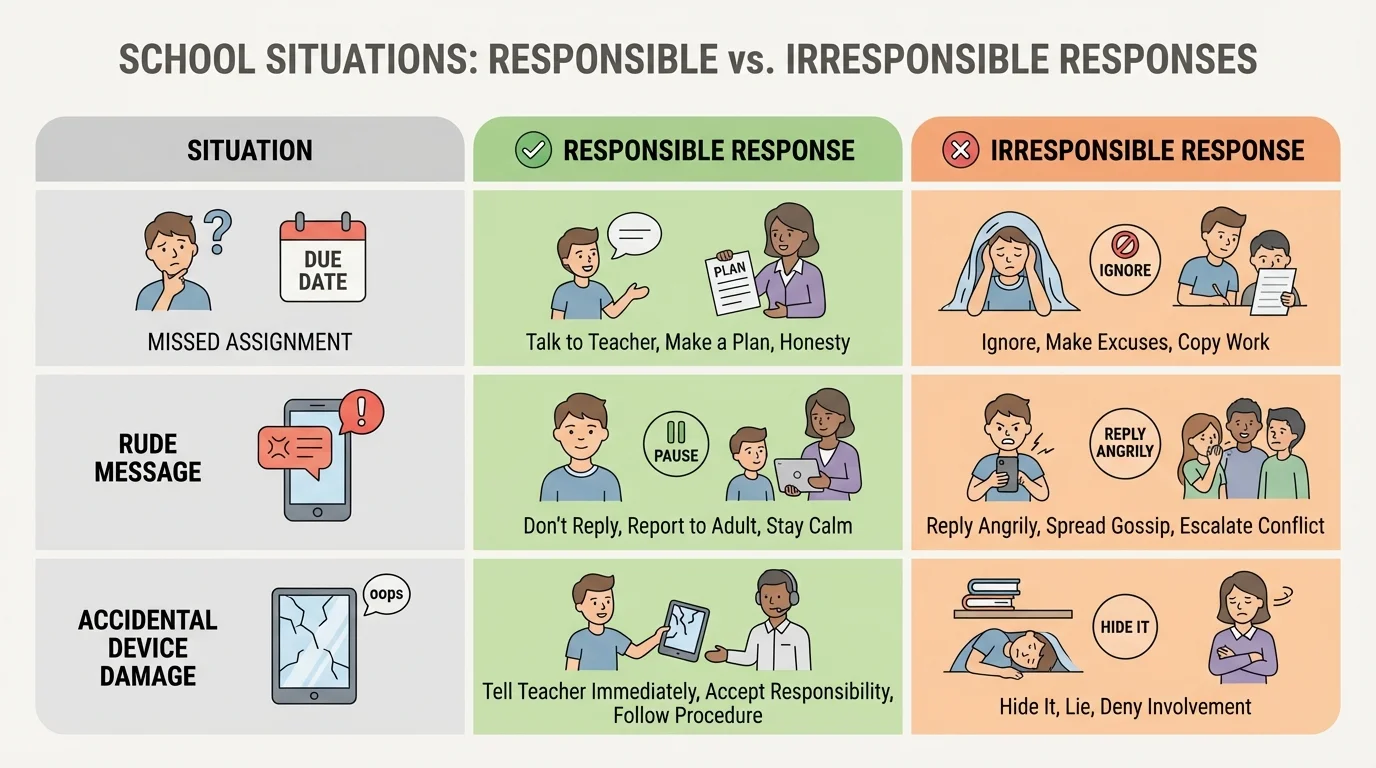
Many school situations give you two paths. One path may be harder at first but leads to growth. The other may feel easier at first but leads to more trouble. This comparison, shown in [Figure 1], helps you notice how responsible choices build trust while irresponsible choices create stress, confusion, or unfairness.
When you compare responses, ask yourself: Is it honest? Is it respectful? Is it safe? Does it help solve the problem? If the answer is yes to most or all of these questions, the response is probably responsible.
| Situation | Responsible Response | Irresponsible Response | Likely Result |
|---|---|---|---|
| You forgot to turn in an assignment. | Tell the teacher, apologize, and ask how to complete it. | Pretend you already sent it or blame technology without checking. | Responsible action gives you a chance to fix it; irresponsible action damages trust. |
| You receive a rude message in a class chat. | Stay calm, do not insult back, save the message, and tell a trusted adult or teacher. | Send an even meaner message back or post it publicly to embarrass the other person. | Responsible action protects safety; irresponsible action grows the conflict. |
| You do not understand the lesson. | Ask a question, review directions, or request help. | Give up, copy someone else's work, or click random answers. | Responsible action helps learning; irresponsible action hides the real problem. |
| You accidentally damage a borrowed device or item. | Tell the truth right away and help find a solution. | Hide the damage and hope no one notices. | Responsible action shows honesty; irresponsible action makes the problem worse. |
Table 1. Comparison of responsible and irresponsible responses to common school situations.
Notice something important: a responsible response is not always the easiest or most comfortable choice in the moment. Sometimes it means admitting a mistake. Sometimes it means asking for help. Sometimes it means stopping yourself before sending a message you will regret.
Your brain gets better at making good choices when you practice them again and again. Habits grow stronger with repetition, so every responsible action helps train your future self.
That means responsibility is a skill you can build. You are not just "a responsible person" or "an irresponsible person" forever. Your daily actions matter more than labels.
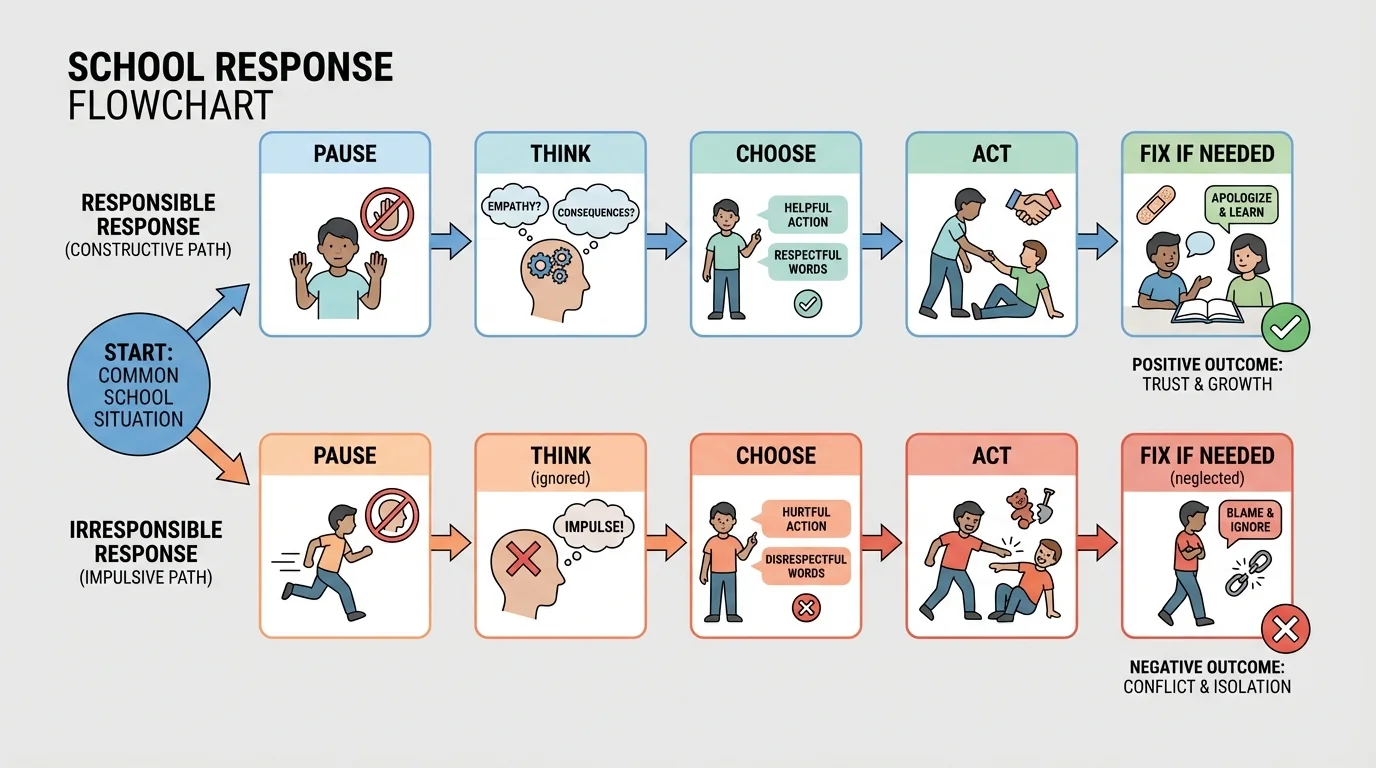
When emotions are strong, people sometimes react too fast. A simple tool for thinking about consequences, outlined in [Figure 2], helps you slow down and choose wisely.
Step 1: Pause. Stop for a moment. Take one slow breath.
Step 2: Name the problem. Ask, "What happened?"
Step 3: Think ahead. Ask, "What could happen next if I do this?"
Step 4: Choose the best action. Pick the action that is honest, respectful, safe, and helpful.
Step 5: Fix it if needed. If you already made a poor choice, decide how to repair the damage.
This tool works for many situations, from schoolwork to texting to handling frustration at home. It can help you move from a quick reaction to a thoughtful decision.
Here is a fast check you can keep in mind: True, Kind, Safe, Helpful. Before you act, ask whether your choice matches those four words. If not, stop and try again.
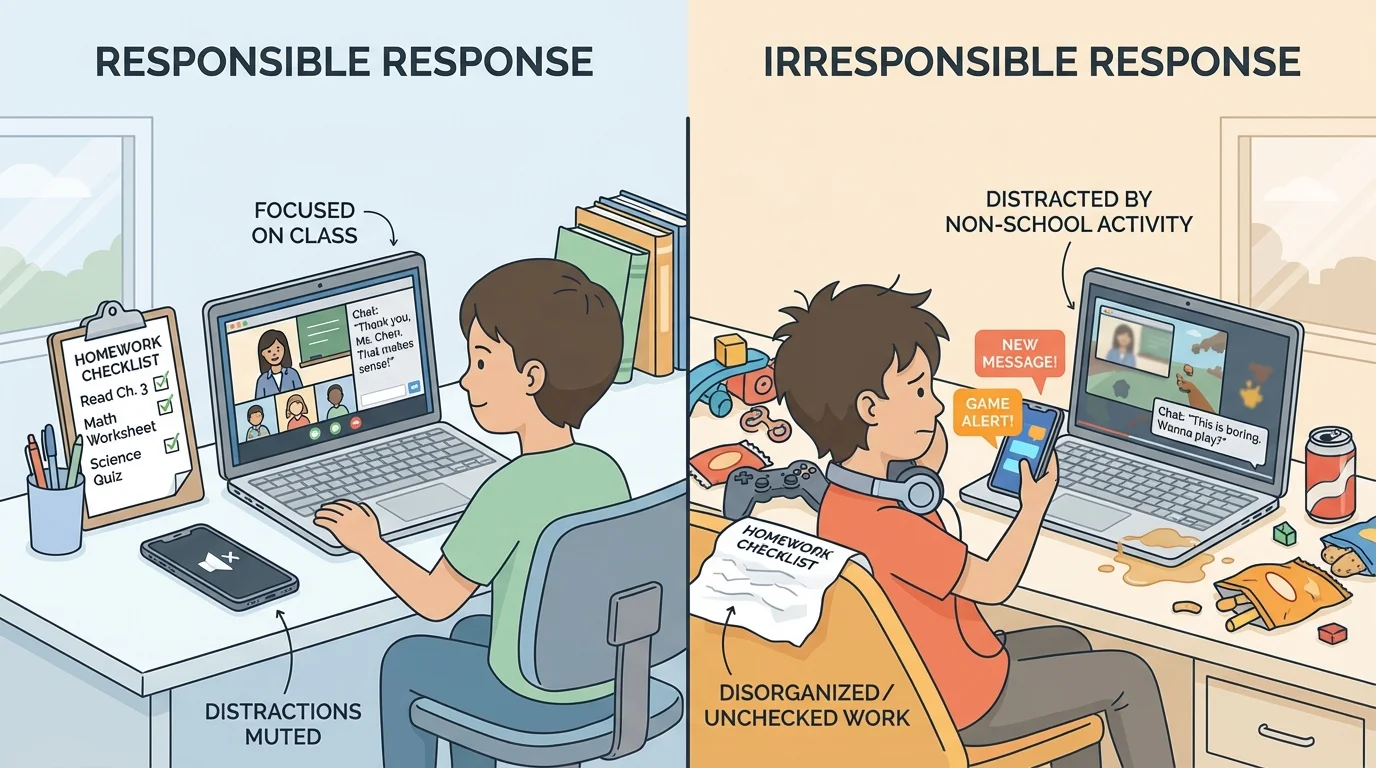
[Figure 3] Responsible habits show up in everyday moments, not just big emergencies. In online school, responsibility can look like logging in prepared, using respectful messages, and managing distractions at home.
Situation 1: You are late to a video lesson. A responsible response is to join quietly, check what you missed, and send a polite message if needed. An irresponsible response is to skip class because you are already late, or to make up a false story instead of simply apologizing.
Situation 2: You forgot your homework. A responsible response is to admit it, ask if you can still turn it in, and make a better plan for tomorrow. An irresponsible response is to say someone else deleted it when that is not true.
Situation 3: A friend offers to send you their answers. A responsible response is to say no and ask for help understanding the work. An irresponsible response is to copy. Copying may look like a shortcut, but it is not fair and it stops real learning. It also harms integrity, which means doing the right thing even when no one is watching.
Situation 4: You feel annoyed by someone in a class discussion. A responsible response is to disagree politely, take a break, or ask an adult for help if needed. An irresponsible response is to type a rude comment, mock the person, or keep the argument going online.
Situation 5: You are distracted by games, videos, or your phone during school time. A responsible response is to silence distractions, close unrelated tabs, and return your attention to the lesson. An irresponsible response is to keep switching away from class and then blame the lesson for not understanding.
Situation 6: You are working with a group online. A responsible response is to do your share, answer messages politely, and meet deadlines. An irresponsible response is to disappear, let others do all the work, or submit your part very late without explanation.
Situation 7: You need help. A responsible response is to speak up early. Waiting too long can make a small problem become a big one. Asking for help is not weakness. It is a smart and mature action.
Case study: Two different responses
Mia has a writing assignment due by the end of the day. She spends too much time playing a game and realizes the assignment is unfinished.
Step 1: Irresponsible path
Mia sends a message saying the website was broken all afternoon, even though she did not check until the evening.
Step 2: What happens next
The teacher may try to help with a technology problem that was not real. Mia still has unfinished work, and trust is weaker.
Step 3: Responsible path
Mia tells the truth: she got distracted, she is sorry, and she asks whether she can finish the assignment with a late penalty or another plan.
Step 4: Better result
Mia still faces the consequence, but she learns from it and keeps trust stronger.
Being responsible does not always remove consequences. Sometimes you still lose points, lose free time, or need to redo work. But responsibility helps consequences stay fair and manageable. It also helps you grow.
Everyone messes up sometimes. The real test of character is what you do afterward. The same choice process from [Figure 2] still works when you need to repair a problem: pause, tell the truth, and choose the next right step.
If you make a mistake, try this plan. First, admit what happened. Second, apologize clearly. Third, ask how to make it right. Fourth, make a new plan so it is less likely to happen again.
How to apologize in a responsible way
Step 1: Say what you did.
"I sent a rude message in the class chat."
Step 2: Show understanding.
"That was disrespectful and could hurt someone's feelings."
Step 3: Say sorry.
"I am sorry."
Step 4: Repair the damage.
"I will delete it, send a respectful apology, and be more careful before I post."
A weak apology sounds like this: "Sorry, but you made me mad." That is not taking responsibility. A strong apology does not blame the other person for your choice.
"You may not be able to choose every problem, but you can choose your response."
Sometimes the most responsible thing is asking an adult to help fix the situation, especially if there is bullying, unsafe behavior, cheating pressure, or damage to something valuable.
Responsibility is not only for school. It helps in sports, clubs, friendships, family life, and future jobs. If people know you are honest, prepared, and respectful, they are more likely to depend on you. That can create opportunities.
As we saw earlier in [Figure 1], the difference between responsible and irresponsible choices often starts small. One honest message, one finished task, one calm response, or one truthful apology may not seem huge, but these moments build your reputation over time.
You can build responsibility with simple daily habits: keep a checklist, use reminders, charge your device before class, prepare materials early, read directions carefully, and ask questions before a deadline passes. These habits lower stress because you are not always scrambling at the last minute.
You do not have to feel ready before acting responsibly. Often, responsible action comes first, and confidence grows after you do the right thing.
Try This: Before your next school task, make a short plan with three items: what you need, when you will do it, and what might distract you. Then remove one distraction before you begin.
Try This: The next time you make a mistake, practice saying the truth in one clear sentence instead of making excuses.
Try This: After an online lesson, ask yourself, "What was one responsible choice I made today?" Noticing your good choices helps them grow.
