Have you ever noticed that adults have gotten to their jobs in different ways? a computer programmer, a chef, and a firefighter may all work hard, but they did not all prepare in the same way. Some went to college. Some learned in training programs. Some started working and learned more while doing the job. Your future does not come with only one road. It comes with choices.
Even though you are in fourth grade, this is a great time to start learning about those choices. You do not need to decide your whole life right now. You only need to understand that people can keep learning after high school in different ways. Knowing that helps you stay curious, ask better questions, and respect other people's journeys too.
Postsecondary is a big word that means after high school. It includes education, training, and work that happen after a person finishes high school. Some people continue learning in classrooms. Some learn by practicing real job skills. Some begin working right away and keep building their skills over time.
Postsecondary pathways are the different roads people can take after high school to prepare for jobs, careers, and adult responsibilities. Common pathways include college, training programs, and work.
Thinking about postsecondary life is really about thinking about your future. What kinds of problems might you want to solve? What kinds of skills might you want to learn? What kind of work might feel interesting or meaningful to you? The answers can change as you grow, and that is normal.
After high school, people often choose one of several main paths, as [Figure 1] shows. One person may go to college. Another may join a training program to learn a specific skill. Another may start working. All three are real paths, and all three can lead to success.
Pathway means a route or direction someone takes toward a goal. A pathway is not always straight. A person can start in one path and later move to another. For example, someone might work first, then go to college later. Someone else might finish a training program and then decide to take college classes too.
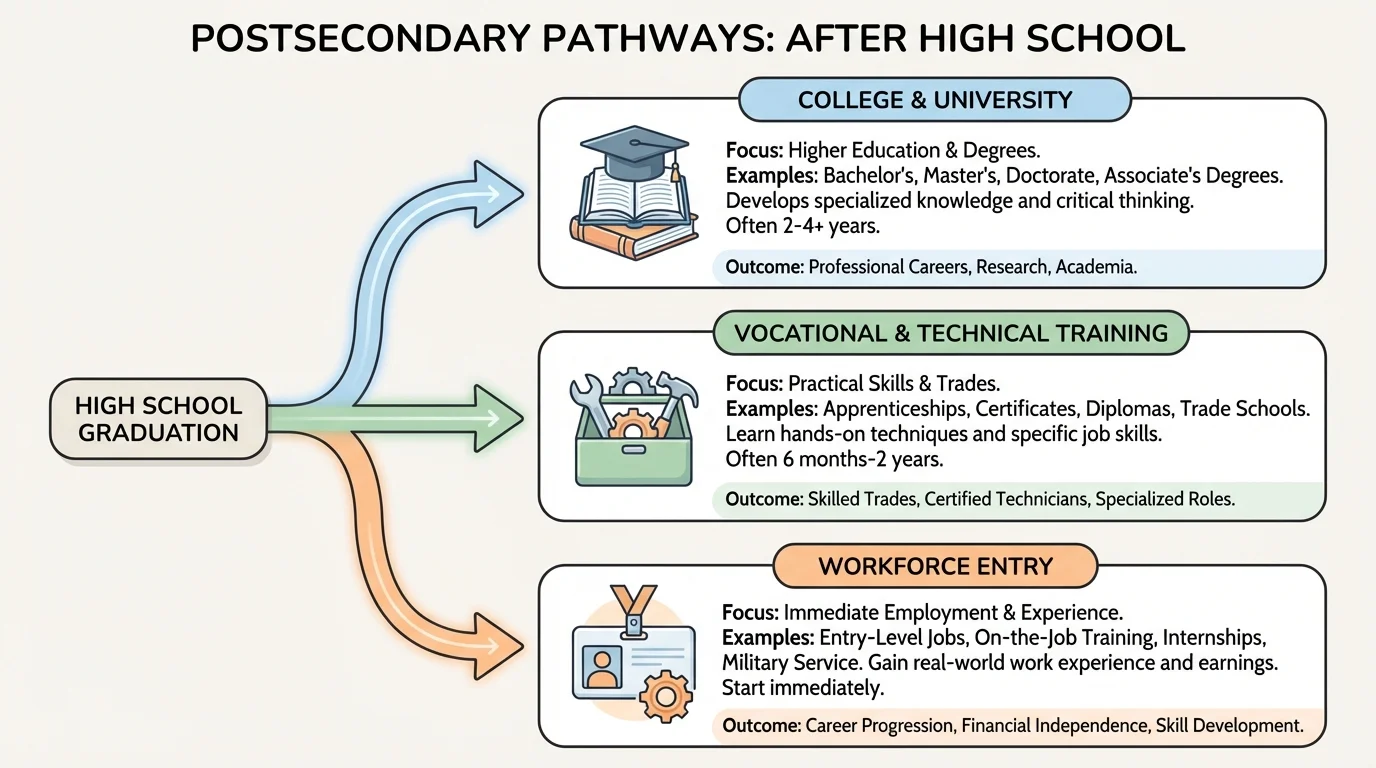
That is important to remember: these pathways are not about which person is "better." They are about what fits a person's goals, needs, interests, and situation. A smart choice is a choice that matches what someone wants to do and what steps will help them get there.
If people do not learn about their options, they may think there is only one "right" answer. That can cause stress or confusion. But when people understand different paths, they can make better decisions and feel more confident.
College is a place where people take classes after high school to learn about a subject or prepare for certain jobs. Some jobs, like a teacher, an engineer, or a doctor, usually require many years of college. Other jobs may need only some college classes or a shorter college program.
There are different kinds of college. A community college often has shorter programs and can sometimes cost less. A four-year college or university usually offers longer programs that can lead to a degree. In college, students may read, write, solve problems, practice skills, and learn how to manage their time.
College is one way to prepare, not the only way. College can be a strong choice for people who want jobs that need advanced study, enjoy academic learning, or want to explore subjects in depth. It also takes time, effort, and planning, so it is important to choose it for a reason, not just because others expect it.
For fourth graders, the most useful thing to understand is this: college is continued learning. It can open doors to some careers, but it is not needed for every job. Later in life, people think about what they want to do and whether college fits that plan.
For example, if someone wants to become a veterinarian, college is an important step. If someone wants to study computer science, college may help. If someone wants to become a graphic designer, there may be several options, including college, training, or building skills through practice and projects.
Training program means a program that teaches the skills needed for a certain kind of job. These programs are often more focused on a specific skill than college is. They may be shorter, more hands-on, or connected directly to a job.
Examples include learning to become an electrician, dental assistant, welder, automotive technician, or cosmetologist. Some training programs lead to a certificate, which is proof that a person finished a program and learned certain skills. Some jobs also require a license or test after training.
Another kind of training is an apprenticeship. In an apprenticeship, a person learns by doing real work with a skilled adult while also getting instruction. This is a great fit for people who like active, hands-on learning.
Training programs matter because many important jobs depend on them. People who repair heating systems, style hair, fix vehicles, help in medical offices, or build homes often need special training. As we saw earlier in [Figure 1], this path is different from college, but it is still a path of learning and preparation.
Many jobs that keep communities running every day depend on skilled workers who learned through training programs or apprenticeships. When a sink is leaking, power is out, or a car needs repair, these workers solve real problems people cannot ignore.
If people do not take training seriously, they might wrongly believe hands-on jobs are easy. In truth, these jobs require skill, safety knowledge, responsibility, and practice.
Workforce means the people who do jobs in a community or country. Some people enter the workforce soon after high school. They may start in entry-level jobs and learn from supervisors, coworkers, online training, and experience.
Going straight to work can make sense for someone who wants to earn money sooner, gain experience, support family needs, or explore different job types before choosing more school or training. Work teaches important habits like being on time, following directions, solving problems, communicating clearly, and staying organized.
Working right after high school does not mean learning stops. Many jobs include on-the-job training. A person might begin as an assistant, helper, or beginner and then build new skills step by step. Some employers even help workers pay for more classes later.
Example: Learning while working
Mia finishes high school and starts working at a pet care business.
Step 1: She learns basic tasks like greeting customers and cleaning work areas.
Step 2: She practices responsibility by showing up on time and listening carefully.
Step 3: She decides she wants more skills, so later she joins a training program in animal care.
Mia's story shows that work can be a starting point, not the end of learning.
This is another reason it helps to think of pathways as connected. A person may work, then train, then go to college. Another person may go to college, then work, then take a short training course later.
Choosing a future path is like solving a puzzle with several pieces, and [Figure 2] illustrates the kinds of questions people ask. A good choice usually comes from thinking about interests, strengths, goals, time, and cost. Not every path fits every person in the same way.
One important question is: What do I enjoy? If someone loves reading, researching, and studying ideas for years, college may feel like a good fit. If someone prefers building, fixing, or practicing a skill with their hands, training might feel better. If someone wants to begin gaining work experience quickly, starting a job may be the best first step.
Another question is: What job do I want? Some jobs require a degree. Some require a certificate or license. Some allow people to begin working and learn while they go. Knowing the job goal helps people choose the right preparation.
People also think about time and cost. Some paths take longer than others. Some cost more money. Families and students often make plans carefully so they can choose wisely.
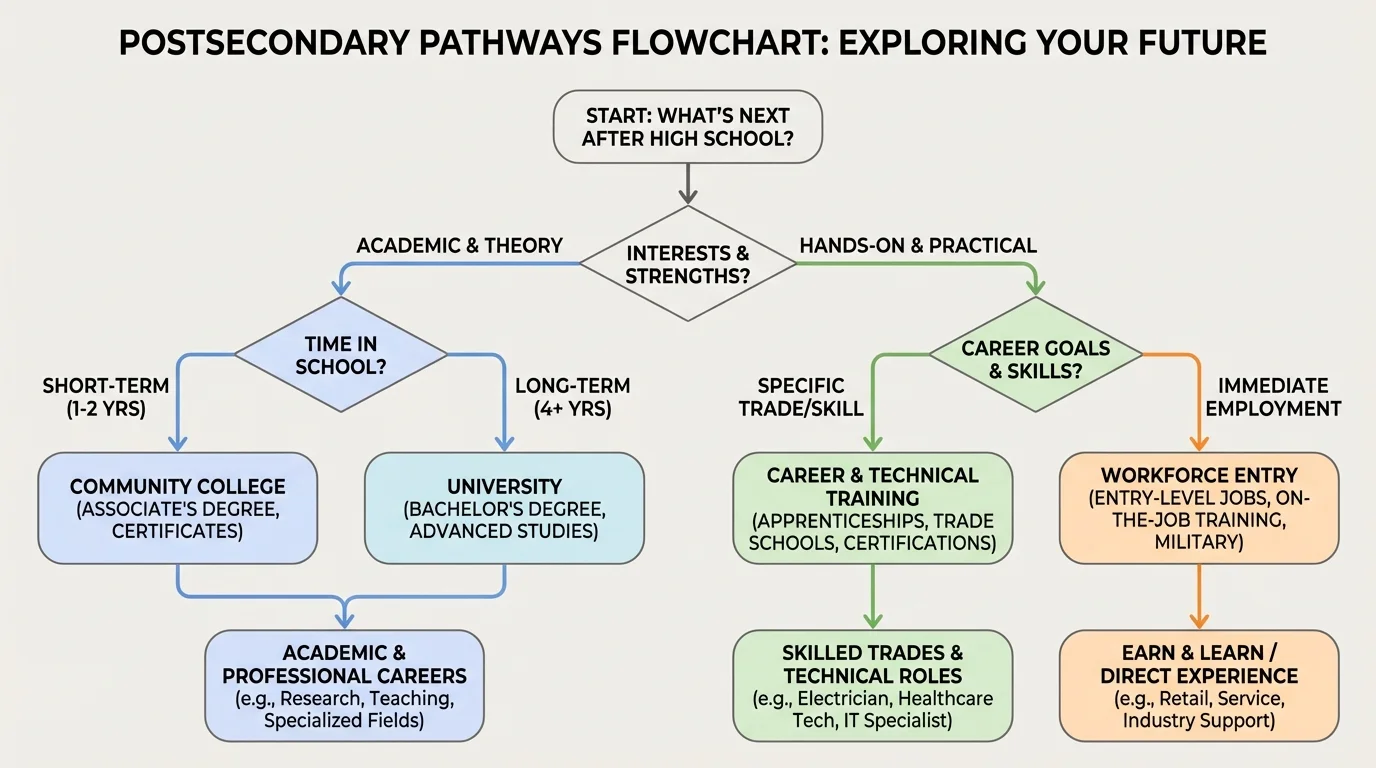
One more big question is: How do I learn best? Some people enjoy class discussions, reading, and writing. Others learn best by trying, building, testing, and practicing in real situations. Neither way is bad. It is helpful to know yourself.
If someone chooses a path without thinking it through, they may feel frustrated later. But if they ask questions, listen to advice, and learn about options, they can choose more carefully. That does not guarantee everything will be easy, but it gives them a stronger start.
Your future does not have to match anyone else's future. Two friends can both become successful adults while making very different choices. One may study at college for years. One may learn a trade. One may begin working and build skills over time. Success is not about copying another person. It is about growing, contributing, and taking responsibility.
People's pathways can also change. A person may think they want one job at age 18 and discover a different interest at age 25. That is not failure. That is learning more about themselves. In fact, the comparison in [Figure 1] helps show that pathways can branch, connect, and change direction over time.
"Your future is built one choice at a time."
It is also respectful to value many kinds of work. Communities need nurses, builders, coders, drivers, artists, teachers, repair workers, childcare workers, scientists, and many others. When you respect different pathways, you show maturity and understanding.
Future planning starts with today's habits, and [Figure 3] shows several simple ways you can begin. You do not need to pick a career now, but you can build skills that help in any pathway: responsibility, curiosity, effort, and communication.
One helpful habit is learning to finish tasks. When you complete your assignments, chores, or projects, you practice follow-through. Another helpful habit is managing your time. Using a planner, checklist, or calendar can help you remember what to do and when to do it.
You can also explore interests. If you like drawing, coding, animals, cooking, music, sports, or building things, spend time learning more. Watch safe, age-appropriate videos with a trusted adult's permission, read books, try beginner projects, or join community activities. Interests can become clues about future pathways.
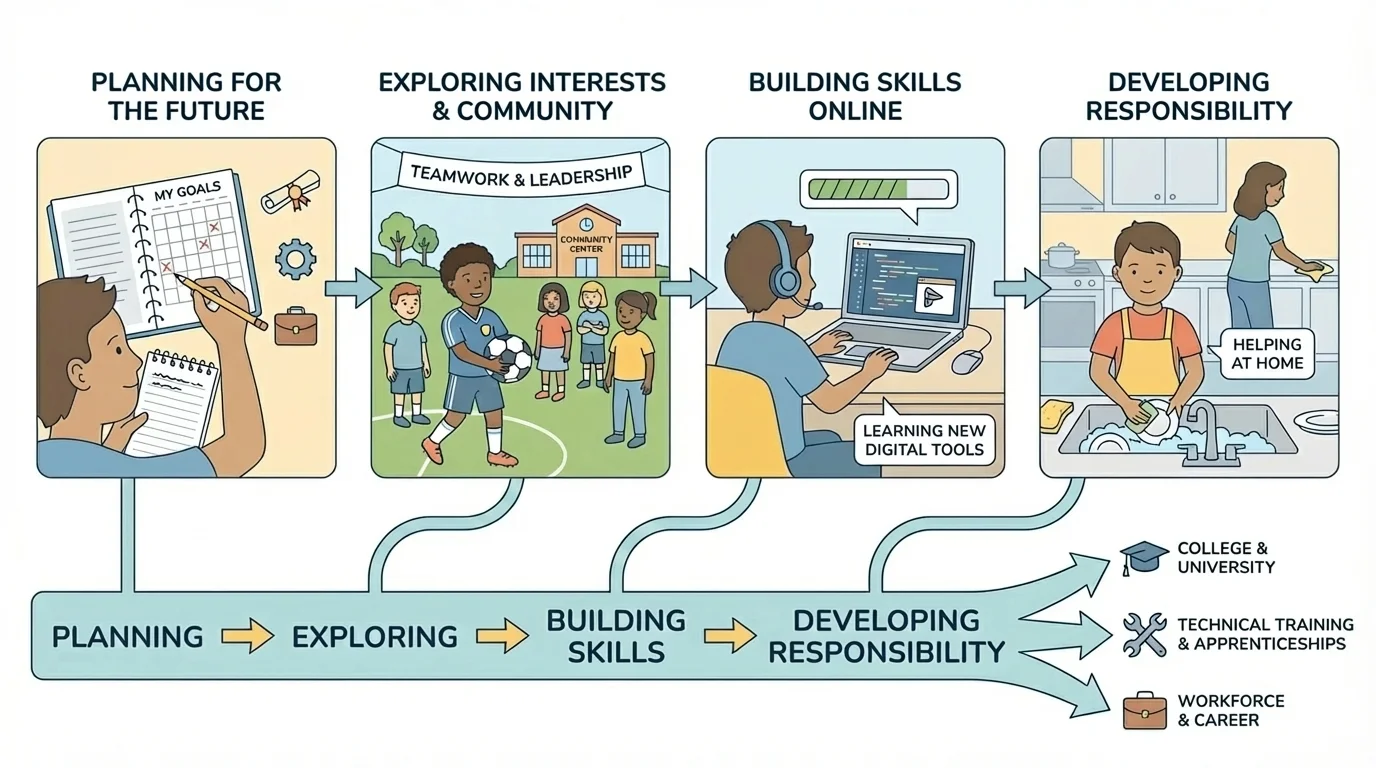
Talking to adults is another smart step. Ask family members, neighbors, community helpers, coaches, or mentors what they do and how they learned it. Because you learn online, some of these conversations may happen on video calls, messages, or family chats. You can ask questions like, "What do you like about your job?" or "What did you have to learn to do that work?"
Try This: Start a "future notebook" or digital document. Write down jobs you hear about, skills those jobs use, and which ones sound interesting to you. You are not choosing yet. You are collecting ideas.
Try This: Practice one work habit this week: being on time for online meetings, organizing your materials before you begin, or checking your work before turning it in.
Try This: Learn one new life skill at home, such as making a simple snack, folding laundry, writing a polite message, or helping plan a shopping list. Small skills build confidence for bigger responsibilities later.
These actions may seem small, but they matter. Readiness is built from everyday habits, not just big future decisions.
Here are a few examples of how different pathways can fit different goals.
Example: Three different futures
Each student grows up and chooses a path that matches personal goals.
Step 1: Jordan wants to design bridges, so Jordan plans for college because engineering usually requires a degree.
Step 2: Elena likes fixing machines and solving hands-on problems, so Elena joins a technical training program.
Step 3: Sam wants to start earning money quickly and gains experience in a business job, then later takes extra classes to move up.
All three students are preparing for adult life in thoughtful ways.
Notice that these stories are not about who is smartest. They are about matching a path to a purpose. The best question is not "Which path is better?" The better question is "Which path fits the goal?"
When you hear adults talk about jobs and education, listen for the path they took. Some may say, "I went to college." Others may say, "I learned through training." Others may say, "I started working and kept building skills." Each story teaches you something useful.
As you grow, people may ask what you want to be when you are older. You do not need a perfect answer. It is enough to say what you are curious about right now. You can say, "I'm still learning about different jobs," or "I'm interested in animals," or "I like building and designing things."
It is also good to speak respectfully about all pathways. Instead of saying one path is "for smart people" and another is not, remember that every path takes effort. A kind, accurate way to speak is: "Different jobs need different kinds of preparation."
If you are talking online with adults or community groups, use clear digital manners. Write polite messages, wait your turn in video calls, and ask thoughtful questions. These communication skills will help whether you go to college, enter training, or start work one day.
| Pathway | Main Purpose | What Learning Looks Like | Example Jobs |
|---|---|---|---|
| College | Deep study for some careers | Classes, reading, writing, projects | Teacher, engineer, veterinarian |
| Training Program | Specific job skills | Hands-on practice, job-focused lessons | Electrician, dental assistant, welder |
| Work | Earn money and gain experience | Learning on the job, supervision, practice | Assistant roles, service jobs, business support |
Table 1. A simple comparison of three common postsecondary pathways.
As you continue growing, keep your mind open. Learn about jobs. Notice your strengths. Practice responsibility. Ask questions. Your future will be built over time, and understanding pathways now gives you a strong beginning.
