Have you ever wanted something good to happen, like saving for a new art kit, learning to ride your bike longer distances, or helping more at home, but then felt stuck because you did not know what to do first? That happens to many people. A goal can feel exciting at the start, but without a plan, it can also feel too big. The good news is that you can learn how to turn a wish into a real plan.
When you make a plan for a goal, you are practicing responsibility. You are telling yourself, "This matters, and I am going to take care of it." You are also practicing future planning, because you are thinking about what you want later and what you need to do now to get there.
A goal is something you want to do, make, learn, or improve. Some goals are small, like cleaning your room by the end of the day. Some are bigger, like reading for twenty minutes every day for a month. Both kinds of goals work better when you know your next steps.
Without a plan, people often say things like, "I will do it later," or "I do not know where to start." Then the goal stays in their head and never becomes action. With a plan, the goal becomes clear. You know what to do today, what to do next week, and how to tell whether you are getting closer.
Action steps are the small tasks you do to move toward a goal. Checkpoints are times when you stop and check your progress. A meaningful goal is a goal that matters to you and connects to something important in your life, your family, or your community.
Planning also helps when life gets busy. If you learn online from home, your day may include lessons, chores, hobbies, family time, and maybe activities in your neighborhood or online groups. A plan helps you fit your goal into real life instead of hoping it will just happen somehow.
Not every goal is equally important. A meaningful goal is one that gives you a good reason to keep going, even when it is not easy. Maybe you want to save money for a pet toy for your dog, improve your swimming, be more helpful to your family, or learn how to bake muffins safely. These goals matter because they connect to your real life.
A meaningful goal usually has one or more of these qualities:
For example, "I want to practice keyboarding for ten minutes a day so I can type school assignments faster" is more meaningful than "I guess I should do something with typing." The first goal has a reason. The second one is too fuzzy.
Why meaning helps motivation
When a goal matters to you, your brain treats it as important. That does not mean the work becomes easy, but it does make it easier to stay with the plan. If your goal helps you, helps others, or connects to your future, you are more likely to remember it and protect time for it.
A good way to test whether a goal is meaningful is to ask yourself three questions: Why do I want this? Who does it help? What will be better when I finish? If you can answer those clearly, your goal probably matters.
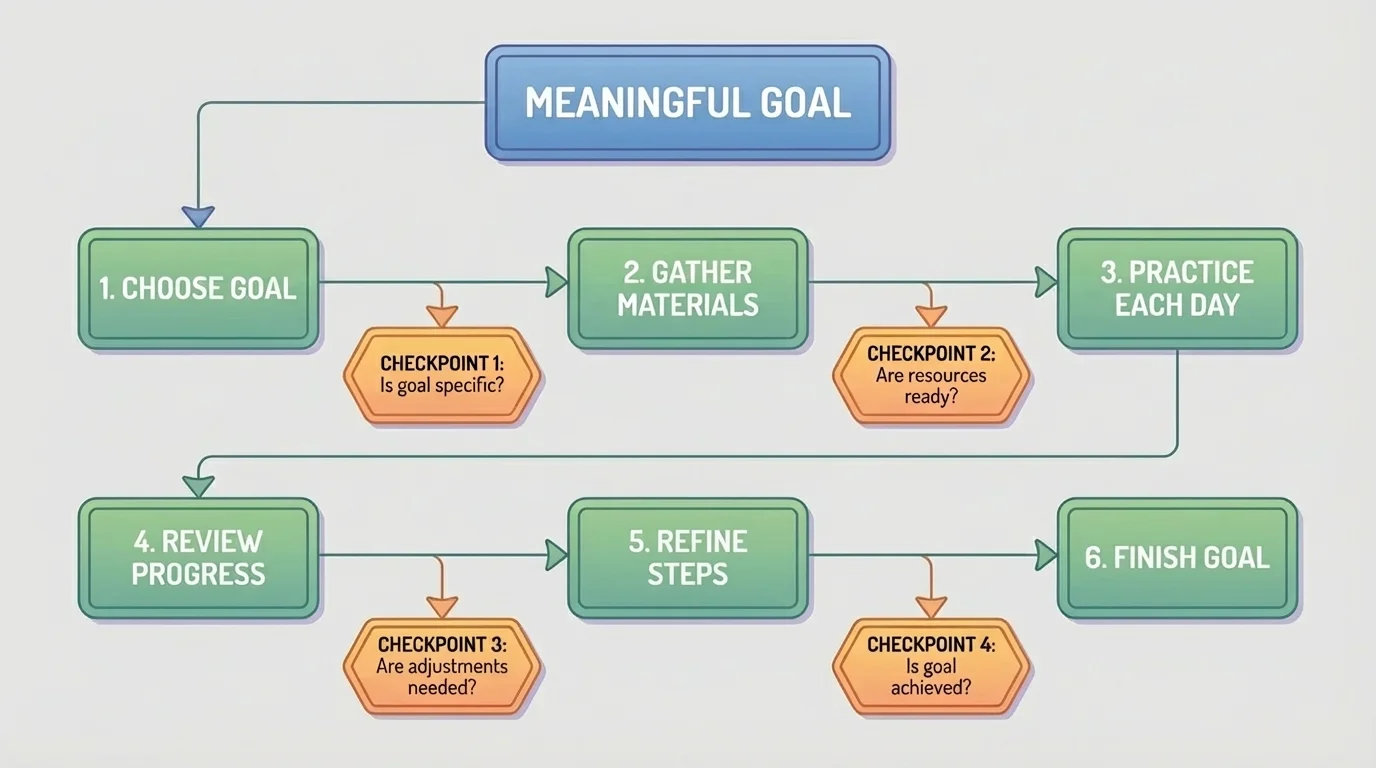
Large goals feel easier when you break them into smaller pieces, as [Figure 1] shows. This process is called creating an action-step plan. Instead of staring at one big job, you create a list of small jobs you can actually do.
Start with the goal. Then ask, "What would I have to do first? What would come next? What would I need before I can finish?" Each answer becomes one step. Put the steps in order. The order matters because some steps must happen before others.
Here is a simple way to build your plan:
Step 1: Say the goal clearly. Instead of "I want to get better at drawing," say "I want to finish four animal drawings by the end of this month."
Step 2: Break it into smaller jobs. For that drawing goal, the jobs might be choosing the animals, finding paper and pencils, making one drawing each week, and asking for feedback from a family member.
Step 3: Make each step doable. A good step is small enough that you can picture yourself doing it. "Practice sketching for fifteen minutes on Saturday" is easier to do than "Become amazing at art."
Step 4: Think about what you need. Do you need supplies, time, help from an adult, or a quiet place to work? Planning ahead prevents surprises.
Step 5: Write it down. A written plan is easier to follow than a plan you are trying to remember.
Example: Saving for a book
You want to buy a book that costs $12. You already have $3. You need $9 more.
Step 1: Set the goal clearly.
Goal: Save $12 for the book by the end of six weeks.
Step 2: Find the missing amount.
You need to save \(12 - 3 = 9\).
Step 3: Break the goal into weekly action steps.
If you save the same amount each week for six weeks, that is \(9 \div 6 = 1.5\). You need to save $1.50 each week.
Step 4: Plan the actions.
Put part of your allowance in a jar each week, keep a savings chart, and ask an adult to help you remember on the same day each week.
The big goal becomes much easier when you know the exact steps.
Notice how the plan turns a big idea into small, manageable actions. That is the power of action steps. If one step feels too hard, make it even smaller.
A checkpoint is a planned time to stop and see how things are going. Checkpoints are important because they help you notice progress early. They also help you fix problems before the whole plan falls apart.
As [Figure 2] suggests, think of checkpoints as mile markers on a road. They are not the end of the trip, but they tell you where you are. If your goal lasts one week, you might have one or two checkpoints. If your goal lasts a month, you might check every week.
At each checkpoint, ask simple questions: Did I do the steps I planned? What worked well? What was hard? Do I need to keep going the same way, or change something?
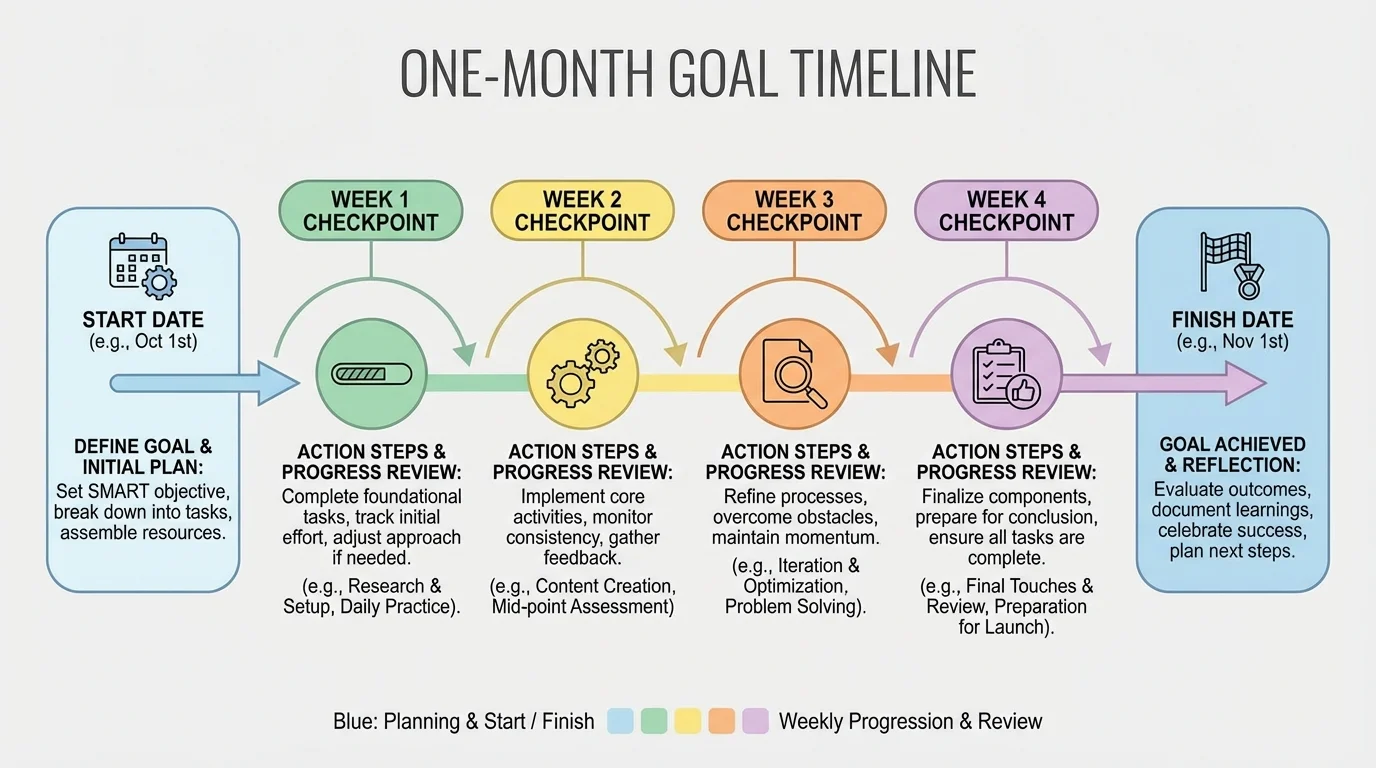
Checkpoints should be regular and clear. For example, if your goal is to read more, a checkpoint could be every Sunday evening. If your goal is to help more at home, a checkpoint could be every three days. Pick a time you can remember.
Checkpoints should also be honest. The point is not to pretend everything is fine. The point is to learn. If you planned four practice times and only did two, that does not mean you failed. It means you now know something useful. Maybe your step was too big. Maybe your reminder system did not work. Maybe you needed help.
People often keep going longer on a hard task when they can see progress. Even a small check mark on a list can make your brain feel, "I am moving forward."
You can use different kinds of checkpoints:
Later, when you compare your progress across several weeks, [Figure 2] helps you picture how checkpoints spread your work across time instead of pushing everything to the last minute.
Different tools can help you stay organized as you work toward different goals. You do not need fancy apps or complicated planners. Simple tools work very well when you use them regularly.
As [Figure 3] shows, three helpful tools are calendars, checklists, and reminders. A calendar helps you decide when to work. A checklist helps you see what to do. A reminder helps you remember at the right time.
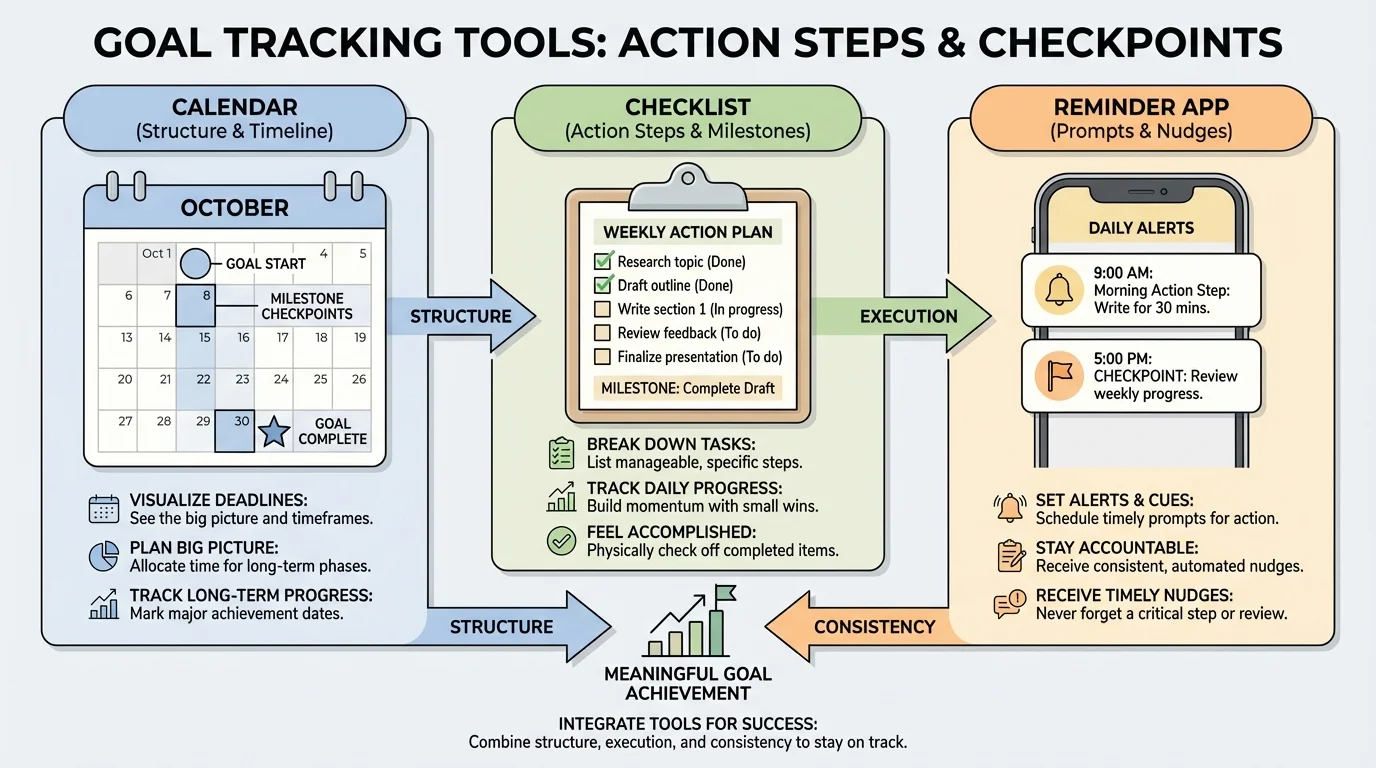
A paper calendar on the wall can help you mark practice days. A notebook checklist can help you cross off steps. A reminder on a tablet or phone, set by an adult if needed, can help you remember a checkpoint.
You can also use a progress tracker. This is a simple record of what you have finished. For example, if your goal is daily reading, your tracker might have boxes for each day of the month. If your goal is saving money, your tracker might show how much you have saved so far.
Here are examples of simple tools and what they do:
| Tool | How it helps | Good for |
|---|---|---|
| Calendar | Shows when to work and when checkpoints happen | Daily or weekly goals |
| Checklist | Breaks the goal into clear tasks | Step-by-step projects |
| Reminder | Prompts you at the right time | Busy schedules |
| Progress tracker | Shows what you have completed so far | Longer goals |
Table 1. Simple tools students can use to organize action steps and checkpoints.
These tools also build independence. Instead of waiting for someone else to remember your goal, you create a system that helps you take care of it yourself. That is a strong life skill.
When you organize your time, small actions add up. Doing a little bit again and again is often more powerful than trying to do everything in one giant rush.
You can also ask for support. A family member can help you set reminders. A coach, club leader, librarian, or trusted adult can listen to your plan. If your goal helps your community, such as collecting canned food or helping clean a shared space, others may help you stay on track too.
Almost every real goal hits a bump. Maybe you get sick, forget a day, lose a supply, or discover that your plan was too hard. That does not mean you should quit. It means you should adjust your plan.
A obstacle is something that gets in the way. Obstacles are normal. Responsible goal-setting includes thinking about what might go wrong and deciding what you will do if it happens.
Here are smart ways to handle obstacles:
For example, maybe your goal is to practice piano four times each week, but your afternoons become busy. Instead of giving up, you might switch to shorter practice times on four mornings. The goal stays the same, but the plan improves.
Changing the plan is not the same as quitting
A strong plan is flexible. If a checkpoint shows that something is not working, you can change the steps, the timing, or the support system. The goal is to keep moving forward, not to follow a broken plan forever.
This is another reason checkpoints matter. They let you catch trouble early. Just like the timeline in [Figure 2], your progress is easier to manage when you stop and review along the way.
Here are a few examples of meaningful goals for your age. Notice how each one has a clear goal, action steps, and checkpoints.
Example: Helping more at home
Goal: Help make dinner twice each week for one month.
Step 1: Pick two days each week.
For example, Tuesday and Saturday.
Step 2: Choose safe jobs.
Wash vegetables, measure ingredients, set the table, or stir with adult help.
Step 3: Use checkpoints.
At the end of each week, check whether you helped on both days.
This goal builds responsibility and helps your family.
Another example could be a community goal: collecting five gently used books to donate to a neighborhood book-sharing box or charity drive. Your action steps might include asking permission, choosing the books, checking their condition, and delivering them with an adult. Your checkpoints might happen every few days to see whether you have collected enough books.
A future-planning goal could be learning a new skill online, such as beginner coding, drawing, or sign language. You might set a goal to complete one short lesson three times each week for four weeks. Then you would choose exact lesson days, keep a checklist, and review your progress each weekend.
As you learned earlier with the action-step flowchart in [Figure 1], each of these examples works because the big goal is turned into smaller parts that can actually be done.
When you learn to plan goals now, you are building habits that help in later life. You will use this skill when you manage homework, practice a sport, save money, prepare for events, work with a team, or help in your community.
Good future planners often do these things:
You do not have to be perfect at goal setting to get better at it. In fact, every plan teaches you something. Maybe one goal shows you that reminders help. Another shows you that shorter steps work better. Another shows you that support from family makes a big difference.
"Big things often grow from small steps done again and again."
That idea is simple, but powerful. If you know what matters, choose small actions, and stop at checkpoints to review, you can make real progress. This helps you care for your responsibilities, contribute to your family or community, and prepare for goals you will have in the future.
