Some people seem confident, but here is the surprising truth: most real confidence is not something you are just born with. It is something you build. When you work at a skill, listen to helpful advice, and keep going after mistakes, your brain starts to believe, "I can handle hard things." That belief is the heart of healthy self-confidence.
Self-confidence means trusting that you can try, learn, and improve. It does not mean thinking you are the best at everything. It does not mean never feeling nervous. A confident person can still feel unsure sometimes. The difference is that they believe they can keep going, learn from problems, and get stronger with practice.
Self-confidence is a strong belief that you can handle challenges, make choices, and improve with practice. Effort is the work you put into something. Feedback is information that tells you what is going well and what you can change. Persistence means continuing even when something is difficult or frustrating.
Healthy confidence grows from real experiences. If you finish a tough reading assignment, practice a song on your instrument, learn how to cook scrambled eggs, or finally figure out a new game strategy, you feel more sure of yourself. Why? Because now you have proof. Confidence gets stronger when your actions give you evidence.
Think about learning to ride a bike, use a new drawing app, or speak up on a video call. You probably were not amazing the first time. You may have wobbled, clicked the wrong button, or forgotten what to say. If confidence only came before success, almost no one would ever begin. Instead, confidence usually grows after you try.
That is why waiting to "feel confident first" can keep you stuck. A better plan is to take a small action first. Then your confidence can catch up. This is an important part of self-awareness: noticing how you feel, but not letting every nervous feeling make your decisions for you.
For example, maybe you want to join an online art club or share your idea during a group project call. If you tell yourself, "I cannot do it until I feel totally ready," you may keep waiting. But if you prepare one idea, say one sentence, and survive that moment, your confidence grows a little. Next time gets easier.
Effort is one of the strongest builders of confidence because it gives you practice. Practice helps your brain and body get better at a task. The more prepared you are, the more likely you are to think, "I know what to do." That feeling is real confidence, not pretending.
Effort matters in small daily situations. If you study your spelling words, rehearse your presentation, organize your materials before an online lesson, or practice dribbling a basketball in your driveway, you are building skill. As skill rises, confidence often rises too. You begin to trust yourself because you know you have put in the work.
This is different from trying to look confident without preparation. For example, a student might say, "I do not need to practice." But when the moment comes, they may freeze or feel embarrassed. Another student practices for fifteen minutes each day. That student may still feel butterflies, but they know they have prepared. Preparation gives confidence something solid to stand on.
Effort creates evidence
Every time you try, practice, or prepare, you collect proof that you are growing. Even if the result is not perfect, your effort shows that you can take action. That matters because confidence becomes stronger when it is based on real effort, not just wishful thinking.
Effort also teaches you that being bad at something at first is normal. Many people quit too early because they think early struggle means they are not good enough. Really, early struggle usually means you are learning. A new skill can feel awkward before it feels easy.
Try This: Pick one skill you want to feel better about this week. It could be typing, baking toast safely, speaking clearly on camera, cleaning your room without reminders, or shooting a soccer ball. Spend a short, steady amount of time on it each day. Even ten minutes can matter when you do it again and again.
Feedback is another important builder of confidence. Feedback tells you what is working and what needs to change. Sometimes feedback comes from a parent, coach, teacher, music instructor, or trusted friend. Sometimes it comes from the result itself, like cookies turning out too burned or a video recording showing that you spoke too quietly.
At first, feedback can feel uncomfortable. Many people hear correction and think, "I must be bad at this." But helpful feedback does not mean you are a failure. It means you are getting useful information. If you use that information, you improve faster. Improvement builds confidence.
Suppose you are learning to make a sandwich lunch by yourself. A parent says, "You remembered everything, but next time spread the peanut butter more evenly." That is not an insult. It is a clue. You already did part of the job well, and now you know one way to do it better.
Or maybe during an online discussion, your teacher says, "Your idea is strong. Speak a little louder and pause between points." That kind of response can actually strengthen self-confidence because it shows that success is possible. You do not need to start over. You just need to adjust.
| Type of feedback | What it sounds like | Helpful response |
|---|---|---|
| Specific and kind | "Your opening was clear. Add one more detail." | Use the suggestion and try again. |
| Result-based | "The plant is drooping. It may need water." | Notice the result and make a change. |
| Too vague | "Do better." | Ask, "What is one thing I should change?" |
| Mean or unhelpful | "You are terrible at this." | Do not treat it as truth. Ask a trusted person for better guidance. |
Table 1. Different kinds of feedback and smart ways to respond to each one.
Not all feedback deserves equal attention. Helpful feedback is usually specific, respectful, and focused on actions you can change. Unhelpful feedback is often mean, confusing, or meant to hurt. Part of growing up is learning the difference.
Using feedback well
A student records a short speech for a club audition and feels disappointed after watching it.
Step 1: Notice what went well.
The student says, "My words were clear, and I remembered my main points."
Step 2: Choose one improvement from feedback.
The student notices, "I looked down too much, and my voice got soft at the end."
Step 3: Make a simple plan.
The student decides to practice looking at the camera lens for one sentence at a time and to end with a stronger final line.
Step 4: Try again.
After another recording, the student sees improvement and feels more confident.
The confidence grows because the student uses feedback as a tool, not as proof of failure.
Try This: The next time someone gives you advice, pause before reacting. Ask yourself, "Is this trying to help me improve?" If the answer is yes, pick one idea to use right away. You do not have to fix everything at once.
Persistence means sticking with something even when it is hard, boring, or frustrating. Confidence gets stronger when you learn that a mistake does not stop you. It is just part of the path.
This matters because almost every useful skill takes time. Reading longer books, learning a skateboard trick, memorizing dance moves, folding laundry neatly, solving a tricky puzzle, or improving your free throw all involve mistakes. If you quit every time something feels hard, your confidence stays weak because you never get to see yourself improve.
Persistence teaches a powerful message: "I can handle not being perfect yet." That message is important for resilience, which is the ability to recover after problems, stress, or setbacks. Resilience and confidence often grow together.
Imagine two students learning keyboarding. One says, "I keep making mistakes. I am just bad at this," and gives up. The other says, "I made mistakes today, but I was a little faster than last week." The second student keeps practicing. After a month, that student is usually more skilled and more confident. Persistence gave them time to improve.
Your brain changes when you practice. The more you repeat a skill, the more your brain strengthens the pathways that help you do it. That is one reason persistence can turn something difficult into something more natural over time.
Persistence does not mean forcing yourself forever without rest. It means taking the next helpful step. Sometimes persistence looks like trying again today. Sometimes it looks like taking a short break, getting advice, and coming back tomorrow with a better plan.
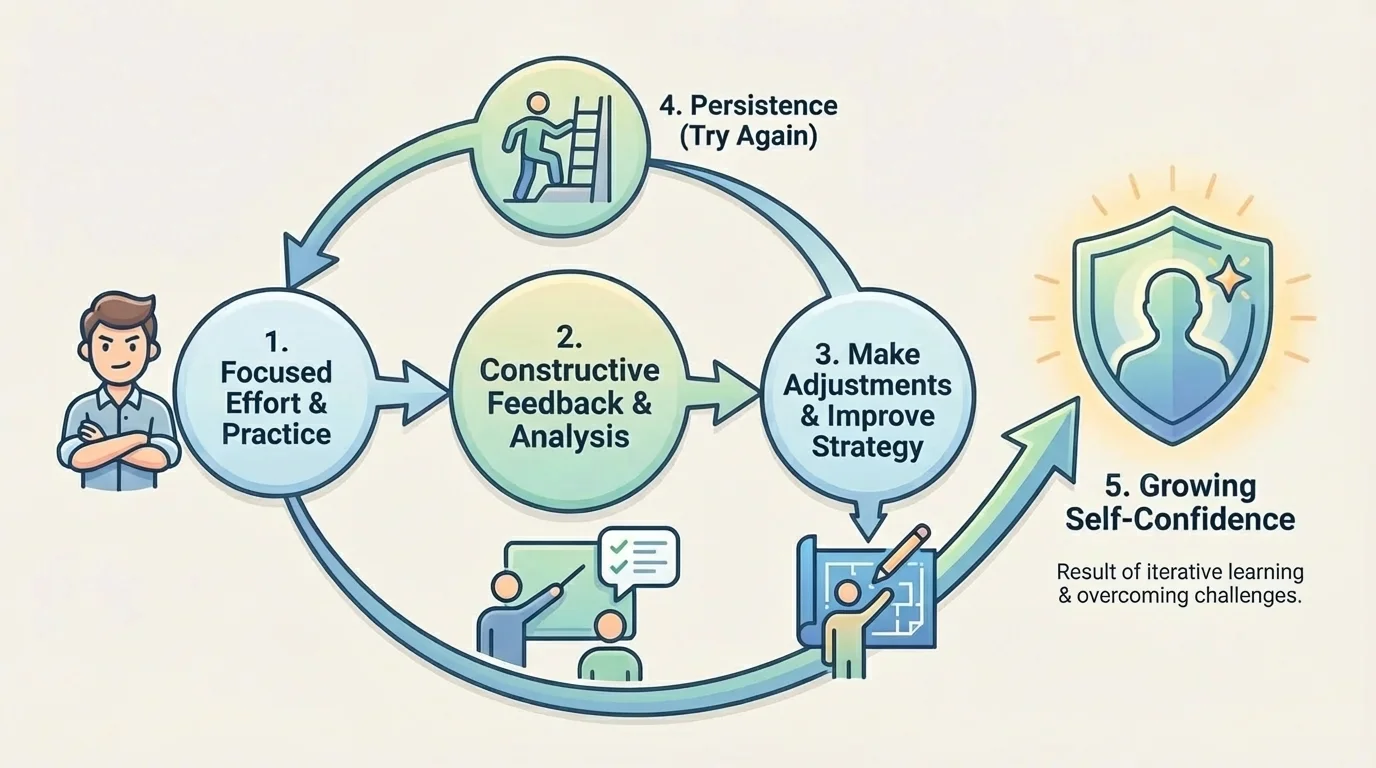
These three ideas are strongest when they work as a team. The cycle in [Figure 1] shows that confidence often grows in a loop: you try, you learn, you adjust, and you try again. Confidence is not a one-time prize. It is built again and again through action.
Here is how the cycle works. First, you put in effort. Then you get feedback from a person, a result, or your own observation. Next, you use persistence to keep going instead of quitting. After repeating this cycle, you improve. As improvement becomes visible, your self-confidence grows.
For example, say you want to learn how to make pancakes. Your first batch may be too dark. That is feedback. You ask what happened, lower the heat, and try again. That takes persistence. After a few tries, the pancakes turn out better. Now you feel more confident making breakfast because your confidence is based on real experience.
The same thing happens in friendships and communication. Maybe you send a message that sounds too short and a friend thinks you are upset. You get feedback when they ask, "Are you mad at me?" Instead of giving up on texting, you explain, add more care to your words next time, and learn. As you handle situations like this, you become more confident in how you communicate.
When you look back, you often realize confidence did not come from one giant success. It came from many small loops of trying, learning, and continuing, just like the process shown in [Figure 1].
Self-confidence is not just for tests or performances. It affects many parts of life. In online school, confidence can help you ask a question in a live class, message a teacher politely, or start an assignment even when you are not sure you will get everything right. At home, confidence can help you learn chores, cook simple foods, care for a pet, or solve problems without giving up right away.
In hobbies and activities, confidence helps you keep practicing music, coding, drawing, gaming strategy, martial arts, swimming, or community sports. In friendships, confidence helps you speak honestly, apologize when needed, and avoid pretending to be someone you are not. That connects to individuality, which means being yourself instead of copying others just to fit in.
Low confidence can cause real problems. A person may avoid trying new things, become too dependent on others to make choices, or compare themselves to everyone online. On the other hand, confidence built through effort, feedback, and persistence can help you act responsibly, recover from mistakes, and feel proud of honest growth.
"I have not failed. I've just found ways that do not work yet."
— A growth-minded way of thinking
That quote matters because it turns mistakes into information. When you see mistakes this way, confidence becomes steadier. It is no longer destroyed by one bad day.
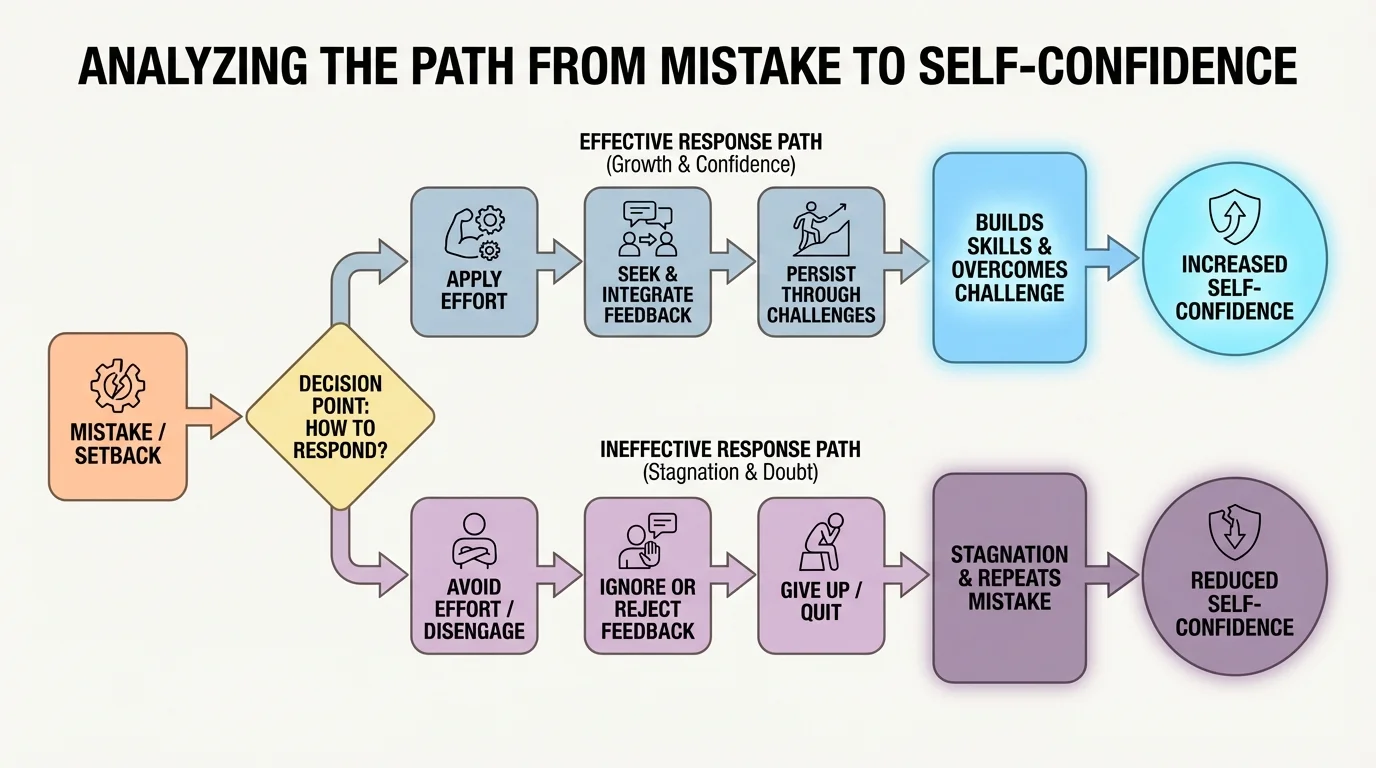
[Figure 2] If your confidence feels shaky, a simple plan can help. The reset process in [Figure 2] starts with noticing the mistake, then choosing one useful next step. This keeps one problem from turning into a giant story about who you are.
Step 1: Name the challenge clearly. Instead of saying, "I am awful at everything," say, "I had trouble remembering my lines," or "I rushed through my homework directions." Clear thinking makes problems easier to solve.
Step 2: Look for one thing you did well. Maybe you started on time, stayed calm, or completed part of the task correctly. This helps your brain stay balanced.
Step 3: Ask for or notice feedback. What specifically needs to change? One small improvement is enough to start.
Step 4: Make a next-step plan. Keep it short and clear. For example: "Tomorrow I will practice for ten minutes," or "Next time I will read all directions before I begin."
Step 5: Try again. This is where persistence turns a plan into growth.
Try This: Use this sentence frame when something goes wrong: "I am still learning. One thing I can do next is ____." This kind of self-talk is not fake. It is honest and helpful.
You can also build confidence by keeping a small "proof list." Write down moments when you worked hard, used feedback well, or kept going after a mistake. The list might include things like "asked for help," "finished the recipe," "fixed my slide show," or "stuck with practice even when I was tired." On low-confidence days, this list reminds you that growth is real.
A confidence plan for one week
A student wants to feel more confident speaking during live online classes.
Step 1: Set a tiny goal.
The student decides to answer one question out loud during the week.
Step 2: Prepare.
Before class, the student writes one idea on a sticky note.
Step 3: Use feedback.
After speaking, the student notices that the answer made sense but came out too fast.
Step 4: Persist.
In the next class, the student takes one breath before speaking and talks more slowly.
By the end of the week, the student feels more confident because they have evidence of improvement.
Notice that the student did not wait to become fearless. The student took a small action, learned from it, and repeated the process. That is how confidence usually grows in real life.
Even strong, capable people have days when confidence drops. Maybe you made a mistake in front of others, got left out of a group chat, lost a game, forgot something important, or saw someone online who seems more talented. Low confidence does not mean you are broken. It means you are human.
One common problem is comparison. If you only look at other people's best moments, you may forget that they also struggle, practice, and make mistakes. Social media and highlight videos often show results, not the effort behind them. Comparing your beginning to someone else's polished middle can make you feel worse than you should.
Another problem is using extreme self-talk. Words like "always," "never," and "everyone" can make one tough moment feel huge. Instead of saying, "I always mess up," try, "That did not go the way I wanted, but I can improve." This kind of thinking supports persistence and protects confidence.
If confidence stays low for a long time, talk to a trusted adult. Sometimes you need support, clearer goals, or help seeing your strengths. Asking for help is not weakness. It is a smart move that can help you grow.
When you handle low-confidence moments well, you are still building confidence. In fact, bouncing back after a rough day may strengthen your self-trust even more than an easy success. You learn that you can recover, not just perform.
