Have you ever had one of those weeks where everything seems to happen at once? You have online lessons, assignments, maybe a club meeting, chores at home, and then suddenly your brain feels like it has too many tabs open. That feeling is real, and it happens to lots of students. The good news is that busy weeks do not have to control you. When you learn how to make a plan and stay calm while following it, busy weeks become much easier to handle.
Busy weeks are tricky because your brain is trying to do many jobs at once. You have to remember what is due, decide what to do first, switch between tasks, manage your feelings, and keep going even when something unexpected happens. That is a lot. If you only try to "remember everything," important things can slip away. If you only focus on working harder, you may get stressed, tired, or upset.
That is why two skills matter together: being organized and being calm enough to use your plan. If you are organized but panicking, your plan may fall apart. If you are calm but have no plan, you may waste time and forget important tasks. Strong self-management means using both.
Organization means keeping track of tasks, time, materials, and responsibilities so you know what to do and when to do it.
Emotional regulation means noticing your feelings and using healthy strategies to stay steady, recover, and make good choices.
Resilience means getting back on track after something goes wrong or feels difficult.
Think of it this way: organization is your map, and regulation is your balance. A map helps you know where to go. Balance helps you keep walking even if the path gets bumpy.
During a busy school week, being organized might look like writing assignments in one place, setting up your learning space before class, and checking your schedule at the same time each day. Being regulated might look like taking a slow breath when you feel rushed, standing up and stretching when your body gets tense, or asking for help before the problem grows bigger.
When these skills are working well, you usually feel more in control. You may still be busy, but you know your next step. When these skills are not working well, you might feel scattered, frustrated, or frozen. For example, a student who keeps assignments in different places may miss one by accident. Another student might know the assignment is due but get so overwhelmed that they avoid starting it. Both students need support, but the kind of support is a little different.
Your brain handles stress better when tasks are clear and broken into smaller parts. A short, simple plan can actually save energy because your brain does not have to keep making the same decisions over and over.
You do not need a perfect system. You need a system that is simple enough to actually use.
The first job is to make the whole week visible. One full view of your week lowers surprise and confusion with a simple planning sheet that puts school, home, and personal tasks together. Busy weeks feel worse when important information is scattered across different tabs, notebooks, messages, and sticky notes.
[Figure 1] Start by collecting everything in one place. This can be a paper planner, a notebook page, a printable chart, or a digital calendar. The tool matters less than using the same one every time. Write down your online class times, assignment due dates, quiz dates, club meetings, sports practice, music lessons, chores, and anything else that takes time.
Now add small details that affect your day. Maybe your internet is sometimes slower in the afternoon. Maybe your sibling uses the same desk at a certain time. Maybe your family eats dinner at a set hour. These details matter because a plan works best when it matches real life.
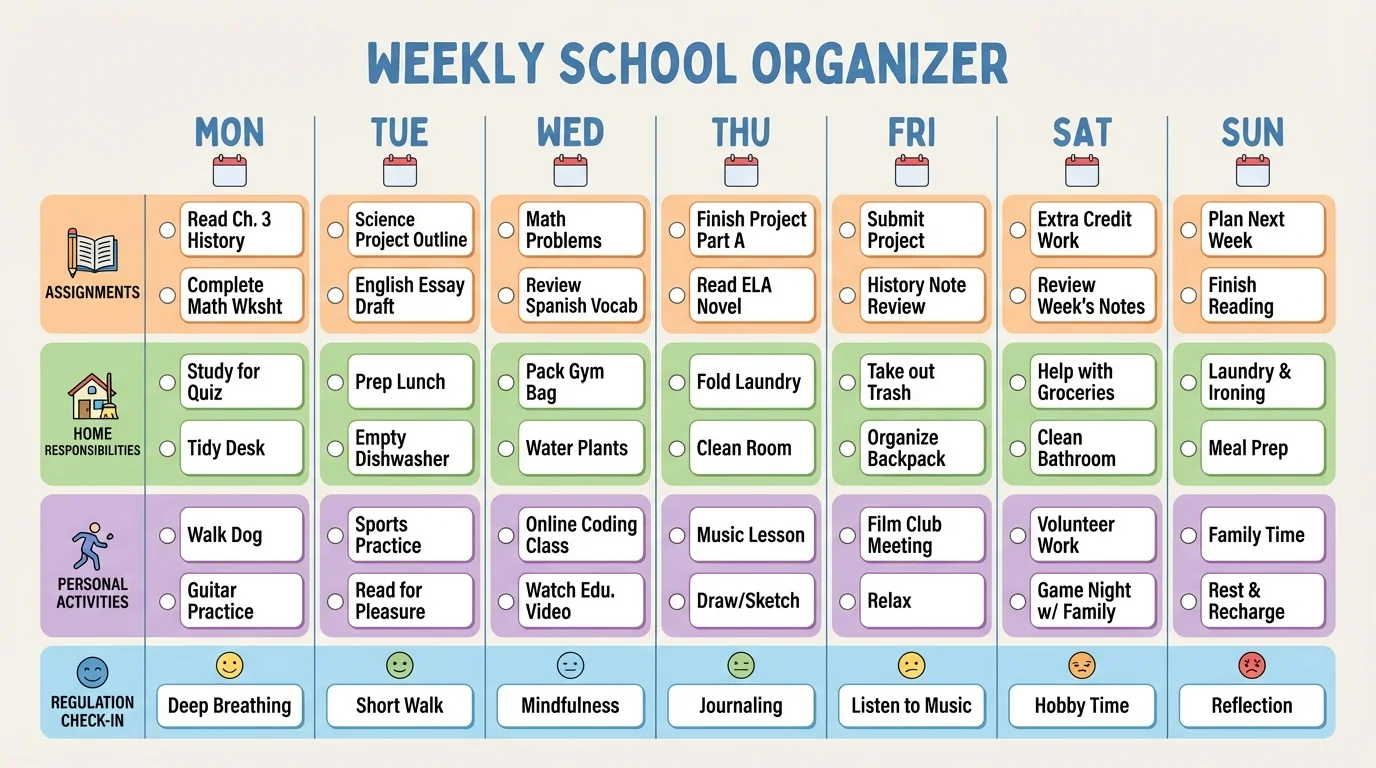
As you fill in your week, look for "crowded spots." Maybe Wednesday has two assignments due and a family appointment. Maybe Friday is lighter. This helps you plan ahead instead of getting surprised later.
Your goal is not to make the week look easy. Your goal is to make the week look honest.
Once you can see the whole week, the next step is deciding what matters most. Not all tasks are equal. Some are urgent because they are due soon. Some are important because they take a long time. Some are small and can be finished quickly. If you treat every task as the same, your brain may feel stuck.
A simple way to choose priorities is to ask three questions: What is due first? What will take the longest? What needs adult help, technology, or materials? A project due on Thursday may need to be started on Monday. A short reading due tomorrow may only take a few minutes. An art task that needs supplies may need planning before you begin.
This is also the time to break big tasks into smaller pieces. A long assignment feels much easier when it becomes a list like this:
Small steps help your brain start. Starting is often the hardest part.
Priority does not always mean "hardest first." Sometimes the best choice is to do one quick task first so your brain feels successful. Other times the best choice is to begin the biggest task early so it does not hang over your whole week. A good plan balances both.
If you notice that there are simply too many important tasks for one day, that is a sign to adjust early. Move what you can, start sooner, or tell an adult you need help making the schedule workable.
A strong schedule gives time for learning, rest, and recovery. A balanced day includes focused work blocks, breaks, meals, movement, and a little extra space for tasks that take longer than expected.
[Figure 2] When you build your weekly plan, begin with the things that usually stay fixed: online class times, meals, bedtime, and regular activities. Then add homework or independent work blocks. Keep these blocks realistic. If your attention starts fading after about 25 minutes, plan shorter chunks with breaks in between.
One smart move is to leave some buffer time. Buffer time is extra open space in your schedule. It protects you when a task takes longer, a website will not load, or you need a few minutes to calm down. Without buffer time, one small delay can throw off the whole day.
You also need transition time. Do not schedule every minute. If one task ends at noon and another begins immediately, you may feel rushed. A few minutes to put materials away, get water, or stand up can help you reset.
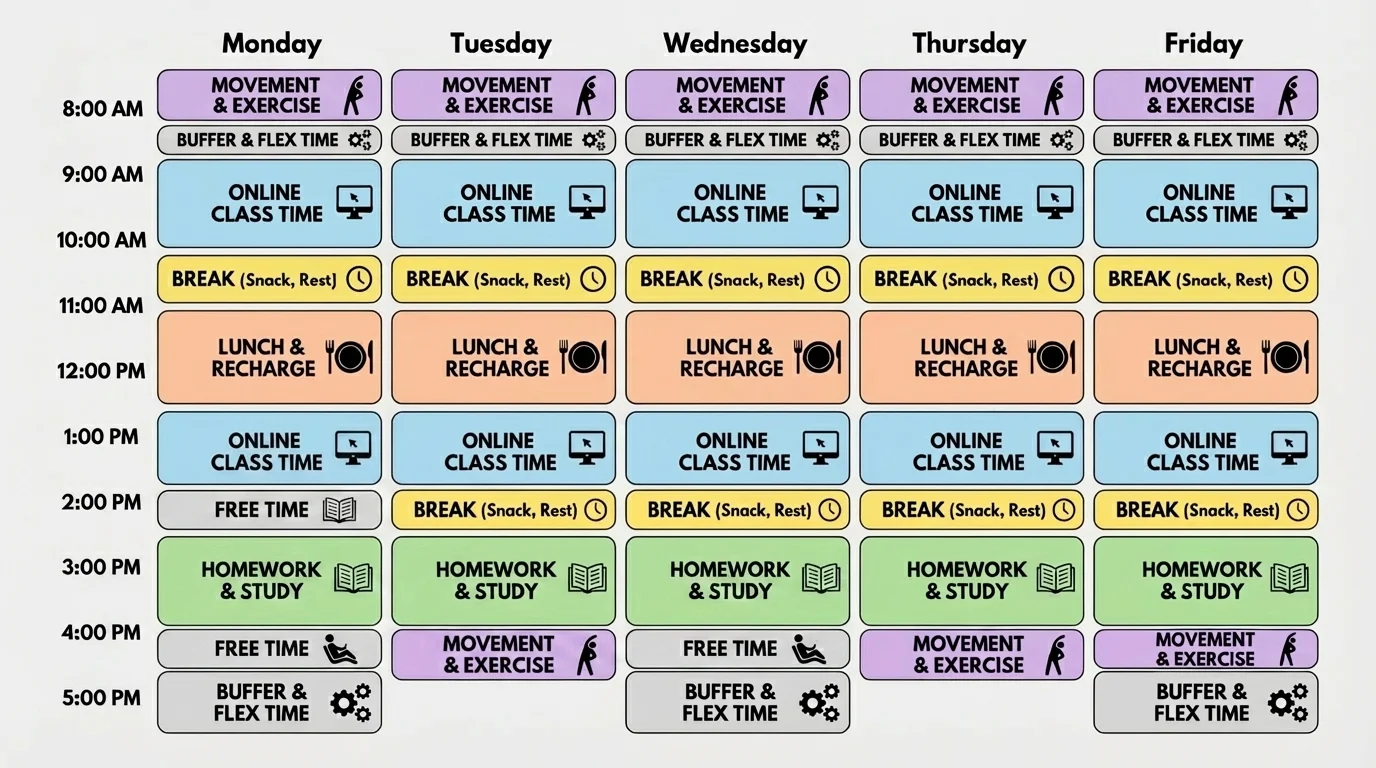
Try making your plan in a simple pattern:
Sleep matters more than many students realize. If you stay up too late, the next day becomes harder to manage. Your attention, patience, and memory all work better when you are rested.
A weekly plan helps you see the big picture, but daily routines help you actually live it. Good routines are short and repeatable. You do not need a giant checklist with 20 items. You need a few actions that make the day smoother.
A morning reset might include: checking your schedule, opening the tabs you need, finding a pencil and notebook, filling your water bottle, and taking one slow breath before class starts. An afternoon reset might include: checking what is finished, seeing what still needs to be done, charging your device, and setting out anything needed for tomorrow.
These routines reduce decision-making. Instead of asking, "What should I do now?" over and over, you follow a pattern. Patterns save brain energy.
Example: A simple daily reset routine
Step 1: Look at today's plan.
Check class times, due tasks, and any activities outside school.
Step 2: Set up your space.
Place your device, charger, notebook, headphones, and water where you can reach them easily.
Step 3: Pick your first task.
Choose one clear starting point, such as opening the assignment page or reading the directions.
Step 4: End with a check.
Mark finished tasks, note unfinished work, and prepare one thing for tomorrow.
This kind of routine takes only a few minutes, but it can prevent many small problems.
If you skip resets, your day may start in a rush and end in confusion. If you use resets, you are more likely to notice missing work, low battery, or needed supplies before they become stressful.
Even the best plan will not remove every hard moment. Stress can still show up, and your body often notices it first. Your shoulders may tighten, your stomach may feel uncomfortable, your thoughts may race, or you may suddenly want to avoid everything. Those signs are useful clues, and noticing them can lead you to a helpful next step instead of a rushed reaction.
[Figure 3] One of the best regulation skills is to pause early. If you wait until you are completely overwhelmed, it is harder to recover. Try a short strategy as soon as you notice the first warning signs.
Helpful regulation tools include slow breathing, stretching, standing up, drinking water, resting your eyes, or saying a calm sentence to yourself like, I can do one step at a time. These tools do not make the work disappear. They help your brain become ready to handle the work.
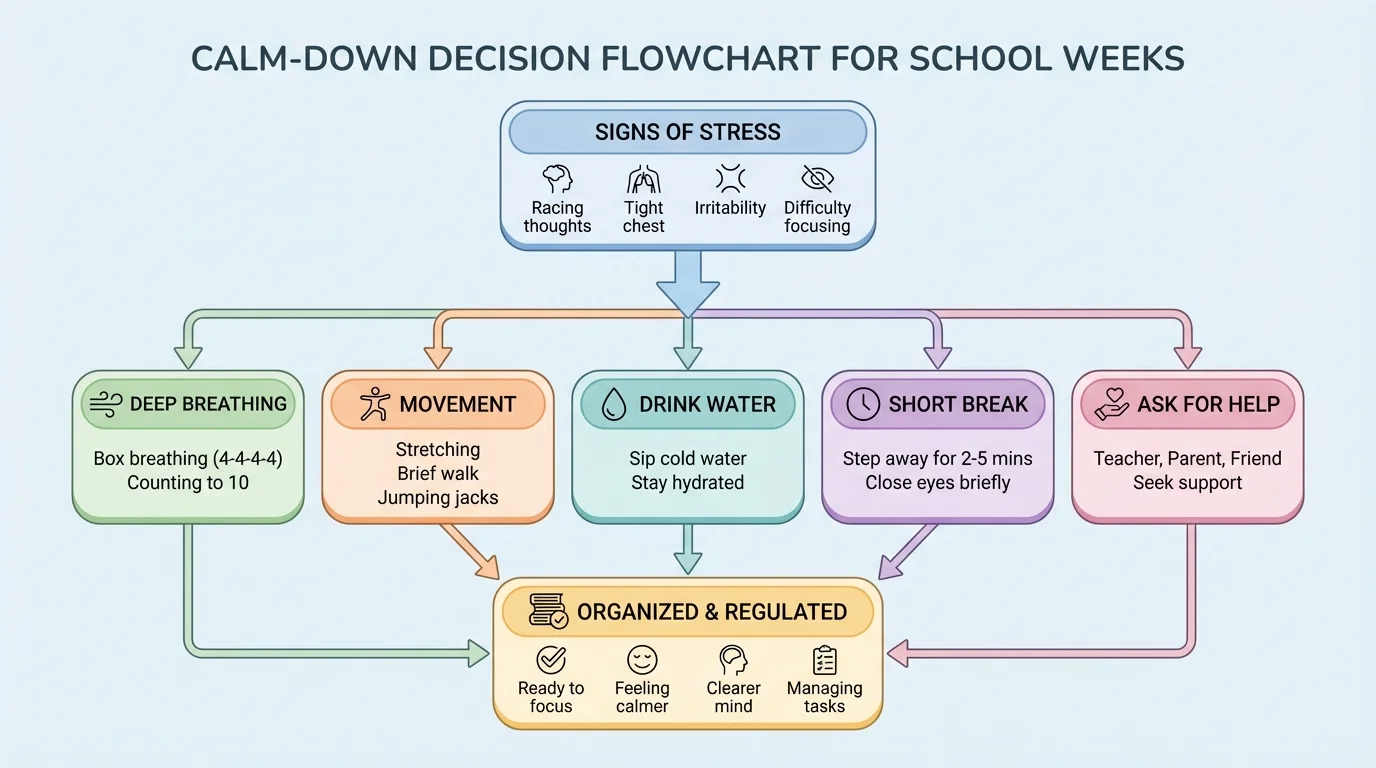
You can also do a quick body check: What am I feeling? Where do I feel it in my body? What would help right now? Sometimes the answer is a break. Sometimes the answer is clearer directions. Sometimes the answer is to start with the easiest part.
Be careful with breaks, though. A break should help you return to your task. If a break turns into scrolling videos for a long time, it is no longer helping. A good break is short, calming, and has an ending.
"You do not have to do everything at once. You only have to do the next right thing."
Later, when you are working through a difficult afternoon, the same calm-down choices in [Figure 3] can help you decide whether you need movement, water, breathing, or support from an adult.
Busy weeks often include surprises. A file may not upload. A class link may not work. A family plan may change. You may feel tired or get a headache. This does not mean your plan failed. It means your plan needs a backup option.
Make an adjustment plan ahead of time. Ask yourself: What will I do if technology stops working? What if I do not finish a task when I hoped? What if I feel too upset to focus?
Your backup plan might look like this:
This is where resilience grows. Resilience does not mean nothing bothers you. It means you know how to recover and continue.
Plans are tools, not rules. If your schedule needs to change, that is not "bad planning." It is real life. The goal is to adjust on purpose instead of giving up completely.
Think back to the weekly overview in [Figure 1]. Seeing your whole week makes it easier to move one task without feeling like everything is ruined.
You do not have to solve every busy week alone. Sometimes the best self-management choice is asking for help early. In online school, this may mean messaging a teacher, telling a parent or caregiver that your schedule is too packed, or asking for help understanding directions.
Clear communication is a life skill. A strong message is polite, honest, and specific. Instead of saying, "I can't do it," you could say, "I'm confused about part 2 of the assignment," or "I had a technology problem and need help making a new plan."
Example: Helpful online messages
Step 1: Name the problem clearly.
"I could not open the science document today."
Step 2: Explain what you already tried.
"I refreshed the page and restarted my device."
Step 3: Ask for the next step.
"Could you tell me another way to access it?"
This kind of message shows responsibility and makes it easier for others to help you.
It is also helpful to check in with an adult at home during extra-busy weeks. A short conversation can help you notice when you need to move a task, take a break, or make a better plan for tomorrow.
Let's look at a realistic example. Maya has online classes each morning, a reading response due Tuesday, a math assignment due Wednesday, a science project due Friday, piano practice on Thursday, and chores every evening. At first, Maya feels stressed because the science project seems huge.
Instead of waiting, Maya makes one weekly chart, like the kind shown in [Figure 1], and writes everything down. Then she breaks the science project into smaller steps: choose topic, find materials, complete experiment, write notes, and upload photos. She notices Wednesday is crowded, so she starts the project on Monday and uses a small buffer block on Thursday in case anything takes longer.
She also makes a simple daily schedule, similar to [Figure 2], with class time, homework, lunch, movement, chores, and a short end-of-day reset. On Tuesday afternoon she starts to feel frustrated because the project photos will not upload. Her shoulders are tense, so she uses the calm-down flow from [Figure 3]: she pauses, drinks water, takes five slow breaths, and asks an adult for help. Because she planned ahead, she still has time to finish.
What happens when students use this kind of plan? They usually miss fewer deadlines, feel less panicked, and recover faster when something changes. What happens when they do not? Small problems pile up, and the week can start to feel much bigger than it really is.
The more often you use these skills, the more natural they become. You start noticing patterns. Maybe you do best on writing tasks in the morning. Maybe you need movement before math. Maybe your busiest day always needs extra buffer time. These patterns help you improve your next plan.
A short weekly review can help. At the end of the week, ask yourself: What helped? What felt too full? When did I get stressed? What strategy worked best? This kind of reflection builds self-management because you are learning how you work best.
You are not trying to become a robot who never feels stressed. You are learning how to notice what is happening, make a plan, adjust when needed, and keep going. That is a powerful skill for school, home, and life.
Try This: Before your next busy week begins, spend 10 minutes making one simple weekly plan, one daily reset routine, and one backup plan for stress or surprises. Keep it small enough that you will actually use it.
