Have you ever been judged before someone really knew you? Maybe someone thought you were unfriendly because you were quiet on a video call, or assumed you were not good at a game because of your age, accent, clothes, or interests. Quick judgments happen fast, but their effects can last a long time. They can shape who gets included, who gets ignored, and who gets treated with respect.
Learning about stereotypes and assumptions is not just about "being nice." It is about making fair choices in real life. When people are treated unfairly, they may feel hurt, left out, angry, or unsafe. When people are treated fairly, trust grows. Friendships get stronger. Teams work better. Communities become more welcoming.
In online school, you meet people through messages, discussion boards, video calls, shared projects, gaming spaces, clubs, sports, religious groups, and neighborhood events. Because you do not always have the full story, it can be easy to guess what someone is like too quickly. That is why this skill matters so much: you can learn to slow down, think clearly, and choose respect.
A stereotype is a fixed idea about a group of people. It happens when someone believes that all people in a group are the same in some way. An assumption is something you believe without checking if it is true. The two ideas are connected, and a stereotype is about a whole group while an assumption can be about one person or situation.
Stereotype means thinking a group of people all share the same traits, even though people are individuals.
Assumption means deciding something is true before you have enough facts.
[Figure 1] Here is a simple way to tell them apart. Saying, "Kids who like science are boring," is a stereotype because it puts a whole group into one box. Saying, "He did not answer my message, so he must be mad at me," is an assumption because it jumps to a conclusion without evidence. Both can be wrong, and both can lead to unfair treatment.
People sometimes make stereotypes and assumptions because the brain likes shortcuts. It tries to sort information quickly. That may feel fast, but fast is not always fair. A shortcut in thinking can cause you to miss the truth about a person.
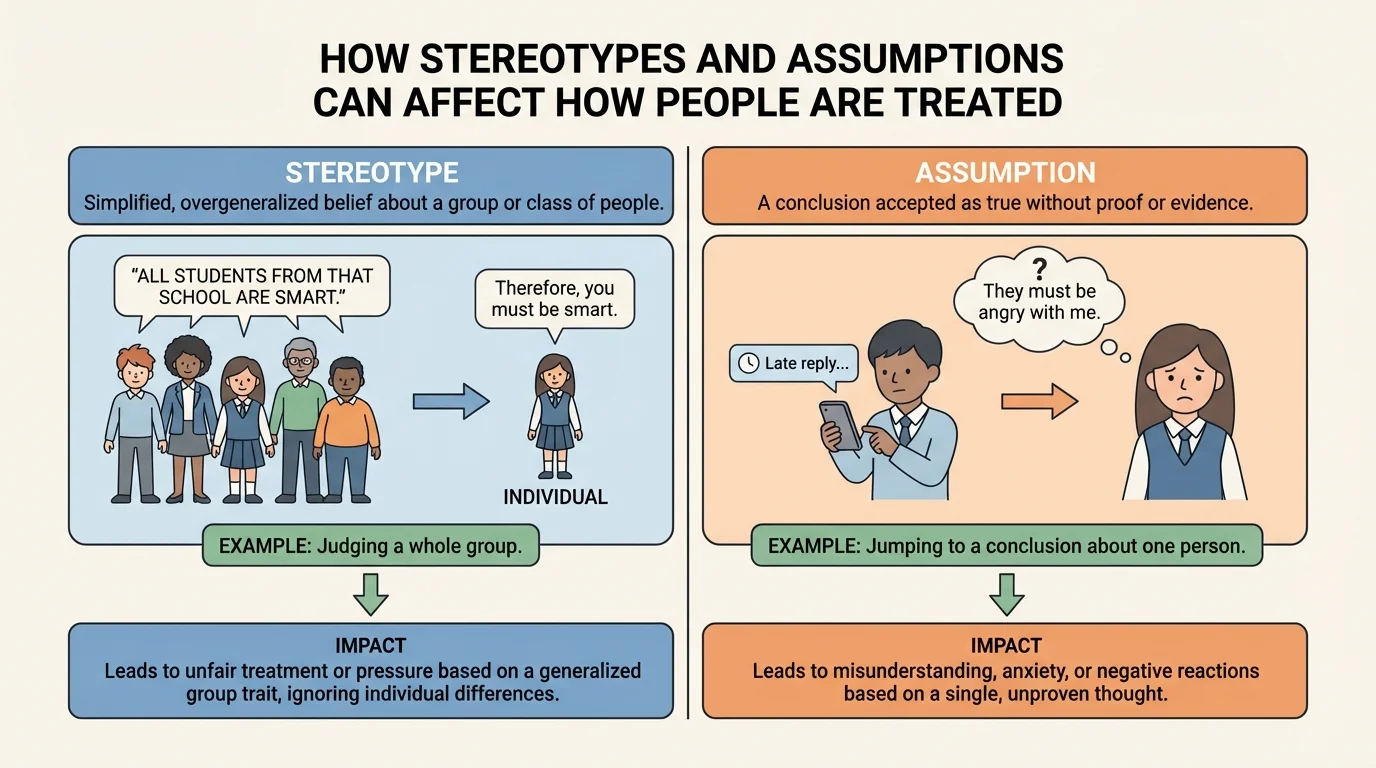
For example, someone might stereotype people from a certain neighborhood as troublemakers. Someone else might assume a new club member is rude because they do not talk much at first. But maybe the person is shy, tired, new to the group, or having internet problems. When you do not check the facts, your first thought may be wrong.
Stereotypes and assumptions can appear in many ordinary situations. They can happen in group chats, online classes, team practices, community centers, stores, parks, and family gatherings. They are not always loud or obvious. Sometimes they show up in small choices, like who gets picked first, who gets interrupted, whose ideas get ignored, or who gets left out of a conversation.
Here are some examples you might notice in real life:
These moments may seem small, but they can build up. If a person keeps getting judged unfairly, they may start to feel like they do not belong. They may stop sharing ideas, stop joining activities, or stop trusting others.
People often remember information that matches what they already believe and miss information that proves them wrong. That is one reason stereotypes can stick around even when they are unfair.
Social media can make this harder. Short videos, jokes, comments, and memes can spread stereotypes quickly. If lots of people laugh at the same unfair idea, it can start to seem normal, even when it is harmful. That is why it is important to ask yourself, "Is this true, fair, and respectful?" before repeating something.
When stereotypes and assumptions guide behavior, people can get treated unfairly. Unfair treatment can be direct, like teasing, excluding, insulting, or blaming. It can also be less obvious, like ignoring someone's idea, talking over them, avoiding them, or expecting less from them.
The effects can be emotional and practical. A person may feel embarrassed, lonely, frustrated, or angry. They may begin to doubt themselves. They might lose chances to make friends, join a team, or show what they can do. In a group, unfair treatment can create arguments, mistrust, and a negative atmosphere.
Why quick judgments are a problem
When you decide who someone is before listening and learning, you stop seeing the real person. You react to your idea of them instead of who they truly are. That makes it harder to be fair, kind, and accurate.
Think about a community soccer team. If the coach assumes a player is not serious because they are quiet, that player may not get many chances. But if the coach learns more, they might find out the player is focused, hardworking, and nervous about speaking up. The wrong assumption changes how that person is treated.
The same thing can happen in online group work. If people assume one classmate is not helping because they have not posted yet, they may complain or leave that person out. Later they may learn the student was helping a family member, having a device issue, or carefully working on their part. A quick judgment can damage trust before the facts are known.
As we saw earlier in [Figure 1], the problem starts when a thought gets treated like a fact. A thought is only a starting point. It is not proof.
The good news is that you can train yourself to catch unfair thoughts before they become unfair actions. A simple process helps you slow down when a snap judgment pops into your mind.
[Figure 2] Step 1: Pause. Do not send the message, make the comment, or decide right away. Even taking one slow breath can help.
Step 2: Name the thought. Ask yourself, "Am I making a stereotype or an assumption?" Saying it clearly in your mind helps you notice it.
Step 3: Look for evidence. Ask, "What facts do I actually have?" and "What facts do I not have?" If you only have a guess, you need more information.
Step 4: Think of other reasons. There is almost always more than one possible explanation. A late reply could mean busy, tired, offline, confused, or distracted—not rude.
Step 5: Choose a respectful response. You can ask a kind question, wait, include the person, or simply avoid making a hurtful comment.
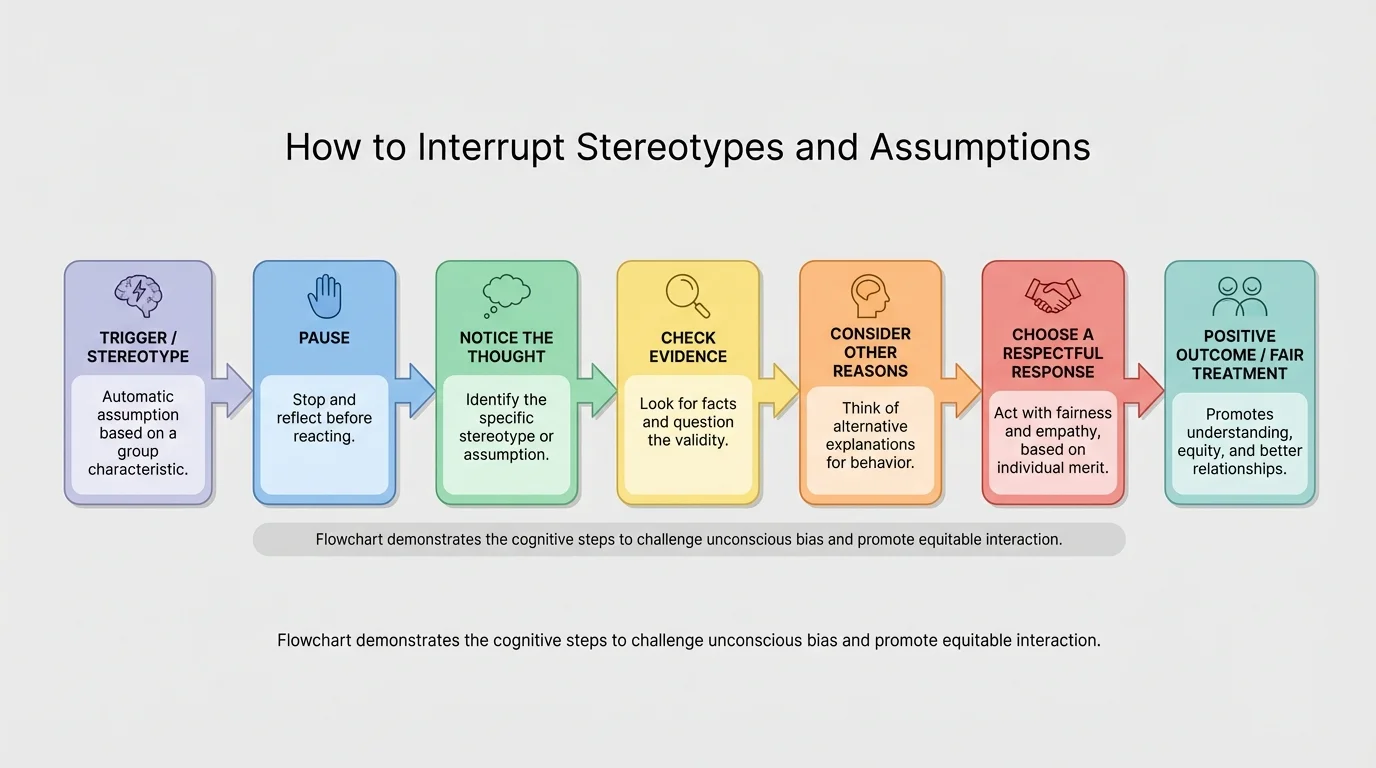
This skill takes practice. Your first thought may be unfair sometimes, because everyone makes quick guesses now and then. What matters most is your response. You can learn to correct yourself.
Real-life check before reacting
You are in a community art club chat. A new member posts only one short comment, and someone says, "She probably does not care."
Step 1: Pause before agreeing.
You do not add a negative comment right away.
Step 2: Check the evidence.
You realize you only know that she posted once. That is not enough information.
Step 3: Consider other reasons.
Maybe she is new, shy, busy, or unsure what to say.
Step 4: Choose respect.
You reply, "Welcome. Want help finding the project details?"
This response keeps the space kind and gives the new person a fair chance.
Try this in daily life: when you notice yourself making a fast judgment, silently say, "That is one possible story, not the whole story." This short sentence can help you stay open-minded.
Fair treatment means giving people respect, listening to them, and not deciding who they are based on a label or quick guess. Everyday actions matter, and fairness in group settings can include inviting people in, taking turns, and responding kindly.
[Figure 3] You can treat people fairly by using these habits:
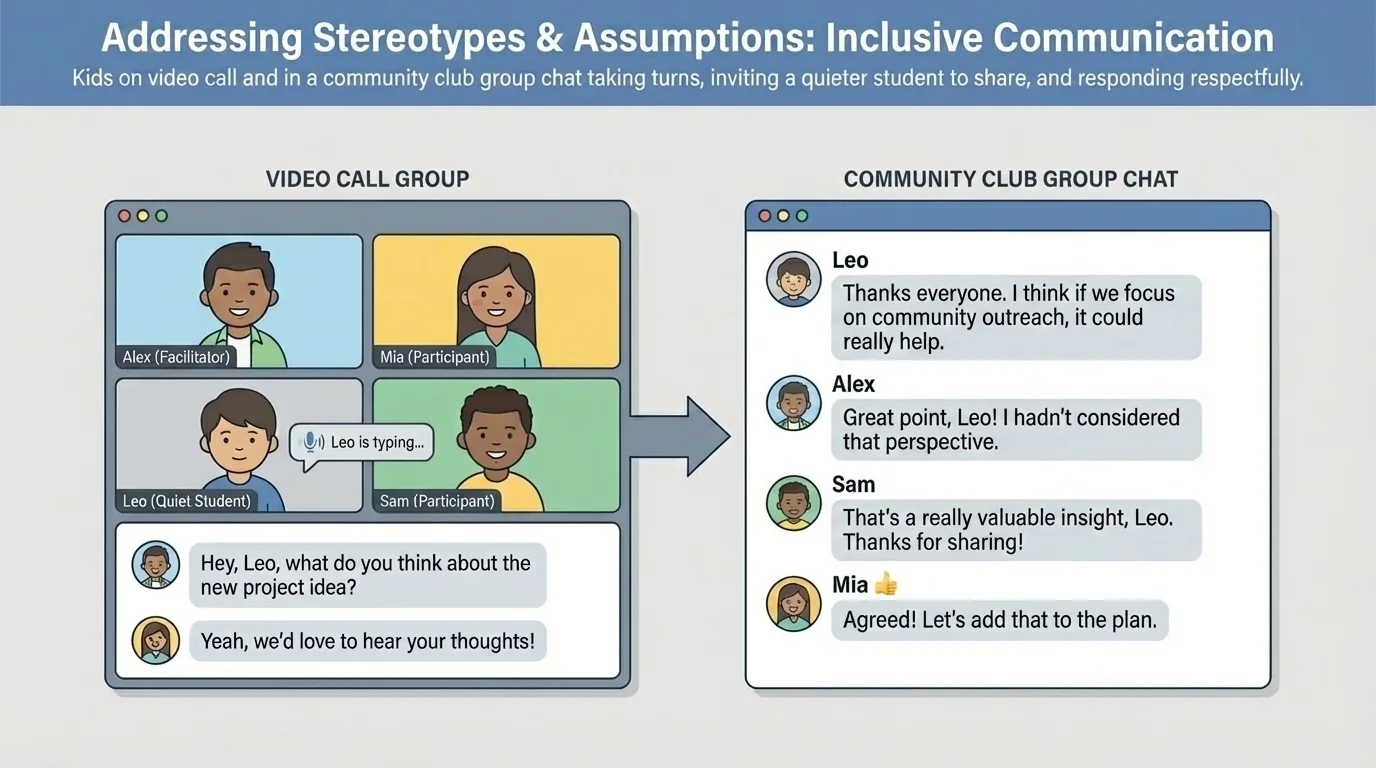
Here is what this can sound like in real life. Instead of saying, "You are bad at this," you might say, "Do you want to practice together?" Instead of thinking, "He is rude," you might say, "I am not sure what happened. I should ask or wait." Instead of laughing at a stereotype, you can stay quiet, change the subject, or say, "That is not fair."
Small respectful choices build a safer community. One welcoming message can help someone feel included. One thoughtful question can stop a misunderstanding. One brave comment can interrupt unfair behavior before it grows.
"Be curious, not quick to judge."
— A useful rule for everyday life
Later, when you think back to the pause process in [Figure 2], you can see that fair treatment is not only about what you avoid doing. It is also about what you choose to do on purpose.
If someone makes a stereotype about you or assumes something hurtful, it can feel upsetting. You might want to hide, argue, or give up. But there are calm, strong ways to handle the situation.
First, remember this: unfair treatment does not define who you are. Someone else's wrong idea is not your identity. Their stereotype or assumption says more about their thinking than about your worth.
You can try these responses when it feels safe:
If the unfair treatment is repeated, threatening, or targeted at someone's identity, getting adult help is especially important. Safety comes first. You do not have to handle serious bias all by yourself.
When someone stereotypes you
A person in an online game says, "Kids your age are always terrible at strategy."
Step 1: Stay calm.
You do not need to insult them back.
Step 2: Name the problem.
You can say, "That is a stereotype. You do not know everyone my age."
Step 3: Protect yourself.
If they continue, mute, block, or leave the game if needed.
Step 4: Get support.
Tell a trusted adult if the behavior continues or becomes threatening.
This protects your dignity and your safety at the same time.
If you see someone else being treated unfairly, you can help too. You might include them, check on them privately, or tell an adult. You do not have to be loud or dramatic to make a difference. Quiet support matters.
Empathy means trying to understand how another person might feel. It does not mean you always know exactly what they are going through. It means you care enough to listen, imagine their point of view, and respond with kindness.
Empathy helps stop unfair treatment
When you pause and wonder, "How would I feel if someone judged me without knowing me?" it becomes easier to choose fair words and actions. Empathy turns respect into a habit.
Communities are stronger when people feel seen and respected. In a club, team, neighborhood group, or online class, people participate more when they believe they will be treated fairly. They share ideas more freely. They help each other more often. They trust the group.
That is why stereotypes and assumptions are not just private thoughts. They affect the whole community. In contrast, inclusive choices like the ones shown in [Figure 3] help everyone feel they belong.
Try this in everyday life: once a day, notice one person you might usually overlook. Send a kind message, invite them into a conversation, or give them time to share. Fairness grows through small repeated actions.
You do not have to be perfect. You just need habits that move you in the right direction. Here are practical ways to keep improving:
Everyone wants to be treated like an individual, not like a stereotype. Everyone wants a fair chance to be understood. When you choose curiosity over quick judgment, you help make your world safer, kinder, and more just.
