One message in a group chat can change everything. A joke can make people laugh, or it can hurt someone. A quick reply can calm a problem, or make it bigger. You can learn skills that help you handle these moments. When you know how to set a limit, apologize honestly, and repair harm, you protect your peace and build stronger relationships.
Friends, teammates, gaming buddies, neighbors, and club members will not always agree with you. Sometimes someone goes too far. Sometimes you might be the one who says or does the wrong thing. That does not mean every relationship is ruined. It means you need tools.
These tools matter most in real life: in a video call where someone keeps interrupting you, in an online game where a player is rude, in a group text where private information gets shared, or in a community activity where someone excludes another person. Knowing what to say can help you stay safe, respectful, and confident.
Boundary means a limit that protects your feelings, space, time, body, privacy, or values. Apology means saying you are sorry in a way that takes responsibility for harm you caused. Repair means taking action to make things better after someone has been hurt or trust has been damaged.
A strong relationship does not mean people never make mistakes. It means people know how to handle mistakes in healthy ways.
A boundary is not a punishment. It is not being mean. It is a clear message about what is okay and what is not okay for you. Boundaries help you protect your energy, privacy, safety, and self-respect.
You might need a boundary if someone keeps spamming you with messages, pressures you to turn your camera on during a call, shares your secret, borrows your things without asking, teases you in a way that feels bad, or keeps asking after you already said no.
In healthy friendships, people can hear a boundary without turning it into a huge fight. They may feel disappointed, but they still respect your limit.
Boundaries and respect work together. When you set a boundary, you are saying, "This is how I want to be treated." When you respect someone else's boundary, you are showing that their feelings and choices matter. Both parts are important. A friendship is healthier when both people can speak up and listen.
It also helps to know that different people have different limits. One person may be fine with joking around during a game, while another wants a calmer tone. One person may enjoy texting a lot, while another needs quiet time. Different does not mean wrong.
Your body and feelings often give you clues. If you feel tense, annoyed, embarrassed, pressured, worried, or tired after talking with someone, that can be a sign that something needs to change.
Watch for patterns like these:
Sometimes the clue is small at first. Maybe you notice that every video chat with a certain person leaves you upset. Maybe a friend keeps using a nickname you do not like. You do not have to wait until a problem becomes huge before speaking up.
Your first boundary does not have to sound perfect. Clear and calm is usually better than long and complicated. A short sentence often works best.
If a situation feels unsafe, very threatening, or too big to handle alone, the goal is not to give a perfect boundary speech. The goal is to protect yourself and get help from a trusted adult.
Setting a boundary works best when you are calm, direct, and specific. You do not need to give a long speech or a giant explanation. You are telling the other person what needs to change.
Step 1: Name the behavior. Say exactly what is bothering you. Step 2: State your limit. Explain what you do or do not want. Step 3: Say what you will do next if needed. This is called a consequence, which means the action you will take to protect yourself if the behavior continues.
Here are clear examples:
Notice what these examples do well. They are short. They name the problem. They avoid insults. They tell the other person what needs to happen next.
"I" statements can help. An "I" statement focuses on your feeling and need instead of attacking the other person. For example: "I feel uncomfortable when you read my messages out loud. Please stop." This can lower the chance of the other person getting defensive.
Example: Setting a boundary in a group chat
A friend keeps posting embarrassing stories about you in a shared chat.
Step 1: Name the behavior
"You've posted private stories about me in the group chat."
Step 2: State the limit
"I want you to stop sharing private things about me."
Step 3: Say what you will do
"If it keeps happening, I will leave the chat and tell an adult."
This response is respectful, clear, and protective.
You are not responsible for making other people like your boundary. You are responsible for saying it clearly and protecting yourself if it is ignored.
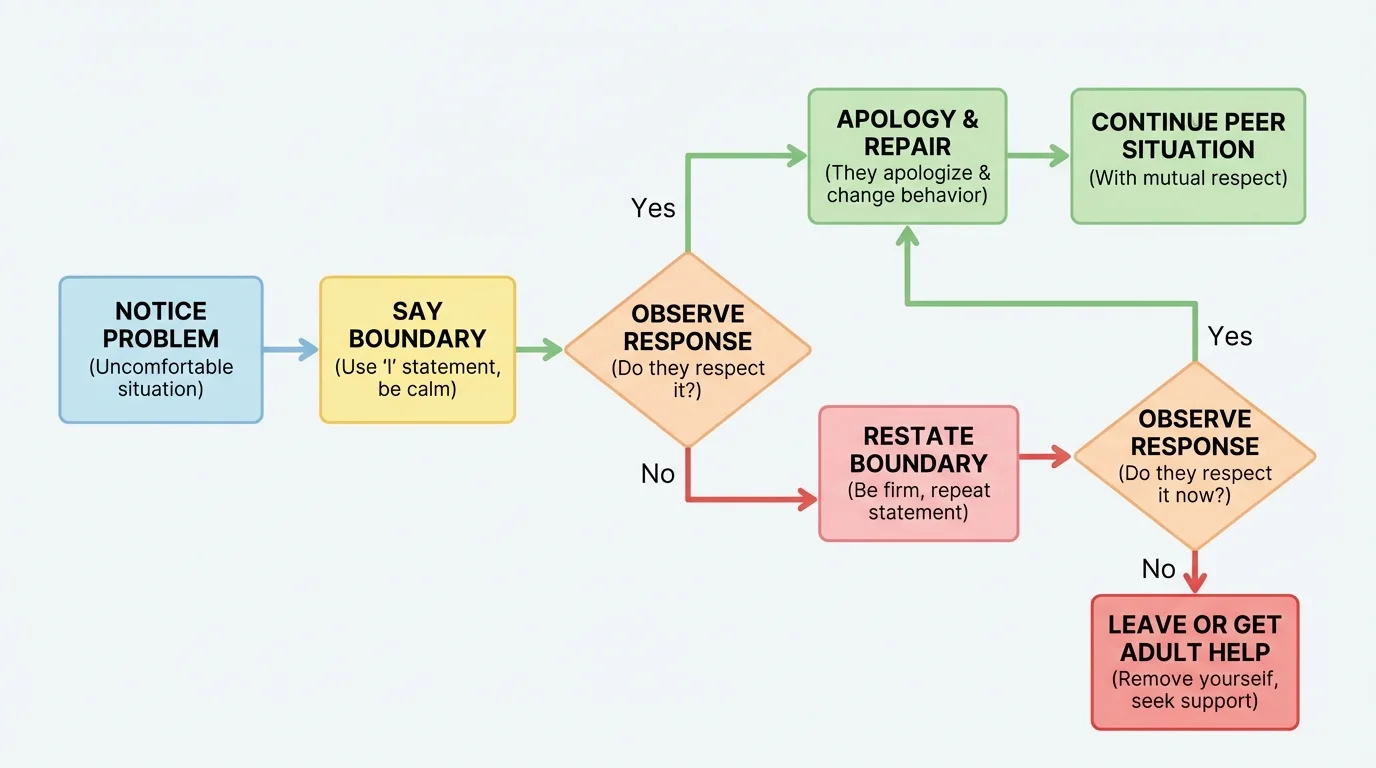
Sometimes one clear statement solves the problem. Other times, the other person laughs, argues, blames you, or keeps doing the same thing. If that happens, you may need to repeat yourself once and then act.
You can use this pattern: restate, reduce contact, reach out. Restate the boundary. Reduce contact by muting, leaving, blocking, or stepping away. Reach out to a trusted adult if the behavior is repeated, threatening, or unsafe.
For online situations, it can help to save screenshots or messages if there is bullying, threats, or repeated harassment. You are not "causing drama" by keeping evidence. You are protecting yourself.
As the process in [Figure 1] illustrates, a boundary is not just words. It also includes what you do next. If someone repeatedly ignores your limit, distance can be the healthiest choice.
If a peer situation includes threats, blackmail, sexual messages, hate speech, or pressure to keep dangerous secrets, skip the back-and-forth and tell a trusted adult right away.
It is also okay if you need time before responding. You do not have to answer every message right away, especially when you are upset.
A real apology is more than saying "sorry." It includes responsibility, empathy, and change. If you hurt someone, the goal is not to escape trouble fast. The goal is to show you understand the harm and want to make things better.
A strong apology usually has five parts:
Weak apologies often sound like this: "Sorry you got upset." "I was joking." "Everyone else was doing it." "I already said sorry, so can we move on?" These do not fully accept responsibility. They shift the blame or rush the other person.
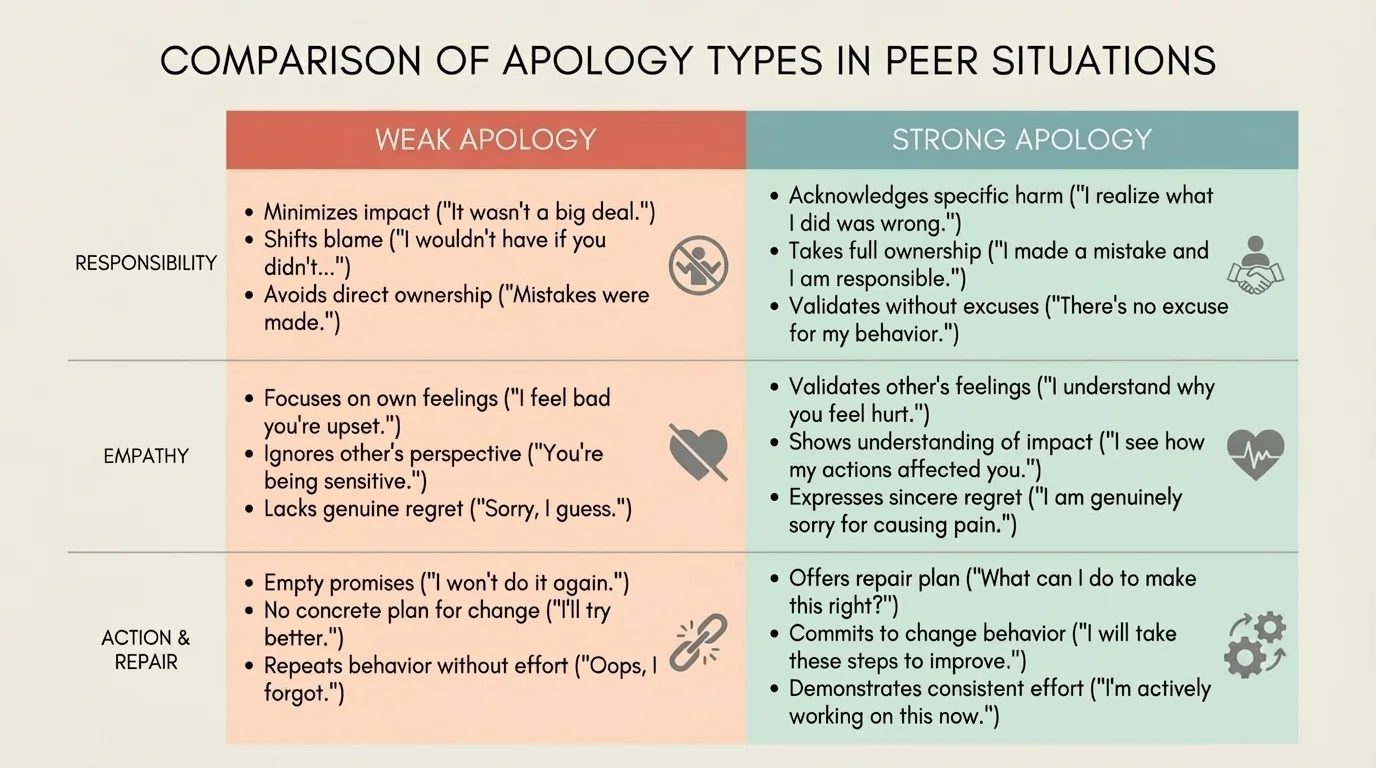
Try to avoid the word but in the middle of an apology. "I'm sorry, but you were being annoying" is not really an apology. The word but often erases what came before it.
A sincere apology does not force the other person to forgive you right away. They may need time. They may still feel hurt. You can apologize honestly without controlling their response.
Example: Turning a weak apology into a strong one
Weak version: "Sorry if you felt bad when I kicked you out of the game."
Step 1: Name the action clearly
"I kicked you out of the game on purpose."
Step 2: Take responsibility
"That was unfair and rude."
Step 3: Show empathy
"I can see why that made you feel left out."
Step 4: Repair and change
"I'm sorry. If you want, you can rejoin next time, and I won't do that again."
The second version shows honesty, care, and a plan to change.
When you apologize, keep your voice and words calm. Do not make the other person comfort you. If you say, "I feel like the worst person ever," the focus shifts away from the person you hurt.
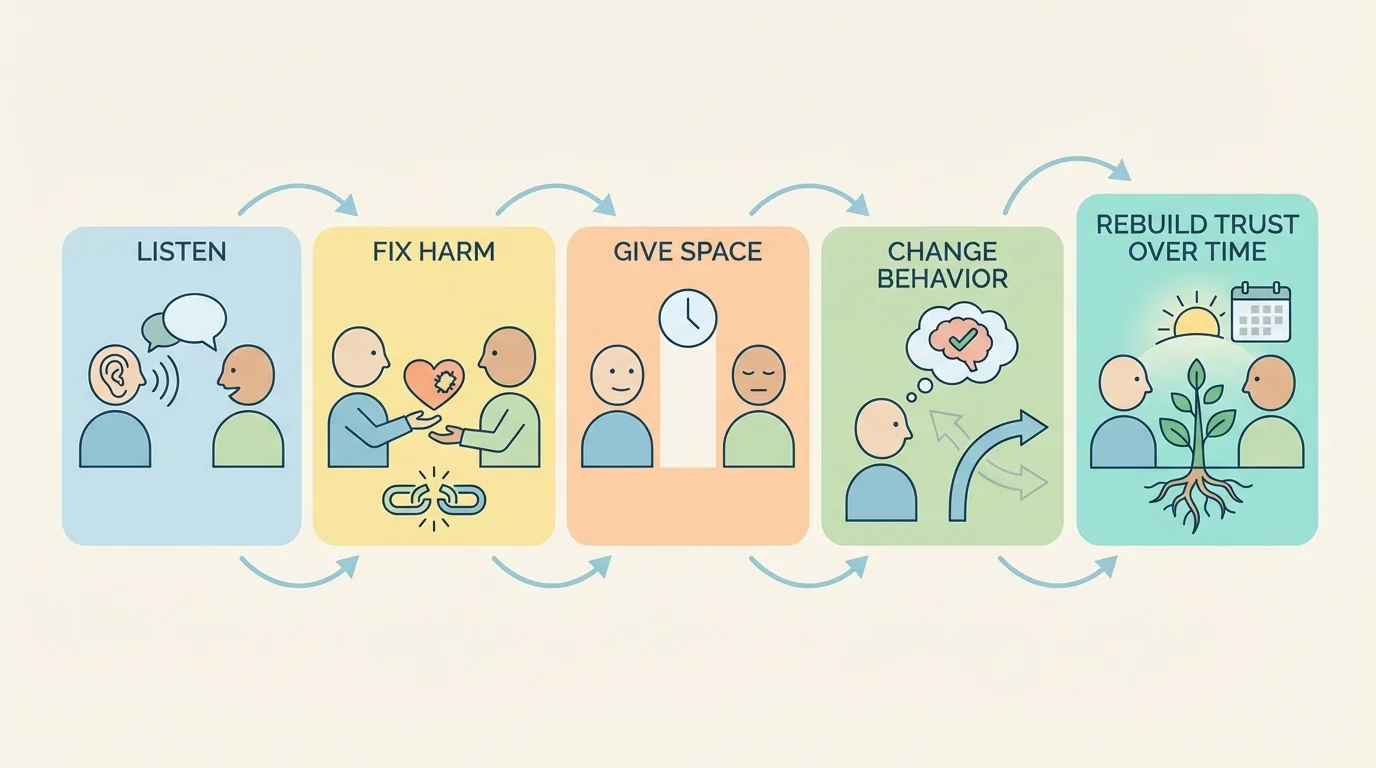
Repair means the actions that help fix a relationship after harm. It is not magic and it is not instant. It happens step by step, with trust rebuilding through repeated respectful choices.
Repair might include listening without interrupting, returning something you took, deleting a hurtful post, correcting a rumor, replacing a broken item, giving someone space, or changing your behavior over time. Words matter, but actions matter too.
Sometimes repair is small and quick. If you interrupted a friend several times on a video call, repair might mean apologizing and making sure they get to finish next time. Sometimes repair is bigger. If you spread private information, trust may take much longer to rebuild.
As the staircase in [Figure 3] illustrates, trust usually comes back slowly, not all at once. Someone may accept your apology but still need time before they fully trust you again.
Repair is about changed behavior. If someone says sorry but keeps repeating the same harmful behavior, repair is not really happening. Real repair includes a different pattern over time.
It is also important to know that repair does not always mean the friendship goes back to exactly how it was before. Sometimes the relationship becomes healthier. Sometimes it becomes more distant. Sometimes ending the friendship is the safest choice.
Let's look at a few practical situations you might actually face.
Situation 1: A friend keeps calling late at night. You need sleep, but they say you are being rude if you do not answer. A boundary might sound like this: "I don't take calls after bedtime. I can talk tomorrow." If they keep pushing, reduce contact at night.
Situation 2: Someone shares a screenshot of your private message. You can say: "That message was private. Delete the screenshot and don't share my messages again." If they refuse, save evidence and tell an adult.
Situation 3: You laughed when others teased someone on a video call. Even if you were not the main person teasing, you still added to the harm. An apology might be: "I laughed when they were making fun of you. That was wrong, and I'm sorry. I should have stopped or stayed quiet." Repair could include checking on the person and not joining in next time.
Situation 4: A teammate in a community sports group never passes the ball to you and mocks you in messages later. A boundary might be: "Do not send me insulting messages. If it happens again, I'm showing an adult." If you were the one sending the messages, repair includes deleting them, apologizing, and changing how you communicate.
Situation 5: You accidentally leave someone out of a gaming group. If it was truly an accident, still own the impact: "I realized I left you out of the invite. I'm sorry. I can see how that hurt. Next time I'll check the list more carefully."
"Clear is kind."
— A useful reminder for hard conversations
Being clear is kind because it helps people know where they stand. Hinting, avoiding, or saying the opposite of what you mean often creates more confusion.
You do not need fancy words. You need useful ones. Here are sentence starters you can adapt.
| Purpose | Sentence starter |
|---|---|
| Set a boundary | "I'm not okay with ___." |
| Ask for change | "Please stop ___." |
| Protect time | "I can talk later, not right now." |
| Protect privacy | "Don't share that without asking me." |
| Restate a boundary | "I already said no." |
| Apologize | "I was wrong when I ___." |
| Show empathy | "I understand that it hurt you because ___." |
| Repair | "Here is what I'm doing to make it right: ___." |
Table 1. Useful sentence starters for boundaries, apologies, and repair.
If speaking feels too hard, writing can help. A short text or message can work if it is respectful and clear. But for bigger problems, a live conversation with a trusted adult nearby may be better.
Hard peer moments can make your heart race. You may worry that speaking up will make someone mad, or that apologizing will feel embarrassing. That is normal. Courage does not mean feeling relaxed. It means doing the healthy thing even when it feels uncomfortable.
Keep these reminders close: you are allowed to protect your peace, other people are allowed to have feelings about your boundary, saying sorry does not erase harm instantly, and trust grows through actions. If a relationship becomes unsafe, cruel, or exhausting, it is okay to step back.
Good communication is not about winning. It is about being honest, respectful, and responsible. Those are life skills you can use with friends, teammates, family members, and someday with coworkers too.
