A surprising thing about communication is that people often remember how you said something even more than the exact words. A short message like "Fine" can sound calm, annoyed, hurt, or unsafe depending on the style behind it. In online school, group chats, games, video calls, family conversations, and community activities, your communication style can help people feel safe and included—or confused, left out, and blamed.
Communication is not just about talking. It includes texting, typing in chats, commenting online, using your voice in a video call, and even choosing when to stay silent and get help. Learning to analyze communication style means noticing the tone, the word choices, the timing, and the effect on other people. That matters because your style can change three big things: safety, belonging, and accountability.
Communication style is the way a person expresses a message. It includes tone, word choice, timing, volume, facial expression, and body language on video. It also includes digital choices such as punctuation, all caps, repeated messages, and whether the message is clear or confusing.
Safety means feeling protected from harm, threats, bullying, or pressure. Belonging means feeling accepted, included, and valued. Accountability means taking responsibility for your actions, words, and mistakes.
These three ideas connect. If people communicate in ways that feel threatening or disrespectful, safety goes down. If they ignore, mock, or shut others out, belonging goes down. If they blame others and refuse to own mistakes, accountability goes down. Strong communication helps all three grow at the same time.
Think about these two messages: "You never listen. Whatever." and "I feel ignored when I'm interrupted. Can I finish my thought?" Both messages are about not feeling heard. But they do not have the same effect. The first one pushes people away and can start a fight. The second one gives clear information and makes problem-solving more likely.
That is why analyzing style is so useful. You are not only asking, "What is the message?" You are also asking, "What does this message do?" Does it calm things down? Does it make someone feel small? Does it show respect? Does it hide the real problem? Does it make it easier to fix what went wrong?
When you understand communication style, you become better at protecting yourself, treating others fairly, and speaking up in ways that work.
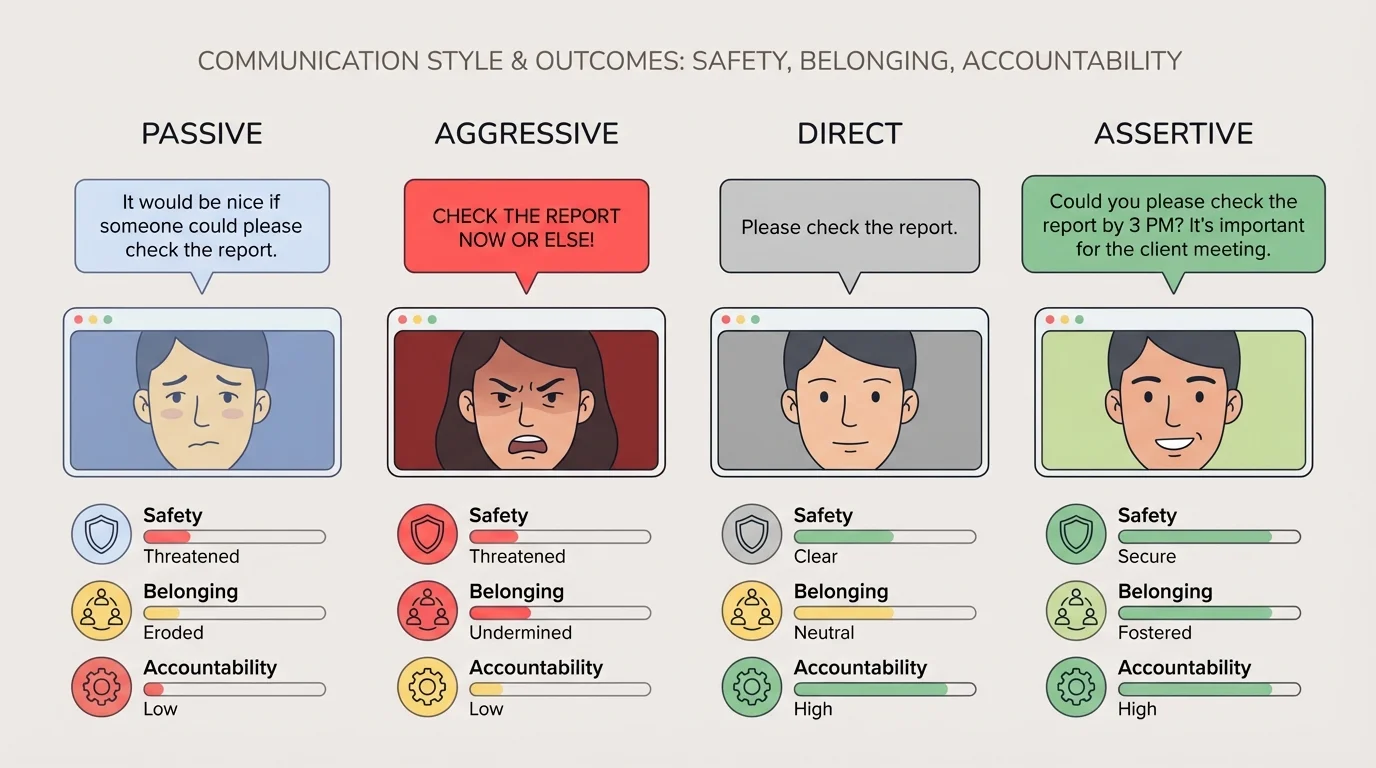
The same idea can sound very different depending on style, as [Figure 1] shows. For example, if you want a teammate in an online club project to respond, you might write, "Are you there???" or "Please answer me now," or "Hi, I'm checking in because we need your part by tonight. Can you reply by 7 p.m.?" Each version sends a different feeling.
Tone is the feeling carried by your words or voice. Tone can be friendly, annoyed, rude, calm, respectful, sarcastic, nervous, or confident. In typed messages, people often guess tone from punctuation, capital letters, repeated texts, and word choice. For example, "OK." can feel very different from "Okay, thanks!"
Word choice matters too. Saying "You messed everything up" attacks a person. Saying "This file is missing the last part" describes the problem. One creates shame. The other creates a chance to fix things.
Timing is part of style. Sending five angry messages in a row late at night feels very different from sending one calm message at a reasonable time. In a video call, facial expression, eye contact, and whether you interrupt also affect how your message lands.
Style does not mean pretending to be cheerful all the time. You are allowed to be upset, disappointed, or frustrated. The goal is to express yourself in a way that is honest and respectful.
Short digital messages are often misunderstood because the reader cannot hear your voice. That is one reason it helps to reread an important message before you send it.
Later, when you compare different styles, you can return to [Figure 1] and notice that the basic goal stays the same while the effects change a lot.
[Figure 2] Communication affects safety in many ways, and good judgment about style is part of protecting yourself. A message can feel unsafe if it includes threats, pressure, secrets that should not be secret, insults, repeated demands, or attempts to make you afraid. In these moments, style matters because calm, clear choices help you think better.
Safety includes emotional safety. Emotional safety means you can speak without being mocked, shouted at, or humiliated. If a group chat laughs at people for asking questions, members may stop speaking up. That can lead to mistakes, loneliness, and hidden problems.
Safety also includes digital safety. If someone messages, "Don't tell your parent," "Send me this now," or "If you don't answer, I'll expose you," the safest response is usually not to argue. Pause. Save the message if needed. Block or report if possible. Tell a trusted adult. Clear communication includes knowing when a conversation is not healthy to continue.
One helpful rule is: if a message creates panic, pressure, or fear, do not rush your reply. Fast reactions can make unsafe situations worse. Slowing down gives your brain time to notice what is happening.
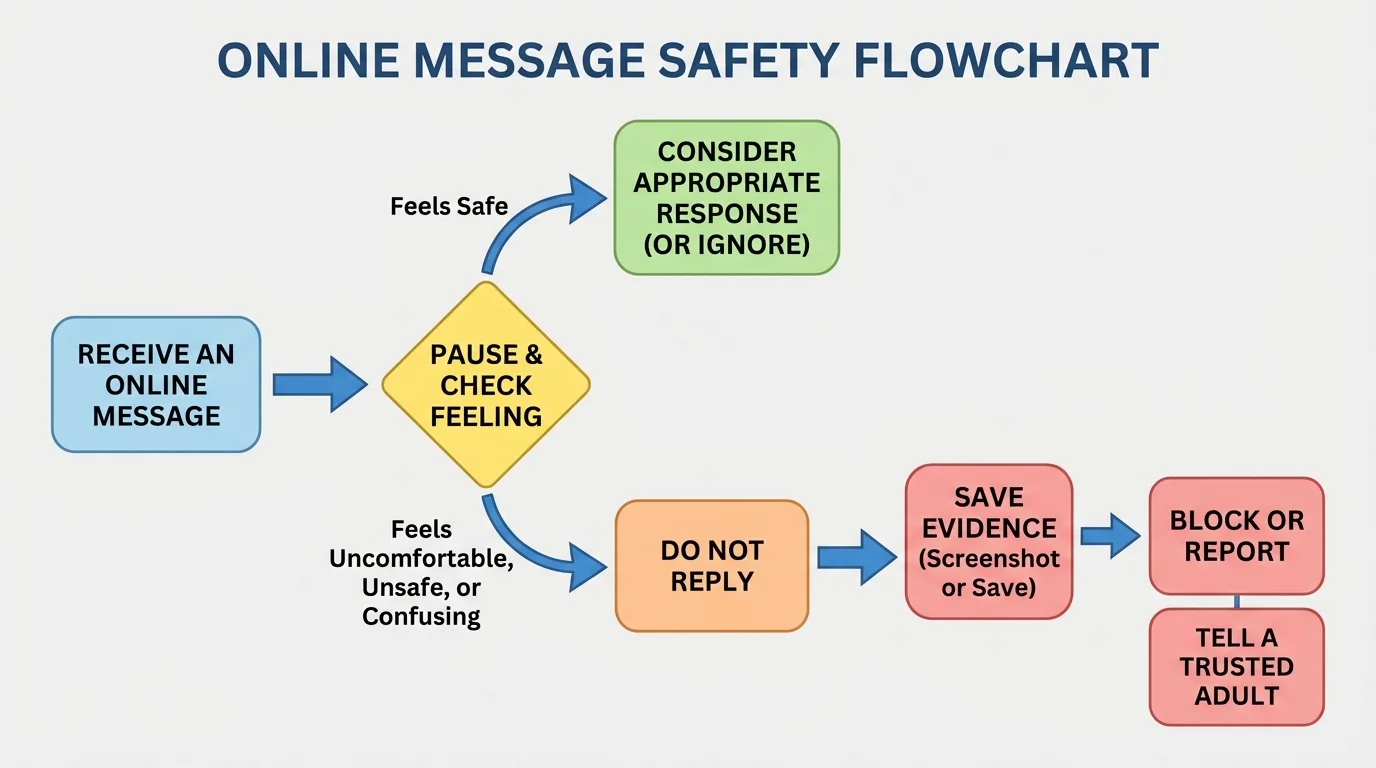
If you need help, use direct language. Instead of hinting, try saying, "I got a message that made me feel unsafe. I need you to look at it with me." This is especially important when someone is threatening, bullying, or asking for private information.
Communication can also prevent accidents and misunderstandings. If you are joining an online meetup for a club, game event, or community activity outside school, clear questions help keep you safe: "Who will be there?" "What time does it start and end?" "Is a parent or trusted adult informed?" Safety often grows when communication is specific, not vague.
Safe communication is not always nice communication. Sometimes the safest style is firm. You may need to say, "No." "Stop messaging me." "I am telling an adult." A respectful tone is good when possible, but your first job is staying safe.
That idea connects back to [Figure 2]: a smart response is not always a long response. Sometimes it is a pause, a screenshot, and getting help.
People feel like they belong when communication says, "You matter here." That message can be spoken directly, but it can also be shown in small habits: greeting people, listening fully, using their correct name, inviting someone into a conversation, and replying kindly instead of ignoring them.
Belonging matters in online classes, gaming groups, neighborhood teams, clubs, and family life. If one person always gets interrupted on a video call, or if a chat leaves someone out on purpose, that person may start to feel invisible. Communication style can either open the door or close it.
A welcoming style sounds like this: "I want to hear your idea." "Thanks for sharing." "I disagree, but I see your point." "Do you want to join our group call?" These messages lower stress and help people trust the group.
An excluding style sounds like this: "That's dumb." "Nobody asked you." "We already have enough people." "You're too slow." Even if said as a joke, those messages can make belonging disappear quickly.
Belonging does not mean everyone agrees all the time. Healthy groups can disagree. The key is whether the style stays respectful. You can say, "I don't think that plan will work because we only have one day left," without attacking the person who suggested it.
Real-life example: making space in a group chat
A student notices that one person in a shared activity chat keeps getting ignored.
Step 1: Notice the pattern
The student sees that others answer each other but skip over one person's messages.
Step 2: Use inclusive communication
The student writes, "I think Maya had an idea a few messages up. Maya, do you want to say more?"
Step 3: Keep the tone respectful
The student does not shame the group. The message invites better behavior without starting a fight.
This style supports belonging because it helps someone feel seen.
When you want others to feel they belong, ask yourself: "Will my words help this person feel respected, or embarrassed?" That question is simple, but it can change a whole conversation.
Accountability means owning what you say and do. In communication, that means being honest, correcting mistakes, apologizing when needed, and trying to repair harm instead of hiding from it.
Sometimes people use communication to avoid accountability. They say, "It was just a joke," "You're too sensitive," "Everyone else was doing it," or "I only said that because you made me mad." These statements push responsibility away.
Accountability sounds different. It sounds like: "I interrupted you." "I posted that without checking." "I hurt your feelings." "I was wrong." "I will fix it." Those are not always easy words to say, but they build trust.
A good apology has three parts. First, name what happened. Second, show that you understand the effect. Third, say what you will do next time. For example: "I shared your photo without asking. That was not respectful. I deleted it, and next time I will ask first."
"Being responsible is not about being perfect. It is about telling the truth about your choices."
Accountability also matters when giving feedback. If you blame a person instead of describing the problem, they may become defensive and stop listening. Compare these two responses to a teammate who forgot their part: "You always ruin everything," and "We're missing your slide, and the deadline is tonight. Can you finish it by 8 p.m., or should we make a new plan?" The second message is clearer and more useful.
Owning your words also means correcting online mistakes. If you post something mean, spreading it further with excuses only makes the problem bigger. A better choice is to remove it, apologize directly, and change your behavior.
It helps to compare styles side by side, as [Figure 3] shows. Four common styles are passive, aggressive, direct, and assertive. These are not labels for a person forever. They are patterns a person might use in different moments.
| Style | What it sounds like | Likely effect |
|---|---|---|
| Passive | Very quiet, unclear, or avoids saying what is needed | Problems stay hidden; needs may not be met |
| Aggressive | Blaming, threatening, insulting, or controlling | People feel unsafe or defensive |
| Direct | Clear and simple; focused on the message | Helps others understand the issue |
| Assertive | Clear, respectful, and honest about needs or limits | Supports safety, belonging, and accountability |
Table 1. A comparison of common communication styles and their likely effects.
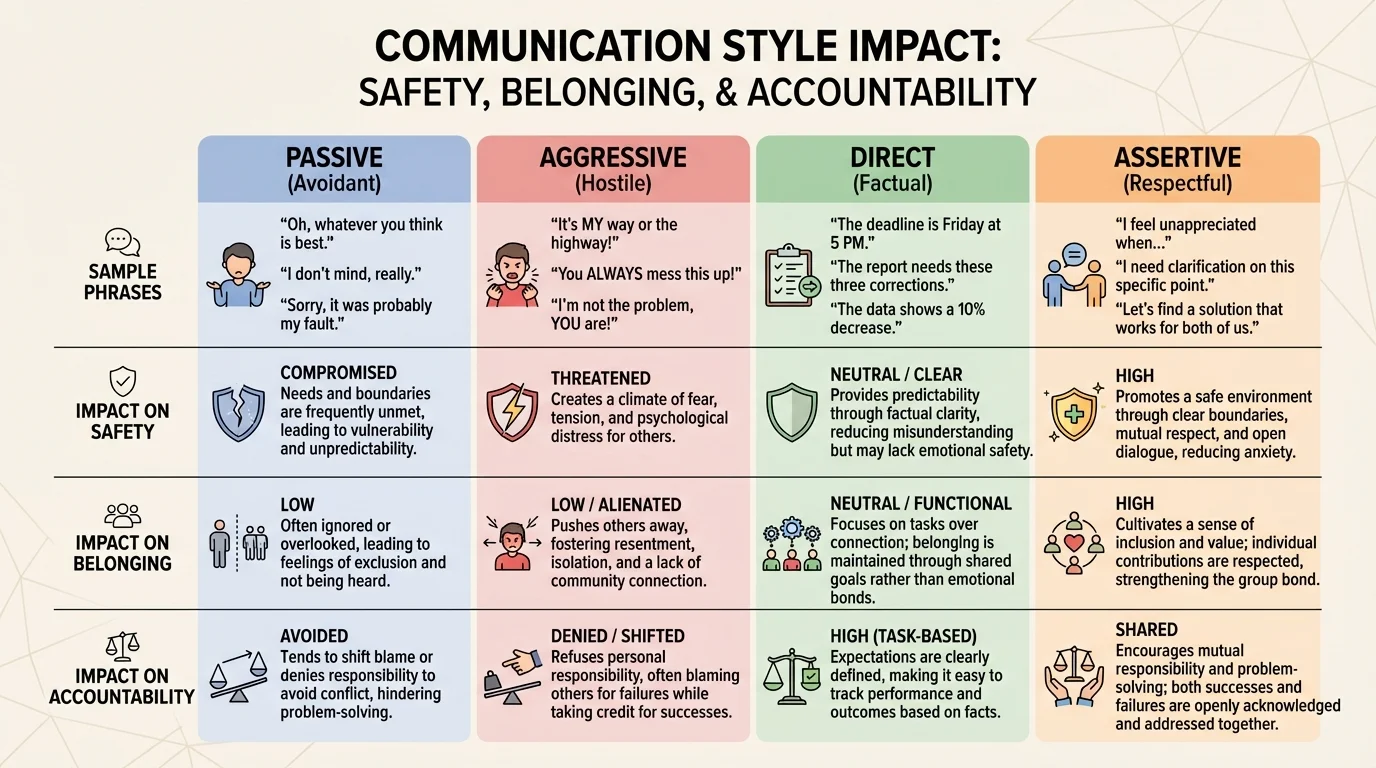
Passive communication may sound like, "It's okay, never mind," when the person is actually upset. This style can make problems harder to solve because other people do not know what is wrong.
Aggressive communication may sound like, "Do it now or else," or "You're useless." This style can scare people, damage trust, and create unsafe situations.
Direct communication is clear. It may sound like, "The link is broken," or "I need the file today." Directness is useful, but if it lacks warmth, it can sometimes feel cold.
Assertive communication is often the strongest choice. It is clear like direct communication, but it also respects people. It may sound like, "I need a turn to speak," "Please stop joking about that," or "I can help after dinner, not right now."
If you look again at [Figure 3], you can see why assertive language is so powerful: it protects your needs without attacking someone else.
You already know that actions have consequences. Communication style is one of those actions. Words are choices, and choices shape relationships.
[Figure 4] When emotions are big, it helps to follow a simple process instead of replying instantly. A step-by-step method makes better choices more likely and lays out a useful path you can follow before you speak, post, or send.
Step 1: Stop. If you feel angry, embarrassed, or panicked, pause for a moment. Even waiting 30 seconds can help you avoid a message you regret.
Step 2: Name your goal. Ask, "What do I want to happen?" Do you want help? Do you want someone to stop? Do you want to solve a problem? Do you want to repair trust?
Step 3: Choose respectful, clear words. Try using "I" statements when possible: "I feel left out when the plan changes and no one tells me." This is usually more helpful than "You never tell me anything."
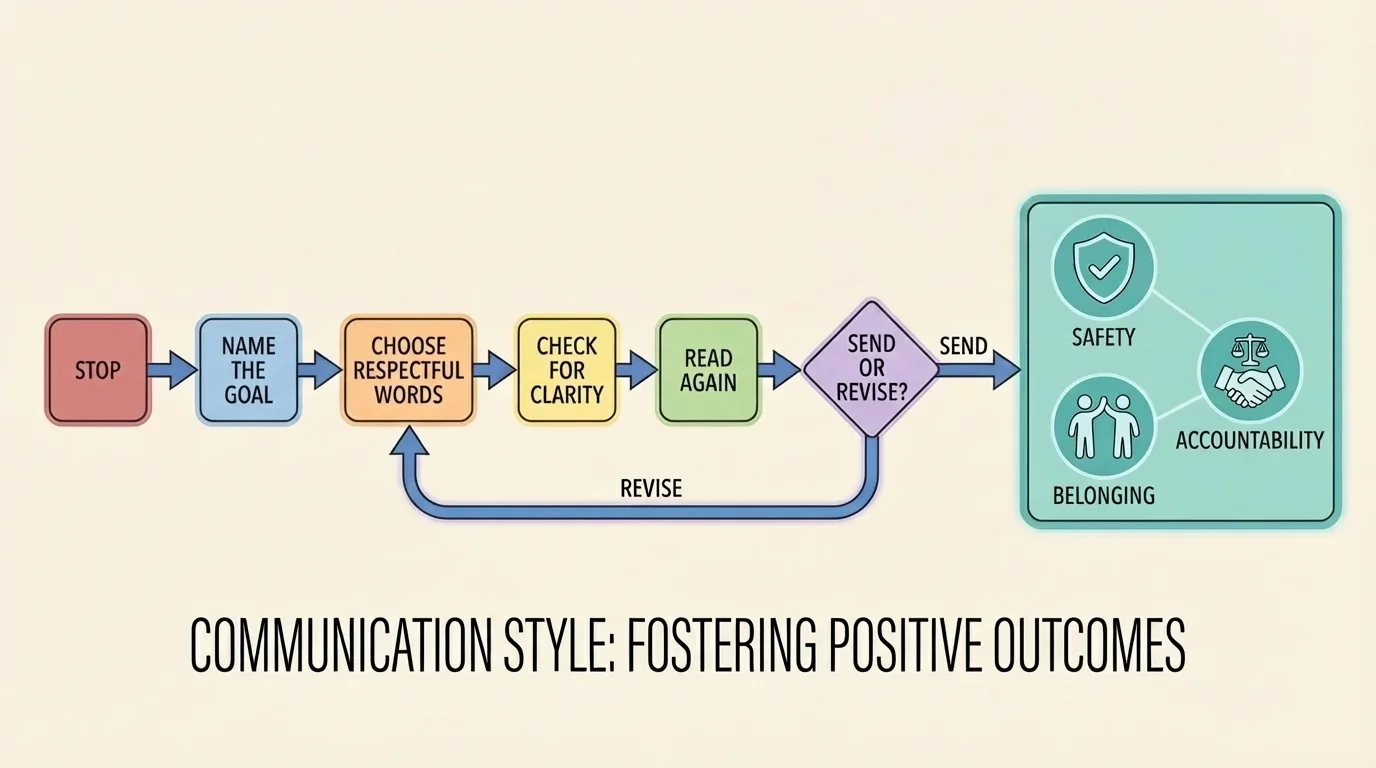
Step 4: Check for blame, sarcasm, or vagueness. Ask yourself, "Could this sound mean, threatening, or confusing?" If yes, revise it.
Step 5: Read it one more time before sending. In digital communication, rereading is like checking your work before turning it in.
Step 6: Decide whether to send, wait, or get help. Not every message should be sent right away. Some should be discussed with a trusted adult first.
Changing a weak response into a stronger one
Suppose a friend in an online activity keeps making fun of your idea.
Step 1: First response that might come to mind
"You're so annoying. Shut up."
Step 2: Notice the problem
This response is aggressive. It may increase conflict and make the group feel unsafe.
Step 3: Rewrite it assertively
"Please stop making jokes about my idea. If you disagree, say it respectfully."
The second version is stronger because it sets a clear boundary without insulting the other person.
Later, when you are deciding whether to send a message, you can return to [Figure 4] and mentally walk through the steps again.
Scenario 1: Online class discussion. A student types, "That answer makes no sense." The content may be about disagreement, but the style is dismissive. A better version is, "I understood it differently. Can you explain how you got that answer?" The second style protects belonging while still allowing disagreement.
Scenario 2: Gaming chat. Someone starts blaming one player for every mistake. The group becomes tense. A more accountable response is, "We all missed some things that round. Let's call out the plan sooner next time." That shifts the conversation from blame to problem-solving.
Scenario 3: At home. You are upset because someone used your things without asking. Aggressive style: "Stay out of my stuff!" Assertive style: "I don't like my things being used without permission. Please ask first." The assertive version gives a clear limit and makes repair easier.
Scenario 4: Community activity. An organizer sends unclear directions, and people show up at the wrong time. Blaming style: "You messed this up." Accountable style: "The message was confusing, and several people misunderstood. Can we send one corrected update with the time in bold?" That response focuses on fixing the problem.
Strong communication is not about winning. It is about making the next right move. Sometimes that means speaking up. Sometimes it means listening. Sometimes it means apologizing. Sometimes it means getting adult help right away.
In each scenario, the style changes the result. A conversation can become safer, more welcoming, and more honest when the communication is clear and respectful.
Some situations are too serious to handle alone. If communication includes threats, bullying, pressure to keep unsafe secrets, requests for personal information, sexual messages, hate speech, stalking, or repeated harassment, tell a trusted adult right away.
You do not need to solve every problem by yourself. In fact, part of good judgment is knowing when a problem is bigger than peer-to-peer communication. If someone is in danger, if you are scared, or if the problem keeps repeating, adult support is the right next step.
You can use simple, direct words: "I need help with something serious." "Someone keeps sending me upsetting messages." "I tried to set a boundary, but it did not stop." Being clear helps adults understand the urgency.
Analyzing communication style helps you notice what is happening beneath the words. It helps you ask better questions: Is this respectful? Is it safe? Is it honest? Does it include people? Does it take responsibility? Those questions can guide you in almost every part of life.
