Have you ever been completely sure about something, and then found out later that you were missing an important fact? That happens to everyone. A decision can feel right in the moment and still turn out badly if your thinking gets pushed by feelings, guesses, or incomplete information. Learning how to spot these problems is a real-life skill that helps you stay safe, fair, and smart.
Every day, you make choices. You decide whether to trust a video, whether to spend your money, whether to believe a message, whether to join an activity, or whether to react quickly when something seems unfair. Some decisions are small. Some matter a lot. When you understand how thinking can get off track, you become better at solving problems and making choices you can feel good about later.
A decision is a choice you make after thinking about what to do. Good decisions usually come from looking at facts, thinking calmly, and checking whether you know enough. Poor decisions often happen when you rush, trust only one side, or let a strong feeling take over.
Sometimes the problem is not that you are careless. Sometimes your brain is trying to take shortcuts. Shortcuts can be helpful when you need to act fast, but they can also cause mistakes. That is why strong decision-making is not about being perfect. It is about noticing when you need to slow down and think more carefully.
Your brain often makes quick guesses before you even realize it. That can save time, but it can also make you believe something before you have checked whether it is true.
When you learn to notice these quick guesses, you gain more control. Instead of letting your first thought make the decision for you, you can pause and ask, "What do I really know?"
Three common problems can affect your choices: bias, assumptions, and missing information. The comparison in [Figure 1] helps you see how these are different, even though they sometimes happen at the same time.
Bias is a leaning or preference that pushes you toward one side. Bias can come from your experiences, feelings, favorite brands, friendships, or what you hear again and again. Bias is not always mean or harmful on purpose, but it can still make a decision unfair or inaccurate.
Assumptions are things you believe without proof. An assumption might sound like, "She did not answer my message, so she must be upset," or "This item costs more, so it must be better." Sometimes assumptions turn out to be true, but many times they are just guesses.
Missing information means you do not have all the facts you need. Maybe you read one review but not others. Maybe you heard one person's story but not the full situation. Maybe a video left out important details. If information is missing, your decision may be based on only part of the truth.
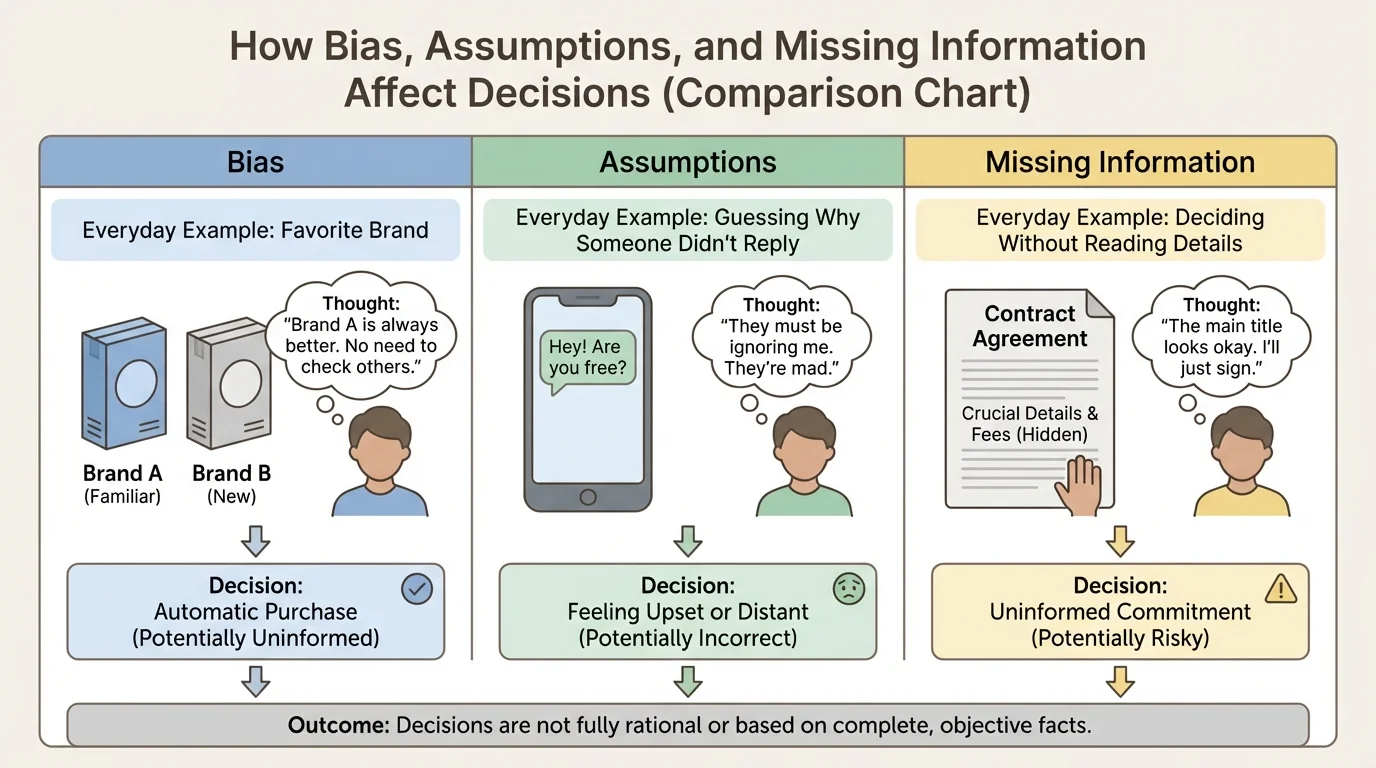
Bias is a preference or leaning that can push your thinking in one direction.
Assumption is a belief you accept without checking proof.
Missing information is important facts you do not have yet.
These three problems can work together. For example, if you already love a certain game company, that bias might make you assume a new game is great. Then if you skip reading reviews, you are also deciding with missing information. One weak spot in thinking can lead to another.
Bias can show up in simple ways. Maybe you always choose one snack brand because you know the logo. Maybe you trust one online creator because they are funny, even when they are talking about something serious. Maybe you listen more closely to a friend you agree with and ignore someone who says something different.
That does not mean your favorites are bad. It means favorites can affect your judgment. If you only trust what feels familiar, you may miss better choices. A video with exciting music and bright editing can feel convincing, but being entertaining is not the same as being true.
Bias can also affect fairness. Suppose two people both make mistakes during an online club project. If one is your friend, you might excuse that mistake quickly. If the other person is someone you do not know well, you might judge them more harshly. The facts are the same, but your feelings change the decision.
Example: Choosing a product because of a favorite brand
Step 1: Notice the bias.
You might think, "I always like this brand, so this new pair of headphones must be good."
Step 2: Separate feelings from facts.
Ask: "What do I actually know about this product? What are the reviews? How long does the battery last? Is it worth the price?"
Step 3: Make a fairer choice.
Compare at least two options instead of choosing only by logo, color, or popularity.
Bias becomes less powerful when you name it. If you can say, "I might be leaning toward this because it is familiar," you are already thinking more clearly.
Assumptions are fast stories your brain creates. They fill in blanks, but they are not always true. This happens a lot in text messages, comments, and social media posts because you cannot always hear the tone of voice or see the full situation
For example, if someone replies with only "ok," you might assume they are annoyed. But maybe they were busy, tired, or using voice-to-text while walking the dog. If you react strongly to your assumption, you can create a problem that was not there before.
Assumptions also show up when you judge what people can or cannot do. You might assume a younger child cannot help cook dinner, or assume a quiet person has no ideas, or assume a person who is confident online knows the most. These guesses can stop you from learning the truth.
Assumptions grow fastest when details are missing. Your brain likes complete stories, so when you do not have all the facts, it may quickly fill the gap with a guess. That guess can feel true, but feelings are not proof.
A strong habit is to replace assumptions with questions. Instead of saying, "He ignored me," try, "I have not heard back yet. I should check before deciding what it means." That small change can prevent hurt feelings and poor choices.
Sometimes a choice seems simple, but an important detail is hidden. Missing information can lead you into unfair, unsafe, or expensive decisions. You might sign up for something without knowing the rules. You might agree to share a photo without understanding who can see it. You might buy something online without checking shipping cost, return policies, or product size.
One reason missing information is dangerous is that you may not realize anything is missing. If a short video shares only one side of a story, it can feel complete even when it leaves out major facts. This is why asking questions is such a powerful skill.
Useful questions include: Who said this? How do they know? What facts support it? What is not being shown? Is there another side? What could happen if I am wrong? These questions help you spot holes before you decide.
| Problem | What it sounds like | Better response |
|---|---|---|
| Bias | "I trust this because I already like it." | "Let me compare it with other choices." |
| Assumption | "I know why this happened." | "I should check before deciding." |
| Missing information | "I guess I know enough." | "What facts am I still missing?" |
Table 1. A comparison of common thinking problems and better responses.
As you saw earlier in [Figure 1], these problems are connected. Bias pulls you, assumptions fill in blanks, and missing information leaves the blanks there in the first place.
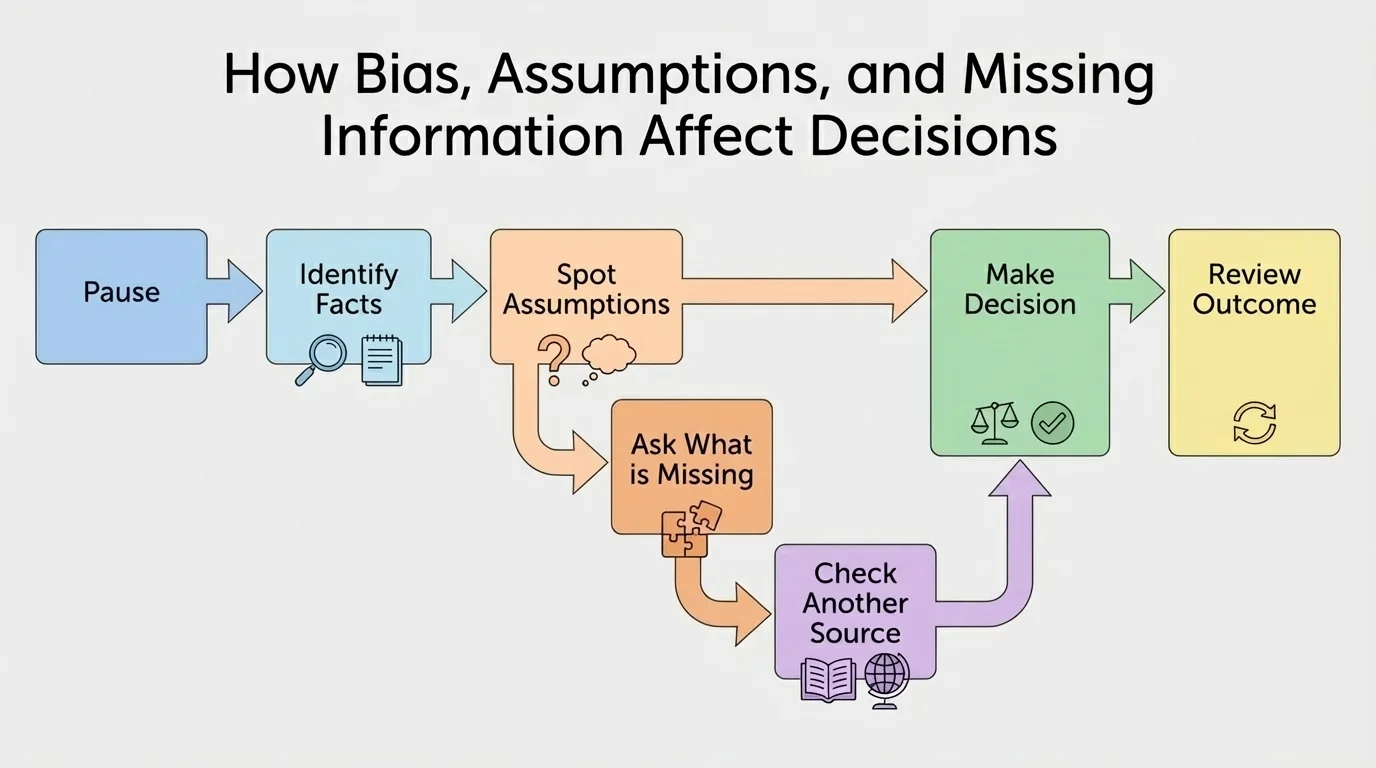
When a choice matters, you do not need a complicated system. You need a simple one you will actually use. The process in [Figure 2] gives you a quick decision check for everyday life.
Step 1: Pause. If you feel angry, excited, embarrassed, or rushed, do not decide right away. Strong feelings can make bias and assumptions grow.
Step 2: Name what you know. Say the facts out loud or write them down. Facts are things you can check.
Step 3: Notice what you think you know. These may be assumptions. Mark them as guesses, not facts.
Step 4: Ask what is missing. What details, rules, evidence, or viewpoints do you still need?
Step 5: Check another source. Read more than one review, ask a trusted adult, or look for the original source instead of only repeating what someone posted.
Step 6: Decide, then review. After choosing, think about what happened. This helps you get better the next time.
Quick decision check in action
Step 1: You see a post saying a community event was canceled.
You feel disappointed and want to tell everyone right away.
Step 2: Pause and check the facts.
Was the post from the official account? Does the event page say the same thing?
Step 3: Look for missing information.
Maybe the event is only delayed, moved online, or changed to a new time.
Step 4: Make a better choice.
Wait until you confirm, then share the correct information instead of spreading a rumor.
This kind of pause can save you from confusion and can also protect other people from false information.
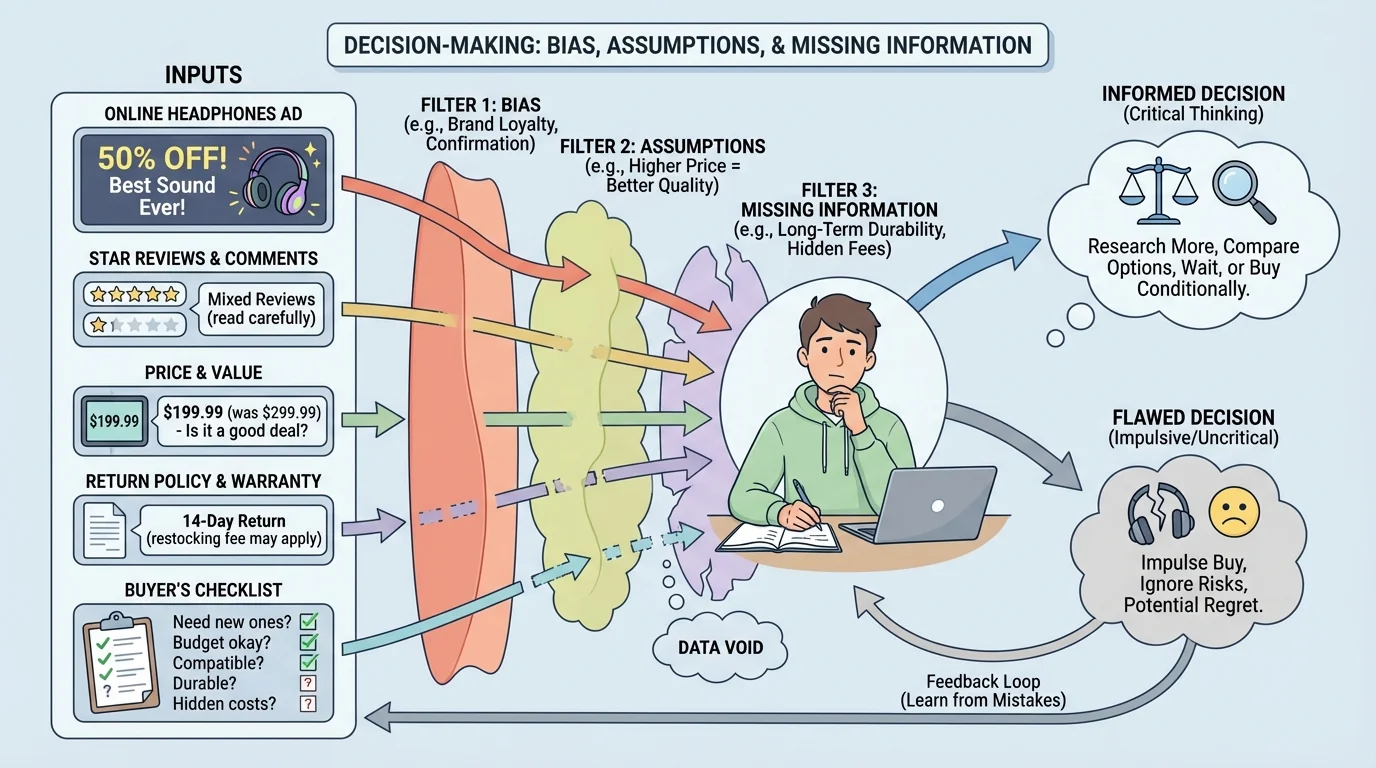
[Figure 3] These ideas matter most when you use them in real life. In the shopping situation shown here, a smart decision does not come from the ad alone. It comes from checking details, comparing choices, and noticing what is still unknown.
Buying something online: You want wireless headphones. The ad says they are "the best ever." That is not proof. A bias toward the brand might make you trust the ad. An assumption might make you think expensive means better. Missing information might include battery life, comfort, return rules, or whether reviews are real.
Believing a rumor: A person in your sports group chat says someone quit the team. If you already dislike that person, bias may make the rumor easier to believe. You may assume the rumor is true because it came from a confident voice. But important information may be missing. Before you repeat it, check whether it came from the person or coach directly.
Choosing who to work with: Maybe you are picking a partner for an online project or community activity. If you choose only your best friend, that may be comfortable, but your bias could make you ignore someone who is organized and reliable. Looking at skills, not only feelings, often leads to a better result.
Making a safety choice: Someone online asks for personal information and says it is urgent. Fear can rush your decision. You may assume the request is real because the message looks official. Missing information includes who sent it, why they need it, and whether a trusted adult can verify it. In safety situations, it is especially important to pause and check.
Later, when you use the step-by-step check from [Figure 2], you will notice that many bad decisions begin the same way: a strong feeling, a quick guess, and not enough facts.
"Slow down when the choice feels fast."
— A strong rule for smart decision-making
This rule is useful because many poor choices feel urgent. Ads, rumors, and emotional messages often try to get a fast reaction. Slowing down gives your thinking time to catch up.
Good decision-making is a skill you build through habits. One helpful habit is to listen to more than one point of view. If two sources disagree, that does not always mean one is lying. It may mean you need more context.
Another strong habit is to separate facts from opinions. A fact can be checked. An opinion is what someone thinks or feels. Opinions matter, but they are not the same as evidence. If a review says, "This game is boring," that is an opinion. If it says, "The game crashes after five minutes on this device," that is a fact you can test or confirm.
A third habit is being willing to change your mind. Some people think changing your mind means you were weak. Actually, it often means you learned something new. If you find better information, changing your decision can be the smartest move.
You already use problem-solving when you break a big task into smaller steps. Decision-making works the same way. Instead of guessing, you pause, gather facts, and choose carefully.
You can also build stronger judgment by noticing patterns in your own thinking. Ask yourself: Do I trust popular things too quickly? Do I assume I understand messages without checking? Do I often decide before I have enough facts? Honest answers help you improve.
Over time, these habits help in many parts of life: friendships, online spaces, money choices, safety, teamwork, and solving everyday problems. The goal is not to doubt everything forever. The goal is to think clearly enough to make choices that are fair, thoughtful, and informed.
