Have you ever finished something quickly, but then realized you rushed, forgot a step, or did not understand it very well? That happens to a lot of students. Academic success is not just about being "smart." It is also about using good habits. When you know how to get ready, work at a steady speed, and think back on what happened, school feels less stressful and your results usually get better.
These habits matter even more in online school. At home, you often have to keep track of deadlines, manage distractions, and decide when to start work on your own. That means your brain uses important "self-management" skills. These skills help you organize, make choices, stay focused, and improve over time.
Planning means deciding what you need to do and how you will do it before you begin. Pacing means working at a steady, manageable speed instead of rushing or waiting too long. Reflection means looking back at what happened so you can learn from it and make a better choice next time.
When these three skills work together, they help you feel more in control. You waste less time, make fewer avoidable mistakes, and feel more confident. They are useful for schoolwork, but also for chores, sports practice, learning an instrument, or saving up for something you want.
Think about two students taking an online quiz. One student opens the lesson platform, notices the quiz is due that night, and starts right away without reviewing. The other student checked the due date earlier, reviewed for a few short sessions, and stopped to think about mistakes after practice. Even if both students are capable, the second student is more likely to do well because the work was handled in a smarter way.
This is where executive functioning comes in. Executive functioning is a group of brain skills that help you plan, focus, remember directions, and control your actions. You use these skills when you decide what to do first, ignore a distracting game tab, or check your work before clicking submit.
Success is a process, not a lucky moment. Strong results usually come from small choices made before, during, and after a task. Planning helps you prepare. Pacing helps you keep going without burning out. Reflection helps you improve the next time. One good test score might happen by chance, but steady success usually comes from steady habits.
If one of these parts is missing, problems can show up. Without planning, you may forget materials or miss a deadline. Without pacing, you may procrastinate and then rush. Without reflection, you may repeat the same mistakes again and again. The goal is not to be perfect. The goal is to notice what helps you learn best.
Planning is like making a map before a trip. In online school, planning helps you see what is coming instead of getting surprised by it. When you plan, you check your class dashboard, write down due dates, gather what you need, and decide when you will work on each task.
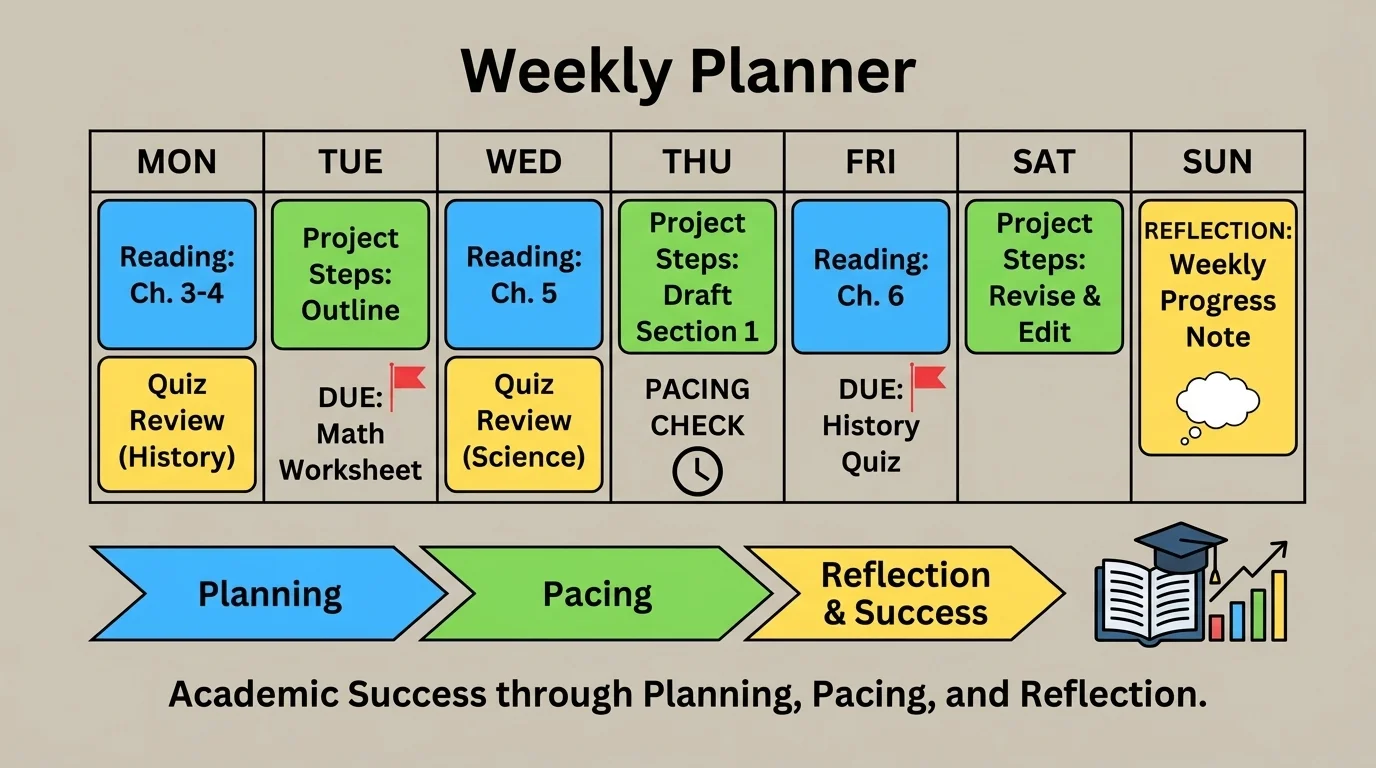
A good plan does not need to be fancy. It can be a paper checklist, a digital calendar, or sticky notes near your workspace. As shown in [Figure 1], what matters is that you can clearly answer these questions: What do I need to do? When is it due? What should I do first? What materials do I need? How long might it take?
Big tasks are easier when you break them into smaller parts. For example, a science slide project might become: choose topic on Monday, find facts on Tuesday, make slides on Wednesday, practice speaking on Thursday, and submit on Friday. That is much easier than staring at "Do whole project" on one day.
Planning also protects your time. If you know you have reading, a quiz, and a writing task this week, you can spread them out. Suppose a reading assignment takes about \(20 + 20 = 40\) minutes across two days instead of one long stressful session. Shorter work times often feel more doable.
Here is a simple planning method you can use:
Step 1: Check your online classes for new assignments and due dates.
Step 2: Choose your top priorities. Start with tasks due soon or tasks that need more time.
Step 3: Break big tasks into small actions.
Step 4: Put those actions into your day or week.
Step 5: Gather supplies before you begin, such as headphones, notebook, charger, and login information.
Planning is not only about school. If you want to bake cookies, you check the recipe, gather ingredients, and preheat the oven before mixing. School works the same way. A little preparation at the start can save a lot of trouble later.
Example: Planning a busy Wednesday
You have an online math lesson, reading notes, and a history response due tomorrow.
Step 1: List the tasks.
Math lesson, reading notes, history response.
Step 2: Estimate the time.
Math lesson: about \(30\) minutes. Reading notes: about \(20\) minutes. History response: about \(25\) minutes.
Step 3: Decide the order.
Do the math lesson first because it may need the most focus, then reading notes, then history response.
Step 4: Prepare your space.
Open the lesson tabs, get a pencil and notebook, and silence extra notifications.
This plan turns one stressful pile of work into three clear actions.
One mistake students make is overplanning. If your plan is too complicated, you may spend more time decorating the plan than using it. Keep it simple and useful. A plan should help you begin, not slow you down.
Later, when you reflect on your week, you can look back at the same kind of schedule we saw in [Figure 1] and notice whether you gave enough time to each task or packed too much into one day.
Pacing means you do not try to do everything at once, and you do not wait until the last minute either. A steady speed often works best. Good pacing helps your brain stay alert and keeps you from feeling overwhelmed.
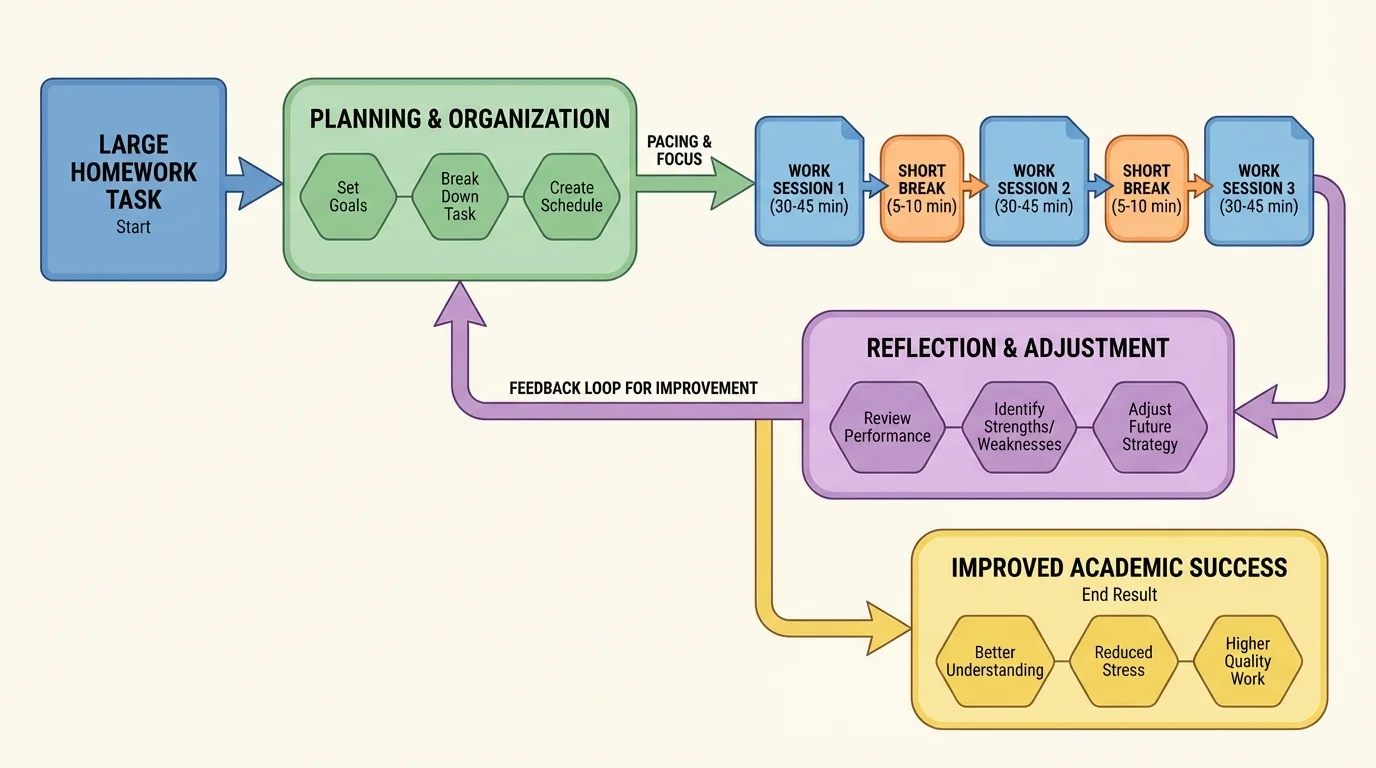
Think of pacing like running a longer race. As shown in [Figure 2], one large task can be split into smaller pieces. If you sprint at the very beginning, you may get tired too fast. If you move too slowly or keep stopping, you may never finish on time. School tasks usually go best when you find a middle speed: focused, steady, and realistic.
One useful pacing strategy is called chunking. Chunking means breaking work into smaller parts. Instead of saying, "I have to study everything," you say, "I will review vocabulary for \(15\) minutes, take a short break, then do \(10\) practice questions." Smaller pieces feel less scary and help you stay on track.
Breaks are part of pacing too. A short break after focused work can help your attention reset. During a break, stand up, stretch, get water, or rest your eyes from the screen. A break should help you recharge, not pull you into a \(45\)-minute distraction.
Pacing also means knowing your own energy. Some students focus best earlier in the day. Others do better after a snack and a few minutes to settle in. If you know when your brain works best, you can use that time for harder tasks and save easier tasks for when your energy is lower.
Here are signs that your pacing may need work: rushing near the deadline, skipping directions, feeling exhausted after a short work session, or constantly saying, "I will do it later." If those signs sound familiar, do not panic. You can improve by using shorter work sessions, earlier start times, and fewer distractions.
Your brain usually remembers more when learning is spread over time instead of crammed into one long session. Studying in smaller sessions across several days often helps information stick better.
Pacing can even make hard work feel easier. Suppose you have \(24\) practice problems. Doing \(6\) problems in each of \(4\) short sessions can feel more manageable than trying to do all \(24\) at once. The total is the same, \(6 + 6 + 6 + 6 = 24\), but the experience is very different.
When you build a pace that works, you are more likely to finish carefully. That is why athletes practice in sets, musicians repeat sections, and gamers learn levels step by step. Slow enough to think, fast enough to move forward—that is the sweet spot.
Reflection is the part many students skip, but it is one of the most powerful. Reflection means stopping after a task and asking, "What went well? What was hard? What should I do differently next time?" It turns every school experience into a chance to improve.
Reflection is not the same as being hard on yourself. It is not about saying, "I am bad at this." It is about being honest and helpful. For example, "I waited too long to start," or "Using note cards helped me remember." Reflection should lead to a useful next step.
Reflection changes mistakes into information. A low score, a missed deadline, or a confusing lesson can feel disappointing. But if you reflect, those moments become clues. They tell you what to change: your study time, your work space, your note-taking method, or the moment you ask for help.
A simple reflection routine has three questions: What worked? What did not work? What will I try next time? You can answer them in your head, in a journal, or in a note on your device. The key is to be specific. "Study harder" is too vague. "Start review two days earlier" is much more useful.
Reflection also helps you notice strengths. Maybe you learned that listening to directions twice helps, or that drawing a diagram improves understanding, or that your focus is better when your phone is in another room. These are important discoveries. They help you repeat what works.
Example: Reflecting after a quiz
You scored lower than you hoped on a quiz.
Step 1: Name one thing that worked.
You remembered the vocabulary words because you reviewed them in short sessions.
Step 2: Name one problem.
You mixed up two ideas because you studied the night before and felt tired.
Step 3: Choose one change.
Next time, start reviewing two days earlier and make a small comparison chart.
This kind of reflection is useful because it leads to action.
Reflection is a big part of growth. A student who reflects may not get everything right immediately, but that student keeps getting better. Improvement often happens because someone pays attention, not because everything was easy at the start.
Later, when you use the work sessions from [Figure 2], reflection helps you decide whether those chunks were too long, too short, or just right for your focus.
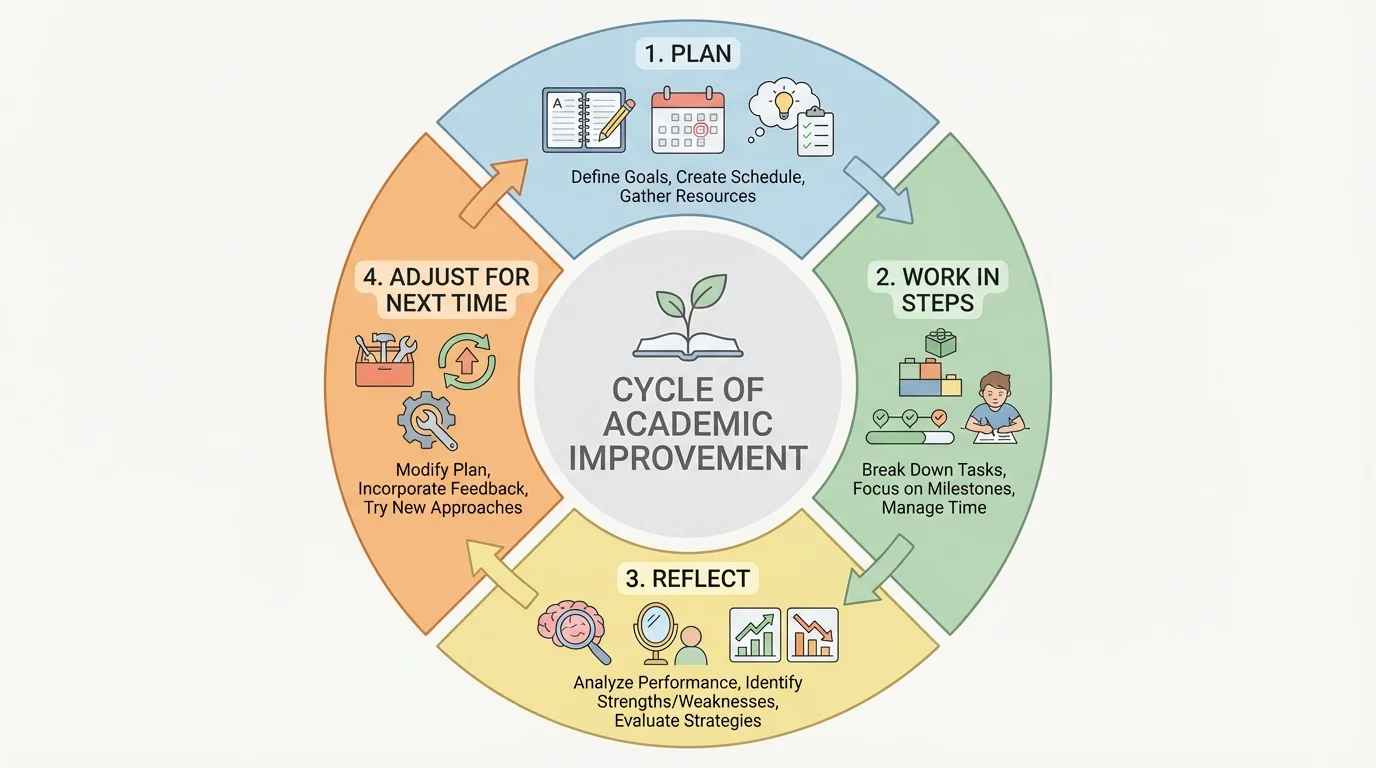
Planning, pacing, and reflection are strongest when they work as a cycle. First, you plan what to do. Next, you work at a steady pace. Then, you reflect on the result. After that, you adjust your next plan. Each round helps you improve.
Here is what that can look like in real life. As shown in [Figure 3], you plan to complete a writing assignment in three parts. You pace yourself by doing one part each day. After submitting, you reflect and notice that your best ideas came when you made an outline first. Next time, you add outlining to your plan from the beginning.
This cycle matters because school success usually happens over time. One homework assignment, one quiz, or one project is not the whole story. Good habits build on each other. A better plan leads to better pacing. Better pacing leads to calmer work. Reflection helps the next plan become even better.
You can use this cycle for almost anything. If you are learning a song, you plan your practice, pace yourself by repeating one section at a time, and reflect on which part still needs work. If you are saving allowance for something special, you plan the amount, pace your spending, and reflect on whether your choices matched your goal.
The important idea is that success is not only about effort. It is also about direction. Working hard without a plan can waste energy. Working steadily without reflection can keep old mistakes in place. The cycle in [Figure 3] helps your effort go in a smarter direction.
These skills show up in ordinary moments. Maybe you have a reading response due on Friday, a live video class on Thursday, and chores at home each day. Planning helps you see the whole week. Pacing helps you divide your time. Reflection helps you notice if your routine is helping or hurting.
They also matter when distractions are everywhere. At home, you may hear TV noise, notice your pet, want to text a friend, or open a game tab. Planning can include putting your device on focus mode. Pacing can include a break time when you check messages later. Reflection can help you notice which distractions pull you away most often.
Sometimes students think these skills are only for students who struggle. That is not true. Strong students use them too. In fact, many successful people use versions of these same habits: chefs plan ingredients and timing, coders test and revise, athletes train in steps, and creators reflect on what their audience liked.
"Success is the sum of small efforts, repeated day in and day out."
— Robert Collier
Even outside school, these skills can help you manage responsibilities. If you are helping cook dinner, you plan ingredients, pace the steps, and reflect if something took longer than expected. If you are preparing for a community event or club meeting, you use the same pattern. That makes these habits practical life skills, not just school skills.
One common mistake is procrastination, which means delaying a task even though you know it needs to be done. Procrastination often feels easier in the moment, but it usually creates stress later. A simple fix is to start with the smallest possible step: open the assignment, read the directions, or write one sentence.
Another mistake is trying to multitask. You might think listening to a lesson, texting, and checking notifications at the same time saves time. Usually it does not. Your attention keeps switching, and your work quality drops. A better choice is to focus on one task, then enjoy your break afterward.
Some students also quit too soon when work feels hard. Reflection can help here. Instead of saying, "I cannot do this," try asking, "Which part is confusing?" That question helps you choose a next step, like rewatching a video, reading directions again, or asking your teacher for help online.
| Problem | What it looks like | Simple fix |
|---|---|---|
| Forgotten work | Missed deadline or missing materials | Check planner and prepare supplies the day before |
| Rushing | Careless mistakes and stress | Start earlier and break work into chunks |
| Getting stuck | Not knowing what to do next | Reflect on the hardest part and ask for help |
| Distractions | Leaving tasks unfinished | Use focus mode and keep breaks separate from work time |
Table 1. Common planning, pacing, and reflection problems with simple solutions.
Notice that each fix is small. You do not need a huge life change. A better habit might begin with one checklist, one earlier start time, or one reflection note after a quiz. Small changes are easier to keep.
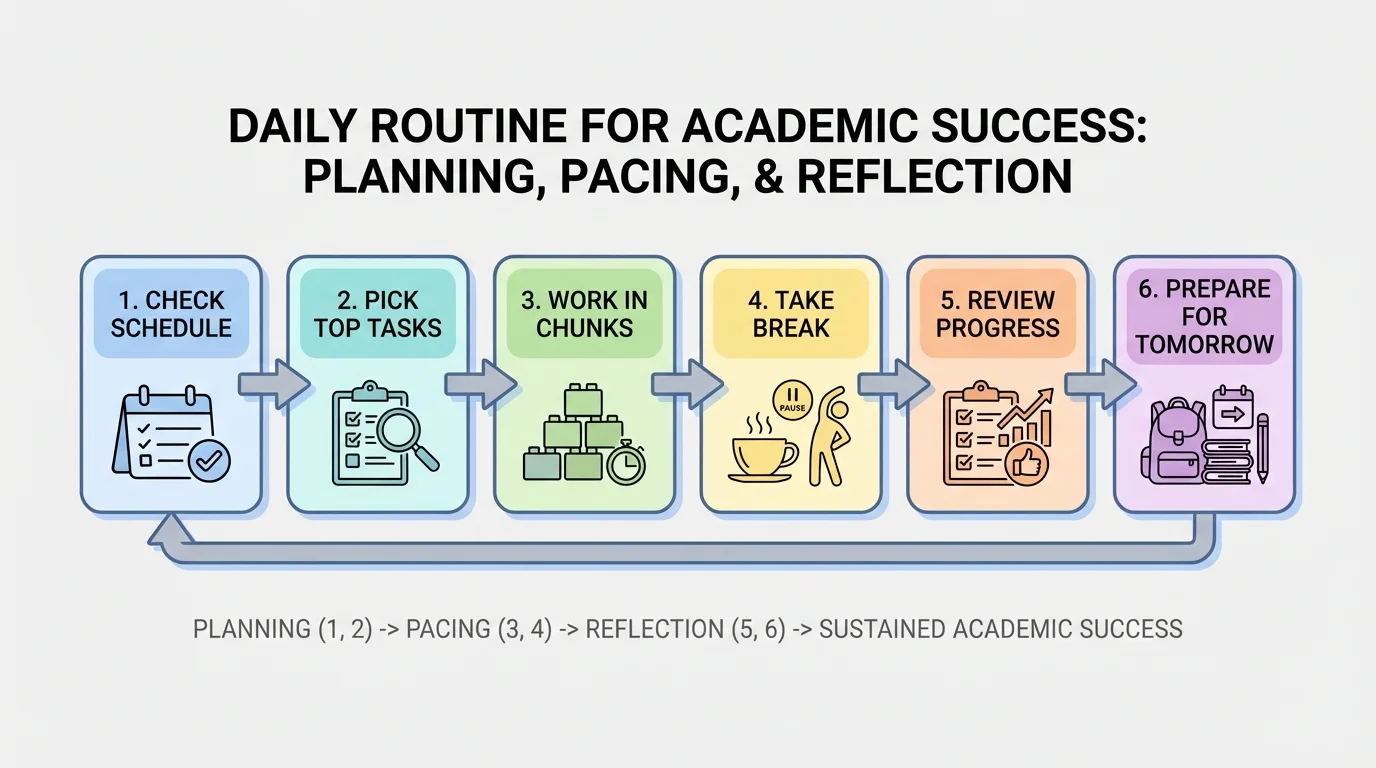
You do not need a perfect system. You just need one that is simple enough to use every day. A basic routine can help you turn these ideas into actions. The routine should help you review what matters most, work in steps, and look back before the day ends.
As shown in [Figure 4], try this daily pattern: check your assignments, choose your top \(2\) or \(3\) tasks, work in short chunks, take brief breaks, and do a quick reflection at the end. That routine can take only a few minutes to set up, but it can save a lot of stress.
Here is a practical guide you can follow:
Before work: Open your school platform, check deadlines, and choose your most important tasks.
During work: Focus on one chunk at a time. Keep only the tabs and materials you need.
After work: Ask yourself what you finished, what still needs time, and what tomorrow's first step should be.
Example: One evening routine
A student has \(90\) minutes available for schoolwork.
Step 1: Plan the time.
Choose three work periods of \(25\) minutes each, with two short breaks of \(5\) minutes.
Step 2: Check the total.
Work time is \(25 + 25 + 25 = 75\) minutes. Break time is \(5 + 5 = 10\) minutes. Planning and wrap-up use about \(5\) minutes, so the total is \(75 + 10 + 5 = 90\) minutes.
Step 3: Reflect at the end.
Write one note: "Starting with the hardest task helped," or "I need fewer distractions during breaks."
This routine is simple, but it uses all three skills.
You can also make a weekly reset. Once a week, look at upcoming tasks, notice where your time went, and decide one thing to improve. Maybe you need to begin projects earlier. Maybe your breaks are too long. Maybe your desk setup is helping a lot. These small observations build stronger habits over time.
The goal is not to become a robot who follows a schedule perfectly. Life changes. Some days are busy, and some tasks take longer than expected. The real skill is learning how to adjust. Planning gives you direction, pacing gives you steadiness, and reflection gives you improvement.
When you use all three, you are not just finishing assignments. You are building a way to handle challenges with more calm, confidence, and control. That is a powerful skill for school now and for life later.
