Have you ever noticed that two people can get the same job to do, but one person's work turns out much better? It is usually not because one person is magically more talented. Most of the time, the difference comes from three habits: trying hard, speaking clearly, and being dependable. These habits matter when you help at home, work on an online project, care for a pet, or someday have a job.
Work quality means how well something is done. High-quality work is careful, complete, accurate, and finished on time. Low-quality work is often rushed, messy, confusing, or incomplete.
Even at your age, people notice your work quality. A family member notices whether you finished a chore correctly. A coach or club leader notices whether you follow directions. If you help design a flyer for a community event or make a slideshow for an online group, others can tell whether you paid attention or just hurried through it.
Work quality is how good the final result of a task is. It includes things like accuracy, neatness, effort, completeness, and being on time.
Good work quality matters because it builds trust. When people trust you, they are more likely to give you important jobs, invite you to help again, and believe that you can handle more responsibility in the future.
Think about washing dishes. If you rinse only the fronts of the plates and leave food stuck on the backs, the chore is not really done well. If you wash everything carefully, dry what needs drying, and put the dishes away where they belong, the work quality is much higher.
The same idea works in many situations. If you record a short video for a club announcement, good work quality means your voice is clear, your information is correct, and your video is ready by the deadline. If you help a neighbor pull weeds, good work quality means you finish the whole area, not just the easy parts.
You can ask yourself four simple questions to judge work quality: Is it correct? Is it complete? Is it neat or clear? Is it on time? If the answer to all four is yes, the work is probably strong.
Effort is the energy and care you put into a task. It does not mean making yourself exhausted. It means giving the task the attention it deserves. Strong effort includes focusing, not giving up quickly, and checking your work before saying, "I'm done."
Effort affects work quality because careful work usually looks different from rushed work. A rushed poster may have spelling mistakes, crooked pictures, or missing information. A carefully made poster may still not be perfect, but it is much more useful because the person worked steadily and checked details.
Here is an important truth: effort does not always make work perfect, but it usually makes work better. If something is hard, strong effort helps you learn, improve, and fix mistakes. Weak effort often leads to avoidable problems.
Effort is more than "trying." Real effort includes starting on time, sticking with a task when it gets boring or tricky, and reviewing your work at the end. Someone who says "I tried" after working for only two minutes may not actually have given full effort.
Suppose you are helping create a digital invitation for a family event. If you spend a few extra minutes checking the date, time, and spelling of names, you improve the final result. That extra care is effort, and it raises work quality.
Effort also affects your future at work. Employers and team leaders often value a person who is willing to learn and keep improving. A person who gives up fast or does the minimum every time may be seen as less reliable.
Communication is how you share information with other people. It includes speaking, writing, listening, asking questions, and giving updates. In online life, communication might happen through messages, email, video calls, or shared documents.
Work quality improves when communication is clear. If you do not understand directions and stay silent, you may do the wrong task. If you ask a smart question early, you can avoid a big mistake later.
For example, imagine a community leader asks you to help make name tags for an event. If you are unsure whether they want first names only or full names, one quick message can save time. Good communication prevents confusion.
Strong communication also means listening. If someone gives feedback like, "Please make the letters larger so people can read them," listening carefully helps you improve the work instead of repeating the same mistake.
Clear message example
A respectful update message might sound like this:
Hi, I finished the first draft of the flyer. I'm not sure whether to use Saturday's time or Sunday's time. Can you please confirm before I send the final version?
This message is short, polite, and specific. It helps the work move forward.
Poor communication can lower work quality even if your effort is strong. You might work very hard on the wrong thing. That is why effort and communication need to work together.
Responsibility means doing what you said you would do and taking ownership of your actions. A responsible person remembers tasks, treats materials carefully, tells the truth, and admits mistakes instead of hiding them.
Responsibility affects work quality because dependable people finish tasks properly. If you promise to feed a pet, lock a gate, return borrowed supplies, or upload a finished file by a certain time, other people are counting on you. When you follow through, the whole job works better.
Responsibility also means fixing problems. If you forget part of a task, saying "I forgot, but I can fix it now" is much better than pretending nothing happened. Owning a mistake protects trust better than making excuses.
"People may forget what you said, but they remember whether they could count on you."
Imagine you are helping a younger sibling organize books, and you leave halfway through without telling anyone. Even if you worked hard for a few minutes, the overall work quality is low because the job was not completed responsibly.
Great work usually does not come from only one good habit. It comes from all three working together, as [Figure 1] shows. You need effort to do the task carefully, communication to stay clear and connected, and responsibility to finish what you promised.
Think of a small real-world job like helping set up chairs for a neighborhood event. If you use effort, you line the chairs up neatly. If you use communication, you ask where the chairs should go and tell the organizer when you are done. If you use responsibility, you arrive on time and complete the setup. The result is high work quality.
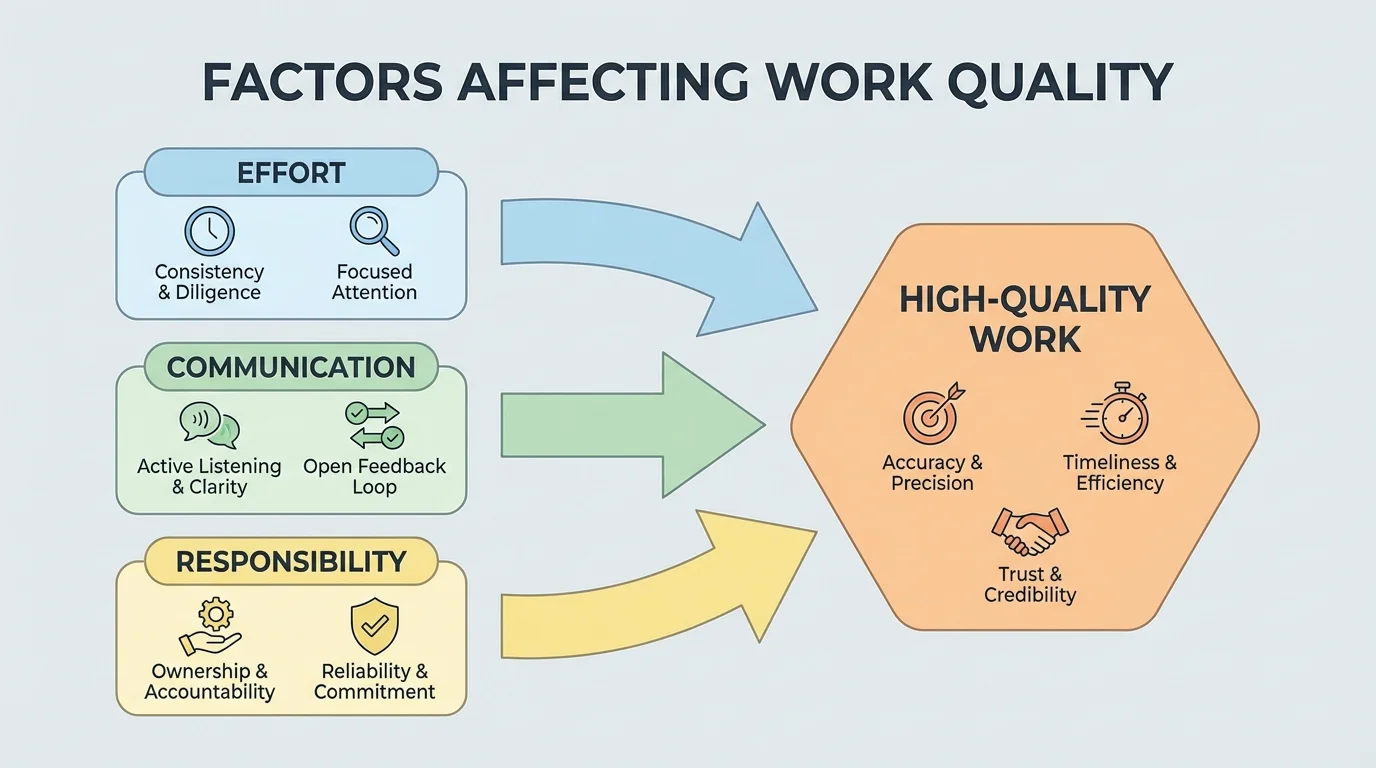
If one part is missing, the final result can suffer. You might try hard but not communicate, so you place the chairs in the wrong area. You might communicate well but not put in effort, so the rows are messy. You might try hard and ask questions but forget to show up on time, which is a responsibility problem.
This is why adults often talk about being an effective worker, not just a skilled one. A skilled person can still do poor-quality work if they are careless, unclear, or unreliable.
Different missing skills create different kinds of problems. When effort is weak, the work may be sloppy. When communication is weak, the work may be confusing or off-target. When responsibility is weak, the work may be late or unfinished.
[Figure 2] Let's compare what that can look like in real life.
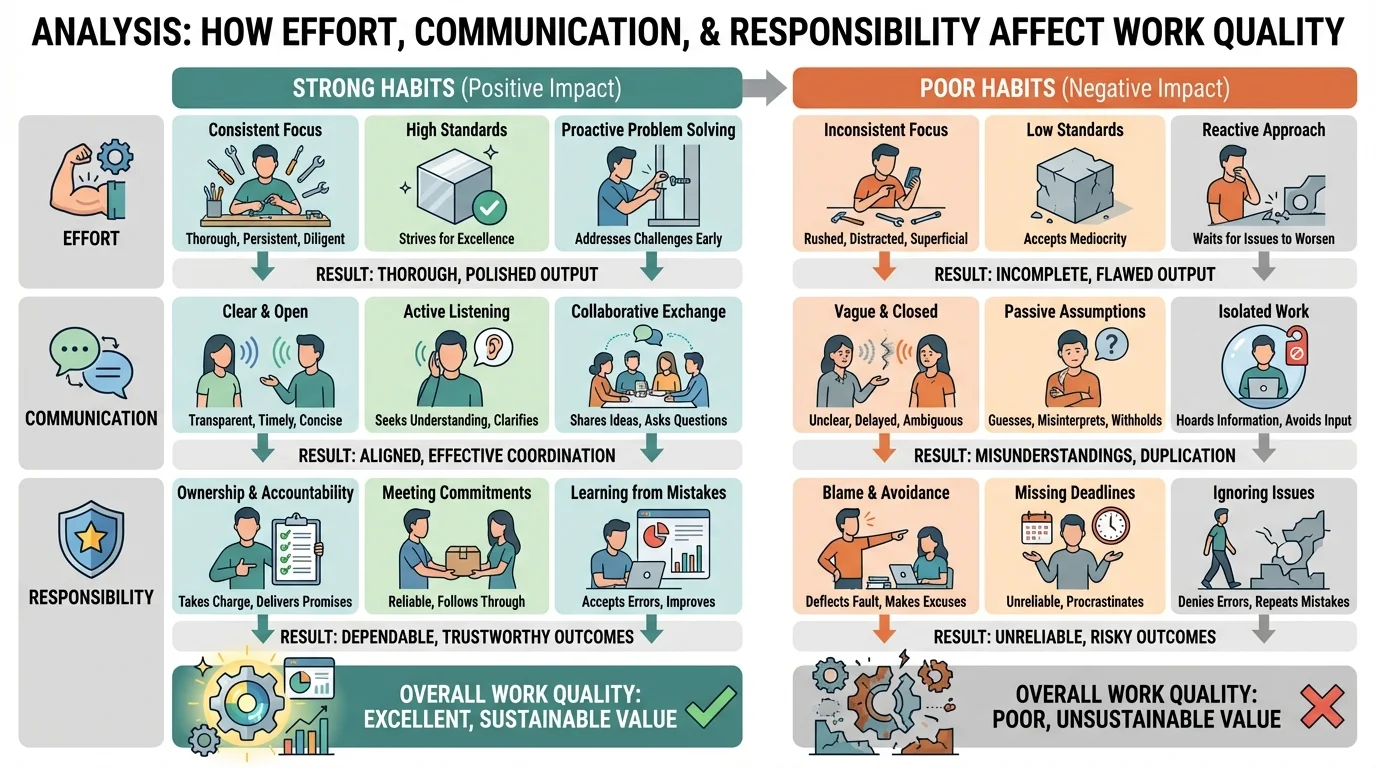
| Skill | When the skill is strong | When the skill is weak |
|---|---|---|
| Effort | Work is careful, checked, and complete | Work is rushed, messy, or only half done |
| Communication | Directions are clear, questions are asked, updates are shared | People get confused, details are missed, mistakes grow |
| Responsibility | Tasks are finished on time and promises are kept | Tasks are late, forgotten, or left for others to fix |
Table 1. Comparison of how strong and weak habits affect work quality.
Notice that weak work quality is not always about talent. A person may know how to do something but still do poor work if they do not use these habits. This is encouraging because habits can be improved.
Many employers say they can teach job tasks, but it is harder to teach dependability and clear communication. That means your everyday habits now can help you later when you apply for real jobs.
As we saw earlier in [Figure 1], strong results come from combining good habits, not from depending on only one strength.
You do not need to wait until you are older to build professional habits. A simple checklist can help you do better work right now when you help at home, volunteer, or complete a personal project.
[Figure 3] Step 1: Understand the task. Before you start, make sure you know what "done" looks like. Ask questions if directions are unclear.
Step 2: Plan your time. Do not wait until the last minute if the task has several parts. Give yourself enough time to check your work.
Step 3: Work carefully. Focus on one task at a time. Try not to rush just to get finished fast.
Step 4: Communicate. If you are stuck, need help, or will be late, tell the right person early. Clear updates protect work quality.
Step 5: Review before you finish. Check for mistakes, missing steps, and unclear parts.
Step 6: Follow through. Turn it in, clean up, return supplies, or let the other person know the job is complete.
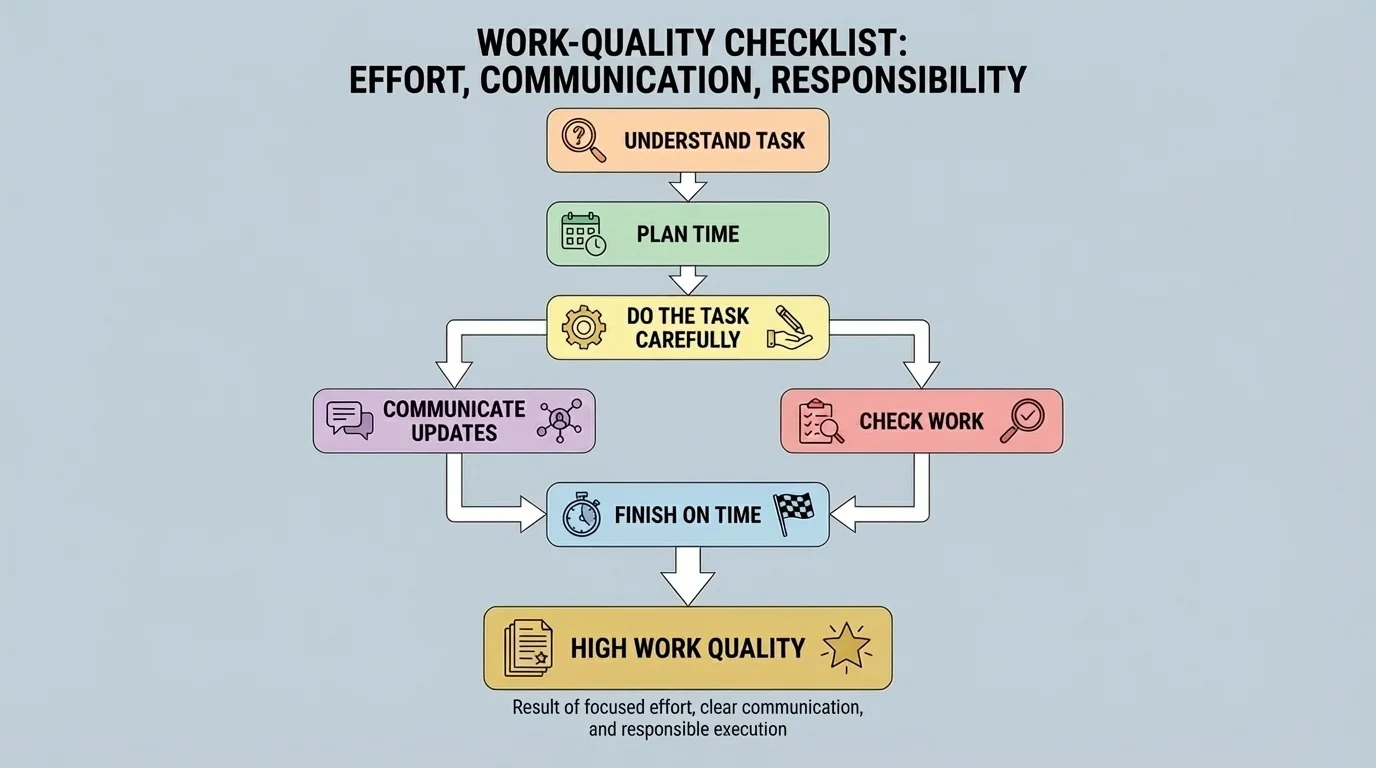
These steps may seem simple, but they are powerful. Small habits repeated often can change how people see your work. Over time, people begin to think of you as someone who can be counted on.
Work-quality self-check
Step 1: Ask, "Did I do the whole job?"
This checks completeness.
Step 2: Ask, "Did I do it carefully?"
This checks effort.
Step 3: Ask, "Did I tell people what they needed to know?"
This checks communication.
Step 4: Ask, "Did I finish on time and own my part?"
This checks responsibility.
If you can answer yes to all four, your work quality is probably strong.
Later, when you are helping on a bigger task, you can look back at [Figure 3] in your mind and move through the checklist again.
Here are some everyday situations where these skills matter.
Scenario 1: Helping with a family chore. You are asked to sort laundry and start a load. Effort means checking colors and reading the settings. Communication means asking if a delicate item should be washed another way. Responsibility means starting the load when you said you would and telling someone when it is done.
Scenario 2: Making a flyer for a pet-sitting service. Effort means spelling words correctly and choosing readable colors. Communication means asking what contact information should be included. Responsibility means sending the finished flyer by the deadline.
Scenario 3: Online club project. You and two other students are each making one slide for a presentation. Effort means adding strong information and checking your spelling. Communication means telling the group when your slide is done and asking if your part fits the style. Responsibility means uploading your slide on time so nobody has to cover for you.
Scenario 4: Watering a neighbor's plants. Effort means watering the right amount, not just splashing quickly. Communication means asking which plants need extra care. Responsibility means showing up on the correct days and not forgetting.
High-quality work creates opportunities. When people notice that you try hard, communicate clearly, and act responsibly, they are more likely to trust you with bigger tasks. That is how small jobs today can grow into bigger responsibilities later.
These situations may seem ordinary, but they are the same types of habits people use in real jobs. Someone who babysits, stocks shelves, designs graphics, repairs bikes, or helps at an animal shelter all needs strong effort, communication, and responsibility.
Choose one task you already do each week, such as cleaning your room, helping cook, caring for a pet, or finishing an online assignment for an activity outside school. Before you begin, say to yourself: I will do this carefully, communicate if needed, and finish responsibly. That short reminder can change how you work.
You can also keep a tiny note on paper or on a device with three words: Effort. Communication. Responsibility. Before you say a task is done, check all three. This helps turn good choices into habits.
When your work does not go well, do not just think, "I'm bad at this." Instead ask, "Which part needs improvement?" Maybe the effort was rushed. Maybe the communication was unclear. Maybe the responsibility piece was weak because you forgot a deadline. When you can name the problem, you can fix it.
Getting better at life skills usually happens through practice, not overnight. Every time you redo careless work, send a clearer message, or take ownership of a mistake, you are building stronger habits.
Strong work quality is not about being perfect. It is about doing your best with care, staying clear with people, and being someone others can count on. Those are skills that help in childhood, in teen years, and far into adult life.
