Some of the most useful ideas in the world started with a very ordinary problem: shoes that came untied, a backpack that was hard to organize, a pet bowl that spilled, or a video channel that taught people something they wanted to know. People create value when they notice what others need and then make something helpful, enjoyable, or meaningful. That "something" might be an object, a service, or even a creative project.
Learning how value is created helps you in real life. It teaches you to pay attention, solve problems, listen to feedback, and think like a person who can make a difference. Those are not just business skills. They are life skills. Whether you want to earn money someday, start a project, help your family, or share your talents online, understanding value creation helps you move from "I have an idea" to "I made something people actually want or need."
Value means the usefulness, help, enjoyment, or meaning that something gives to a person. A need is something people must have or strongly require. A want is something people would like to have, even if they can live without it. A good idea often creates value by meeting a need or by making a want easier, better, faster, safer, or more fun.
Not everything valuable costs money. A chore chart that helps your family stay organized creates value. A dog-walking service creates value. A comic you draw that makes people laugh creates value too. The key question is simple: Who does this help, and how?
When people create value, they solve problems or improve lives. A baker makes food people enjoy. A mechanic fixes cars so people can travel safely. A game designer creates fun and challenge. A tutor helps someone understand a hard topic. All of these people are valuable because they provide something others care about.
In the world of work, value matters because people are more likely to support, buy, recommend, or thank someone whose work truly helps them. If a person makes something nobody needs, it may not get used. But if they notice a real problem and respond well, their idea has a much better chance to succeed.
That is one reason career readiness starts early. You do not need to wait until you are an adult to practice noticing needs and responding with action. You can begin with your own room, home, neighborhood, online communities, hobbies, and interests.
People often think ideas appear like magic, but they usually begin with observation. A opportunity is a chance to do something useful, and creators often find one by looking closely at everyday problems, as [Figure 1] shows. Maybe your family always loses charging cords. Maybe younger kids in your community need easier craft instructions. Maybe pet owners want a cleaner feeding area.
To spot needs, ask questions like these: What keeps going wrong? What feels slow or frustrating? What do people complain about? What do they wish were easier? What do they enjoy so much that they want more of it? What skills do you have that could help someone else?
Needs are not always big emergencies. Sometimes a need is small but common. For example, if several people struggle to keep track of reading time, a simple reading log printable might help. If people want birthday cards that feel more personal, handmade cards could be valuable. If busy families want healthy snacks ready faster, a snack-prep guide might be useful.
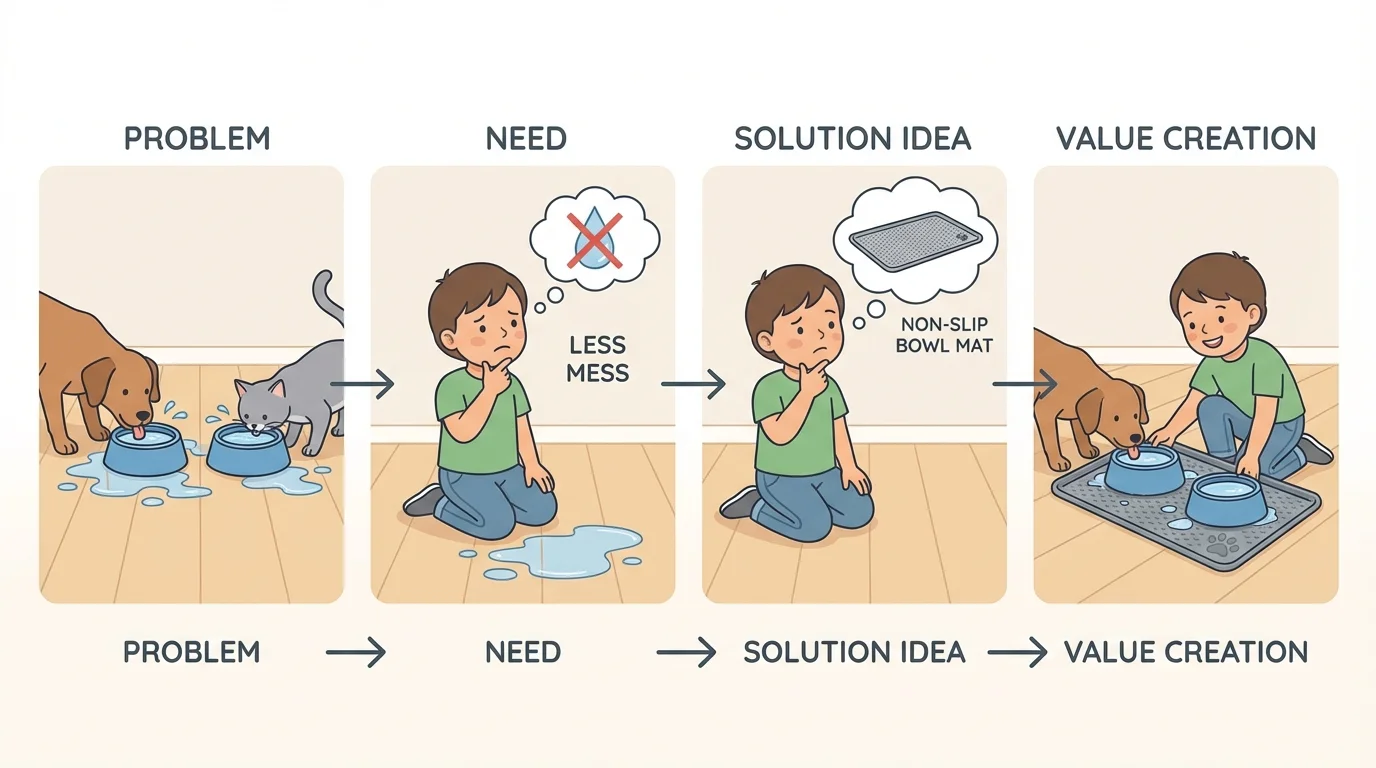
One smart habit is to carry an "idea list" in a notebook or notes app. When you notice a problem, write it down right away. Then add who has the problem, when it happens, and what makes it annoying. This turns random thoughts into possible projects.
Many inventions and small businesses began because someone got tired of doing a task the hard way and decided to improve it. Big ideas often grow from very small frustrations.
A person who creates value does not just think, "What do I want to make?" They also think, "What do people actually need?" That shift matters. It keeps you focused on helping real people instead of guessing.
There are three common ways people create value: through a product, a service, or a creative project. These can overlap, but it helps to understand the differences.
A product is something people can use or own. Examples include bookmarks, slime kits, phone stands, baked goods, planners, and reusable tote bags. A service is work you do for someone else. Examples include pet care, yard help, tech help, tutoring, organizing digital photos, or designing a simple flyer. A creative project might be art, music, videos, stories, online tutorials, or digital designs that entertain, inspire, or teach others.
Here is a simple comparison.
| Type | What it is | Example | Value it gives |
|---|---|---|---|
| Product | An item people use | Homemade bookmark | Makes reading more organized and fun |
| Service | Helpful work done for others | Dog walking | Saves time and helps pet owners |
| Creative project | Something made to share ideas, feelings, or entertainment | Drawing tutorial videos | Teaches and inspires others |
Table 1. Different ways people create value through things they make, do, or share.
Sometimes the same idea can fit more than one category. If you design printable chore charts, that is a product. If you customize one for each family, that also becomes a service. If you make a video teaching others how to organize chores, that is a creative project.
Creating value works best when you follow a clear process instead of jumping straight to the final idea. The basic steps are easier to remember when you see them in order, as [Figure 2] illustrates. First notice a need, then choose a solution, make a simple version, test it, collect feedback, improve it, and share it.
Step 1: Notice a need. Watch, listen, and ask questions.
Step 2: Choose one idea. Pick the one that seems useful and realistic.
Step 3: Make a simple version. Start small.
Step 4: Test it. See what works and what does not.
Step 5: Get feedback. Ask people what they noticed.
Step 6: Improve it. Fix problems and make it better.
Step 7: Share it responsibly. Explain clearly what it does and who it helps.
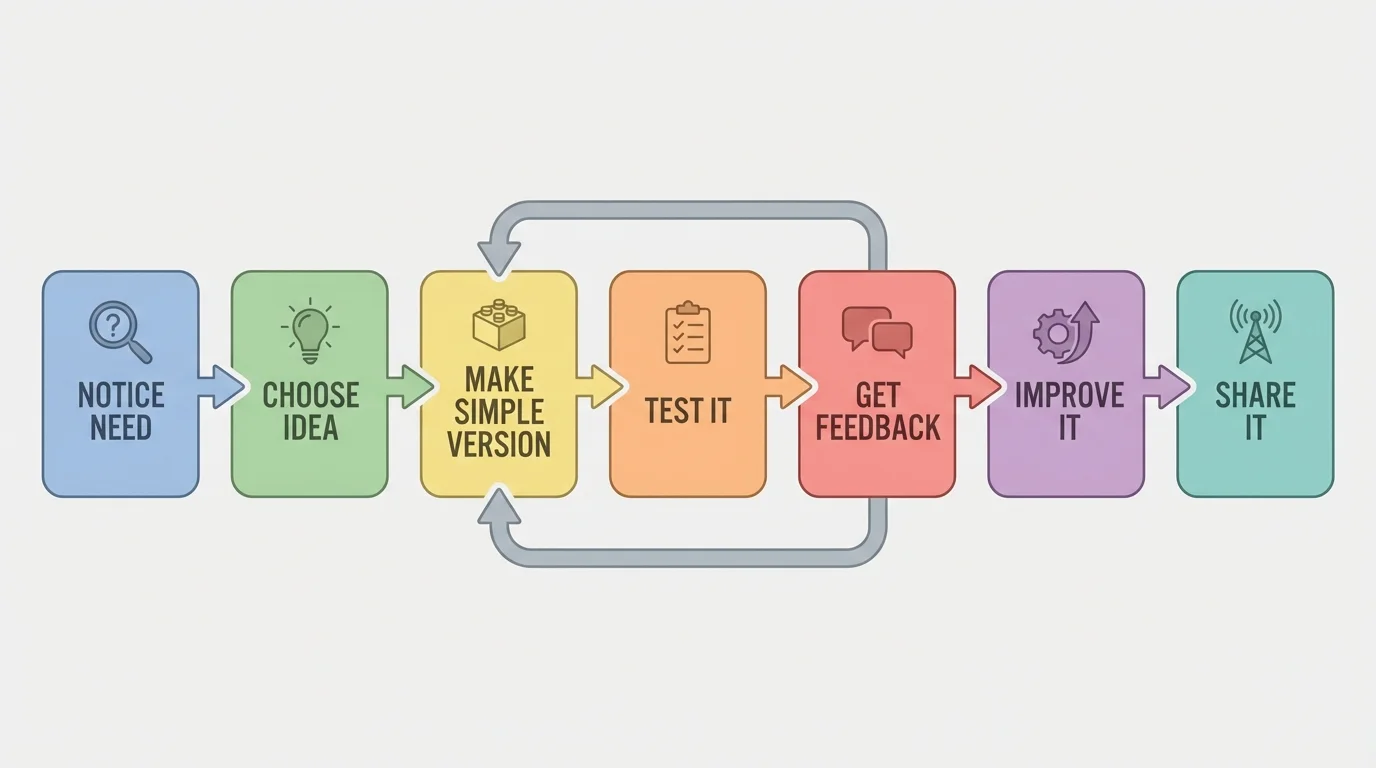
This process keeps you from wasting time. For example, if you spend hours making ten decorated pencil cups before checking whether anyone likes the design, you might learn too late that people wanted different colors or sizes. Starting with one simple version is smarter.
Example: Creating value with a homework helper card set
Step 1: Notice the need
You realize younger students in your family get stuck remembering steps for math homework and reading assignments.
Step 2: Choose the idea
You decide to create a set of colorful cards with reminders such as "Read directions twice" and "Check your work."
Step 3: Make a simple version
You design just three cards first instead of a full set.
Step 4: Test and improve
A family member says the words are helpful but the print is too small, so you make the text bigger and use clearer colors.
The value comes from making schoolwork easier and less stressful for the person using the cards.
The same pattern works for almost anything. Whether you are baking treats, editing videos, organizing files, or offering a dog-walking service, the most successful ideas usually go through small improvements before they become truly useful.
A prototype is a first version that you test before making the final one. It does not have to be perfect. In fact, it should be simple enough that you can change it easily. A rough sketch, sample design, short video draft, or one practice batch of a snack can all be prototypes.
Testing means finding out what really happens when someone uses your idea. Does the bookmark bend too easily? Is the tutorial too fast to follow? Does the organizer fit in the drawer? Does your flyer make the message clear? Testing gives you facts instead of guesses.
Feedback is information people give you about what works and what should change. Good feedback is specific. "It's nice" is not very helpful. "The handle is too small to grip" is helpful. "I liked the joke, but the audio was hard to hear" is helpful too.
Some people feel upset when they hear criticism, but useful feedback is a tool. If you listen carefully, it helps your work improve. This is one of the strongest habits in any future career: learn, adjust, and try again.
Why improvement matters
The first idea that comes to your mind is not always the best version. Improvement is how creators turn a decent idea into a strong one. Small changes can make something safer, easier to use, more attractive, or more effective.
You can ask for feedback in a respectful way: "What part was most useful?" "What was confusing?" "What should I change first?" Those questions often lead to better answers than "Do you like it?"
Creating value is not just about having a clever idea. It also means making choices about resources. A budget is a plan for how money will be used, and creators also think about time and effort, as [Figure 3] shows. Sometimes the cheapest idea takes the longest. Sometimes a faster option costs more.
Suppose you want to make decorated treat bags. If each bag costs $1 for supplies and you make 8 bags, the total supply cost is \(1 \times 8 = 8\), so the supplies cost $8. If you sell each bag for $3, the total money collected is \(3 \times 8 = 24\), or $24. After paying back the $8 in supplies, \(24 - 8 = 16\), so $16 remains. That remaining money is not always pure profit if there are other costs, but it shows why planning matters.
Creators also compare choices. A hand-drawn poster may cost very little money but take a long time. A digital template may take less time after you learn the software. Trade-offs like these are easier to understand when compared side by side.
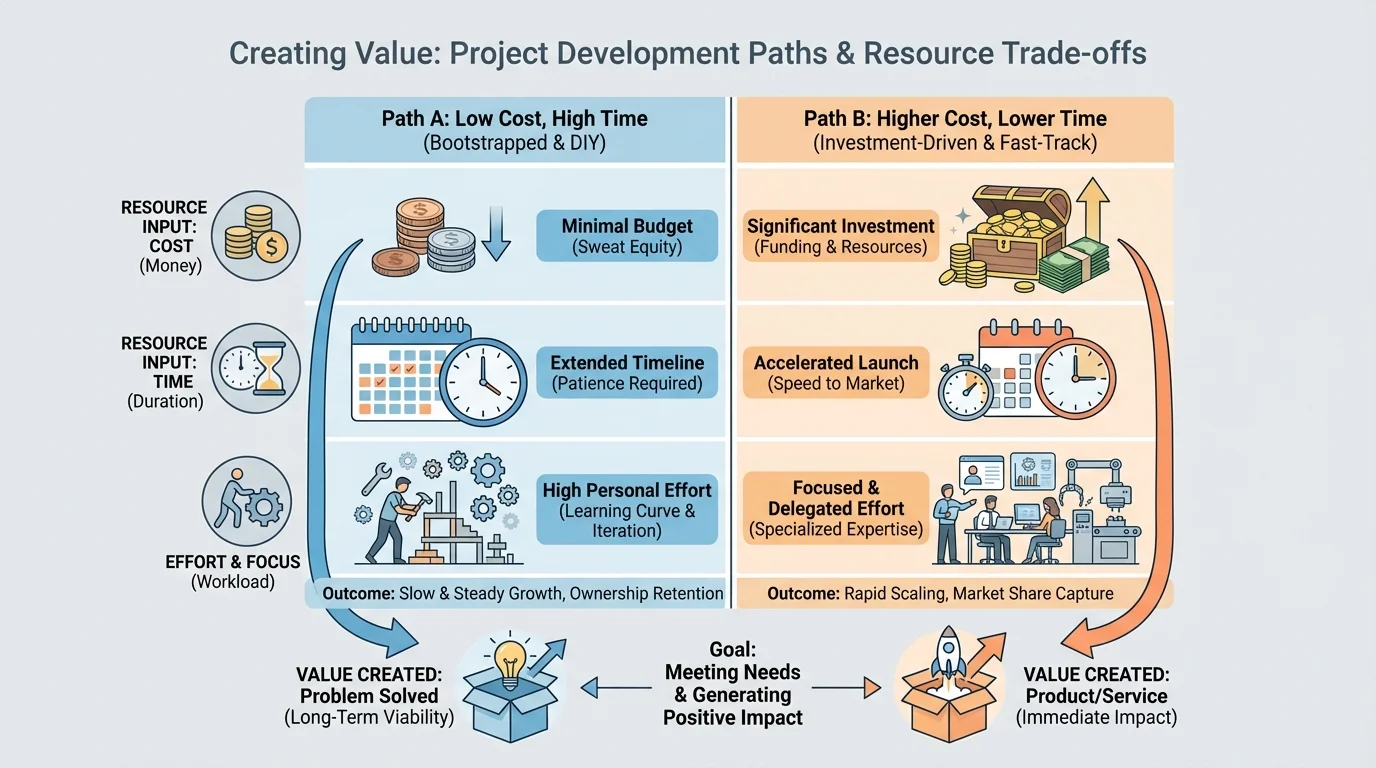
Before you begin, ask yourself: What materials do I need? How much will they cost? How long will this take? Do I have the skill to do it well right now? Can I start smaller?
Example: Planning a small creative project budget
Step 1: List the costs
Paper costs $4, markers cost $6, and sticker labels cost $2.
Step 2: Add them
The total cost is \(4 + 6 + 2 = 12\), so the supplies cost $12.
Step 3: Estimate time
If each item takes about \(15\) minutes and you plan to make \(6\) items, the total time is \(15 \times 6 = 90\) minutes.
This helps you decide whether the project fits your time and money.
Planning does not have to be complicated. Even a short list can prevent mistakes. When creators ignore cost, time, or effort, they often feel stressed, run out of supplies, or promise more than they can finish.
Creating value also means being honest and responsible. If you offer a service, explain clearly what you will do and when. If you share a creative project online, use respectful language and protect your privacy. If you make a product, be truthful about what it can do.
Trust matters. If someone says they will deliver custom drawings by Friday and then disappears without a message, people may stop trusting them. But if they explain the timeline clearly, communicate politely, and do quality work, others are much more likely to support them again.
Responsibility also includes safety and respect. Do not copy someone else's art and pretend it is yours. Do not use music, photos, or designs without permission when permission is needed. Do not offer services that require adult supervision unless you actually have that support.
"The best ideas help real people in real ways."
Good communication is part of value creation. You may have an excellent idea, but if people do not understand it, they might not use it. Use simple words, clear pictures, neat organization, and honest descriptions.
When you practice creating value now, you are also building career skills for later. Employers, clients, teammates, and communities all look for people who can notice needs, solve problems, improve ideas, and follow through.
These skills include initiative, responsibility, creativity, planning, communication, and persistence. If something does not work on the first try and you improve it anyway, that is a powerful work habit. If you listen to users and adjust your design, that is a skill used in many jobs.
Think about how different careers create value. A nurse helps people heal. A software designer makes tools easier to use. A chef prepares food people enjoy. A video editor helps messages become clearer and more engaging. A business owner brings together products or services people want. Even though the jobs are different, each one begins by understanding needs.
That is why small projects you do now matter. A homemade organizer, a useful checklist, a neighbor-helping service, or a digital art project can all teach you how value works in the real world.
Here are a few simple examples of value creation in action.
Example 1: A student notices that family game pieces get lost. They make labeled storage bags for each game. The value is better organization and less frustration.
Example 2: A student who loves drawing creates custom pet portraits for friends and family. The value is joy, personalization, and a meaningful gift.
Example 3: A young tech helper shows relatives how to organize phone photos. The value is saved time and less confusion.
Example 4: Someone creates short online videos explaining easy recipes for busy families. The value is useful instruction and convenience.
Notice that some of these ideas save time, some solve a problem, and some create happiness or meaning. Value is not just about fixing broken things. It can also be about making life easier, calmer, more fun, or more beautiful.
As you saw earlier in [Figure 1], strong ideas usually begin by noticing a real problem or wish. Then, as the process in [Figure 2] shows, creators test and improve their ideas instead of assuming the first version is perfect. Finally, the trade-offs from [Figure 3] remind us that good planning includes time, cost, and effort.
You do not have to invent something huge to create value. Small, thoughtful solutions count. A person who listens carefully, starts small, and keeps improving can create something truly useful.
