Have you ever wanted something a lot, and then later realized, "Wait... I only wanted that because I kept seeing it everywhere"? That happens to almost everyone. A video ad pops up before a game clip. A favorite content creator shows an appealing product. A friend says everyone is getting it. Suddenly, buying it feels like a great idea. But sometimes that feeling comes from persuasion, not from what you truly need or even really want.
Learning how advertising and influence work is a powerful money skill. When you understand what is pushing your choices, you are more in charge of your own spending. That means you can save for bigger goals, avoid regret, and make choices that match what matters to you.
Every time you spend money, you are making a decision. Maybe it is about a snack, a toy, sports gear, a craft kit, a game add-on, or a gift. Even if the amount is small, your choices add up. If you spend $4 here and $6 there, the total becomes \(4 + 6 = 10\). Ten dollars may not sound huge, but if you do that again and again, your money can disappear fast.
Advertising does not always tell lies. Many ads show real products. The tricky part is that ads are designed to make you feel interested, excited, worried about missing out, or eager to fit in. They are built to get attention and encourage spending.
Advertising is any message made to get people interested in buying or using something.
Influence is the effect that people, messages, or situations have on your choices.
Spending decision is the choice you make about whether to use your money, and how much to use.
You see advertising in many places: videos, apps, websites, stores, packaging, signs, podcasts, sports events, and social media. Influence also comes from other people around you, including family members, online creators, review videos, and friends messaging you about what is "cool" or "worth it."
Advertising is not only a giant poster or a commercial. It can be subtle. A game may offer a "special bundle." A video may include a paid product mention. A social media post may look casual but still be trying to sell something. Some ads are obvious. Others blend in so well that you may not notice them right away.
Influence is even broader. It can happen when someone says, "You need this," or when lots of people seem to like the same thing. You may start to think, "If they all want it, maybe I should too." That feeling is normal, but it does not always lead to smart spending.
Companies often repeat the same message many times because people are more likely to notice, remember, and trust something they have seen again and again.
That is why it helps to slow down and ask yourself whether the idea started with you, or whether it was planted by repeated messages from ads and other people.
Many advertisements are carefully built from attention-grabbing parts, as [Figure 1] shows. They may use bright colors, exciting words, popular music, or a smiling person who seems happy because of the product. The goal is often to connect the product with a good feeling.
Here are some common ad tricks to notice:
Feeling-based messages: The ad tries to make you feel happy, included, cool, strong, smart, or special. It may suggest that the product will change how others see you.
Urgency: Words like "today only," "last chance," or "limited time" are meant to make you rush. When people rush, they often think less carefully.
Popularity: An ad might say "best-selling," "everyone loves it," or "trending now." This makes it sound like buying it is the normal choice.
Celebrity endorsements: A celebrity, athlete, or content creator may be shown using the product. That can make the product seem more desirable, even if the person was paid to promote it.
Free extras: Sometimes the ad says you get a bonus item, extra points, or a mystery reward. That can make the deal feel bigger and more exciting.
Eye-catching prices: A price like $9.99 can feel much smaller than $10, even though the difference is only \(10.00 - 9.99 = 0.01\).
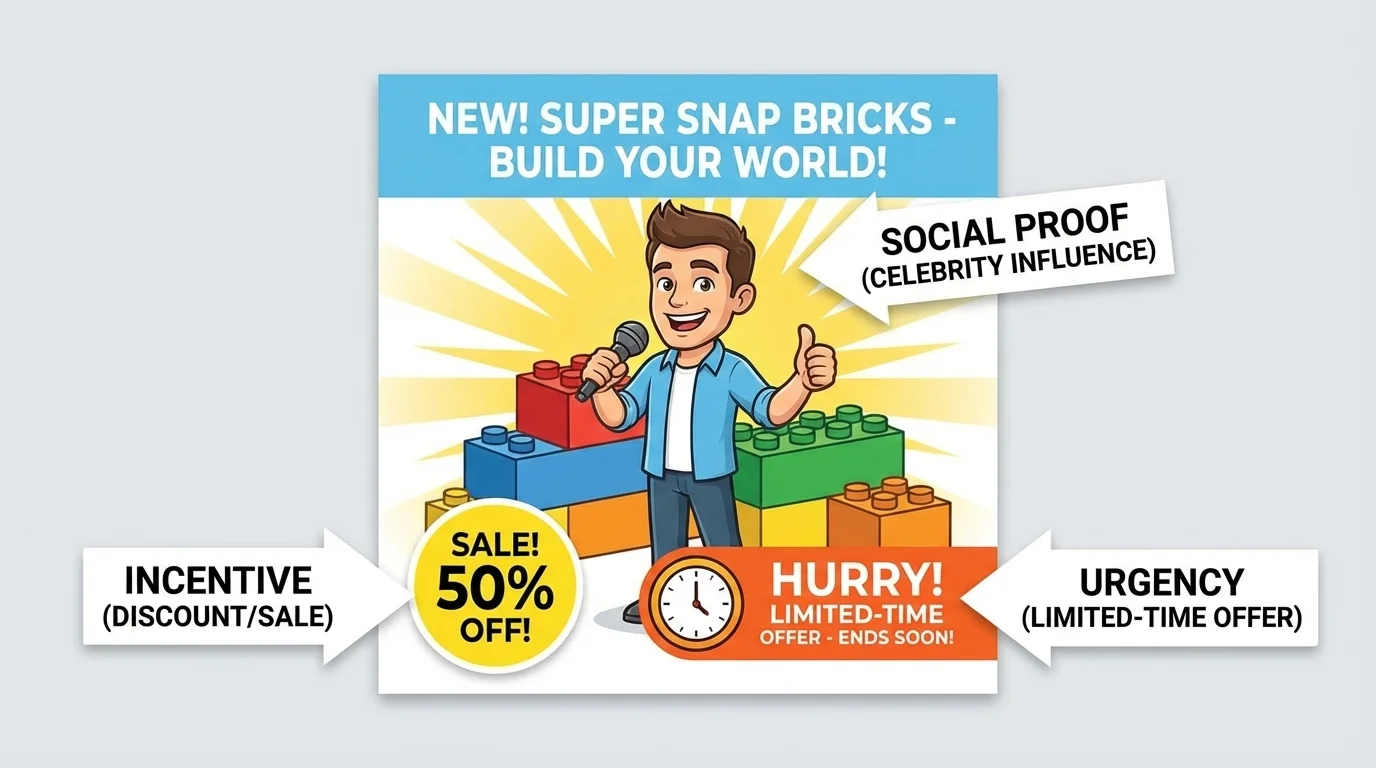
Not every ad uses every trick, but many use several at once. That is why ads can feel powerful. They are designed that way.
Another important thing to watch for is what the ad does not say. Maybe it shows the fun parts but hides the extra costs, low quality, or the fact that something does not last long. When you only see the exciting part, the product can seem better than it really is.
Buying choices are not shaped only by ads. Other people can strongly affect them too, as [Figure 2] illustrates. Sometimes the influence is direct, like a friend saying, "Get this one." Sometimes it is indirect, like seeing many people online talk about the same item.
Here are a few common sources of social influence:
Friends and peers: You may want what others have so you can feel included.
Family: Family members may recommend brands or say certain purchases are smart or wasteful.
Influencers: These are online creators whose opinions can shape what people buy.
Reviews: Ratings and comments can help, but some are more trustworthy than others.
Trends: When something becomes popular fast, it can create pressure to join in before the trend fades.
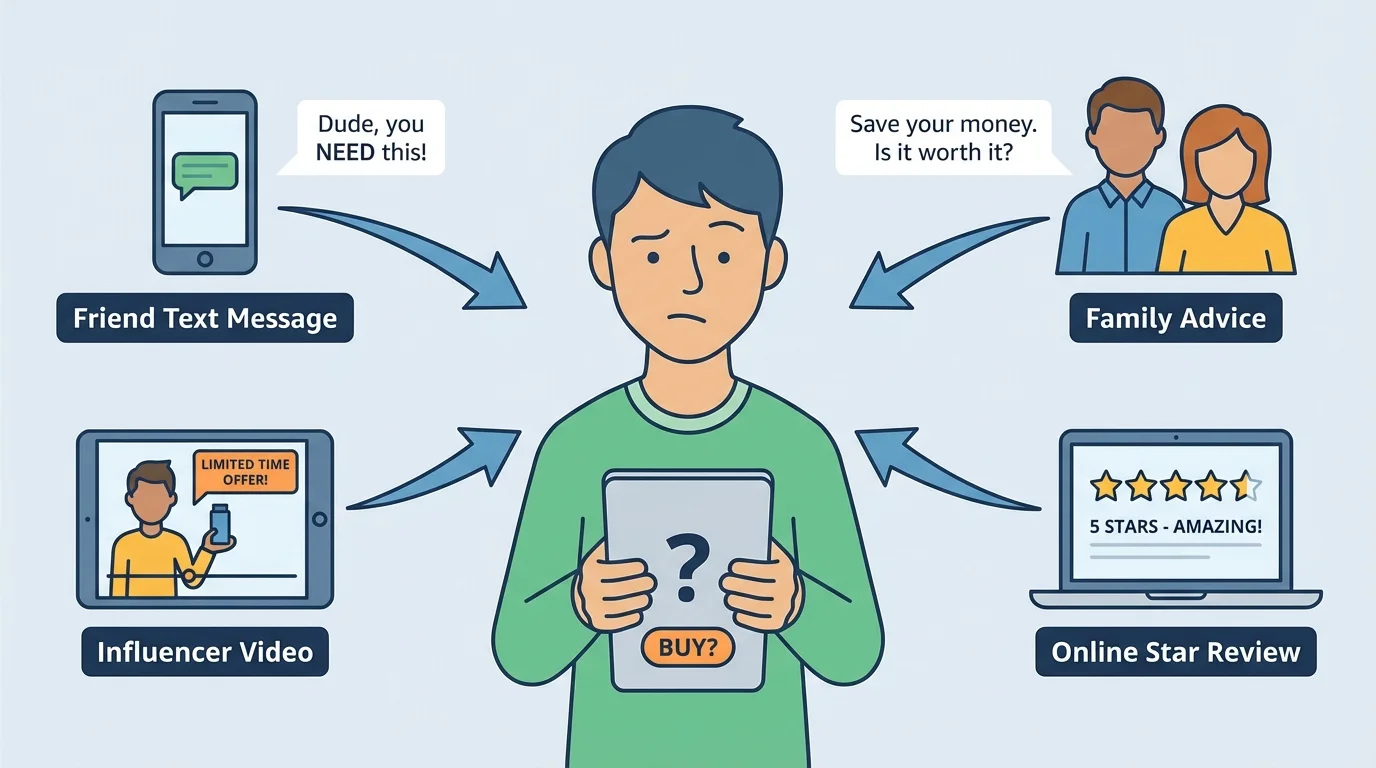
Influence is not always bad. A trusted adult might help you avoid wasting money. A helpful review might point out that an item breaks easily. The key is learning to tell the difference between useful advice and pressure.
Pressure often sounds like this: "Everyone has it," "You have to get it now," or "If you do not buy it, you will miss out." Useful advice sounds more like this: "Let's compare options," "Check if it fits your budget," or "Read what is included."
To make smart spending decisions, you need three ideas: needs, wants, and a budget. A need is something important for daily life, health, or safety. A want is something you would enjoy but can live without. Many things kids buy are wants, and that is okay. The problem starts when you spend on wants without thinking.
A budget is a plan for your money. If you have $20 and you want to buy a game accessory for $12 and a snack for $5, you can check the total: \(12 + 5 = 17\). That leaves \(20 - 17 = 3\). If there is also tax or another small cost, you might have even less left than you expected.
Why budgets protect your choices
When you know your money limit before you shop, ads and pressure have less power over you. A budget acts like a guardrail. It reminds you, "I may like this, but does it fit my plan?"
Without a budget, it is easy to buy one exciting thing and then realize later that you do not have enough money for something more important. With a budget, you can enjoy spending while still staying in control.
One of the best ways to resist pressure is to use a simple decision process before you buy. This step-by-step check works for small choices and bigger ones, and [Figure 3] shows the flow clearly.
Step 1: Ask, "Is this a need or a want?"
Step 2: Ask, "Why do I want it?" Is it because it is useful, or because an ad or person made it seem exciting?
Step 3: Check the price and your budget.
Step 4: Compare options. Is there a cheaper, better, or longer-lasting choice?
Step 5: Wait. For a non-urgent purchase, take time before deciding.
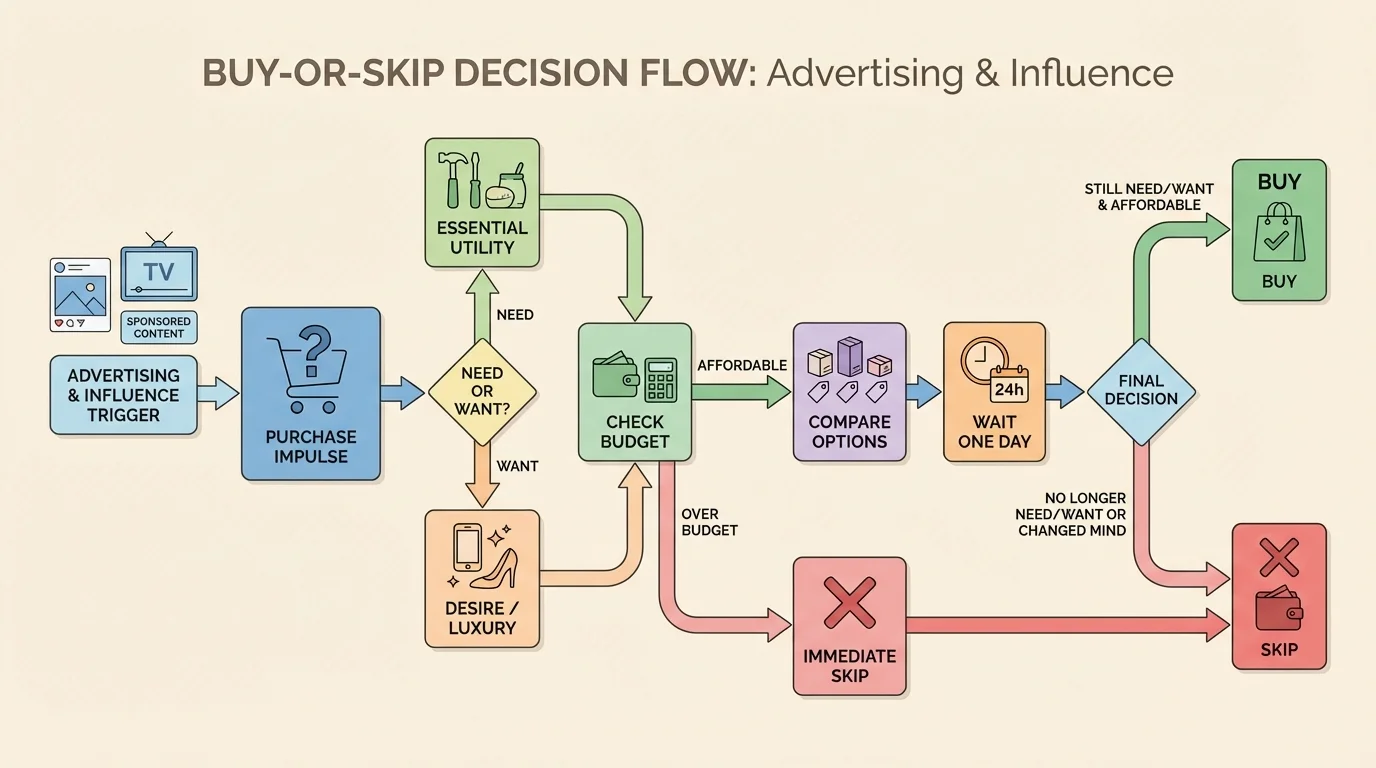
That waiting step is powerful. Strong feelings often shrink with time. If you still want the item later and it fits your budget, the decision may be a better one.
Using the smart spending check for a snack purchase
You have $8. You see a brightly packaged candy pack for $5 because the ad says it is a "must-try new flavor."
Step 1: Need or want?
It is a want, not a need.
Step 2: Why do you want it?
The packaging and ad made it feel exciting.
Step 3: Check money.
If you spend $5, you will have \(8 - 5 = 3\) left.
Step 4: Compare.
A different snack costs $2 and you already know you like it.
Step 5: Decide.
You might skip the expensive candy and keep more money for later.
The smart choice is not always "do not buy." The smart choice is to buy only after thinking clearly.
As the flow in [Figure 3] reminds you, a short pause can stop a rushed purchase and give your brain time to catch up with your feelings.
Let's look at how this works in situations you might actually face.
Example 1: The in-game item
A game offers a limited-time costume for $7. A countdown timer makes it feel urgent.
Step 1: Notice the persuasion.
The timer creates urgency. That is a common advertising trick, like the one shown earlier in [Figure 1].
Step 2: Check your reason.
Do you want the item because you truly like it, or because you are afraid of missing out?
Step 3: Check your budget.
If you have $10, then buying it leaves \(10 - 7 = 3\).
Step 4: Think ahead.
Will you still care about this item next week?
A smart choice might be to wait and see if the urge fades.
Game purchases can feel small, but many small purchases add up. If someone buys three $7 items over time, the total is \(7 + 7 + 7 = 21\). That is enough money for a bigger goal.
Example 2: The trending water bottle
Several kids in your activity group have the same brand. You start wanting one too.
Step 1: Spot the influence.
This is social influence, like the kinds connected in [Figure 2].
Step 2: Ask what matters.
Do you need a water bottle, or do you only want that exact brand?
Step 3: Compare function and price.
If one bottle costs $18 and another sturdy bottle costs $9, the difference is \(18 - 9 = 9\).
Step 4: Decide based on value.
If both hold water well and are durable, the lower-cost option may be the smarter buy.
This helps you choose based on usefulness, not only on what is popular.
Sometimes trends fade fast. A month later, people may move on to something else, but your money is already gone.
Example 3: The creator-recommended art set
Your favorite creator says an art set is amazing. The set costs $24.
Step 1: Pause.
Remember that creators may be paid to promote products.
Step 2: Research.
Read reviews and see whether buyers mention missing pieces or low quality.
Step 3: Compare.
If another set has similar supplies for $16, the price difference is \(24 - 16 = 8\).
Step 4: Match the purchase to your goals.
If art is a hobby you use often, it may be worth spending more for quality. If not, a simpler set may be enough.
Good spending decisions match both your budget and your real use of the item.
Some signs should make you slow down right away. These are red flags in spending:
You feel rushed. Pressure and countdowns can push quick choices.
You only know the exciting part. You have not checked details, size, quality, or total cost.
You want it mainly because others have it. That can lead to regret.
You would use money meant for something else. This is a sign the purchase may not fit your plan.
You feel nervous about asking an adult or checking twice. If a choice feels secretive or uncomfortable, pause.
Good spending habits are the opposite. Compare prices. Ask questions. Read what is included. Think about how long you will use the item. Give yourself time. Keep savings for goals that matter more.
You do not have to reject every fun purchase. The goal is balance. Enjoying your money is fine when you are making the choice on purpose instead of being pushed into it.
When you practice these habits often, you become a more informed consumer. That means you understand how buying works and can protect your money from pressure.
Advertising is not only something to defend yourself from. You can also use it wisely. For example, ads can alert you to sales, coupons, or new products that truly fit your needs. The trick is to stay in charge.
If an ad shows a sale, check whether it is really a good deal. A shirt marked down from $20 to $15 saves $5 because \(20 - 15 = 5\). But if you did not need the shirt at all, you still spent $15. Saving money on something unnecessary is not the same as making a smart choice.
| Situation | Pressure-Filled Thinking | Smart Thinking |
|---|---|---|
| Sale ad | "It is on sale, so I must buy it." | "Do I need it, and is it still within my budget?" |
| Influencer recommendation | "They like it, so it must be great." | "Was this sponsored, and what do other reviews say?" |
| Friend has it | "I need the same one." | "Will this actually be useful for me?" |
| Countdown timer | "I have to decide now." | "Rushing is a warning sign. I can pause." |
Table 1. A comparison of pressure-filled thoughts and smart consumer questions.
The more you ask these smart questions, the easier they become. Over time, you start noticing persuasion sooner. You begin to hear the hidden message behind the ad: "Spend now." Then you can answer with your own message: "I will decide after I think."
"If you do not tell your money where to go, it will disappear little by little."
That idea matters because spending is not only about the item in front of you. It is also about what else your money could do. Money spent on one thing cannot also be used for something else. That is why every choice has a trade-off.
When you notice ad tricks from [Figure 1], watch social pressure like the paths in [Figure 2], and use the pause-and-check process from [Figure 3], you make spending decisions with more confidence and less regret.
