Some relationships get stronger not because people spend more time together, but because they learn how to treat each other well. A friendship can start with just a few messages, a shared game, or a video call. But as people get closer, the rules matter more: Can you say no? Do they keep your secrets safe? Do they listen when you feel uncomfortable? Those answers help decide whether a relationship grows in a healthy way.
As you get older, your relationships become more complicated. You may have close friends online, teammates in community sports, cousins you text often, neighbors you see every week, or people you collaborate with in clubs and activities. Healthy relationships are not about doing everything together or agreeing all the time. They are about knowing how to care for yourself and others at the same time.
When you are younger, adults often make many decisions for you. As you grow, you start making more choices about your conversations, your time, your online spaces, and the people you trust. That is why learning about boundaries, privacy, and respect becomes so important.
A growing relationship usually means two people are learning more about each other. They may share jokes, opinions, worries, and plans. This can feel exciting, but it also means each person needs to be careful. If one person pushes too hard, shares private information, or ignores feelings, the relationship can become stressful instead of supportive.
Boundaries are limits that help you feel safe and comfortable. Privacy means having control over personal information, personal space, and private thoughts or belongings. Respect means treating yourself and others with care, fairness, and kindness, even when you disagree.
These three ideas work together. Boundaries tell people where your limits are. Privacy helps protect personal parts of your life. Respect is the way people honor those limits and protections. When all three are present, trust has a chance to grow.
Boundaries are not walls that shut everyone out. They are healthy limits that help you stay safe, calm, and comfortable. They can be about space, feelings, devices, and time, as shown in [Figure 1]. A boundary helps you say, "This is okay for me," or "This is not okay for me."
There are different kinds of boundaries. Physical boundaries are about your body and personal space. Emotional boundaries are about your feelings and what you are ready to talk about. Digital boundaries are about messages, photos, accounts, and online behavior. Time boundaries are about how much time and energy you can give.
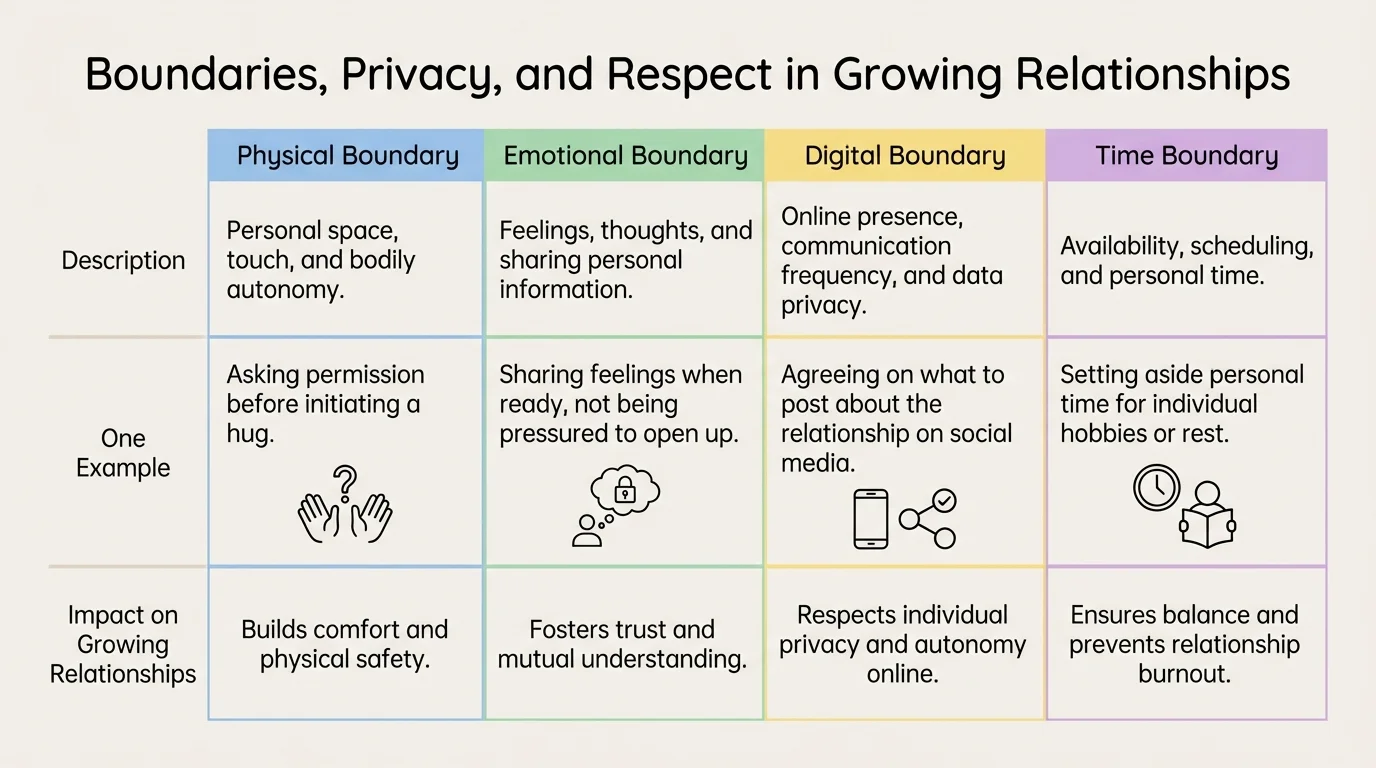
Here are simple examples of each kind of boundary:
Physical boundary: You do not want someone to grab your shoulders during a video call or pressure you to show your room on camera.
Emotional boundary: A friend keeps asking why you seem upset, but you are not ready to explain yet.
Digital boundary: Someone asks for your password, wants to read your private messages, or tells you to send a picture you do not want to share.
Time boundary: A friend expects you to answer every message right away, even when you are busy with family time, homework, or rest.
Healthy people understand that everyone has different limits. One friend may love long video chats, while another prefers shorter check-ins. One person may enjoy joking around, while another wants more serious and careful communication. As we saw in [Figure 1], boundaries are not all the same. What matters is noticing, speaking up, and listening.
Having a boundary does not make you rude, mean, or unfriendly. It means you are taking care of yourself. A strong friendship can handle honest limits. In fact, relationships often become stronger when both people know what feels comfortable and what does not.
Many friendship problems do not start with someone trying to be cruel. They start with one person guessing instead of asking. Clear boundaries can stop small problems from turning into big ones.
It is also important to respect other people's boundaries. If a friend says, "I don't want to talk about that," the respectful response is not pushing harder. If someone says, "Please don't post that picture," respect means not posting it. Boundaries only work when people honor them.
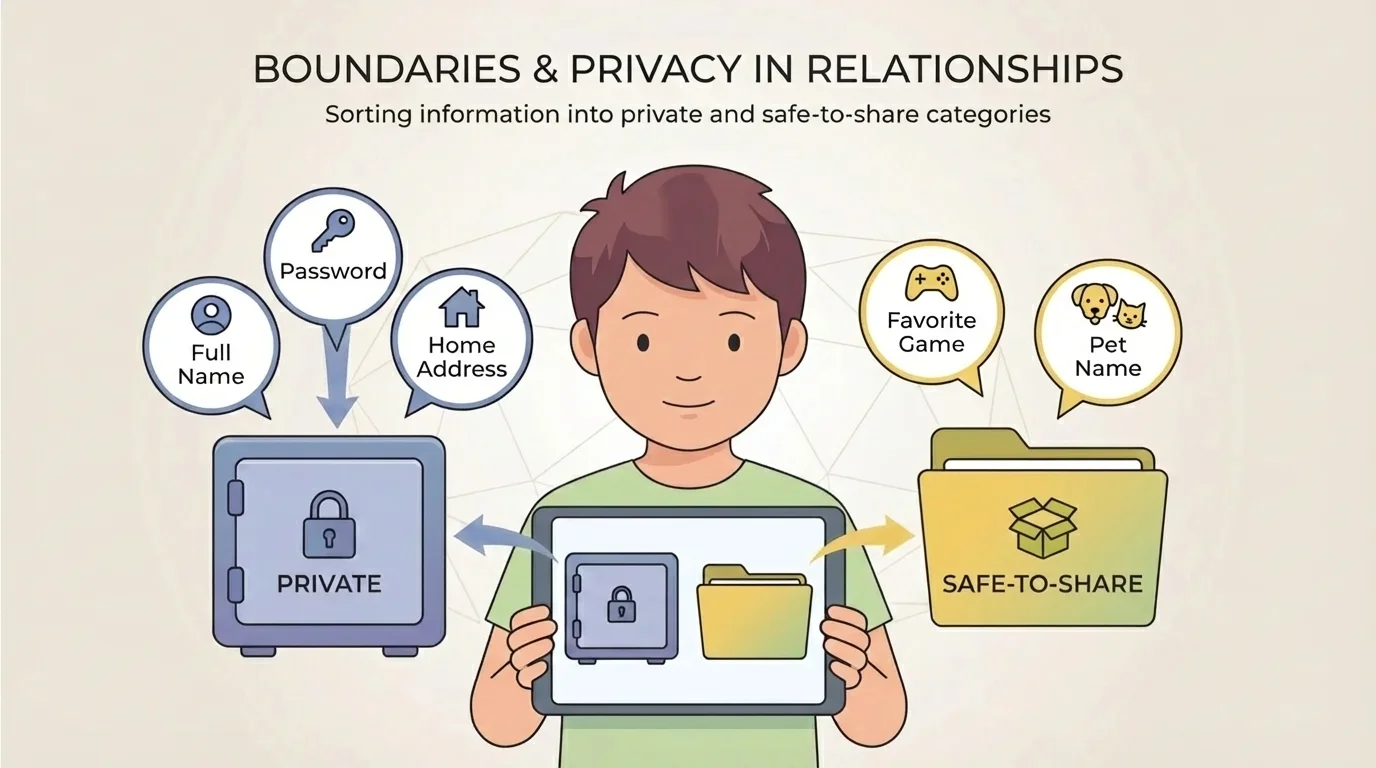
Privacy is about control. You get to decide what personal information, thoughts, and belongings you share. Some information should stay protected online and at home, as [Figure 2] shows. Privacy is not about hiding bad behavior. It is about keeping personal things safe.
Private information can include your password, home address, phone number, full name, school or activity schedule, private messages, diary or journal entries, and photos you do not want shared. Even if someone is your friend, they do not automatically get access to everything about you.
Think about these situations:
Scenario 1: A friend says, "If you trust me, give me your password." That is not a healthy request. Trust does not mean giving away control of your account.
Scenario 2: Someone takes a screenshot of your private chat and shares it with others. That breaks privacy, even if they say it was "just funny."
Scenario 3: A cousin walks into your room and starts reading your notebook without asking. That is also a privacy problem.
Scenario 4: A teammate asks before posting a group photo from an event. That is a respectful way to handle privacy.
Privacy also means you should be careful with other people's information. If a friend tells you something personal, do not pass it along just because it is interesting. If someone sends you a message meant only for you, think carefully before showing it to anyone else. [Figure 2] reminds you that some things belong in the private category even when sharing feels easy.
Privacy and trust are connected, but they are not the same. You can trust someone and still keep some things private. Healthy relationships allow both closeness and personal space. You do not have to share every thought, every message, or every password to prove you care.
Sometimes adults may need to step in for safety reasons. For example, if a trusted adult checks a device because they believe a child may be in danger, that is different from a friend demanding access. Safety rules and friendship rules are not always the same. When you are unsure, ask a trusted adult to help you sort it out.
Respect is the action that makes boundaries and privacy real. A person can say "I care about you," but their choices show whether that is true. Respect looks like listening, asking first, accepting no, telling the truth, and being careful with another person's feelings and information.
Trust grows slowly. It is built through many small moments: not laughing when someone is serious, not sharing secrets for attention, not teasing someone after they ask you to stop, and not pressuring a friend to do something that feels wrong. Respect is not only about being nice when things are easy. It matters most when you do not get your way.
One important part of respect is consent. Consent means giving permission freely. In everyday life, that can mean asking before posting a picture, before borrowing something, before adding someone to a group chat, or before bringing up a topic that may feel personal. If the answer is no, respect means stopping.
"A caring relationship makes room for both people to feel safe."
Respect also includes how you talk. Saying, "Come on, don't be so dramatic," after someone shares a boundary is disrespectful. Saying, "Okay, thanks for telling me," is respectful. The words you choose can either make someone feel heard or make them feel smaller.
Another part of respect is honesty. If you made a mistake, it is better to admit it than to hide it. For example, if you shared a photo without asking, a respectful response is to take it down, apologize, and learn from it. Pretending it was no big deal usually makes the hurt worse.
These ideas are strongest when they work together. Imagine a friendship where one person says, "I don't want to talk about my family problems right now." That is a boundary. The other person does not tell others what they already know. That protects privacy. They also respond kindly and stop asking. That shows respect.
Now think about the opposite. A person keeps asking questions after being told to stop, then shares what they learned in a group chat, and laughs when the other person gets upset. That relationship may feel unsafe and unhealthy because all three parts are missing.
Healthy relationships do not mean perfect relationships. People make mistakes. Someone may forget to ask before posting a photo or may joke too far before realizing it. What matters is how they respond after the mistake. Do they listen, fix it, and change their behavior? Or do they blame you for being upset?
Real-life comparison
Step 1: Healthy response
You tell a friend, "Please don't share my voice message." They answer, "Okay, I won't," and they keep that promise.
Step 2: Unhealthy response
You say the same thing, but they send it to others anyway and then say, "You're overreacting."
Step 3: What this tells you
The first response protects privacy and shows respect. The second response breaks trust and ignores your boundary.
When you notice this pattern, it becomes easier to decide who is safe to trust more deeply. Growing relationships need kindness, but they also need responsibility.
Many relationship problems show up in everyday moments, not huge dramatic events. That is why it helps to think through normal situations before they happen.
Group chats: If someone adds you to a chat without asking, you can say, "Please ask me before adding me next time." If people start gossiping or sharing private screenshots, leaving the chat and telling a trusted adult may be the smart move.
Gaming: If a player demands your social media, photo, or personal details, you do not owe them that information. You can refuse, block, mute, and report if needed.
Video calls: You do not have to turn your camera on if you are uncomfortable. You can also choose what part of your home is visible.
Family and siblings: You can say, "Please knock before coming in," or "Please don't read my messages over my shoulder." Respect goes both ways, so you should also avoid grabbing their belongings or sharing their stories without permission.
Teams, clubs, and activities: Jokes should stop when someone says stop. Teammates do not have to hug, share personal stories, or join every social chat to be good team members.
| Situation | Healthy choice | Unhealthy choice |
|---|---|---|
| Friend asks for password | Say no and protect your account | Share it to prove trust |
| Photo from an event | Ask before posting | Post first and laugh later |
| Private message received | Keep it private unless safety is a concern | Screenshot and spread it |
| Friend says no | Accept the answer | Keep pushing |
| You feel uncomfortable | Speak up or get help | Stay silent just to please others |
Table 1. Everyday choices that either protect or damage a relationship.
Good decisions in small moments build strong patterns. Poor decisions in small moments can slowly break trust, even if no single event seems huge.
It can feel hard to speak up, especially if you do not want to hurt someone's feelings. But you do not need a long speech. There is a simple path you can follow when something feels off, as [Figure 3] illustrates. The goal is to be clear, calm, and direct.
Start by noticing your body and feelings. If you feel tense, embarrassed, pressured, worried, or annoyed, that may be a sign that a boundary is needed. You do not need to wait until you are extremely upset.
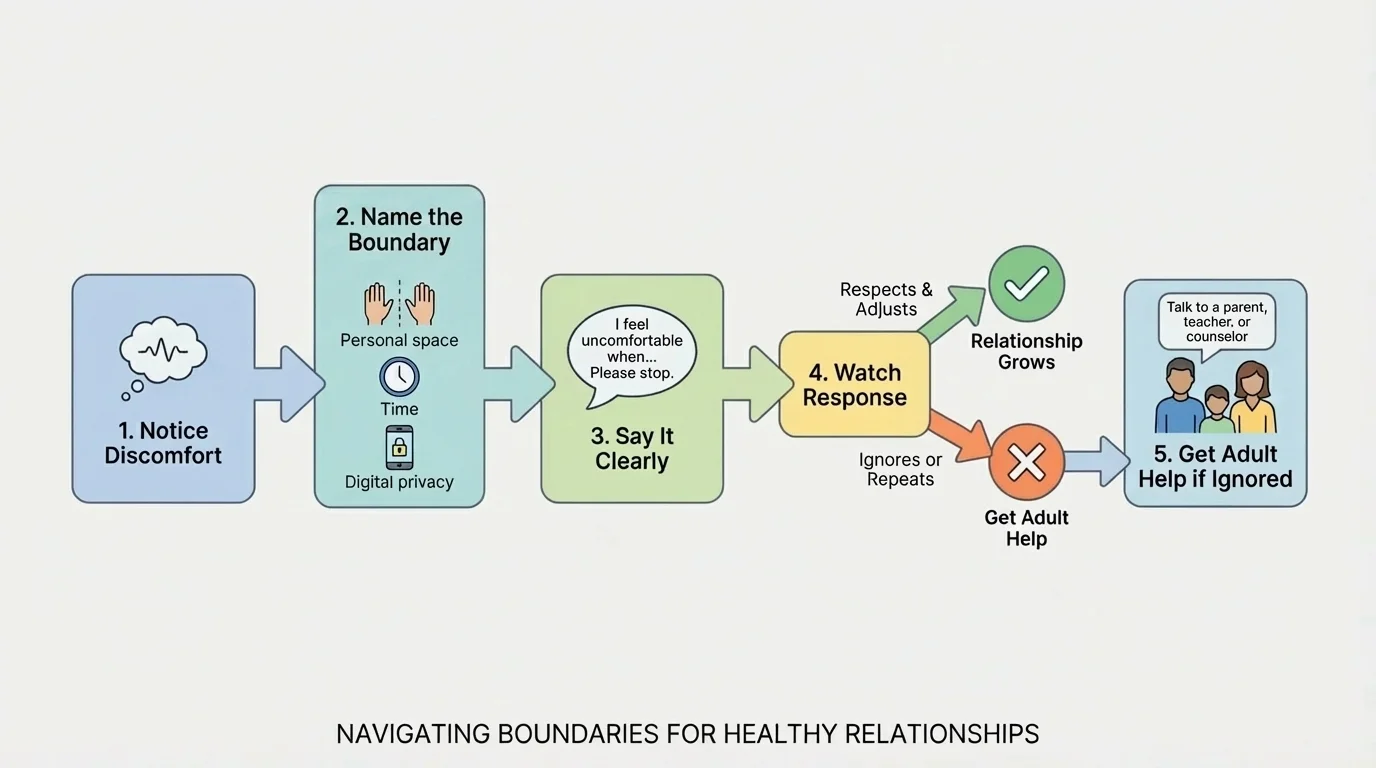
Here are simple steps you can use:
Step 1: Notice the problem. Ask yourself, "What feels wrong here?"
Step 2: Name the boundary. Is it about space, privacy, feelings, or time?
Step 3: Say it clearly. Use short words.
Step 4: Watch the response. A respectful person may not love your answer, but they will listen.
Step 5: Get help if needed. If the behavior continues, talk to a trusted adult.
Useful scripts
Step 1: Setting a boundary
"Please don't share that."
"I'm not ready to talk about this."
"I need a break from messaging right now."
Step 2: Protecting privacy
"I don't give out my password."
"That's private."
"Please ask before posting my picture."
Step 3: Responding with respect
"Okay, thanks for telling me."
"I understand."
"Sorry, I won't do that again."
As shown earlier in [Figure 3], the most important part is not sounding perfect. It is taking action early, before a small problem grows bigger.
If you are the one being corrected, try not to become defensive right away. Listen first. You can say, "Thanks for telling me," even if you feel embarrassed. That response protects the relationship better than arguing.
Some problems can be handled with a clear conversation. Others need adult support right away. A red flag is a warning sign that something may be unsafe or unhealthy.
Red flags can include repeated pressure after you say no, threats like "I'll stop being your friend if you don't do this," demands for passwords or secret pictures, sharing your private information, trying to isolate you from other trusted people, or telling you to keep unsafe behavior secret from adults.
It is also a red flag if someone makes you feel scared to set a boundary. Healthy relationships allow room for honesty. They do not punish people for having limits.
Trusted adults can include a parent, guardian, family member, coach, counselor, club leader, or another adult who takes your concerns seriously. Asking for help is a smart safety choice, not tattling.
Get adult help right away if someone asks for personal photos, tries to get your address or password, threatens you, keeps contacting you after you block them, or shares private information to embarrass you. If something feels unsafe, trust that feeling and get support quickly.
Healthy relationships grow best when both people feel safe, heard, and respected. You do not build that in one conversation. You build it over time by noticing what matters to the other person, being honest, asking before sharing, and accepting limits.
You can strengthen your relationships by checking in with simple questions: "Is this okay to share?" "Do you want advice or just someone to listen?" "Is now a good time to talk?" These small habits show care. They also prevent misunderstandings.
Another smart habit is balance. You can be kind without saying yes to everything. You can be private without being secretive. You can be friendly without giving up your comfort. Strong relationships make room for both closeness and independence.
When you protect your own boundaries, respect other people's privacy, and treat others with care, you help relationships become more trustworthy. And when someone does the same for you, that is a sign the relationship is growing in a healthy direction.
Try This: Before your next group chat, game, or video call, think of one boundary you want to keep, one private detail you will protect, and one respectful action you will practice. Small choices like these can change the way your relationships feel.
