Have you ever noticed how one tiny problem at home can turn into three bigger ones? A missing charger can leave your device uncharged. An uncharged device can make you miss your online class. Then you feel rushed, frustrated, and behind. Practical living skills help stop that chain reaction. When you plan ahead, solve problems calmly, and stay organized, home life runs more smoothly and you feel more in control.
These skills are not just for adults. You use them every day when you get ready for online learning, help with chores, keep track of supplies, or figure out what to do when something goes wrong. Being responsible at home does not mean being perfect. It means noticing what needs attention, taking smart steps, and asking for help when needed.
At home, there is always something to manage: meals, laundry, pet care, charging devices, cleaning up, sharing space, and keeping track of important items. Planning ahead means thinking about what you will need before the last minute. Problem-solving means finding a safe and useful way to fix an issue. Organization means giving your time, space, and belongings some order so life is less stressful.
Planning ahead means preparing early for something you know will happen.
Problem-solving means noticing a problem, thinking of safe choices, and trying a solution.
Organization means arranging time, tasks, and belongings so they are easy to manage.
When these skills are strong, you waste less time, lose fewer things, and feel calmer. When these skills are weak, jobs get forgotten, messes grow, and small problems become emergencies. That is why practical living skills matter so much in independent living.
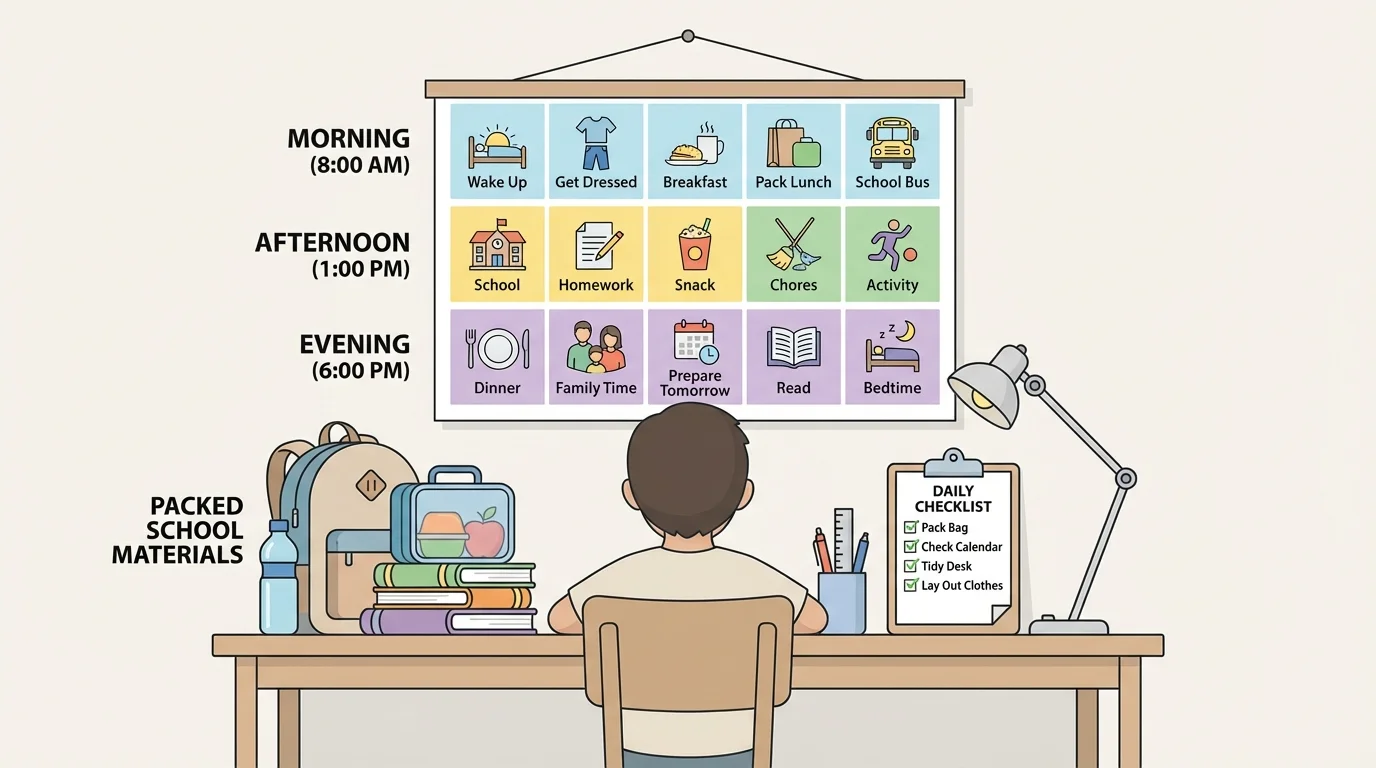
A good home plan does not have to be fancy. It can be a notebook, a wall calendar, sticky notes, or a reminder app. What matters is that your system helps you remember what to do and when to do it. As [Figure 1] shows, a simple plan works best when your calendar, checklist, and packed supplies all support each other.
One useful habit is the look-ahead routine. At the end of the day, take a few minutes to ask: What do I need tomorrow? Do I need clean clothes, a charged device, homework materials, sports gear, or lunch items? This short check can save a lot of stress the next morning.
You can also make a daily checklist. Keep it short and realistic. For example: charge tablet, fill water bottle, set out clothes, check chore list, and put reading book by desk. If you have five jobs and finish three, that is still progress. The goal is steady action, not perfection.
Planning ahead also means noticing supplies before they run out. If your soap is almost empty, your pet food bag feels light, or the printer paper stack is small, that is a signal to tell a family member or add it to a shopping list. Waiting until something is completely gone often creates extra problems.
A smart planner estimates time honestly. If cleaning your room usually takes about 20 minutes, do not tell yourself it will take only 5. If a task has three parts, count all three parts. For example, taking care of laundry might include sorting, moving clothes to the dryer, and folding. Honest planning helps you avoid rushing.
Your brain remembers tasks better when you write them down and put them in the same place every day. A regular checklist or calendar can lower stress because you do not have to keep every job in your head.
Later, when your day feels busy, the planning system in [Figure 1] still helps: instead of trying to remember everything, you can check your list and take the next step.
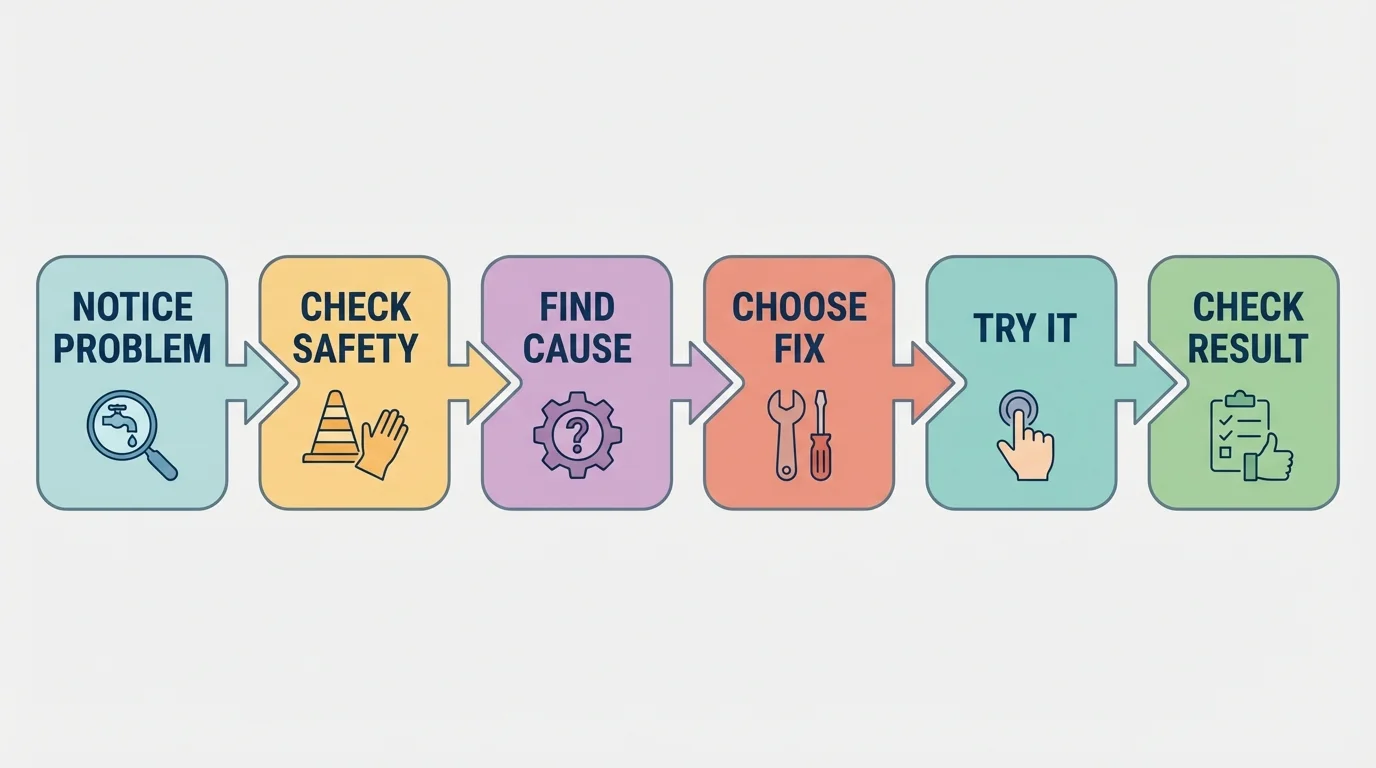
Every home has surprises: a spill on the floor, a missing remote, a backpack strap that loosens, a light that will not turn on, or a sink that seems clogged. Instead of panicking, use a routine for solving problems. As [Figure 2] illustrates, a good method moves from noticing the problem to checking safety, finding the cause, choosing a fix, and checking whether it worked.
Here is a simple process you can use for many household problems. Step 1: Notice exactly what is wrong. Step 2: Check safety first. Step 3: Think about the cause. Step 4: Choose a solution. Step 5: Try it and see if it works.
Safety always comes before fixing. If there is broken glass, a strong smell of gas, smoke, sparks, a sharp tool, a medicine issue, or anything involving electricity and water together, stop and get an adult right away. Being responsible includes knowing your limits.
Here is how the process looks in real life. Suppose the lamp does not turn on. First, notice the exact problem: the lamp is plugged in, but no light appears. Next, think safely: do not touch frayed wires or open anything electrical. Then check simple causes: Is the bulb loose? Is the outlet switch off? Is the power strip turned off? Many home problems have simple causes.
Another example is a spill. If juice spills on the counter, act quickly. Move electronics away, wipe the liquid, and dry the surface. If you leave it, the mess can spread, become sticky, attract bugs, or damage items nearby. Quick action often makes problems easier to solve.
Start with the simplest safe fix. Many people waste time by jumping to big solutions too fast. A better habit is to try the easiest safe check first: look, clean, tighten, replace batteries, recharge, or ask where something belongs. Simple causes are common, and simple fixes save time.
When a problem repeats, pay attention. If you keep losing the same item, the problem may not be memory. The real problem may be that the item has no set place. If the trash overflows every week, the issue may be that no one is checking it often enough. Repeated problems usually need a better system, not just a one-time fix.
That is why the flow of choices in [Figure 2] matters. It reminds you that solving a problem is not guessing wildly; it is a calm process.
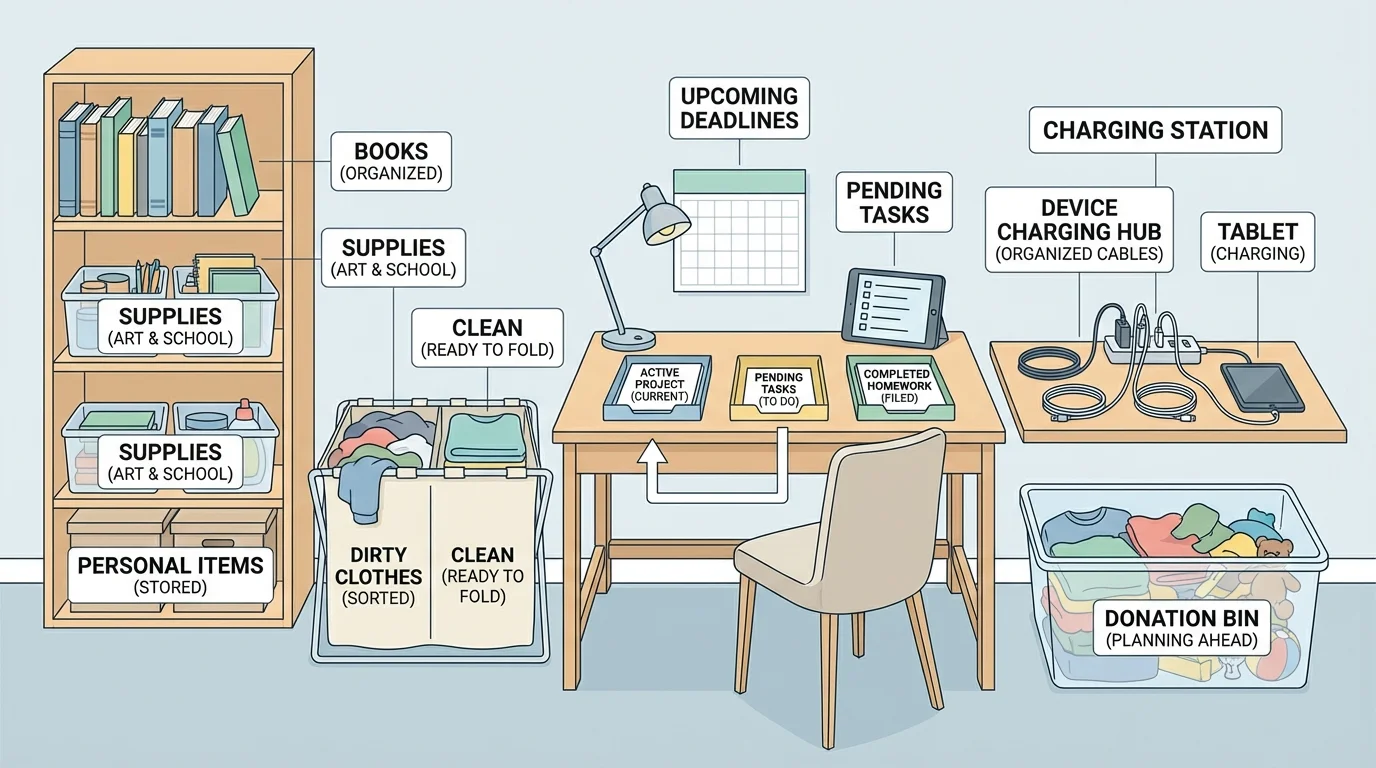
Being organized does not mean your room has to look perfect all the time. It means your things are easy to find, use, and put away. One of the best ways to do that is to create zones. As [Figure 3] shows, a room can have a homework zone, a charging zone, a clothing zone, and a donation zone.
Give every important item a home. Keys go in one dish. Chargers go in one basket. Books go on one shelf. Dirty clothes go in one hamper. When an item has no home, it often ends up everywhere. That creates clutter and wastes time.
Labels can help, especially for shared family spaces. A short label such as "art supplies," "pet care," or "game controllers" makes it easier for everyone to return items where they belong. Labels are not babyish. They are practical tools that save time.
Try a reset habit. A reset means putting a space back in order after you use it. After snack time, wipe the table and put dishes away. After art time, return markers and paper. After online class, put materials back in your learning spot. Small resets stop messes from building into giant cleanup jobs.
It also helps to sort items into groups: keep, store, donate, recycle, or throw away. If you have not used something in a long time, ask if it still belongs in your space. Too much stuff makes organization harder because every item needs a place and attention.
| Item | Best Home | Why It Helps |
|---|---|---|
| Chargers | One basket or drawer | Easy to find and less likely to get damaged |
| Homework supplies | Desk caddy or shelf | Ready for online learning |
| Dirty clothes | Laundry hamper | Keeps floor clear |
| Pet supplies | Small labeled bin | Makes feeding and care faster |
| Important papers | Folder or binder | Prevents loss and crumpling |
Table 1. Examples of common household items, where to keep them, and how that organization helps.
When you start to feel overwhelmed by clutter, use the room setup in [Figure 3] as a reminder: organize by purpose, not by guessing.
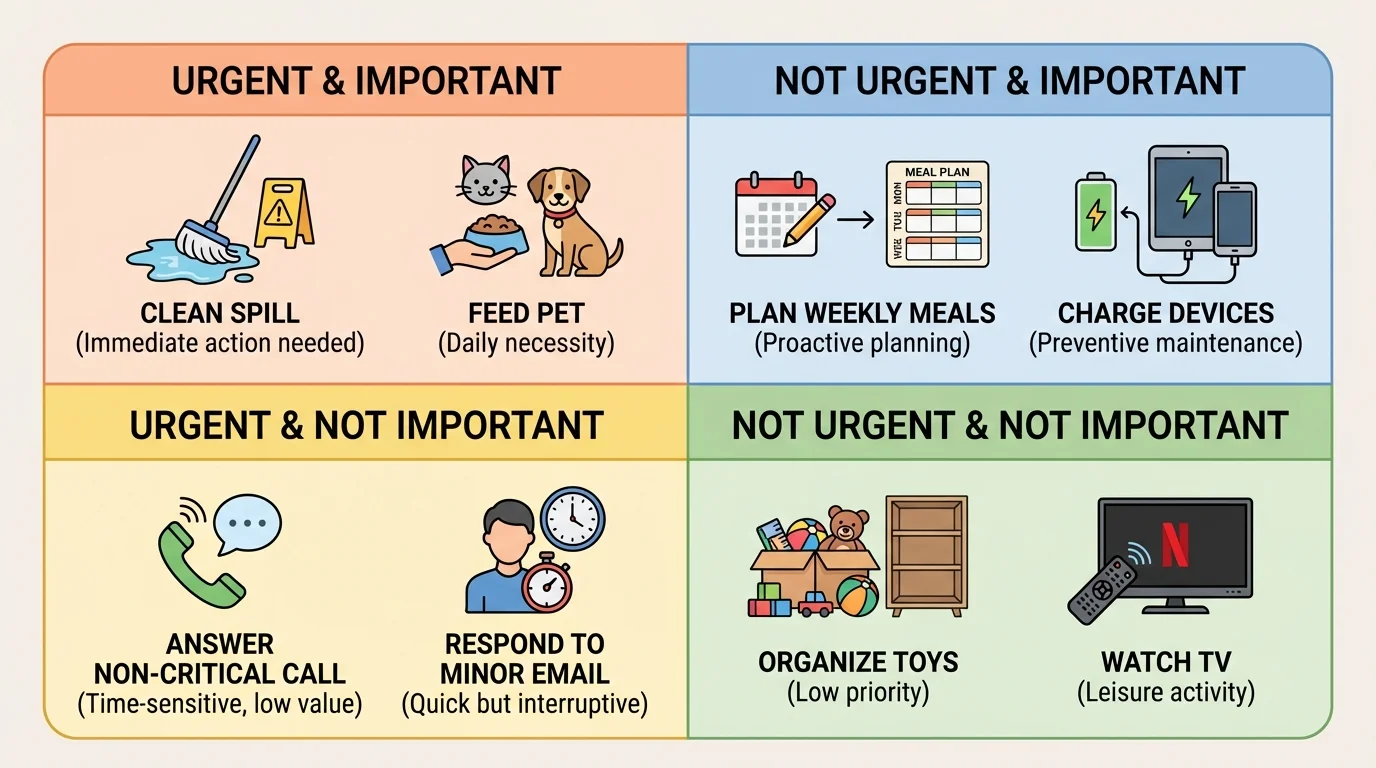
Sometimes the hardest part is not doing a task. It is deciding what to do first. If several jobs are waiting, compare what is urgent and what is important. As [Figure 4] illustrates, urgent jobs need attention soon, while important jobs matter a lot even if they are not due this second.
For example, cleaning a fresh spill is urgent because waiting makes it worse. Charging your device for tomorrow is important because it affects the next day. Feeding a pet may be both urgent and important. Organizing old toys may be important, but not urgent.
You can estimate tasks with simple numbers. If one chore takes about 10 minutes and another takes about 30 minutes, then doing both will take about 40 minutes because \(10 + 30 = 40\). That kind of simple planning helps you fit jobs into your day without guessing.
Big tasks become easier when you break them into smaller parts. "Clean the kitchen" might feel huge. But "put away dishes," "wipe counters," and "sweep floor" feels more manageable. Each part is a clear action.
Another useful skill is building in a backup plan. If your internet is slow, maybe you move closer to the router or use downloaded materials. If your usual pen is missing, you keep one extra in your desk. Planning for common problems does not mean expecting disaster. It means being ready.
Example: Choosing what to do first
You have four tasks: feed the dog, clean a cereal spill, charge your tablet, and sort a toy shelf.
Step 1: Find the urgent task.
The cereal spill is urgent because it can become sticky and someone could slip.
Step 2: Find the task that cannot wait long.
Feeding the dog comes next because a pet depends on people for care.
Step 3: Do the important preparation task.
Charge the tablet so it is ready later.
Step 4: Save the flexible task for last.
Sorting the toy shelf can happen after the more urgent jobs are done.
This order handles safety, care, and preparation before less urgent organizing.
Later, if you are unsure what deserves attention first, the chart in [Figure 4] helps you sort your choices quickly.
Independent living does not mean doing everything alone. It means knowing how to explain a situation clearly. If something is broken, missing, or unsafe, be specific. Instead of saying, "It doesn't work," say, "The kitchen light flickers when I switch it on," or "We are almost out of dish soap." Clear communication helps the right problem get solved faster.
When you share space with family members, respectful communication matters. You may need to ask, "Whose turn is it to take out the trash?" or say, "I moved the scissors back to the art drawer." Sharing information prevents confusion.
If you have learned about using respectful words online, the same idea fits at home: be clear, calm, and kind. Good communication is not just about speaking. It also includes listening, noticing details, and confirming what needs to happen next.
There are also times when asking for help is the smartest choice. Ask right away if a problem involves fire, electrical damage, sharp objects, strong chemicals, medicine, strangers at the door, or anything that feels unsafe. Being careful is a strength, not a weakness.
Habits are actions you repeat so often that they become more automatic. Good habits make practical living easier because you do not have to decide everything from scratch each time. If you always hang your backpack in the same place, you stop searching for it. If you always check tomorrow's schedule each evening, you stop getting surprised by what is coming.
Start small. Choose one habit, not ten. Maybe your first habit is a nightly five-minute reset. Maybe it is charging your device before bed. Maybe it is checking the family chore board after breakfast. Small habits are easier to keep, and repeated success builds confidence.
"Small steps done regularly can solve big problems before they even start."
If you forget a habit one day, do not quit. Restart the next day. Practical life skills grow through repetition, not through being perfect every single time.
Here are a few everyday situations where these skills work together.
Case study: The missing water bottle
You cannot find your water bottle before a video club meeting.
Step 1: Stop and think.
Do not run around grabbing random things. Remember the last place you used it.
Step 2: Check the item's usual home.
If it has no usual home, that may be the real problem.
Step 3: Search in order.
Desk, kitchen counter, living room table, and bag are smarter places to check than searching everywhere at once.
Step 4: Make a better plan for next time.
Choose one place where the bottle goes after every use.
You solved the immediate problem and improved your system.
Another situation: your tablet battery is nearly empty before an online session. The quick solution is to charge it, but the deeper solution is to create a nightly charging habit. Strong practical living skills solve today's problem and prevent tomorrow's problem.
Case study: The messy shared table
The family table is covered with books, mail, cords, and snacks, and nobody wants to clean it.
Step 1: Sort by category.
Books together, papers together, electronics together, trash together, dishes together.
Step 2: Return each group to its home.
If a group has no home, create one.
Step 3: Clean the surface.
Wipe crumbs and sticky spots.
Step 4: Prevent repeat mess.
Set a rule that the table gets a two-minute reset after each use.
This turns a frustrating cleanup into a repeatable system.
Try This: Tonight, spend 5 minutes doing a look-ahead check for tomorrow. Set out one thing you will need, write down one task, and put one item back in its proper place.
Try This: Choose one spot in your home that gets messy often. Create a simple zone for it using a basket, folder, or label.
Try This: The next time a small household problem happens, say the five steps to yourself: notice, stay safe, find the cause, pick a fix, check the result.
