Have you ever seen a group chat fall apart because nobody knew who was doing what? One person does all the work, another forgets, someone else stays silent, and the whole project gets messy. A strong team is not just a bunch of people together. A strong team has a plan, clear jobs, honest communication, and people who can count on each other.
You already use teamwork in many parts of life, even if you do not call it that. You might work with siblings to clean up before guests arrive, join a sports team, help run a community event, play in a music group, or collaborate with other students online on a shared presentation. Teams matter because many goals are easier, faster, and better when people combine their strengths.
But teamwork is not always easy. Sometimes people interrupt, disappear, complain, or wait for someone else to fix everything. That is why learning to work well with others is an important leadership skill. It helps you be someone others trust. It also prepares you for the future, because adults use teamwork at work, in families, on volunteer teams, and in neighborhoods every day.
Team means a group of people working together toward the same goal.
Role means the job or part each person is responsible for.
Feedback means helpful information about what is going well and what could improve.
Accountability means taking ownership for your actions and following through on what you said you would do.
A team is different from a group. A group may simply be several people in the same place or chat. A team shares a goal and works together to reach it. If four kids are each doing separate things, that is a group. If those same four kids are planning a neighborhood pet-supply drive together, that is a team.
An effective team has a clear goal, good communication, fair effort, and trust. People know what success looks like. They understand their jobs. They speak respectfully. They ask for help when needed. They also keep going when something does not work the first time.
Think about two teams planning the same online fundraiser. Team A never chooses a leader, does not assign tasks, and sends random messages at different times. Team B decides on a goal, picks jobs, sets deadlines, and checks in twice a week. Team B is much more likely to finish on time and feel less stressed.
Effective teamwork is organized cooperation. Teams succeed when members use different strengths in a coordinated way. One person may be great at planning, another at design, another at speaking clearly, and another at checking details. The goal is not for everyone to do the same thing. The goal is for everyone to help the whole team move forward.
Good teams are not perfect. They still make mistakes. The difference is that they notice problems early and fix them together instead of blaming one person.
One of the best ways to improve teamwork is to use roles clearly. When each person knows their job, the team has less confusion, fewer repeated tasks, and fewer forgotten tasks. This role system works especially well when the shared goal is visible to everyone.
[Figure 1] Roles do not make people more important or less important. They simply help organize the work. On a small team, one person may do more than one role. On a larger team, roles may be shared. What matters is that everyone understands who is handling each part.
Some common team roles are listed below.
| Role | Main Job | Helpful Questions |
|---|---|---|
| Leader | Keeps the team focused and moving | What is our goal? What do we need next? |
| Planner | Breaks the job into steps and deadlines | What needs to happen first? When is it due? |
| Communicator | Sends updates and makes sure everyone knows the plan | Who needs this information? |
| Creator | Makes or builds part of the final product | What am I producing for the team? |
| Checker | Looks for mistakes and missing parts | Did we meet the goal? What should we fix? |
| Helper | Supports others and fills gaps where needed | Who needs support right now? |
Table 1. Common team roles and the jobs each role handles.
Suppose you and three others are creating a short online video to teach younger kids how to care for a pet. One student writes the script, one gathers facts, one records the voice-over, and one edits the video. Those are roles. If nobody chooses who edits, the video may never be finished. If two people both think they are doing the same task, time gets wasted.
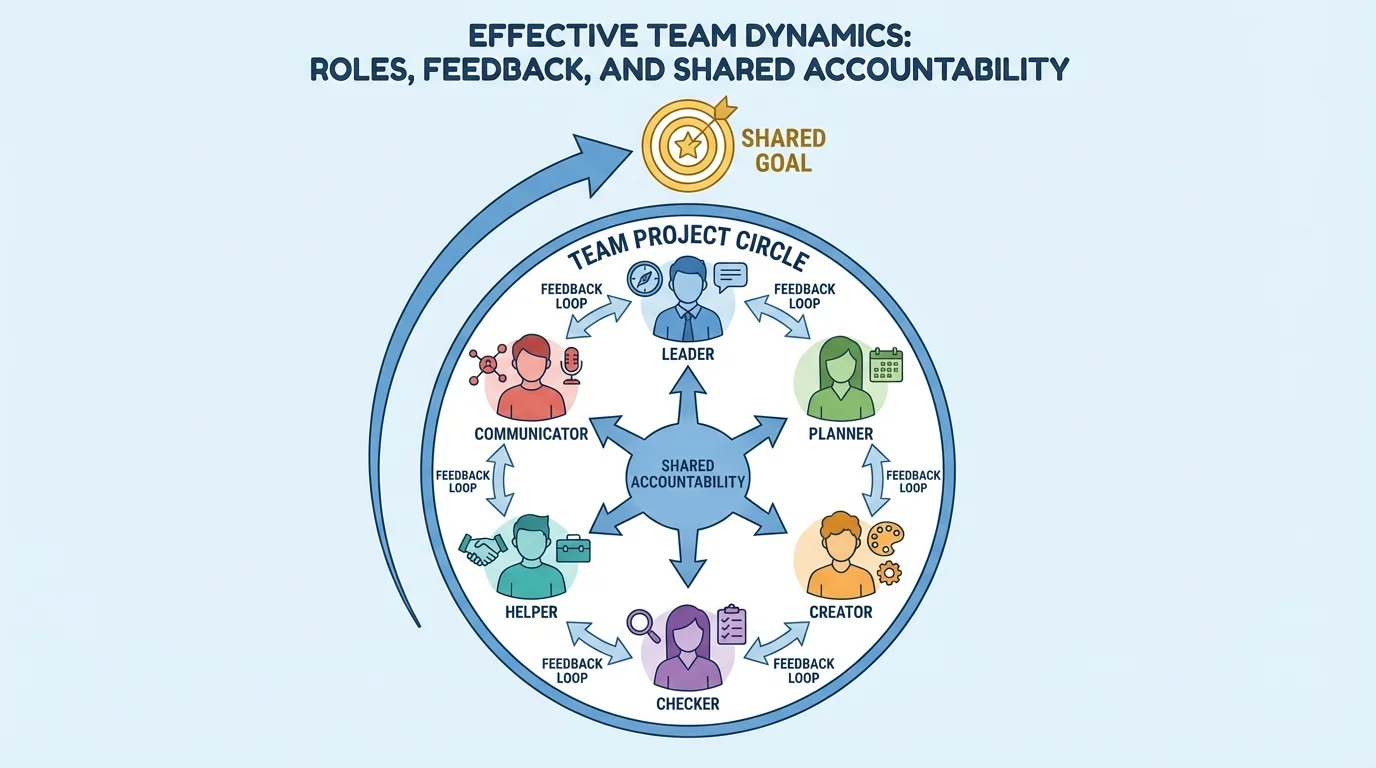
Roles should also match strengths when possible. If you are calm under pressure, you might be a good leader. If you notice small mistakes, you may be a strong checker. If you enjoy explaining things, the communicator role may fit you well. But roles can also help you grow. You do not always need to pick the easiest job. Sometimes trying a new role builds confidence and skill.
A smart team is flexible. If someone gets sick, loses internet access, or has a family emergency, the team may need to adjust roles. That is not failure. That is responsible teamwork. Good teams ask, "How can we adapt?" rather than "Whose fault is this?"
Example: Dividing up a home project fairly
A family wants to get ready for a weekend gathering. Four people need to work as a team.
Step 1: Name the goal.
The goal is to make the home ready by Saturday morning.
Step 2: Assign roles.
One person makes a cleaning list, one tidies shared spaces, one helps prepare snacks, and one checks that everything is finished.
Step 3: Set check-in times.
The team checks progress Friday night and Saturday morning.
Step 4: Adjust if needed.
If one task takes longer than expected, another team member helps instead of waiting.
Clear roles help the work get done with less arguing and less stress.
You can see the same idea from [Figure 1] in almost any strong team: different jobs connect to one shared goal.
Feedback is one of the most powerful teamwork tools. It helps people improve, catch mistakes, and understand what the team needs. Helpful feedback is kind, specific, and focused on the work.
[Figure 2] Unhelpful feedback sounds like this: "This is bad." "You messed it up." "Whatever." Those comments may hurt feelings, but they do not help the team improve. Helpful feedback sounds more like this: "The opening is interesting, but the text is hard to read. Could you make the font bigger?" That gives a person something clear to fix.
A simple way to remember good feedback is this: say what works, say what needs improvement, and suggest a next step. For example: "Your slideshow has great pictures. The labels are a little small. Try making the titles darker so they are easier to read."
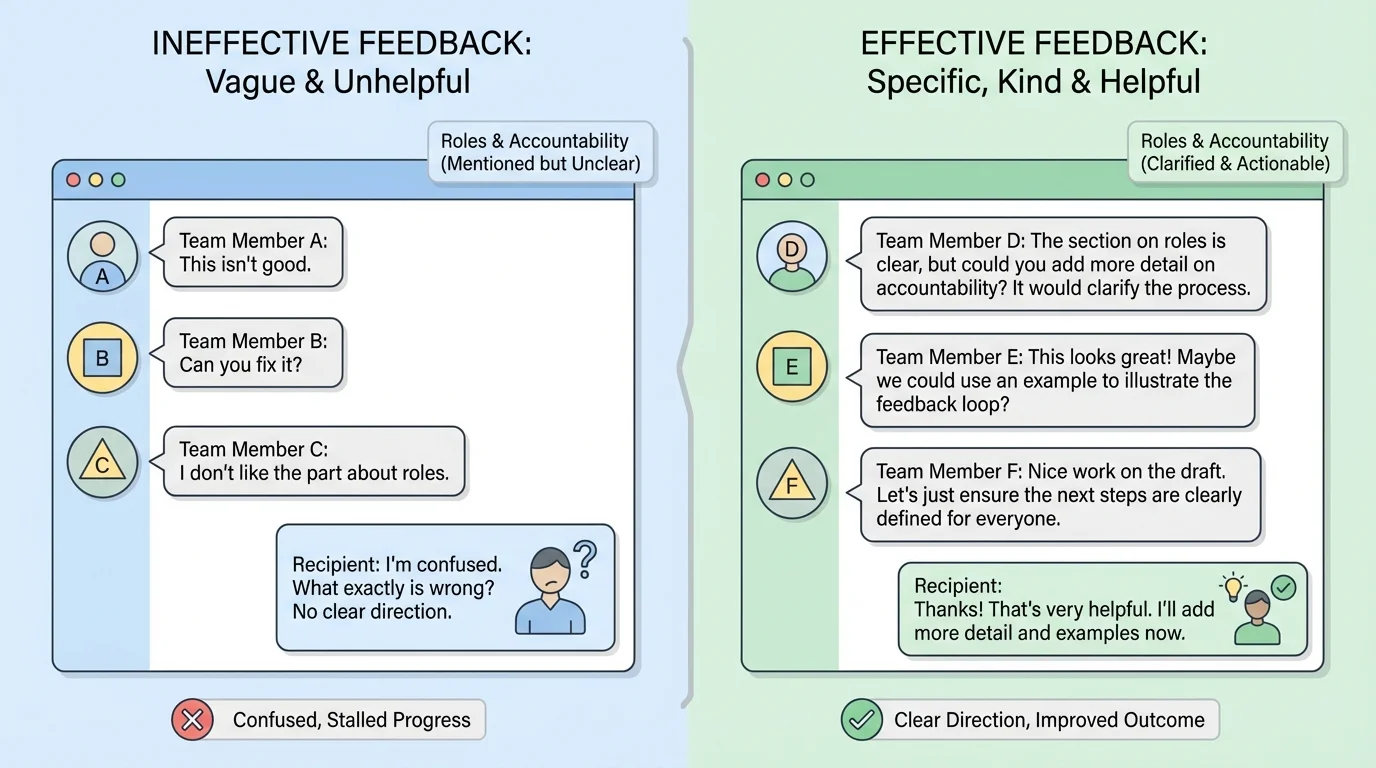
Feedback also works best when it happens early. If a team waits until the very end to speak up, there may not be enough time to improve. A quick check-in halfway through a project can save a lot of trouble later.
You also need to know how to receive feedback. That means listening without getting defensive right away. If someone says your part is missing a source or has unclear wording, that is not always an insult. It may be a chance to make your work stronger. You can say, "Thanks. Can you show me exactly what part you mean?"
Feedback is about improvement, not winning. On strong teams, members are not trying to prove they are perfect. They are trying to make the final result better. This mindset changes the whole tone of teamwork. Instead of "I have to defend my work," the thought becomes "We are making this stronger together."
Sometimes feedback should be private, especially if it might embarrass someone. If a teammate forgot a deadline, sending a kind direct message may work better than pointing it out in front of everyone on a video call. Respect matters.
Another key skill is using "I" statements. For example, "I felt confused about who was doing the research section" sounds calmer than "You never told anyone anything." Calm language makes it easier to solve the real problem.
Later, when your team is reviewing work again, the contrast shown in [Figure 2] still matters: vague comments create frustration, while specific comments create progress.
Teams that pause for short feedback check-ins often work faster in the long run because they catch small problems before those problems become big ones.
A team that never gives feedback may look peaceful for a while, but hidden problems can grow. Silence is not always teamwork. Sometimes it is just avoidance.
Shared accountability means the whole team cares about the outcome, and each person takes responsibility for their own part. A visible plan with tasks, names, and deadlines helps everyone stay on track.
[Figure 3] This idea is important because teamwork can become unfair very quickly. Sometimes one person becomes the "rescuer" who fixes everything. At first, that may seem helpful. But over time it causes stress, resentment, and weaker teamwork. Shared accountability means one person does not carry the whole team while others relax.
If you say you will finish your part by Thursday, shared accountability means you either finish it or tell the team early if there is a problem. It also means you do not hide mistakes. Honesty helps the team adjust. Surprises at the last minute usually hurt everyone.
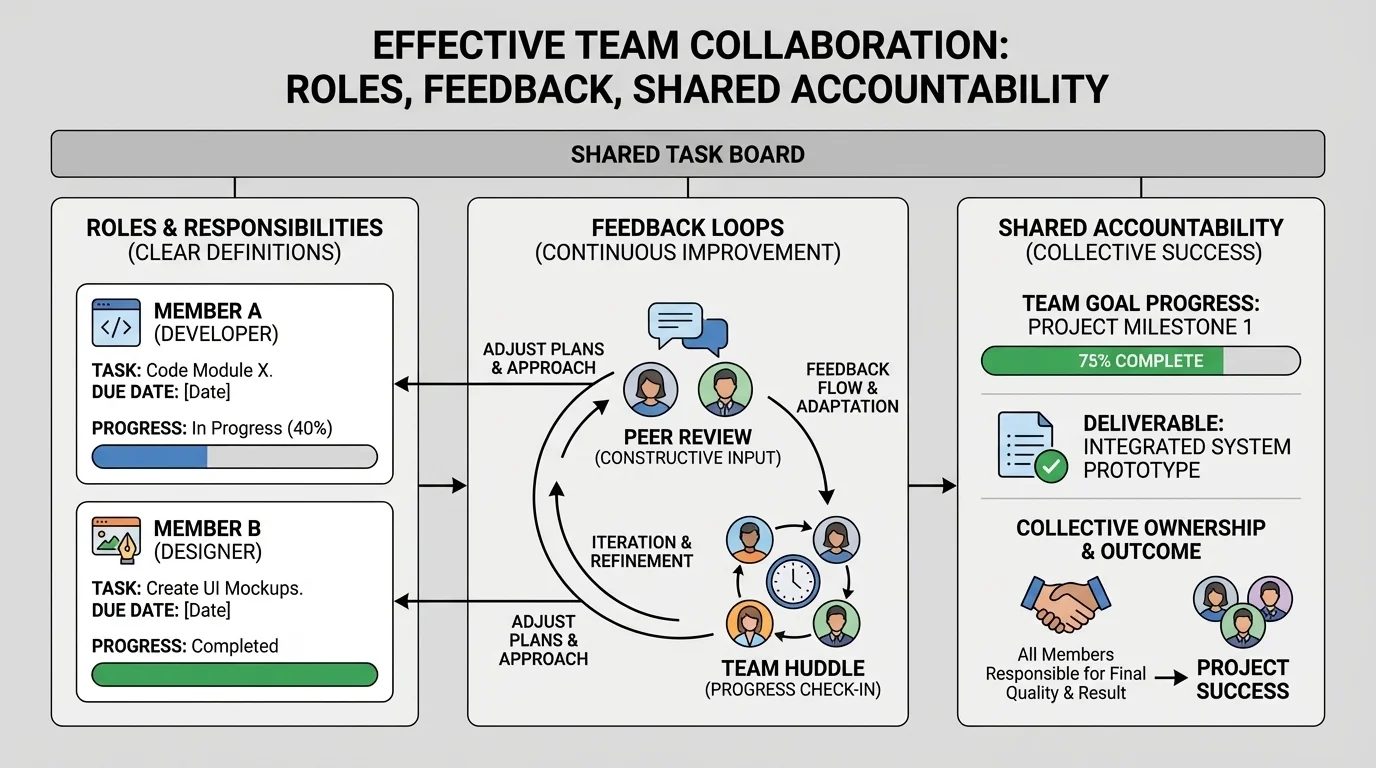
Shared accountability is not about punishment. It is about trust. When teammates know you mean what you say, they can plan around your work. Trust grows when people are reliable.
One useful habit is to break big jobs into smaller pieces. "Make the whole video" is too large and unclear. "Write introduction by Monday," "record audio by Wednesday," and "edit final clip by Friday" are much easier to track. Small steps make accountability possible.
| Weak Accountability | Strong Accountability |
|---|---|
| "Someone will do it." | "Mia will upload the final file by Friday at 5:00." |
| Waiting until the deadline to mention a problem | Warning the team early and asking for help |
| Blaming others | Owning mistakes and fixing them |
| One person doing nearly everything | Work divided fairly and checked by all |
Table 2. A comparison of weak and strong accountability in team situations.
Suppose a community soccer team is planning a snack schedule. If one family always remembers and everyone else forgets, the system is weak. If each family signs up, checks the schedule, and follows through, the team runs smoothly. The same is true in online teamwork, clubs, and home responsibilities.
The task board in [Figure 3] shows why accountability is easier when everyone can see the plan clearly.
Even good teams run into problems. The goal is not to avoid every problem. The goal is to respond well.
Problem 1: One person is doing too much. Fix it by naming the issue early. Use calm words: "Our jobs do not feel balanced right now. Can we divide the remaining tasks more fairly?"
Problem 2: Someone is not participating. First, check whether they understand the task. Sometimes silence means confusion, not laziness. Ask: "Do you want me to explain the next step?" If the problem continues, the team may need to reset expectations.
Problem 3: People keep arguing. Bring everyone back to the goal. Ask, "What choice helps the team most?" This shifts attention away from winning the argument.
Problem 4: The plan is too vague. Make it more specific. Replace "work on project soon" with "finish the title slide by Tuesday night."
Problem 5: A teammate misses a deadline. Do not panic or attack. Find out what happened, decide what still needs to be done, and adjust roles if needed. Then make the next deadline clearer.
Example: Fixing a missed deadline in an online team
Three students are creating a digital poster for a community recycling campaign. One student does not upload their images on time.
Step 1: Check the facts.
The team sends a polite message asking whether there was a problem.
Step 2: Focus on the goal.
Instead of blaming, they say the poster still needs images before the final layout can be completed.
Step 3: Make a new clear plan.
The teammate agrees to upload the images by that evening, and another person offers to resize them if needed.
Step 4: Prevent the problem next time.
The team decides to do a progress check one day earlier on future projects.
This keeps the team moving while still expecting responsibility.
Sometimes the best teamwork skill is simple courage: speaking up kindly before a small problem becomes a big one.
If you want your team to work better, use this simple routine.
Step 1: Name the goal clearly. Everyone should be able to say what the team is trying to do.
Step 2: Break the goal into tasks. Large projects become easier when divided into smaller parts.
Step 3: Assign roles and deadlines. Make sure each person knows their job and due date.
Step 4: Choose how to communicate. Will you use a shared document, text thread, email, or video call?
Step 5: Do short check-ins. Ask what is done, what is next, and what support is needed.
Step 6: Give feedback early. Fix problems while there is still time.
Step 7: Review the final result together. Check whether the team met the goal and what could be better next time.
Being responsible on your own is important, but teamwork adds another layer: your choices affect other people. When you follow through, you are not just helping yourself. You are supporting the whole team.
Try This: The next time you work with others at home, in sports, or online, ask two simple questions at the start: "Who is doing what?" and "When will it be done?" Those two questions prevent many teamwork problems before they start.
Leadership in a team does not mean bossing people around. Real leadership means helping the team succeed. A leader listens, notices what is needed, encourages others, and keeps the group focused on the goal.
You can show leadership even if you are not the official leader. For example, you might summarize the plan after a meeting, offer to organize the task list, invite a quiet teammate to share an idea, or calmly solve a misunderstanding. Leadership often looks like initiative plus respect.
"A good team gets stronger when people help each other do their best."
Good leaders also share credit. If the team succeeds, they do not act as if they did everything alone. They recognize effort from everyone. This builds trust and makes people more willing to contribute next time.
Teamwork skills matter now, and they matter even more as you grow. In the future, you may work on a robotics team, help plan an event, join a volunteer project, play on a sports team, run a small business, or work at a job where people depend on you every day.
Adults are often chosen for opportunities not only because they are talented, but because they are reliable, cooperative, and good at solving problems with others. That starts with small habits now: taking your role seriously, giving useful feedback, and sharing accountability.
Try This: Pay attention to one team you are part of this week. Notice whether roles are clear, whether feedback helps, and whether responsibility is shared fairly. Then make one small change that helps the team work better.
