Some of the strongest leaders are not the loudest people in the room. They are the ones who notice a problem, treat others fairly, and keep going until the job is done. That matters whether you are helping at home, working with a sports team, joining a community group, or chatting with others online. Leadership is not just a job title. It is a set of habits you can build.
At this stage of life, leadership can look simple but powerful: reminding your sibling about a shared plan without being rude, helping organize a team message, speaking up when someone is left out, or finishing the part you promised to do. These actions may seem small, but they change how people feel around you. They help others trust you.
Leadership means helping a group move in a positive direction. Initiative means noticing what needs to be done and getting started without waiting to be told. Fairness means treating people honestly and respectfully. Follow-through means doing what you said you would do and finishing responsibly.
A person can be a leader without controlling everyone else. In fact, bossiness often pushes people away. Real leadership invites people in, solves problems, and builds teamwork. You do not need to be perfect. You need habits that help you act with care and responsibility.
Many people confuse leadership with giving orders. But being bossy is very different from leading well. A bossy person may grab control, interrupt others, or act like their ideas are the only good ones. A good leader helps the group work better together. That means listening, encouraging, and making sure everyone understands the goal.
Think about two students helping run an online book club for kids. One says, "We are doing my idea. Everybody else just do your part." The other says, "I have an idea for our next meeting. What do you think? Let's split jobs so everyone can help." The second student is more likely to build teamwork because people feel respected.
Leadership also includes responsibility when nobody is watching. If you only help when you might get praise, that is not strong leadership. Strong leaders do the right thing because it helps the group, not because it makes them look important.
"Leadership is not about being in charge. It is about taking care of those in your charge."
— Simon Sinek
This idea fits everyday life. You might not be leading a company or a huge team, but you can still take care of the people around you by being dependable, fair, and ready to help.
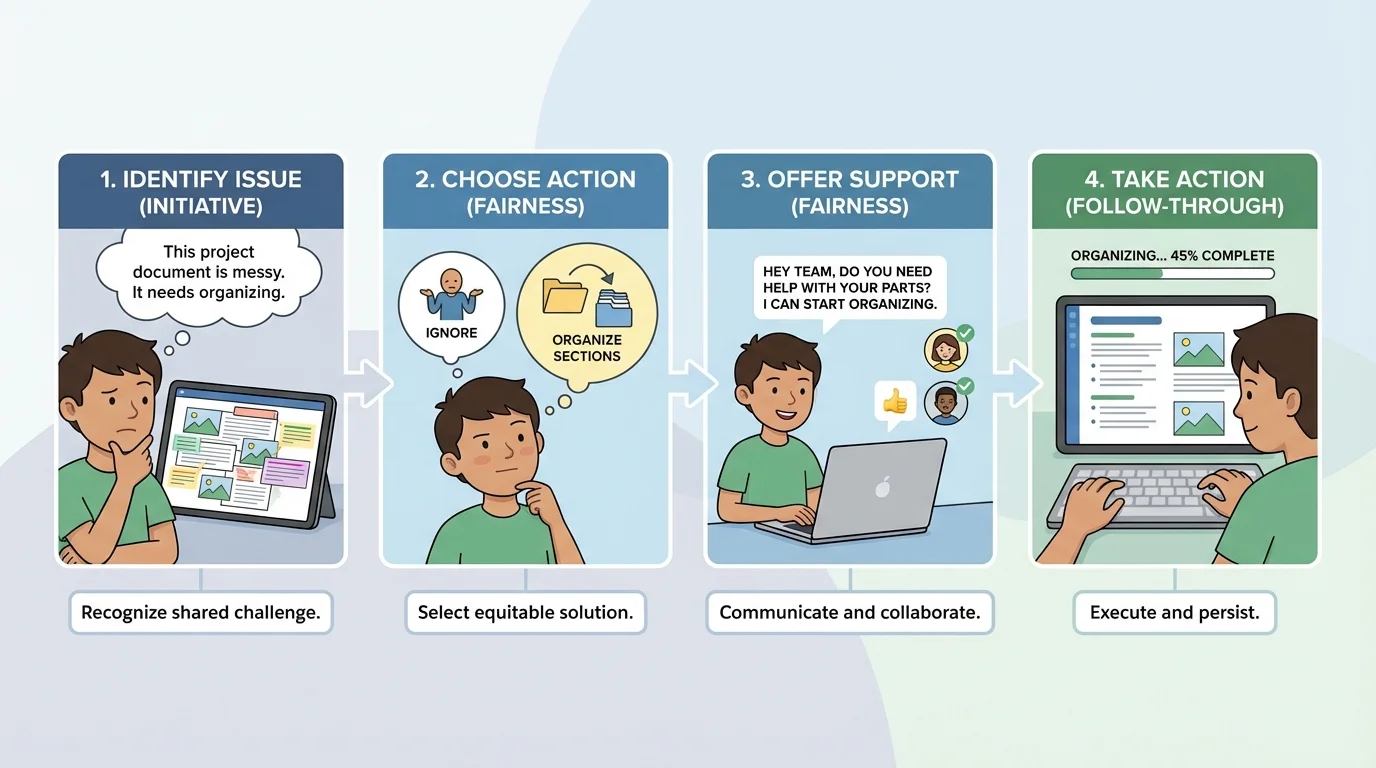
One of the clearest signs of initiative is seeing a need and acting on it, as [Figure 1] shows through a simple step-by-step path. You do not wait for someone else to fix everything. You pay attention and ask, "What would help right now?"
That could mean many things: cleaning up your materials after a project, starting a shared document for a group plan, checking whether everyone understands the instructions for an activity, or offering to help a neighbor carry groceries. Initiative is not about doing everything yourself. It is about getting the helpful action started.
Sometimes students hold back because they are worried about making a mistake. But waiting too long can create bigger problems. If no one starts, the task stays stuck. A leader takes a reasonable first step. If the first idea is not perfect, it can be improved.
There is a smart way to show initiative. First, notice the need. Second, pick one helpful action. Third, make sure your action respects others. Fourth, begin. These steps keep initiative useful instead of pushy.
Example: Showing initiative at home
Your family is getting ready for a busy evening. Dinner still needs to be set up, and a younger sibling is looking for supplies for an activity.
Step 1: Notice the need
You see that several things need attention and an adult is already busy.
Step 2: Choose one helpful action
You set the table or gather the supplies your sibling needs.
Step 3: Communicate clearly
You say, "I started setting up dinner. Is there anything else that would help?"
Step 4: Keep going until that task is done
You finish the job instead of stopping halfway.
This is leadership because you noticed, started, and supported the group.
Try This: Today, look for one task you can begin without being told. Choose something realistic, helpful, and respectful. Start small. Small actions build strong habits.
Starting first is not enough. How you start matters. If you jump in by taking over, people may feel annoyed or ignored. Good leaders start in a way that helps others join the work.
A helpful start often sounds like this: "I can begin this part," "Would it help if I organized the notes?" or "Let's make a quick plan together." These phrases are strong but respectful. They show confidence without acting like other people do not matter.
When you offer an idea, leave room for others to respond. For example, if your community club is planning a fundraiser, you could say, "I think a snack sale might work because it is simple. What ideas do the rest of you have?" This keeps the door open. It tells others, "Your thoughts count too."
A leader also notices who has not spoken yet. Some people have good ideas but need time. You can help by saying, "We have not heard from Maya yet. Maya, do you want to add anything?" That is leadership because it supports the whole group, not just yourself.
Leading without taking over means balancing action with respect. You move the group forward, but you do not grab all the power. This balance helps people feel safe enough to share ideas, ask questions, and work together.
If you accidentally come across as too controlling, fix it quickly. You can say, "I think I got ahead of everyone. Let's slow down and hear other ideas." Leaders are not perfect. They correct themselves when needed.
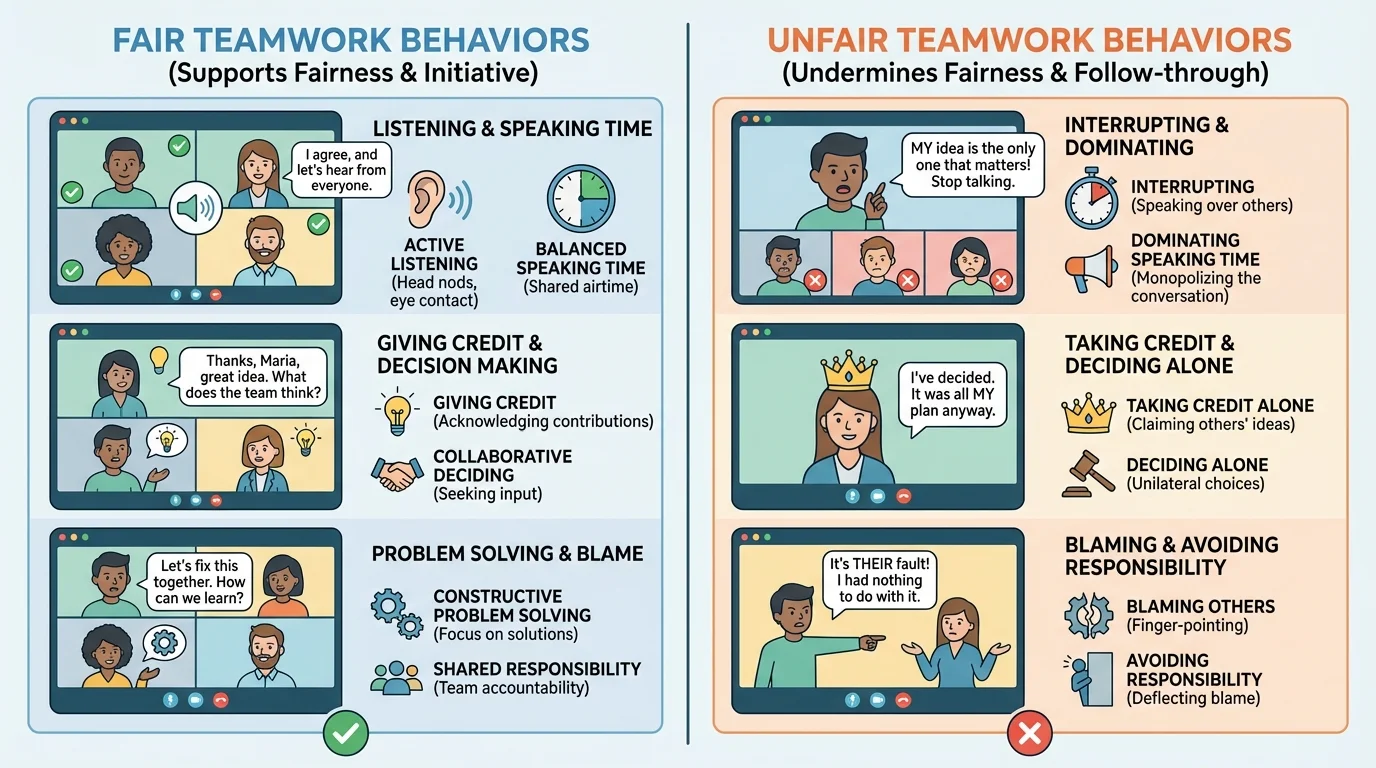
Fairness includes several clear behaviors, as [Figure 2] makes easy to compare. A fair leader listens, shares chances to speak, gives credit, and uses the same rules for everyone. People trust leaders more when they see fairness in action.
Being fair does not always mean everyone gets the exact same thing. Sometimes fairness means giving people what they need to do well. For example, in a team activity, one person may need more time to explain an idea, while another may be ready to design the final slides. Fairness means making room for both people to contribute.
Fair leaders do not play favorites. If your best friend is on your team, that does not mean your friend should get all the easiest jobs or all the praise. If another person had the strongest idea, say so. If someone else did an important part, give them credit.
Fairness also matters during disagreements. If two people want different things, do not just side with the person you like better. Listen to both sides. Ask questions. Look for facts. Then choose the option that best supports the group goal.
Suppose you are helping organize an online game night for a community group. One person wants a long trivia game. Another wants shorter games so younger kids can join. A fair leader does not say, "We are doing trivia because that is what I like." A fair leader says, "Our goal is to include more people. Let's choose shorter rounds so more ages can participate."
| Fair leadership habit | What it looks like | What happens |
|---|---|---|
| Listening | Letting others finish before you answer | People feel respected |
| Sharing turns | Making space for more than one voice | More ideas are heard |
| Giving credit | Saying who helped and how | Trust grows |
| Using the same rules | Not changing rules for favorites | The group sees honesty |
| Fixing unfairness | Admitting a mistake and correcting it | People feel safer working with you |
Table 1. Everyday habits that show fairness in leadership and the positive results they create.
Later, when you are deciding how to divide tasks, the comparison in [Figure 2] still matters. If you notice interrupting, blaming, or deciding alone, those are warning signs that fairness is slipping.
Groups often work better when members believe the process is fair, even if they do not get their first choice every time. Feeling heard can matter almost as much as the final decision.
Try This: The next time you work with others, aim to speak after at least one other person has spoken. Then notice whether the conversation feels more balanced.
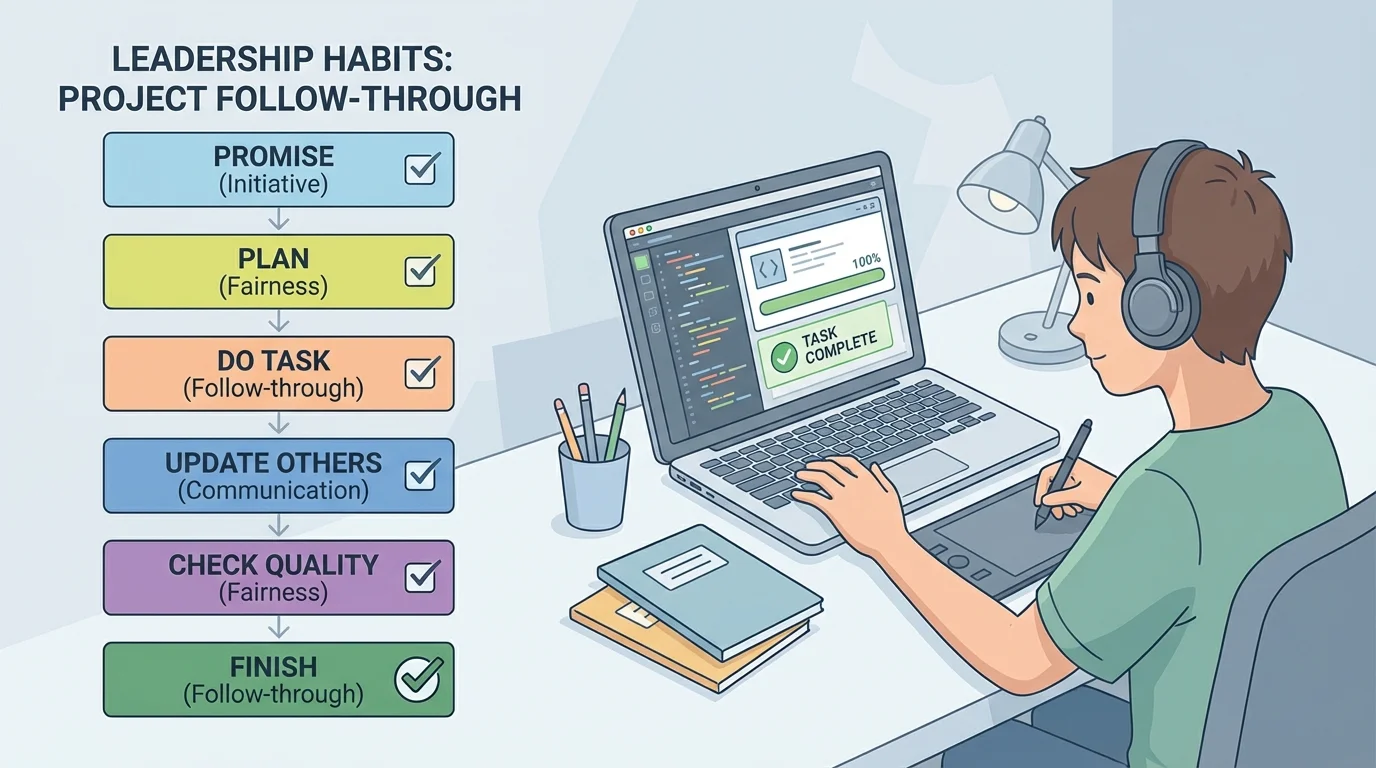
Follow-through is what turns good intentions into results. Strong leaders move through clear stages, as [Figure 3] lays out: make a promise, make a plan, do the work, update others, and check that the job is really finished. Many people start strongly. Fewer people finish strongly. That is why follow-through stands out.
When you say, "I'll do it," people begin to count on you. If you forget, delay, or disappear, others may have to rush at the last minute. That creates stress and weakens trust. But when you complete your part on time, you make the whole team stronger.
A simple follow-through routine can help: write it down, break it into smaller steps, choose when you will do it, and check back before the deadline. Even one short message such as "I finished my part and sent it" shows responsibility.
Checking quality matters too. A task is not truly finished if it is messy, confusing, or missing key parts. Leaders ask, "Is this complete? Is it clear? Will it help the group?"
Example: Following through on a shared project
You tell your local robotics club that you will create the welcome slide for an online presentation.
Step 1: Write down exactly what you promised
You note: "Create one welcome slide with the title, date, and team name."
Step 2: Make a small plan
You decide to draft it on Tuesday and revise it on Wednesday.
Step 3: Finish before the deadline
You complete the slide early enough to fix mistakes if needed.
Step 4: Update the group
You send a message: "The welcome slide is done and uploaded."
Step 5: Check quality
You make sure names are spelled correctly and the slide is easy to read.
This is follow-through because you did not stop at saying yes. You completed the full responsibility.
If you realize you cannot finish on time, leadership still matters. Tell people early. Say what happened, what you have completed so far, and what help you need. Waiting until the last minute makes the problem bigger.
Much later, when you are deciding whether people can count on you, the checklist in [Figure 3] remains useful. Reliability is built one kept promise at a time.
Even good leaders face problems. Someone may misunderstand directions. A teammate may not respond. A plan may fail. Leadership is not about avoiding every problem. It is about responding well when problems appear.
Start by staying calm. If you get upset, pause before you answer. Take a breath. Read the message again. Ask yourself what the real problem is. Then respond to the issue, not just your first feeling.
Next, name the problem clearly and kindly. For example: "We are missing two pieces of the plan, so we cannot finish yet," or "I think we are talking over each other. Let's slow down." These statements focus on solving the issue instead of attacking people.
Then choose the next best action. That might mean dividing tasks again, asking for clarification, apologizing, or setting a new deadline. Leaders do not waste time pretending nothing is wrong.
Example: Fixing a mistake responsibly
You were supposed to send a reminder message for a volunteer event, but you forgot.
Step 1: Admit it
Say, "I missed sending the reminder. That was my mistake."
Step 2: Fix what you can right away
Send the message now and add the key details clearly.
Step 3: Help the group recover
Ask, "Do we also need a quick follow-up message or post?"
Step 4: Prevent the same mistake
Set a reminder for the next event.
This kind of response builds more trust than hiding the mistake.
A leader who can say "I was wrong" is often stronger than a leader who always tries to look perfect.
Because so much communication happens online, digital leadership matters. The same habits still apply, but they show up in different ways. Initiative may mean creating a clear message thread for a project. Fairness may mean not flooding the chat so other people cannot keep up. Follow-through may mean answering by the time you promised.
In group chats and video calls, tone can be hard to read. A short message might sound rude even if you did not mean it that way. Good digital leaders choose words carefully. They reread before sending. They avoid typing in anger. They use respectful language, even when disagreeing.
Good online leaders also include people. If someone joins a call late, briefly catch them up. If a person has technical problems, pause and help them rejoin the conversation. If instructions are buried in many messages, rewrite them clearly in one place.
Digital leadership means using technology in ways that help people work together, stay informed, and feel respected. It includes clear messages, patient communication, and responsible choices about when and how to respond.
Be careful with private information too. Leadership includes protecting trust. Do not share screenshots, personal details, or private messages without permission unless safety is at risk and a trusted adult needs to help.
Try This: Before sending an important message, ask yourself three questions: Is it clear? Is it kind? Is it useful? If the answer to one of these is no, improve the message first.
Leadership grows from repeated habits, not one big moment. You do not need a perfect personality. You need a routine that helps you notice needs, act respectfully, and finish what you start.
One easy routine is to check yourself at three times of the day. In the morning, ask, "What responsibility do I need to handle today?" During the day, ask, "Who else needs a fair chance to be heard?" At the end of the day, ask, "What did I promise, and did I finish it?" These simple questions train your mind to lead.
You can also keep a short leadership list in a notebook or on a device. Write down one area where you showed initiative, one moment where you practiced fairness, and one task where you followed through. Over time, this helps you notice progress.
Leadership habits are especially important for the future. As you grow older, people will trust you with bigger responsibilities. The habits you build now affect whether others see you as dependable later. That can matter in friendships, community groups, jobs, and family life.
Remember, leadership is not about being the most powerful person. It is about helping people move forward in a way that is honest, fair, and dependable. If you notice what needs to be done, include others, and finish responsibly, you are already practicing real leadership.
