Have you ever noticed that almost every place people share has some kind of rule, even when it feels casual? A park has safety signs. A library has quiet expectations. An online game has community guidelines. A neighborhood has traffic laws. These are not just random limits. They connect to something important: helping people live together fairly, safely, and respectfully.
A strong community does not run on rules alone. It also depends on people having rights and fulfilling their responsibilities. If a community had only rules, it might feel bossy or unfair. If it had only rights, people might demand what they want without thinking about others. If it had only responsibilities, some people might work hard while others ignore what is fair. Communities work best when all three fit together.
A community is a group of people who share a place, an activity, or a purpose. Your community can include your family, your neighborhood, a sports team, a club, a library group, a faith group, or even an online space where people gather regularly. You do not have to be in the same building every day to belong to a community.
When people share spaces and activities, problems can happen unless everyone understands what is expected. That is why communities make rules, protect rights, and expect responsibilities. These three ideas help answer three big questions: What are the limits? What is fair? and What should each person do?
Rule means a direction about what people should or should not do in a group or place.
Right means a freedom or protection that people should have.
Responsibility means a duty or job a person should carry out.
Think about riding your bike on a neighborhood path. You may have the right to use the path, but you also have the responsibility to pay attention to where you are going and be careful around pedestrians. A rule such as "slow down near others" protects everyone's right to use the path safely. This is how the three ideas work together in real life.
Rules can be formal or informal. A formal rule may be written, like a library sign that says food is not allowed near computers. An informal rule may be an expected behavior, like waiting your turn in a conversation during a video call. Both kinds matter because they guide behavior.
A right is not the same as getting everything you want. A right is usually connected to fairness, safety, respect, or freedom. For example, people have a right to be treated respectfully, a right to learn, and a right to be safe from harm. In many places, children also have rights to care, protection, and education.
A responsibility is what you do to help those rights become real for everyone. If you want others to listen when you speak, you have the responsibility to listen when they speak too. If you want a clean park, you have the responsibility to throw away trash properly. Rights and responsibilities often match each other like two sides of a team effort.
Some responsibilities are personal, like telling the truth or cleaning up your own mess. Others are shared, like reporting a broken swing at the park, following safety signs, or speaking kindly in a group chat. Shared responsibilities are especially important because communities depend on many people doing their part.
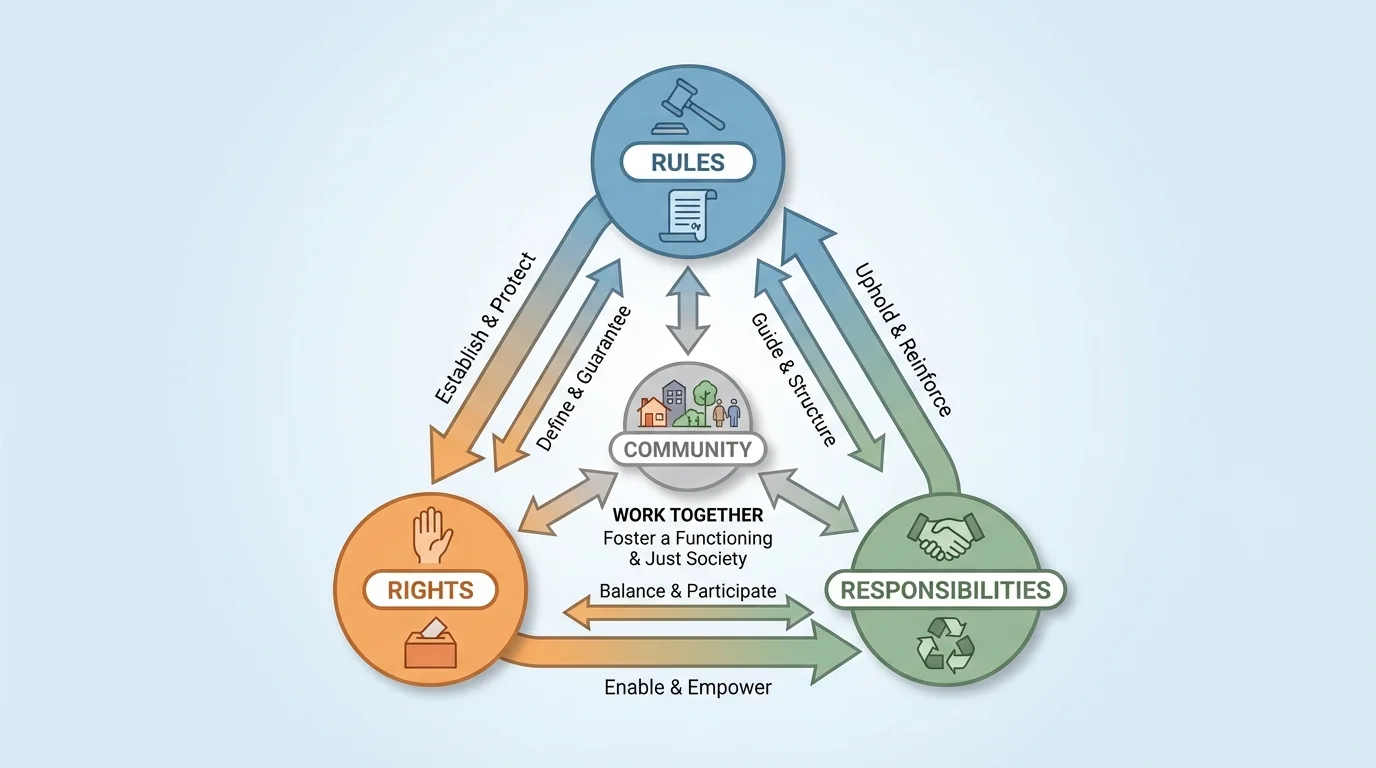
[Figure 1] The ideas of civic engagement, fair rules, and everyday choices come together because rules, rights, and responsibilities depend on each other. Rules should protect important rights, and responsibilities help people use those rights in ways that do not harm others.
Here is a simple way to think about it: rules set boundaries, rights protect people, and responsibilities guide actions. When one part is missing, the system gets weaker. If there are no rules, stronger or louder people may take over. If rights are ignored, people may be treated unfairly. If responsibilities are ignored, the community becomes messy, unsafe, or unkind.
For example, think about an online discussion group for kids who like drawing. A good rule might be "No insulting comments." That rule protects people's right to participate without being bullied. Your responsibility is to give feedback respectfully and report harmful behavior instead of joining in. If members follow only the rule because they fear punishment, the group may feel stiff. But if members understand the right being protected and choose responsible behavior, the group becomes welcoming and creative.
Another example is a public pool. People have a right to enjoy the space safely. Rules such as "No running" and "Only enter deep water if you can swim" protect that right. Responsibilities include listening to lifeguards, using equipment properly, and helping younger children follow safety directions. The pool stays safer not because the signs are magical, but because people act responsibly.
This connection matters later in life too. Communities make stronger decisions when people understand fairness. A healthy community does not choose only freedom or only control. It looks for a fair balance where people are protected and also expected to help.
Balance is the key idea. Good communities do not use rules just to control people. They use rules to protect important rights, and they teach responsibilities so people can share spaces well. When rules are fair, rights are respected, and responsibilities are taken seriously, trust grows.
Trust is a big deal in communities. When you trust the people around you, you feel safer asking questions, joining activities, and speaking up. When trust is broken by cheating, bullying, lying, or ignoring rules, people stop feeling secure. That is one reason even small responsible actions matter.
[Figure 2] You can spot this pattern in many places you use every week. Look at any shared space and ask: What rule exists here? What right is it protecting? What responsibility do people have?
At a library, a rule about keeping voices low protects the right to read and concentrate. At a park, a rule about cleaning up after pets protects the right to enjoy a clean area. In an online game, a rule against cheating protects the right to fair play. On a neighborhood sidewalk, a rule about looking before crossing helps protect the right to be safe.
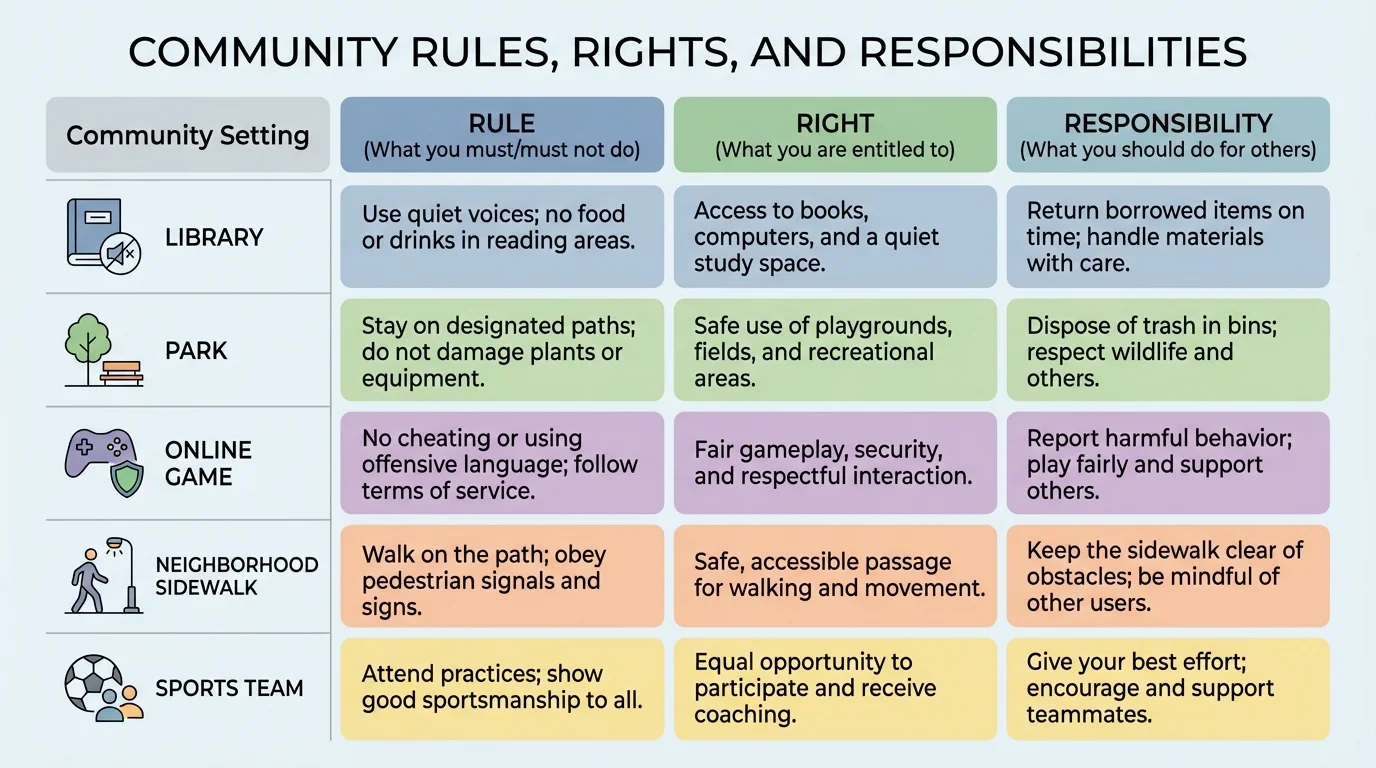
| Community place | Possible rule | Right being protected | Your responsibility |
|---|---|---|---|
| Library | Keep noise low | Right to read and focus | Use a quiet voice |
| Park | Throw trash away | Right to a clean space | Clean up after yourself |
| Online game | No cheating or harassment | Right to fair and respectful play | Play honestly and report abuse |
| Neighborhood street | Follow crossing signals | Right to safety | Watch carefully and obey signals |
| Sports team | Take turns and follow game rules | Right to participate fairly | Show teamwork and self-control |
Table 1. Examples of how rules, rights, and responsibilities connect in common community settings.
These examples are helpful because they show that community life is not only about government or big laws. It is also about everyday actions. The way you comment on a shared post, wait your turn in a local activity, or care for public property all affects the people around you.
Sometimes the responsibility is easy to see. If you borrow something, return it. If you sign up, show up on time. If you make a mess, clean it up. Sometimes the responsibility is harder because it takes courage. You may need to tell an adult about unsafe behavior, stand up for someone being treated badly, or admit when you broke a rule.
Many community rules exist because someone got hurt, excluded, or treated unfairly in the past. A rule often starts as a way to solve a real problem and protect people better.
That is why understanding the reason behind a rule matters. When you know what right it protects, the rule often makes more sense. Even if you do not like the rule, you can better judge whether it is there for safety, respect, fairness, or order.
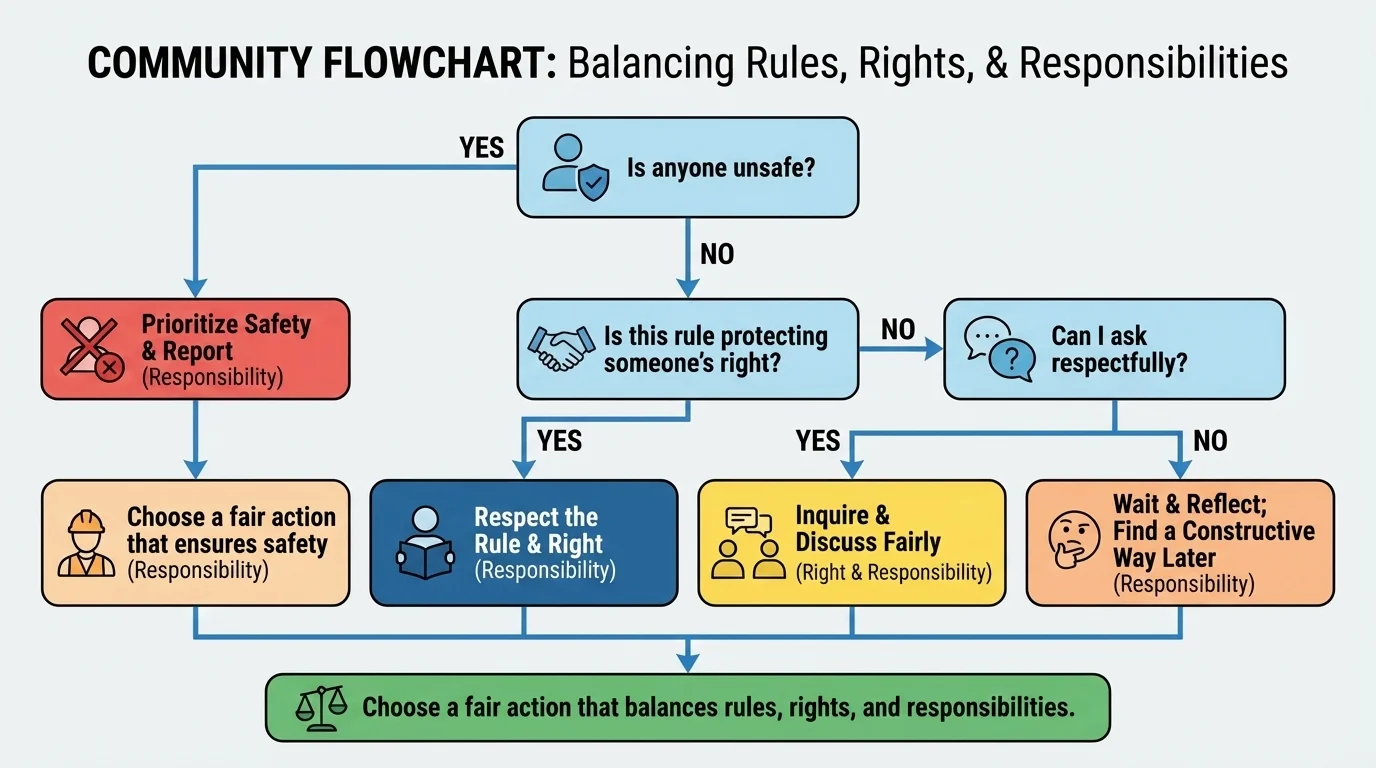
[Figure 3] Sometimes a person feels, "I should be allowed to do what I want," but a rule says no. Before reacting, it helps to slow down and use a clear thinking process. Ask yourself whether the rule protects someone's safety, privacy, learning, property, or chance to participate fairly.
For example, you might want to post a funny video of a friend online. You may feel you have the right to share your ideas. But your friend also has a right to privacy and respect. Your responsibility is to ask permission first. A rule against posting private images without permission protects that right.
Another example: you may want to talk during a community workshop video session because you are excited. But if the group has a rule about muting when others speak, that rule protects everyone's right to hear clearly and participate. Your responsibility is to wait, raise your hand digitally if that tool exists, or type your idea politely in the chat.
Sometimes rules can feel unfair. When that happens, being responsible does not mean staying silent forever. It means speaking up in a respectful way. You can ask questions, explain your concern, and suggest a better solution. Responsible community members do not only obey. They also help improve systems.
A simple decision guide for a tough moment
Step 1: Stop and name the issue.
Ask, "What rule is involved, and what do I want to do?"
Step 2: Identify the right being protected.
Ask, "Is this rule helping someone stay safe, respected, included, or treated fairly?"
Step 3: Check your responsibility.
Ask, "What action can I take that helps the community, not just me?"
Step 4: Respond respectfully.
Follow the rule if it protects others, or question it politely if you think it is unfair.
This kind of thinking helps you avoid quick choices that can hurt trust. It also helps you become someone who solves problems instead of adding to them. Later, when you vote, work, volunteer, or lead projects, this skill becomes even more important.
Being a good community member is not about being perfect. It is about noticing how your choices affect others and trying to act with care. A practical routine can help.
First, notice the shared space. Is this a public place, a team activity, a family setting, or an online group? Shared spaces always involve other people's needs, not just your own.
Second, look for the rule. It may be written, spoken, or understood. If you are not sure, ask. Guessing can lead to trouble, especially online where tone and expectations are harder to read.
Third, think about the right behind the rule. Is it there to protect safety, peace, privacy, fairness, property, or inclusion? This makes your decision stronger because you understand the purpose.
Fourth, choose your responsibility. This could mean following directions, waiting your turn, using kind language, cleaning up, reporting a problem, or helping someone else understand the rule.
Fifth, reflect afterward. Did your action help the group? Did it make things easier, safer, or more respectful? If not, what could you do differently next time?
Real-life case study: Group chat problem
You are in a club group chat. One student starts making fun of another person's artwork.
Step 1: Identify the rule.
The group likely has an expectation against bullying or rude comments.
Step 2: Identify the right.
Everyone has the right to be treated with respect.
Step 3: Identify your responsibility.
Do not join in. Save evidence if needed, support the person kindly, and report the problem to a trusted adult or moderator.
Step 4: Make a responsible choice.
You help protect the community instead of ignoring harm.
Notice that this does not mean starting a fight in the chat. Responsible action is usually calm, clear, and focused on safety and respect. It protects people while keeping the problem from growing.
Not all rules are the same. Some are laws, which are official rules made by governments. Others are local rules, such as park rules, library policies, or team guidelines. Some are social expectations, like being polite in a shared space. They do not all carry the same consequence, but they all shape how communities work.
A law often deals with larger safety and fairness issues. For example, traffic laws help protect people on roads and sidewalks. Community policies may be more specific, like wearing a helmet at a certain skate area or signing in before using equipment. Social expectations may not be written, but ignoring them can still damage trust and relationships.
Consequences also vary. Breaking a family rule may mean losing a privilege. Breaking a club rule may mean a warning or removal from the group. Breaking a law can lead to more serious consequences. But consequences are not only punishments. There are also natural results. If people ignore responsibilities, places can become unsafe, dirty, unfair, or unwelcoming.
This is part of community and citizenship. Citizenship means being a member of a larger group and taking part in it responsibly. Even before you are old enough to vote, you are already practicing citizenship when you care for shared spaces, follow fair rules, respect rights, and speak up about problems.
"With rights come responsibilities."
That idea is short, but it is powerful. If you want your own rights respected, you must help protect the rights of others too. Communities become stronger when people understand that fairness goes both ways.
You do not have to wait until you are grown up to make a difference. Small actions are real forms of participation. You can help keep a park clean, return borrowed items, follow safety rules, welcome new people, report damage, and use respectful language online. These actions may seem small, but they build the habits of responsible citizenship.
You can also practice speaking up respectfully. If a rule seems confusing, ask why it exists. If someone is being treated unfairly, tell a trusted adult. If a shared space has a problem, like broken equipment or bullying, report it instead of assuming someone else will. Communities improve when people notice problems and respond.
As you grow older, your role can expand. You may volunteer, join local projects, attend community events, help organize cleanups, or learn more about how laws are made. The same pattern still applies: understand the rules, protect rights, and carry out responsibilities.
One more important idea is that rights belong to everyone, not just people we like. Responsibility means showing respect even when it is hard. It means choosing fairness over selfishness and courage over silence. That is what helps a community stay safe, welcoming, and just.
If you remember only one thing, remember this: rules, rights, and responsibilities are not separate boxes. They are connected parts of community life. When you understand all three, you are better prepared to make smart choices, solve problems, and help create the kind of community you would want to live in.
